

Discover 10 practical ways generative AI can boost your business efficiency — with real use cases, productivity gains, top tools, and implementation tips for every team.
Businesses aren’t adopting generative AI because it’s trending; they’re adopting it because falling behind now means playing catch-up for years.
McKinsey estimates generative AI could add $2.6T–$4.4T annually in economic value, depending on adoption and implementation.
Traditional automation follows fixed rules. It executes what you program, nothing more.
Generative AI can interpret context and generate adaptive outputs, often faster than traditional rule-based automation for tasks involving ambiguity.
The pressure is real: tighter deadlines, leaner teams, and rising customer expectations mean businesses need smarter workflows, not just faster ones. Generative AI directly addresses all three.
In this guide, you’ll get exactly that: no theory, no hype. Just 10 practical ways businesses are using generative AI right now to cut costs, accelerate output, and free their teams to focus on work that actually moves the needle.
Each section includes real use cases, measurable productivity gains, workflow integration tips, and actionable steps you can apply immediately.
So let’s get into it.
What Is Generative AI in Business?
Simple Definition of Generative AI
Generative AI refers to AI systems that don’t just analyze data; they create.
From drafting detailed reports and summarizing lengthy contracts to writing code, generating marketing images, and surfacing business insights, these systems produce original, context-aware outputs on demand.
Tools like ChatGPT, Claude, Gemini, and GitHub Copilot are already a part of daily workflows in how modern businesses operate.
How Generative AI Differs From Traditional Automation
Traditional automation is rigid. It follows pre-programmed rules: if X happens, do Y. It’s powerful for repetitive, predictable tasks, but the moment a situation falls outside its ruleset, it breaks down.
Generative AI is adaptive. It understands intent, handles ambiguity, and generates nuanced outputs based on context.
A rule-based system can auto-fill an invoice. Generative AI can draft a personalized vendor negotiation email, flag payment anomalies, and summarize the entire transaction history, all from a single prompt. That’s a fundamentally different capability.
Why Businesses Are Investing in Generative AI
The ROI case is straightforward across five dimensions:
- Productivity: Employees handle higher-value work while AI handles the time-consuming groundwork, from first drafts to data summaries.
- Cost Reduction: Automating knowledge work reduces dependency on outsourcing and cuts operational overhead without sacrificing quality.
- Scalability: AI outputs don’t require proportional headcount increases. One team can now do the work of three.
- Faster Decision-Making: Leaders get synthesized insights in minutes instead of waiting days for manually compiled reports.
- Competitive Advantage: Businesses leveraging generative AI ship products faster, respond to markets quicker, and serve customers better than those that don’t.
Key Benefits of Generative AI for Business Efficiency
Saves Time on Repetitive Tasks
Tasks like drafting emails, generating reports, formatting documents, and summarizing meeting notes consume hours weekly.
Generative AI handles all of them faster, giving your team back time they can redirect toward strategic priorities.
Improves Employee Productivity
AI doesn’t replace employees; it removes the friction slowing them down.
When a marketer can generate a first draft in minutes, or a developer can speed up debugging with AI assistance, they can often produce more meaningful work in less time.
Reduces Operational Costs
Fewer outsourced tasks, faster turnaround, and leaner workflows translate directly into cost savings.
Businesses using generative AI report significant reductions in content production, customer support, and data processing costs.
Speeds Up Content and Communication Workflows
From sales proposals to internal communications, generative AI collapses the creation cycle.
Tasks that once took days can, in some teams and workflows, be reduced to hours with AI-assisted drafting and review.
Supports Faster Decision-Making With AI Insights
Generative AI synthesizes large volumes of data into clear, actionable summaries.
Instead of waiting for a manual analysis, decision-makers get the context they need instantly, enabling faster, more confident choices at every level of the business.
10 Practical Ways Generative AI Can Boost Your Business Efficiency
1. Automating Content Creation
Content demand never slows down, but human bandwidth does. Generative AI closes that gap by producing high-quality, on-brand content across every channel, at a fraction of the time and cost.

Blog Posts and Marketing Copy
Marketing teams at mid-sized SaaS companies are using ChatGPT and Jasper to generate SEO-optimized blog drafts, then having writers refine and fact-check, reducing production time significantly. The result: more content, same team size.
Social Media Captions
Ecommerce brands running daily promotions use AI to generate platform-specific captions in bulk.
What once took a content coordinator an entire afternoon now takes 15 minutes, with variations ready for A/B testing.
Product Descriptions
For ecommerce catalogs with hundreds of SKUs, writing unique descriptions manually is unsustainable.
AI generates compelling, keyword-rich descriptions at scale, consistently and instantly.
Email Drafting
Startups with lean sales teams use AI to draft personalized outreach emails, follow-ups, and nurture sequences, maintaining a high-touch feel without the manual effort behind it.
Suggested Tools: ChatGPT (OpenAI), Jasper, Copy.ai, Claude
2. Improving Customer Support Efficiency
Customer expectations are non-negotiable. They want fast, accurate answers around the clock.
Generative AI makes that possible without scaling your support team proportionally.

AI Chatbots for Instant Responses
Modern AI-powered chatbots don’t just pull from a script; they understand context, handle multi-turn conversations, and resolve common issues independently.
Intercom reports that some customers achieve around 50% AI-driven resolution or automation rates, though outcomes vary by setup, knowledge quality, and support volume.
That’s a dramatic reduction in workload with zero drop in response quality.
Automated FAQ Generation
Support teams waste hours manually compiling FAQs from recurring tickets.
Generative AI analyzes past conversations and automatically generates accurate, well-structured FAQ content, keeping your help center current without dedicated maintenance effort.
Related: How to Write Articles Faster Using ChatGPT (Step-by-Step Workflow)
Ticket Summarization
When complex issues do reach human agents, AI summarizes the entire customer history and ticket thread instantly.
Agents walk in fully context-aware, no scrolling through long threads, no repeated questions to the customer.
Zendesk offers AI ticket summaries that help agents review long histories faster, which can improve efficiency in some support environments.
Suggested Tools: Zendesk, Intercom
3. Enhancing Team Communication and Collaboration
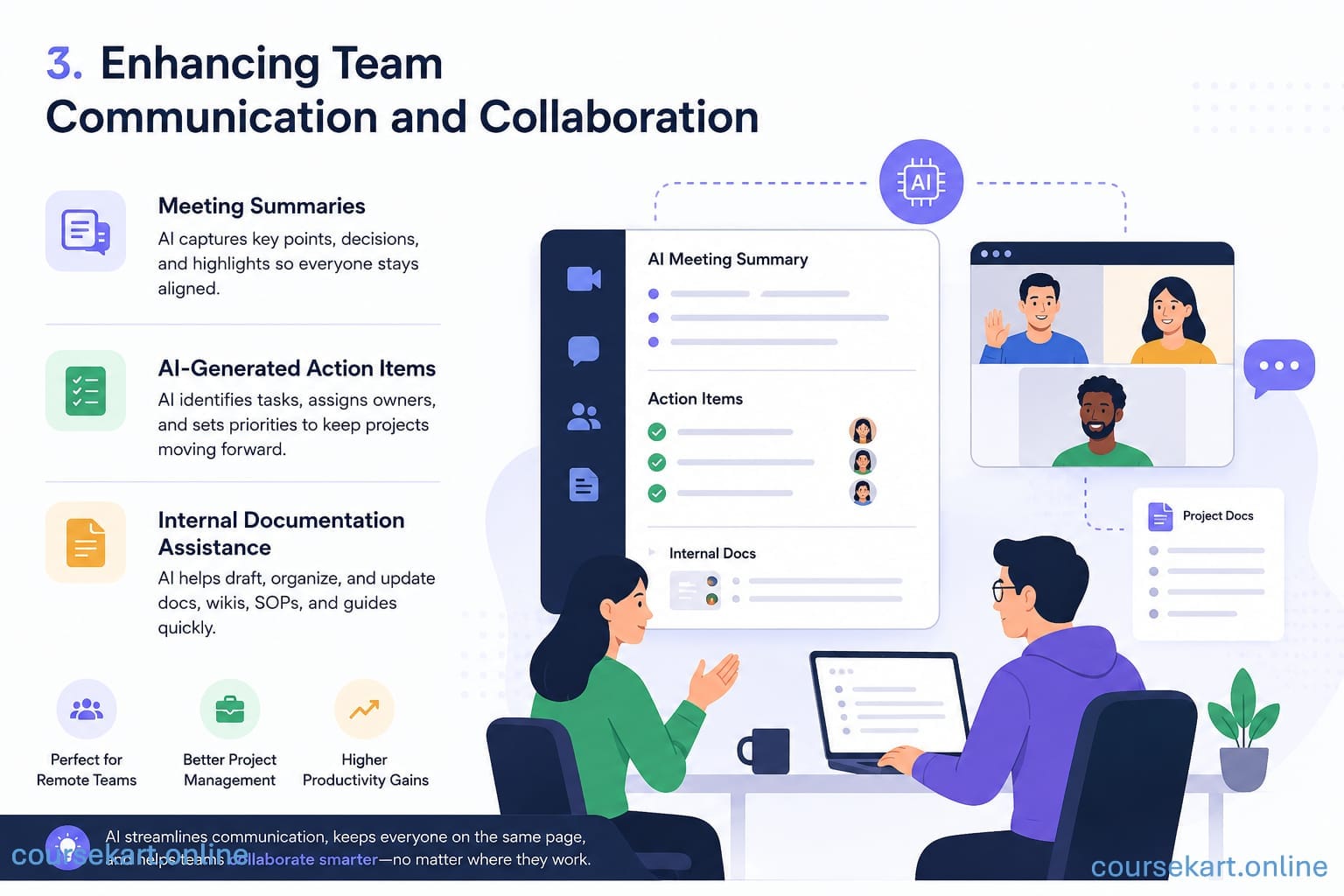
For remote and hybrid teams, communication breakdowns are productivity killers. Generative AI eliminates the friction of keeping everyone aligned without adding more meetings or manual documentation overhead.
Meeting Summaries
Sitting through a one-hour meeting only to spend another 30 minutes writing it up is a workflow tax most teams quietly accept.
Tools like Microsoft Copilot automatically transcribe, summarize, and extract key decisions from meetings the moment they end, giving every participant a clear, structured recap whether they attended or not.
AI-Generated Action Items
Summaries alone aren’t enough. Generative AI goes further by identifying commitments, deadlines, and owners directly from the conversation.
For distributed project teams, this alone eliminates a significant coordination bottleneck.
Internal Documentation Assistance
Notion AI allows teams to generate SOPs, project briefs, onboarding documents, and process guides from rough notes or verbal instructions.
Remote teams especially benefit as institutional knowledge gets documented in real time rather than living in someone’s head or buried in a chat thread.
Suggested Tools: Microsoft Copilot, Notion AI
4. Streamlining Data Analysis and Reporting
Data is only valuable when it’s understood and fast enough to act on. Generative AI removes the bottleneck between raw numbers and actionable business intelligence.
AI-Powered Report Generation
Analytics teams traditionally spend days pulling data, formatting reports, and writing executive summaries.
Microsoft Power BI Copilot changes that entirely. It generates narrative reports directly from your dashboards, translating complex datasets into clear, structured summaries ready for leadership review.
Summarizing Business Data
Not every stakeholder can read a pivot table. Generative AI bridges that gap by converting raw business data into plain-language summaries tailored to the audience, whether that’s a department head, an investor, or a frontline manager making day-to-day calls.
Identifying Trends Faster
Google Gemini integrated into Google Workspace allows teams to surface patterns, anomalies, and emerging trends across large datasets through simple conversational prompts.
Instead of an analyst manually cross-referencing quarterly figures, AI flags what matters, and why, in seconds.
Suggested Tools: Google Gemini, Microsoft Power BI Copilot
5. Accelerating Marketing Campaigns
Speed and personalization are the twin pillars of effective marketing. Generative AI delivers both, compressing campaign timelines while making every touchpoint feel individually tailored.
AI-Assisted Ad Copy
Paid ad campaigns live and die by copy quality and testing volume. Generative AI allows marketing teams to produce dozens of headline and description variants in minutes, covering different angles, tones, and audience segments.
More variants tested means better-performing ads, faster. For SEO-driven content, AI also accelerates keyword-informed copy creation without sacrificing relevance or readability.
Campaign Personalization
Generic email blasts are a conversion dead end. AI-powered personalization engines analyze customer behavior, purchase history, and engagement patterns to generate email content tailored to each recipient dynamically.
The result is higher open rates, better click-throughs, and email marketing that actually drives revenue rather than unsubscribes.
Audience Research Automation
Before a campaign launches, understanding the audience is everything. Generative AI can synthesize competitor positioning, customer sentiment from reviews, social conversations, and search trends into a comprehensive audience brief.
Suggested Tools: Jasper, Copy.ai, ChatGPT
6. Simplifying HR and Recruitment Tasks
Recruitment and people operations are resource-heavy by nature. Generative AI takes the administrative burden off HR teams, so they spend less time on paperwork and more time on people.

Resume Screening
High-volume hiring is one of HR’s biggest time sinks. AI resume screening can speed up candidate review, but it should be used with strict human oversight, bias testing, and regular audits because automated systems can also reinforce unfair patterns.
Job Description Generation
Poorly written job descriptions attract the wrong candidates and waste everyone’s time.
Generative AI produces clear, inclusive, role-specific job descriptions that accurately reflect responsibilities, requirements, and company culture in minutes rather than hours.
HR teams can further fine-tune tone and specifics without starting from a blank page.
Related: Generative AI for HR Professionals Specialization (Coursera): Full Review + Career Benefits
Employee Training Content
Building onboarding materials, compliance training modules, and internal knowledge bases traditionally requires significant L&D resources.
Generative AI generates structured training content, quizzes, and process documentation directly from existing company materials.
Suggested Tools: XInterview AI, HireVue, Workday AI, ChatGPT
7. Improving Sales Productivity
Sales productivity isn’t about working more hours. It’s about spending those hours on the right prospects with the right message. Generative AI handles the groundwork so sales reps focus on closing.
Personalized Sales Emails
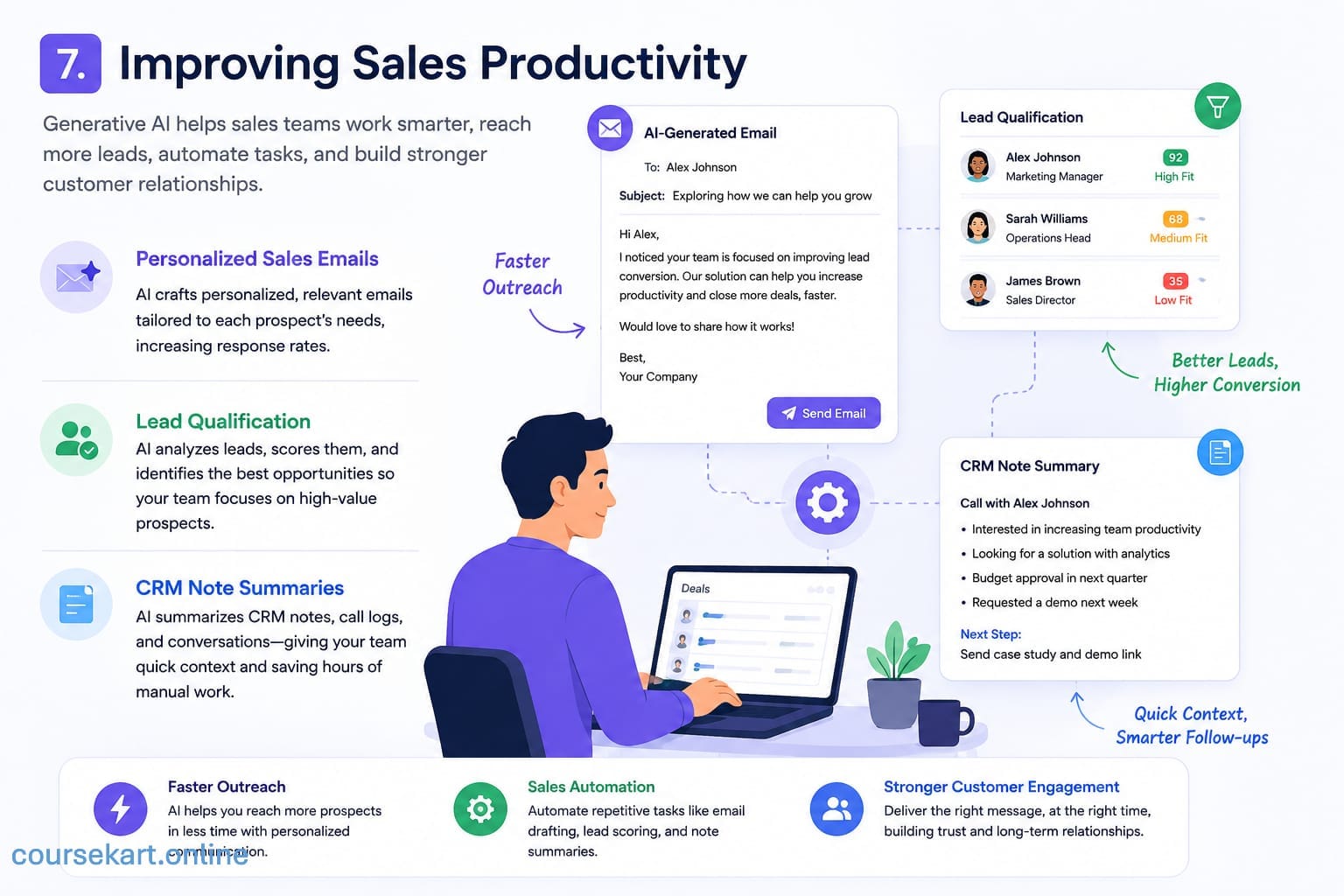
Generic outreach gets ignored. AI analyzes prospect data, industry, role, recent activity, and pain points, and generates tailored emails that speak directly to each lead’s context.
Sales teams using AI-assisted outreach consistently report higher reply rates without increasing the time spent per prospect. Faster outreach, better engagement, stronger pipeline.
Lead Qualification
Not every inbound lead deserves equal attention. Salesforce Einstein AI scores and qualifies leads automatically based on behavioral signals, firmographic data, and historical conversion patterns.
Reps stop chasing dead ends and start prioritizing opportunities that actually move.
CRM Note Summaries
After every call or meeting, reps spend valuable time logging notes and updating CRM records. HubSpot’s AI features auto-generate call summaries, update deal stages, and flag next steps, keeping the CRM accurate without pulling reps away from selling.
Suggested Tools: HubSpot, Salesforce Einstein AI
8. Automating Business Documentation
Documentation is essential but chronically time-consuming. Generative AI handles this task by producing accurate, structured business documents without the hours of manual drafting that typically slow operations down.
SOP Generation
Standard Operating Procedures are critical for consistency, yet most teams delay writing them because the process is tedious.
Generative AI converts rough process notes, voice recordings, or workflow descriptions into polished, step-by-step SOPs ready for immediate use. As processes evolve, updating them takes minutes rather than a full documentation sprint.
Proposal Drafting
Winning proposals require compelling, tailored content, but building each one from scratch is a significant time investment.
AI generates structured proposal drafts based on client requirements, company capabilities, and past successful proposals. Turnaround time drops dramatically without sacrificing quality.
Contract Summaries
Legal and procurement teams spend hours reviewing lengthy contracts for key terms, obligations, and risk clauses.
Generative AI can summarize contracts in minutes and flag critical dates, liabilities, and non-standard clauses so stakeholders get the full picture without reading every line themselves, but legal review is required for accuracy and risk management.
Suggested Tools: ChatGPT, Notion AI, DocuSign AI
9. Improving Software Development and IT Workflows
Development cycles have always been constrained by human coding speed and debugging capacity.
Generative AI directly removes both bottlenecks and allows engineering teams to ship faster without compromising code quality.
AI Code Assistance
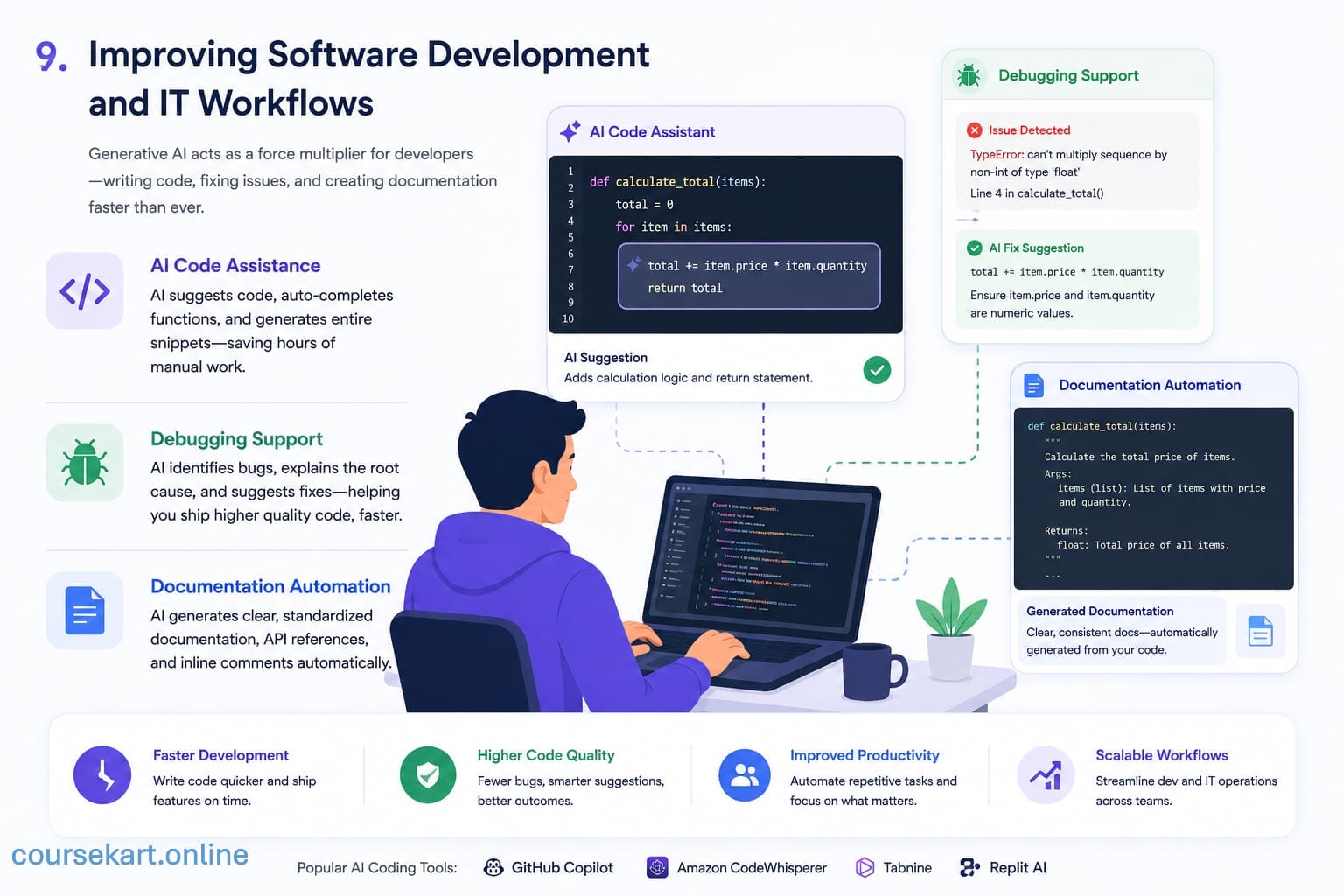
GitHub Copilot functions as a real-time coding partner that suggests entire functions, completes boilerplate code, and generates implementations from plain-language comments.
Developers report spending significantly less time on repetitive coding tasks and more time on architecture and problem-solving.
For startups and lean engineering teams, it’s the equivalent of adding bandwidth without adding headcount.
Related: Generative AI for Software Developers Specialization – A Detailed Review
Debugging Support
Tracking down the root cause of a bug can consume hours and sometimes days.
AI-assisted debugging tools analyze error logs, identify likely failure points, and suggest targeted fixes quickly.
Amazon CodeWhisperer actively scans code for vulnerabilities and quality issues as developers write, catching problems before they reach production rather than after.
Documentation Automation
Technical documentation is universally underprioritized because it competes with shipping.
Generative AI automatically generates inline comments, API documentation, and README files directly from existing code that keeps documentation current without pulling engineers away from development work.
Suggested Tools: GitHub Copilot, Amazon CodeWhisperer
10. Supporting Better Decision-Making
Every strategic decision is only as good as the information behind it.
Generative AI gives executives and leadership teams faster, deeper, and more reliable intelligence to transform decision-making from a bottleneck into a competitive advantage.

Faster Research
Executives and strategy teams routinely need synthesis across industry reports, market data, and internal performance metrics.
Generative AI condenses that research cycle into hours, delivering structured briefings that surface what’s relevant without burying leadership in raw information.
Competitive Analysis
Staying ahead requires knowing exactly where competitors are moving.
AI tools continuously monitor competitor activity, such as pricing changes, product launches, hiring patterns, and public sentiment, and synthesize findings into clear, actionable competitive intelligence.
Strategic planning teams get a live picture of the landscape rather than a quarterly snapshot.
Predictive Insights
Generative AI combined with business intelligence platforms identifies patterns in historical data to forecast demand shifts, revenue trajectories, customer churn risk, and operational bottlenecks before they materialize.
Leaders stop reacting to problems and start anticipating them.
Suggested Tools: Google Gemini, Microsoft Copilot, Perplexity AI
Challenges and Limitations of Generative AI in Business
Generative AI is powerful, but deploying it without understanding its limitations is where businesses get into trouble. Honest adoption means knowing exactly where the risks lie.
Accuracy and Hallucination Risks
Generative AI can produce outputs that sound authoritative but are factually wrong, a phenomenon called hallucination.
For business-critical content like legal documents, financial reports, or medical information, an unchecked AI error can have serious consequences.
Every AI-generated output that involves facts, figures, or claims requires human verification before it goes anywhere near a client or decision-maker.
Data Privacy and Security Concerns
Feeding sensitive business data, customer records, financial details, and proprietary strategies into third-party AI tools creates real exposure.
Businesses still need to review each vendor’s privacy terms carefully, but many enterprise AI products now offer no-training-by-default protections, along with retention controls, contractual safeguards, and admin-level data governance.
Overdependence on AI Tools
Teams that lean too heavily on AI risk eroding the critical thinking and creative skills that make human judgment irreplaceable.
AI should accelerate work, not replace the reasoning behind it. Businesses that stop questioning AI outputs are one bad recommendation away from a costly mistake.
Need for Human Oversight
Generative AI performs best as a force multiplier, not an autonomous operator. Workflows must include designated human review checkpoints, especially for customer-facing content, financial decisions, and anything legally sensitive.
The businesses seeing the best results treat AI as a capable first drafter, not a final authority.
Related: 9 Best Business Intelligence Courses Online to Get Job-Ready Fast
Best Practices for Using Generative AI Efficiently
Adopting generative AI without a clear implementation strategy leads to inconsistent results and wasted investment. These practices separate businesses that see real gains from those that don’t.
Start With Repetitive Tasks
Don’t try to overhaul every workflow at once. Identify the tasks your team performs most frequently that require the least strategic judgment, report formatting, email drafting, meeting summaries, and data entry, and automate those first. Early wins build internal confidence and create momentum for broader adoption.
Use AI as an Assistant, Not a Replacement
The most productive AI implementations position the technology as a collaborator. Employees bring context, judgment, and domain expertise; AI brings speed and scale.
That division of responsibility consistently outperforms either working alone. The goal is augmentation, not abdication.
Train Employees on AI Workflows
Handing teams an AI tool without proper training produces mediocre results. Effective prompt writing, output evaluation, and knowing when not to rely on AI are skills that require deliberate development.
Businesses that invest in AI literacy across departments see significantly higher returns on their tools.
Measure Productivity Improvements
What gets measured gets improved. Establish clear baselines before AI implementation: time spent per task, output volume, error rates, and track changes consistently.
Concrete data justifies further investment and identifies where AI is actually delivering versus where it’s underperforming.
Choose Business-Specific AI Tools
General-purpose AI tools are a starting point, not an endpoint. As usage matures, prioritize tools built for your industry or function, whether that’s legal, finance, HR, or sales.
Specialized tools are trained on relevant data and produce outputs that require far less correction.
Start with pilot programs, define baseline metrics before rollout, keep human review checkpoints for high-risk outputs, and run recurring bias and security audits as adoption expands.
Final Thoughts
Generative AI is now a practical productivity lever that businesses of every size are pulling to work faster and scale smarter.
But the returns come to those who adopt it strategically, not randomly. Start with the workflows where time is being wasted most visibly, experiment with low-risk implementations first, and build from there.
The businesses that treat AI as an ongoing capability to develop, rather than a tool to occasionally use, are the ones that will compound those efficiency gains into a lasting competitive edge.
FAQ
How can generative AI improve business efficiency?
Generative AI eliminates time-consuming manual tasks like drafting content, summarizing data, and generating reports, freeing employees to focus on higher-value work and compressing multi-day workflows into hours.
What are the best generative AI tools for businesses?
Top tools include ChatGPT for content and communication, GitHub Copilot for development, Jasper for marketing, Salesforce Einstein for sales, Microsoft Copilot for productivity, and Notion AI for documentation and collaboration.
Can small businesses benefit from generative AI?
Absolutely. Small businesses gain the most proportionally. AI gives lean teams the output capacity of much larger ones without the overhead, making it a powerful equalizer against bigger, better-resourced competitors.
Is generative AI safe for business use?
It’s safe when used responsibly. Businesses must avoid inputting sensitive data into unsecured tools, verify AI outputs before publishing, and establish clear internal usage policies to manage privacy and accuracy risks effectively.
Will generative AI replace employees?
No, it replaces tasks, not people. Employees who use AI to amplify their output become significantly more valuable. The real risk isn’t replacement; it’s being outcompeted by colleagues and businesses that use AI effectively.
How do companies use ChatGPT in business?
Companies use ChatGPT to draft communications, generate marketing content, summarize documents, answer internal queries, support customer service teams, assist with coding, and accelerate research, often reducing task completion time by 50% or more.
Related Articles
How Generative AI Can Help You Land Your Dream Job: 7 Practical Steps To Follow
Generative AI and You: What can you create with Generative AI?
How to Use ChatGPT And Generative AI To Help Create Content – Detailed Course Review
Best Generative AI Courses on Udemy for Job-Ready Skills

As an engineer with a passion for learning and sharing knowledge, I created CourseKart.online to help students, professionals, and lifelong learners choose the best online courses. With so many options available, finding the right one can be overwhelming. My goal is to simplify that process by offering insights, reviews, and recommendations on the top online learning resources. I hope my posts inspire you to keep growing, learning, and exploring new opportunities.
Discover more from coursekart.online
Subscribe to get the latest posts sent to your email.