

A year ago, knowing what ChatGPT felt like was enough. Today, your LinkedIn feed is full of people building AI agents, shipping LLM-powered apps, and landing roles with “Generative AI” somewhere in the title. The bar has moved. Fast.
Companies are now actively using it and restructuring teams around it.
Whether it’s a startup automating customer support with AI agents or an enterprise integrating LLMs into their core product, one thing is clear: the people getting hired aren’t just those who understand AI. They’re the ones who can do something with it.
That’s where the gap lives. To fill this gap, you need to learn generative AI, and for that, you need the right course.
In this article, I will take you through the 5 Best Generative AI Courses on Udemy that will provide you with job-ready skills. Sounds interesting? Read on.
Quick Comparison: Best Generative AI Courses on Udemy
| Course | Level | Duration | Key Tools Covered | Best For |
|---|---|---|---|---|
| The Complete AI Guide | Beginner | ~42 hrs (regularly updated) | ChatGPT, Custom GPTs, DALL·E, Sora, ElevenLabs | Non-technical professionals, entrepreneurs, content creators |
| Generative AI for Beginners | Beginner | ~4.5 hrs | ChatGPT, LLMs, RAG (conceptual), Prompt Engineering | Curious beginners wanting conceptual depth without code |
| GenAI: ChatGPT, Tools & Automation | Beginner–Intermediate | ~8 hrs | ChatGPT, DALL·E 3, Canva AI, Runway ML, ElevenLabs, Notion AI, Zapier | Creators, freelancers, productivity-focused professionals |
| Generative AI Masters 2026 | Intermediate | ~48+ hrs | Python, LangChain, Hugging Face, FAISS, RAG, TensorFlow, PyTorch | Developers, career switchers, aspiring AI engineers |
| GenAI, ChatGPT 5, Copilot & AI Agents Mastery | Beginner–Intermediate | ~22 hrs | ChatGPT 5, MS Copilot, Gemini, Claude, DeepSeek, Zapier, Pandas | Business analysts, managers, Microsoft 365 professionals |
Best Generative AI Courses on Udemy for Job-Ready Skills
Course 1: The Complete AI Guide: Learn ChatGPT, Generative AI & More
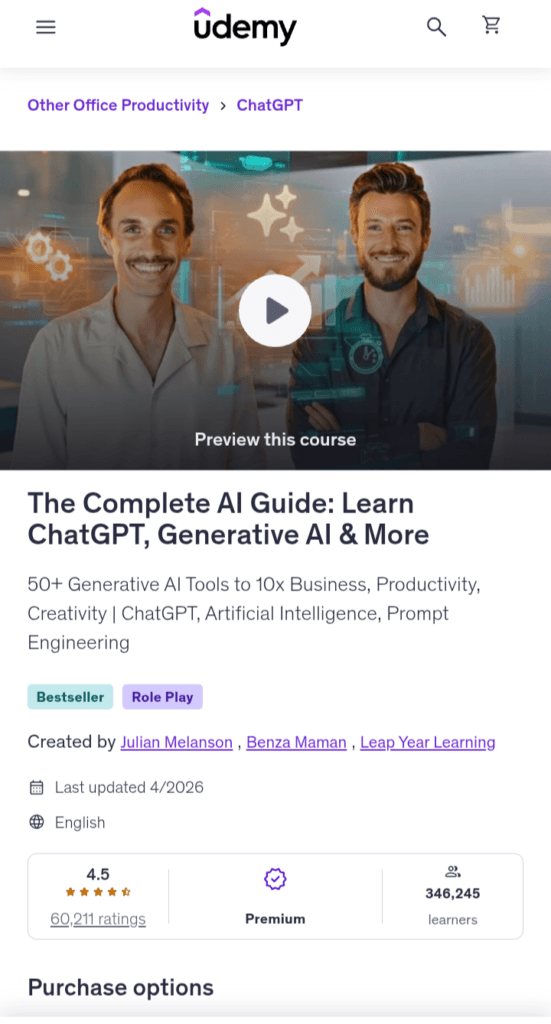
The Complete AI Guide, created in collaboration with Leap Year Learning, aims to teach the most powerful AI tools for personal and professional projects, with students gaining confidence and expertise in using rapidly evolving AI tools.
What You’ll Learn
The course covers how to use AI to create workflow automations, video scripts, presentations, online courses, targeted ads, social media posts, newsletters, podcasts, project outlines, e-books, personalized emails, job proposals, articles, lesson plans, and even “vibe code” apps and websites from scratch.
Beyond the use-case breadth, there’s real substance in how AI works. Students learn the foundational mechanics of Large Language Models, including how ChatGPT understands, processes, and responds to prompts, unpacking key concepts like neural networks, training data, optimization, inference, and prompt structure.
There’s also solid coverage of ChatGPT Projects, such as a structured way to manage chats, files, and custom instructions within a single workspace, showing how to use it to streamline content creation and enhance consistency in workflows.
Tools Covered
- ChatGPT (including Custom GPTs and Projects feature)
- AI agents and workflow automation tools
- Prompt engineering frameworks
- Content generation tools across multiple formats
Who Should Take It
This course is perfect for a complete beginner who wants a structured, judgment-free entry point into AI. Also, freelancers, career switchers, content creators, and educators can take this course.
Related: How to Use ChatGPT for Blog Writing (With 50+ Practical, Workflow-Tested Prompts)
Pros
- Covers an impressive breadth of real-world use cases.
- Custom GPT and automation sections go deeper than most beginner courses dare.
- Practical framing throughout: every lesson ties back to something you can actually do.
Cons
- Not for anyone looking to build apps, use APIs, or write code.
Course 2: Generative AI for Beginners
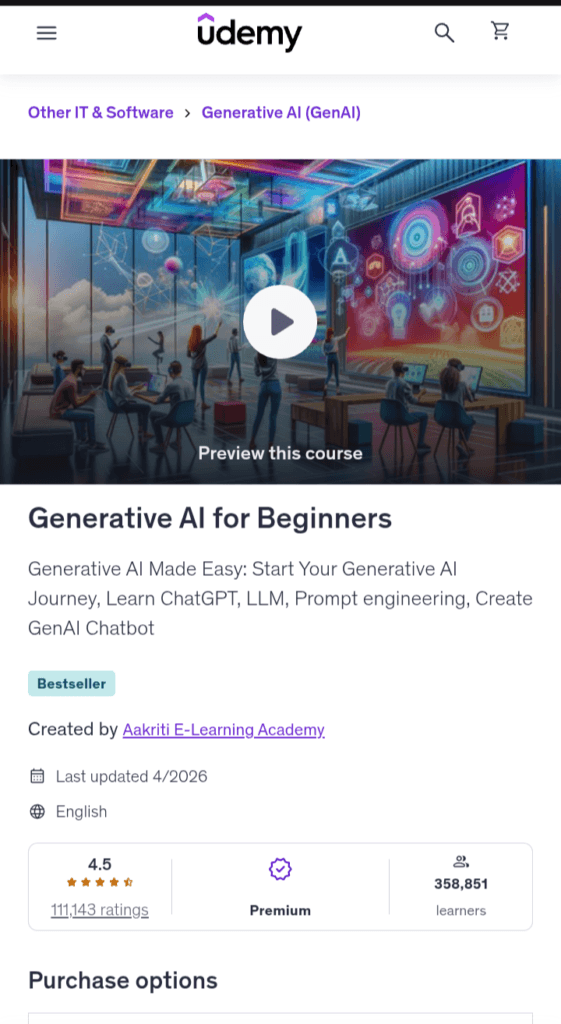
The Generative AI for Beginners course is carefully curated to provide a blend of fundamental concepts, industry applications, and hands-on learning, making it ideal for aspiring AI enthusiasts, professionals, and anyone curious about Generative AI.
This isn’t just “here’s ChatGPT, go use it.” It actually walks you through why things work the way they do, which matters enormously when you’re trying to build a foundation you can actually build on.
Moreover, the course offers lifetime query support, with responses within 48 hours to any doubts or questions.
What You’ll Learn
This course goes further under the hood than most beginner offerings dare to. Students explore the fundamentals of artificial intelligence, machine learning, and deep learning, and learn how neural networks drive advanced generative tools like ChatGPT.
From there, it builds up meaningfully. The course covers how large language models generate text using embeddings and transformers, and teaches how prompt engineering and fine-tuning shape better results across LLMs and domain data.
The course also explores how generative AI disrupts industries and unlocks potential in key sectors by enhancing use cases like chatbots, predictive marketing, and sentiment analysis, and specifically how it drives product description creation, personalized recommendations, and targeted marketing in retail.
And then there’s the hands-on project. The course includes practical exercises, including building your own Generative AI chatbot.
Tools Covered
- ChatGPT and LLMs (conceptual and practical)
- Prompt engineering frameworks
- Embeddings and transformer architecture (conceptual)
- RAG (Retrieval-Augmented Generation) — conceptual + applied
- Generative AI chatbot (optional hands-on project, requires OpenAI credits)
Who Should Take It
Absolute beginners, students, and career switchers should take this course to gain more than surface-level knowledge in generative AI.
Pros
- Covers genuinely advanced concepts like RAG, embeddings, and fine-tuning.
- Industry application sections make the learning feel immediately relevant, not purely academic.
- Lifetime query support with a 48-hour response guarantee is a real differentiator.
Cons
- Depth on tools is limited; the focus is more conceptual than hands-on throughout.
Course 3: Generative AI Course: ChatGPT, Prompting, Tools & Automation
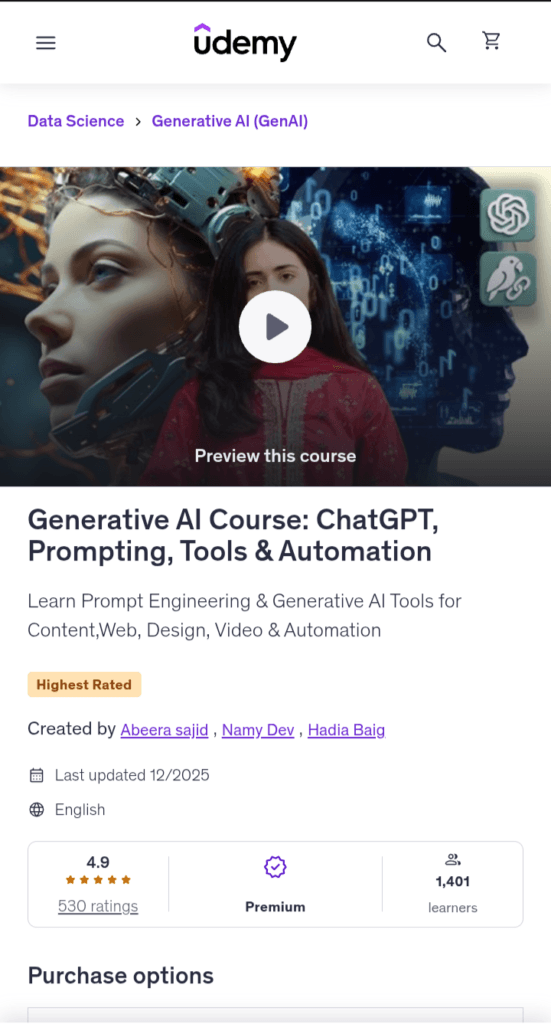
The first two courses in this beginner section were largely about understanding AI: what it is, how it works, and how to use it more intentionally.
This one shifts gears. It’s less interested in explaining AI and more interested in putting tools directly in your hands across as many real-world workflows as possible.
The course focuses on teaching how to use today’s most effective AI tools and automation techniques to improve productivity across writing, design, video creation, voice, data analysis, and web-related tasks.
Throughout the course, students work with tools such as ChatGPT, Canva Magic Studio, Runway ML, ElevenLabs, Notion AI, DALL·E 3, and other modern generative AI platforms.
The instructor’s background is worth noting here, too. The course is built by a full-stack developer and AI educator who specializes in building real-world applications with the MERN stack and the latest Generative AI tools, including ChatGPT, LangChain, and Hugging Face.
What You’ll Learn
The curriculum is organized around doing, not just watching. Prompt engineering is the foundation, but the course quickly builds into applied territory across multiple creative and professional domains.
On the automation side, students learn to automate workflows using tools like Zapier, Notion AI, and Canva, and deploy applications using Streamlit, Gradio, Hugging Face Spaces, and GitHub.
There’s also a developer thread running through the course for those who want to dip their toes in. Students can explore building AI-powered tools using ChatGPT, LangChain, Hugging Face, and vector databases.
The overall arc takes you from understanding how AI tools work, to crafting better prompts, to building real productivity and automation workflows that you could realistically start using the day you finish the course.
Related: Best ChatGPT Courses Online (Learn Prompting, AI Workflows & Real-World Use Cases)
Tools Covered
- ChatGPT (prompting, advanced usage, workflows)
- DALL·E 3 (image generation)
- Canva Magic Studio (AI-powered design)
- Runway ML (AI video creation)
- ElevenLabs (AI voice generation)
- Notion AI (productivity and automation)
- Zapier (workflow automation)
- Streamlit, Gradio, Hugging Face Spaces (deployment — introductory)
- LangChain and Hugging Face (introductory, for those going further)
Who Should Take It
This course is ideal for learners who already know what generative AI is and genuinely want to build something productive with it.
Pros
- Automation and deployment coverage sets it apart from courses that stay purely in “use it” territory.
- Taught by a developer who actually builds with these tools.
- Covers the full creative stack: text, image, video, voice, and design in one place.
Cons
- LangChain and Hugging Face sections are introductory at best; don’t enroll expecting to go deep on either.
Course 4: Generative AI Masters 2026 — From Python to Gen AI
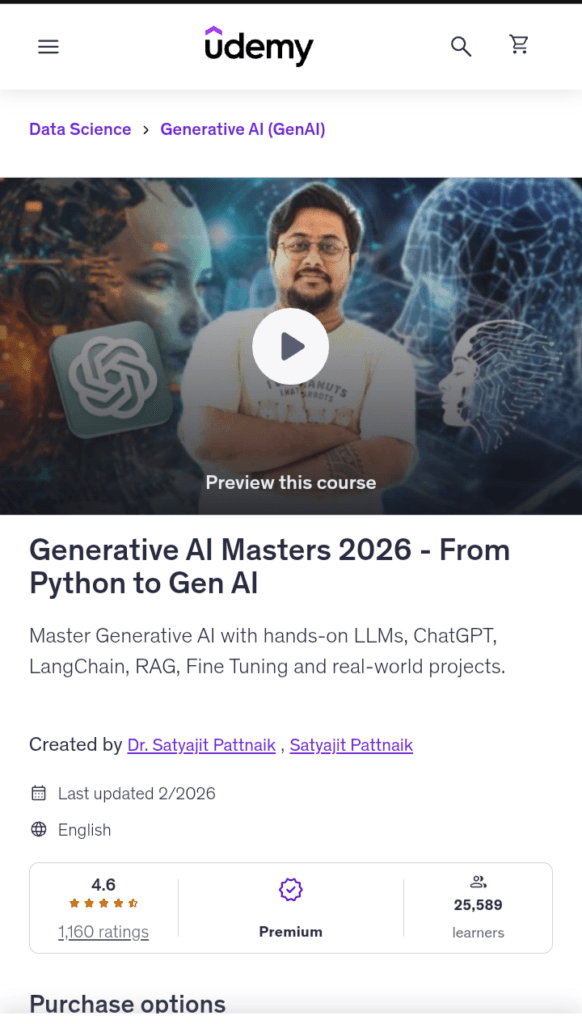
This is where the beginner section ends, and something more serious begins.
The previous three courses in this list were built for people who either can’t code or don’t need to. This one is built for people who are ready to roll up their sleeves, write Python, and understand Generative AI at the level you need to actually build with it.
The course covers a one-stop generative AI program from scratch, Python, NLP, transformers, prompt engineering, tokenization, GPT architectures, RAGs, and vector databases, with industry-specific projects.
The instructor behind it, Dr. Satyajit Pattnaik, is a seasoned Data/AI professional based in Hong Kong with over 35,000 LinkedIn followers and 95,000+ YouTube subscribers, combining expertise in generative AI, machine learning, deep learning, and analytics to mentor aspiring data analysts, scientists, and AI engineers.
A basic understanding of machine learning is beneficial for this course, but not mandatory.
What You’ll Learn
The curriculum is structured as a genuine full-stack Gen AI education, starting from Python fundamentals and moving all the way through to deployment.
The Python section builds proficiency in data manipulation using libraries like Pandas and NumPy, while the NLP section covers the complete pipeline from data preprocessing to model deployment, including powerful libraries like NLTK and SpaCy.
The RAG coverage deserves special mention because it goes beyond the basics. The RAG section covers how it combines retrieval from knowledge sources, embedding-based vector stores, and targeted LLM responses, and also teaches RAG evaluation methods, including the RAGAS framework, BLEU, ROUGE, BARScore, and BERTScore.
The course culminates in a Capstone Project where students apply everything they’ve learned to solve a real-world problem, with options including an AI Career Coach chatbot, an AI-powered automated claims processing system, a Chat Scholar Chatbot with essay grading, a Research RAG Chatbot, and a Sustainability Chatbot built with GROK AI.
Tools Covered
- Python (Pandas, NumPy, NLTK, SpaCy)
- LangChain (hands-on, applied)
- Hugging Face (model access and integration)
- FAISS and vector databases
- Transformer architecture (conceptual + practical)
- RAG systems with the RAGAS evaluation framework
- TensorFlow and PyTorch (deep learning foundations)
- Google Colab (for learners without high-spec hardware)
Who Should Take It
If you are someone who understands the fundamentals of generative AI and wants to build something meaningful using it, this course is for you. Whether you are a student, career switcher, developer, or programmer, you can take this course.
Related: Best RAG Courses Online [Expert Choices]
Pros
- Capstone projects are genuinely industry-relevant, not filler exercises.
- RAG evaluation coverage (RAGAS, BLEU, ROUGE) signals real production awareness.
- Covers both foundational theory (transformers, tokenization, GPT architecture) and hands-on application.
Cons
- Not for complete beginners without coding experience.
Course 5: Generative AI, ChatGPT 5, Copilot & AI Agents Mastery 2026
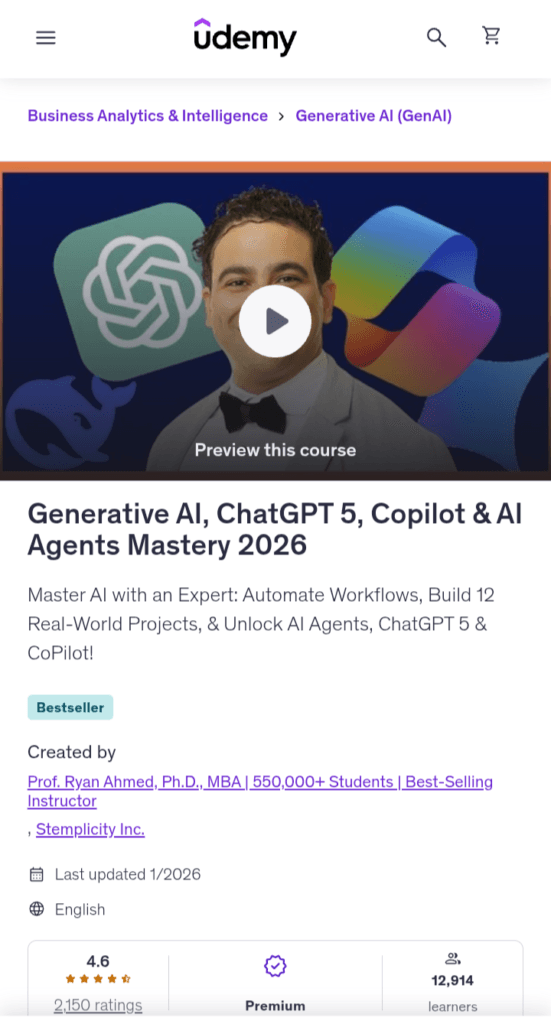
The course is designed to unlock the potential of Generative AI and Microsoft Copilot to transform business processes, enhance decision-making, and drive innovation, equipping professionals with cutting-edge skills to harness AI tools such as ChatGPT, Gemini, Claude, and DeepSeek for a wide range of business applications.
What You’ll Learn
The curriculum is anchored around two parallel tracks: the broader AI tools track and the Microsoft Copilot track. And they’re woven together in a way that mirrors how a business professional would actually use them day-to-day.
On the AI tools side, students learn to leverage ChatGPT, Gemini, Claude, and DeepSeek for various business applications, including research, brainstorming, creative writing, and coding assistance.
On the Microsoft Copilot side, the coverage is genuinely deep. Students master Microsoft Copilot in Excel, PowerPoint, Teams, Word, and Outlook to automate tasks such as report generation, presentation writing, and email drafting, and learn to build AI agents in Copilot to handle complex workflows, decision-making, and business operations.
The data analysis thread is another standout that separates this course from typical business AI offerings.
Students learn to leverage Generative AI for data wrangling, cleaning, and analysis, including handling missing values, merging datasets, and filtering, and to build forecasting models using ARIMA, SARIMA, Random Forest, and Prophet, evaluating performance with key error metrics.
And the data visualization section rounds it all out. Students perform data visualization using Generative AI, including bar charts, heatmaps, scatter plots, pie charts, and time-series visualizations, and use ChatGPT Canvas to draft documents, generate reports, and write code interactively for seamless collaboration between AI and humans.
Tools Covered
- ChatGPT 5 (including Canvas and custom GPT fine-tuning)
- Microsoft Copilot (Excel, Word, PowerPoint, Teams, Outlook)
- Copilot Studio (AI agent building)
- Google Gemini
- Anthropic Claude
- DeepSeek
- ARIMA, SARIMA, Random Forest, Prophet (forecasting models)
- Pandas (data wrangling — applied via AI)
Who Should Take It
This course is the perfect choice for business professionals who are serious about not being left behind in this AI era.
If your job happens inside Microsoft 365 and you want AI to genuinely transform how you do it, this is one of the most targeted and practical courses available anywhere on Udemy right now.
Related: How to Write Articles Faster Using ChatGPT (Step-by-Step Workflow)
Pros
- The multi-model approach (ChatGPT, Gemini, Claude, DeepSeek) reflects how the real workplace actually uses AI in 2026.
- Microsoft Copilot coverage is among the deepest of any Udemy course.
- Forecasting and data analysis sections add genuine analytical depth.
Cons
- The breadth of tools covered means no single platform gets exhaustive treatment.
What Jobs Can You Get After These Courses?
No Udemy course will hand you a six-figure AI job overnight, regardless of what the sales page implies.
What these courses can do is give you a credible, structured entry point into a field where demand is genuinely outpacing supply. Here’s what’s realistically within reach.
Related: High-Paying AI Careers You Should Know (Salary, Skills & Step-by-Step Roadmap)
AI Engineer (Entry-Level)
Build LLM-powered apps, RAG pipelines, and AI-integrated products. This is the most competitive path on this list. A certificate alone won’t cut it. You’ll need a GitHub portfolio with real projects and ideally some cloud platform exposure. More accessible at startups and agencies than at enterprise tech firms, where hiring bars are steeper.
Realistic salary: $70K–$110K (US market)
Prompt Engineer
Design and test prompts that make AI models perform reliably for specific business use cases. This, as a standalone job title, is already evolving, and most companies are folding it into broader product, ops, or content roles. The skill remains valuable; just think of it as a differentiator rather than a destination.
Realistic salary: $55K–$95K as part of a broader role
AI Automation Specialist
Connect AI tools to real business workflows, automating data processes, building AI agents, and integrating ChatGPT with existing systems. This is the most underrated entry point on this list.
Most businesses don’t want to build AI from scratch; they want their existing operations to stop being manual. People who can bridge that gap are in genuine demand, and the freelance opportunity here is particularly strong right now.
Realistic salary: $50K–$85K salaried; $50–$150/hr freelance
Freelance AI Consultant
Help businesses evaluate, adopt, and implement AI tools. Your previous career is actually an asset here. A finance professional who understands AI is more valuable to a CFO than a generalist with no domain context. The income ceiling is high, but building a practice takes time. Start small, document results, and let the work speak.
Realistic income: $30K in year one, building from scratch; $80K–$150K+ once established
Frequently Asked Questions About Generative AI Courses on Udemy
Are Udemy Generative AI Courses Worth It?
Yes, if you pick the right one. Udemy courses are significantly cheaper than bootcamps or university programs, and the best ones are actively maintained. The value isn’t in the certificate; it’s in the practical skills you build.
Can I Get a Job After Learning Generative AI on Udemy?
It’s possible, but a certificate alone won’t do it. Employers want proof you can build things. Use the course as your foundation, then create real projects, document your work publicly, and apply for roles at startups or as a freelancer first. That combination, course plus portfolio, is what actually moves the needle.
Do I Need Coding Skills for Generative AI?
Not always. Three of the five courses in this guide require zero coding, and real careers in AI automation and consulting are built without it. However, if you want to build LLM-powered apps or pursue AI engineering, Python is non-negotiable. Knowing basic coding meaningfully expands what you can do and earn.
Final Verdict
Every course on this list is worth your time if it matches your goal.Pick your goal. Pick your course. Then build something with it. That last step is the only one that actually matters.
Related Articles
What will you learn in the Generative AI for Everyone course on Coursera?
What will you learn in the Introduction to Generative AI Specialization on Coursera?
How Generative AI Can Help Boost Your Efficiency In Business?
How to Implement Generative AI In Your Business?
Generative AI and You: What Can You Create with Generative AI?

As an engineer with a passion for learning and sharing knowledge, I created CourseKart.online to help students, professionals, and lifelong learners choose the best online courses. With so many options available, finding the right one can be overwhelming. My goal is to simplify that process by offering insights, reviews, and recommendations on the top online learning resources. I hope my posts inspire you to keep growing, learning, and exploring new opportunities.
Discover more from coursekart.online
Subscribe to get the latest posts sent to your email.