
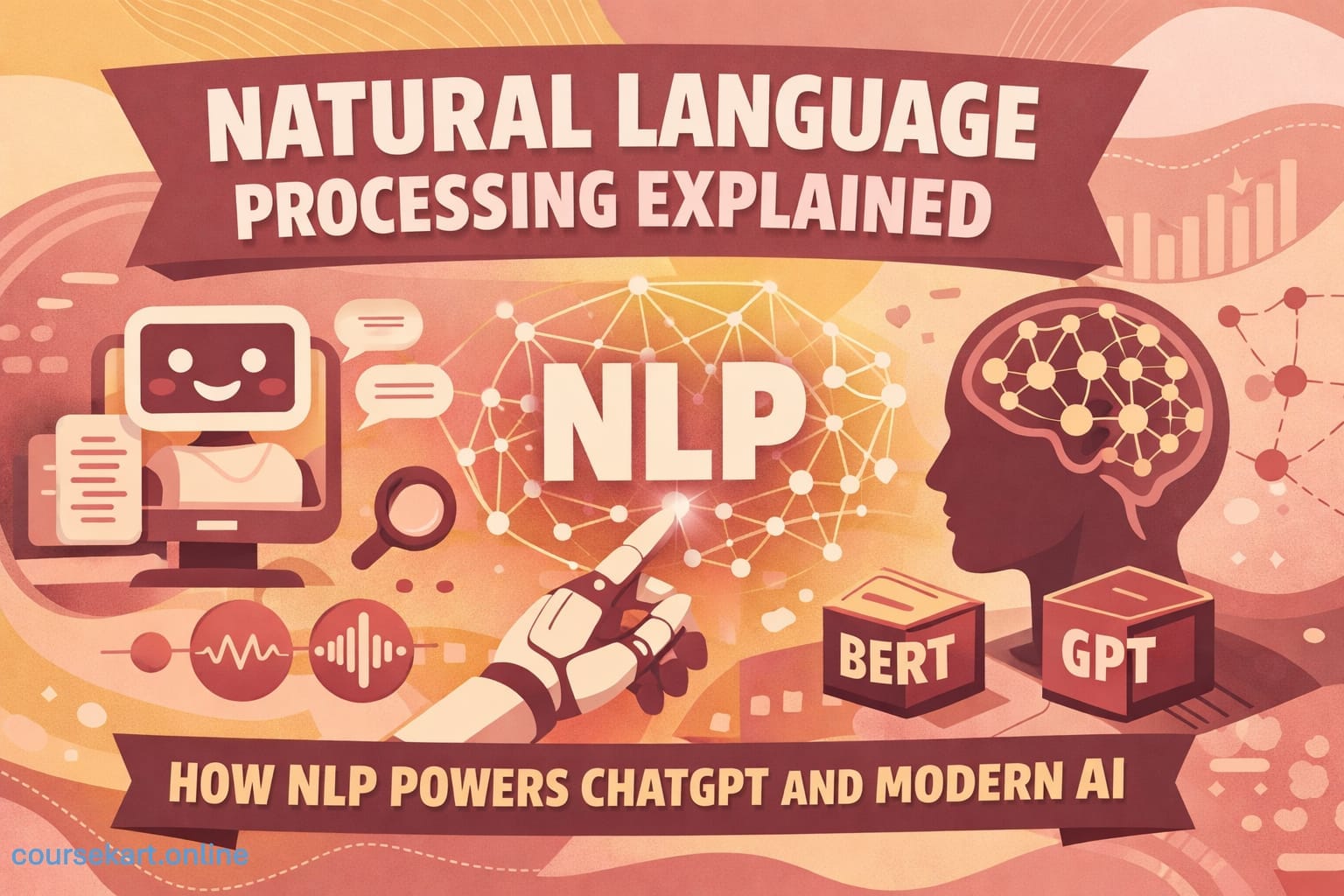
You ask your phone to set a reminder, and it just gets it. You type a half-formed question into ChatGPT at midnight, and it comes back with a response that actually makes sense. You’re venting to an AI assistant, and somehow it understands the mood, not just the words.
None of that is magic. It’s natural language processing, and it’s quietly running the show behind almost every AI tool you use today.
Think about the last time you used ChatGPT to draft an email, asked Google’s Gemini to explain something complex, or had Claude help you think through a problem.
In each of those moments, something remarkable was happening under the hood: a machine was reading human language, messy, ambiguous, context-heavy human language, and actually understanding it well enough to respond.
That’s not a small thing. Language is one of the most complex systems humans have ever created. We use sarcasm, metaphor, slang, and cultural references without even thinking about it.
Teaching a machine to keep up? That’s the core challenge of NLP in AI, and it took decades of research, failed experiments, and some genuinely brilliant breakthroughs to get here.
In this article, we’re going to pull back the curtain on all of it. We’ll start from the very basics, what NLP is in AI, why it matters, and how it actually works, then move into real-world NLP applications, the NLP techniques that power modern systems, and the NLP models like BERT and GPT that changed everything.
Whether you’re a curious beginner or someone who wants to finally understand what’s really happening inside these tools, you’re in the right place. Let’s start from the beginning.
What is Natural Language Processing (NLP)?
Natural language processing is a branch of artificial intelligence that enables machines to read, understand, interpret, and generate human language.
It bridges the gap between the way humans communicate naturally and the way computers process information, turning unstructured text and speech into something machines can actually work with.
Think of it this way: if AI is the brain, NLP is the part that learned how to read.
But NLP isn’t just about recognizing words. It’s about understanding meaning. It’s the difference between a machine that sees the word “bank” and one that knows whether you’re talking about a riverbank or a savings account, based entirely on context.
At its core, NLP sits at the intersection of linguistics, computer science, and machine learning.
It borrows rules from how language works, combines them with statistical models and neural networks, and produces systems that can do things that, not too long ago, only humans could do: summarize articles, answer questions, translate languages, and even hold a conversation.
In simpler terms? NLP is what happens when you stop talking at a machine and start talking with it.
Why Natural Language Processing Matters More Than Ever in 2026
Here’s a number worth sitting with: by 2026, many people will interact with an AI-powered system several times a day, often without realizing it.
Every search query, every autocomplete suggestion, every customer support chat, every voice command. NLP is running in the background of all of it.
We’ve crossed a threshold. Human-computer interaction isn’t about clicking buttons and filling forms anymore. It’s a conversation, and that shift changes everything.
The AI Tool Explosion
The last few years have seen an unprecedented surge in AI tools built directly on natural language processing. ChatGPT crossed 100 million users faster than any app in history.
Google overhauled its entire search experience with AI-powered summaries, putting NLP front and center in how billions of people find information every single day.
Gemini is now woven into Google’s ecosystem, from Docs to Gmail to Search, quietly processing, understanding, and generating language at a scale that’s hard to even comprehend.
And it doesn’t stop at big tech. Startups, enterprises, and solo creators are all building on top of NLP models to power tools for writing, research, customer support, and beyond.
Where NLP is Making a Real Difference
The applications of NLP today span nearly every industry. Here’s where it’s showing up most powerfully.
Search Engines
Google no longer just matches keywords. It understands intent. When you search “best way to sleep faster,” it knows you’re looking for tips, not a definition of sleep. That’s NLP at work.
Chatbots and Virtual Assistants
From airline booking bots to hospital triage assistants, NLP-powered chatbots are handling real conversations, resolving queries, and reducing the load on human teams 24/7.
Content Creation
AI writing tools are helping marketers, journalists, and creators draft, edit, and ideate at a pace that was unimaginable five years ago. The words you read online? Increasingly, NLP had a hand in shaping them.
Automation
Businesses are using NLP to automate email sorting, contract review, sentiment monitoring, and report generation, saving hours of human time every week.
Related: Best Natural Language Processing Courses Online (AI & Python)
How NLP Works: A Step-by-Step Breakdown
Here’s the thing about human language: it’s chaotic. We abbreviate, we misspell, we use the same word to mean five different things.
Before any AI can understand what you’re saying, it has to do a lot of behind-the-scenes work to make sense of the mess.
The flow looks like this:
Text → Clean → Analyze → Understand → Generate
Let’s break down each stage.
Text Preprocessing — Cleaning Up the Chaos
Before a machine can process language, it needs to tidy it up. Raw text is noisy, full of punctuation, filler words, inconsistent formatting, and capitalization. Preprocessing is the cleanup crew.
It starts with Tokenization. The model breaks your text down into smaller chunks, usually individual words or subwords called tokens.
The sentence “ChatGPT is incredible” becomes [“ChatGPT”, “is”, “incredible”]. Simple in concept, surprisingly complex in practice, especially across different languages.
Next comes stop word removal. Words like “is,” “the,” “and,” and “but” appear everywhere but carry very little meaning on their own. NLP systems often strip these out so the model can focus on the words that actually matter.
Then there’s normalization, standardizing text so that “Running,” “RUNNING,” and “running” are all treated as the same thing.
This step also handles things like expanding abbreviations, correcting common typos, and converting everything into a consistent format that the model can work with cleanly.
Linguistic Processing — Reading Between the Lines
Once the text is clean, NLP digs into the structure of the language.
Stemming vs. Lemmatization
Both techniques reduce words to their root form, but they take different approaches. Stemming is the blunter tool. It chops off word endings, so “running” becomes “run” and “studies” becomes “studi” (yes, even if that’s not a real word).
Lemmatization is smarter. It uses vocabulary and grammar rules to return the proper base form. “Studies” becomes “study.” “Better” becomes “good.” The result is more accurate, especially when meaning matters.
Part-of-speech tagging goes a step further. The system labels each word by its grammatical role: noun, verb, adjective, adverb. This helps the model understand how words relate to each other in a sentence.
In “The bank approved the loan,” it knows “bank” is a noun and “approved” is a verb. This is the context that becomes critical in the next stage.
Understanding Meaning — The Real Challenge
This is where NLP gets genuinely impressive and genuinely hard.
Named Entity Recognition (NER) teaches machines to identify and categorize specific entities in text. People, places, organizations, dates, currencies, etc., NER pulls these out and labels them.
When you read a news article and an AI can tell you that “Elon Musk” is a person, “Tesla” is a company, and “April 2024” is a date, that’s NER doing its job.
Sentiment Analysis goes even deeper. It reads the emotional tone behind the text. Is this product review positive or negative? Is this tweet expressing frustration or excitement?
Sentiment analysis is one of the most widely used NLP applications in the real world, powering everything from brand monitoring tools to customer feedback systems to political campaign analytics.
The Machine Learning Layer — Where It All Comes Together
Here’s what separates modern NLP from the rule-based systems of the past: machine learning.
Instead of manually coding every grammatical rule and exception (which is, frankly, impossible), today’s NLP models are trained on enormous datasets of text.
They read hundreds of billions of words, books, websites, conversations, articles, and learn patterns: which words tend to appear together, how sentence structure affects meaning, and how context changes interpretation.
Over time, through millions of training iterations, the model stops needing explicit rules. It builds its own internal understanding of language.
One that’s flexible enough to handle slang, nuanced enough to catch sarcasm, and powerful enough to generate fluent, coherent text from scratch.
As a result, systems don’t just process language, they understand it.
Related: How Neural Networks Work: A Step-by-Step Guide for Data Science Students
Key NLP Techniques You Should Know
Every powerful NLP system you interact with today, from ChatGPT to Google Search, is built on a set of core techniques that evolved over decades. Some are elegantly simple.
Others are genuinely mind-bending. But understanding them doesn’t require a computer science degree, just a willingness to follow the logic.
Here’s a breakdown of the most important NLP techniques, explained in plain English.
1. Tokenization — Breaking Language into Bite-Sized Pieces
We touched on this earlier, but it deserves a proper spotlight because everything starts here.
Tokenization is the process of splitting text into individual units, tokens, that the model can process. Those tokens can be words, subwords, or even individual characters, depending on the system.
Think of it as the NLP equivalent of breaking a LEGO set into individual bricks before you can build anything with them.
Without tokenization, a machine just sees one long, unbroken string of characters. With it, the text becomes structured, countable, and workable.
2. Bag of Words — The Blunt but Useful Approach
Bag of Words (BoW) is one of the oldest and most straightforward NLP techniques, and despite its simplicity, it’s still surprisingly useful.
The idea? Forget grammar. Forget word order. Just count which words appear in a piece of text and how often. Each document becomes a “bag” of its words, represented as a list of word frequencies.
So “The cat sat on the mat” and “The mat sat on the cat” would look identical to a Bag of Words model because it doesn’t care about sequence, only occurrence.
It’s a blunt instrument, but for tasks like spam detection or basic document classification, it works remarkably well.
The limitation is obvious, though: meaning often lives in order, not just presence. That’s where the next techniques come in.
3. TF-IDF — Teaching Machines What Words Actually Matter
Bag of Words treats every word equally. TF-IDF, which stands for Term Frequency–Inverse Document Frequency, is smarter than that.
Here’s the intuition: if a word appears frequently in one document but rarely across all documents, it’s probably important to that specific document. If a word appears everywhere like “the” or “is”, it’s probably not meaningful at all.
TF-IDF scores each word based on exactly this logic. It rewards words that are distinctive and penalizes words that are generic. The result is a much more meaningful representation of what a document is actually about.
Search engines have used TF-IDF for years to rank pages. It’s not the cutting edge anymore, but it remains one of the most intuitive and widely taught NLP techniques in the field.
4. Word Embeddings — Giving Words a Location in Space
This is where NLP starts getting genuinely powerful and a little philosophical.
Word embeddings represent words as vectors, lists of numbers, plotted in a high-dimensional space.
Words with similar meanings end up close together in that space. “King” and “Queen” are neighbors. “Dog” and “Cat” are neighbors. “Happiness” and “Joy” are neighbors.
The famous example that blew people’s minds when it was first demonstrated: King − Man + Woman ≈ Queen. You can do arithmetic with meaning.
The most well-known word embedding model is Word2Vec, developed by Google. It learned these relationships simply by training on massive amounts of text and observing which words tend to appear in similar contexts.
Word embeddings gave NLP models something they’d always lacked before: a genuine sense of semantic similarity. Not just “these two words are different strings of characters” but “these two words mean related things.”
5. The Attention Mechanism — The Breakthrough That Changed Everything
If word embeddings were a leap forward, the attention mechanism was a revolution.
Introduced in a landmark 2017 research paper titled “Attention Is All You Need“, which has since become one of the most cited papers in AI history.
The attention mechanism solved a problem that had frustrated NLP researchers for years: how do you help a model focus on the right words when processing a sentence?
Here’s the challenge. In the sentence “The trophy didn’t fit in the suitcase because it was too big”. What does “it” refer to? The trophy or the suitcase? Humans resolve this instantly. Earlier NLP models struggled badly with it.
The attention mechanism allows the model to weigh the importance of every word in relation to every other word in the sentence, simultaneously. It learns to “pay attention” to the most relevant context when interpreting each token. So when it processes “it,” it knows to look back at “trophy” and “suitcase” and figure out the relationship.
This mechanism became the foundation of transformer models, and transformers became the foundation of every major NLP model you know today: BERT, GPT, and beyond.
No attention mechanism, no ChatGPT. It really is that significant.
How NLP Powers ChatGPT

ChatGPT feels different from anything that came before it. Not just smarter but present. Like, there’s something on the other side of the conversation that actually gets what you’re saying. So what’s really going on under the hood?
The answer is natural language processing taken to its fullest expression.
From NLP to Conversational AI
For decades, building a machine that could hold a real conversation was the white whale of AI research.
Early chatbots like ELIZA in the 1960s mimicked conversation through pattern matching and scripted responses. They were clever parlor tricks, impressive for their time, hollow on closer inspection.
The leap to genuine conversational AI required two things working seamlessly together: language understanding and language generation.
Understanding means the system can take your input, with all its ambiguity, implied context, and conversational shorthand, and correctly interpret what you mean.
Generation means it can respond with language that is coherent, contextually appropriate, and natural-sounding.
NLP provides the foundation for both. And ChatGPT is where those two capabilities converge at a scale and quality that finally makes the conversation feel real.
The Role of Transformers in ChatGPT
ChatGPT is, at its core, a transformer-based language model, specifically built on the GPT (Generative Pre-trained Transformer) architecture.
And the two defining features of that architecture are exactly what make ChatGPT feel so fluent and aware.
Context Awareness
Every time you send a message to ChatGPT, it doesn’t just read your latest sentence. It reads the entire conversation, everything you’ve said, everything it’s responded with, and processes it all simultaneously through the self-attention mechanism.
This is why ChatGPT can follow a thread across a long conversation without losing the plot. When you say “make it shorter” three exchanges in, it knows what “it” refers to. When you shift topics and then circle back, it tracks that too.
The transformer’s ability to hold and weigh context across long sequences is what makes this possible.
Predictive Text Generation
Here’s where it helps to lift the curtain completely because ChatGPT isn’t “thinking” the way humans think. It isn’t reasoning from first principles or consulting an internal knowledge base like a search engine.
ChatGPT predicts the next word based on context, over and over again, at incredible speed. That’s it. Not magic. Not cognition.
Pattern recognition operates at a scale and sophistication that produces something that looks remarkably like understanding.
When you ask it to write a poem about autumn, it doesn’t picture falling leaves and feel something.
It calculates: given everything in this conversation, given billions of patterns learned during training, what sequence of words is most likely to be a good poem about autumn?
And then it generates that sequence, one token at a time, with each new word informed by everything that came before it.
The result is fluent, often genuinely impressive language. But the process underneath is probabilistic prediction, not conscious thought.
Understanding this distinction doesn’t make ChatGPT less remarkable. It makes it more remarkable because what it achieves through pure pattern recognition is extraordinary.
How ChatGPT Was Trained — Simplified
Building a system like ChatGPT wasn’t a single step. It happened in two distinct phases, each one critical.
Phase 1: Pretraining — Reading the Internet (and Then Some)
Before ChatGPT could hold a single conversation, it had to read. A lot.
During pretraining, the model was exposed to an enormous corpus of text, books, websites, articles, code, forums, and research papers, representing a significant chunk of recorded human knowledge and expression. We’re talking hundreds of billions of words.
The training task was deceptively simple: predict the next word. Given a sequence of text, what comes next?
The model made a prediction, compared it to the actual next word, measured the error, and adjusted its internal parameters slightly. Then it did that again. Billions of times.
Through this process, called self-supervised learning, the model wasn’t just memorizing text. It was building a deep, flexible internal representation of how language works: grammar, facts, reasoning patterns, writing styles, conversational norms.
All of it is absorbed through the simple act of predicting what comes next, at a massive scale.
By the end of pretraining, the model was extraordinarily capable but raw. Powerful but unfocused.
Phase 2: Fine-Tuning — Teaching It to Be Helpful
Raw pretraining produces a model that’s great at completing text. It doesn’t automatically produce a model that’s great at helping people.
That’s where fine-tuning comes in, and specifically, a technique called RLHF (Reinforcement Learning from Human Feedback).
Human trainers at OpenAI rated the model’s responses for quality, accuracy, helpfulness, and safety. Those ratings were used to train a separate reward model, essentially a system that learned what “good” responses look like.
The language model was then fine-tuned to maximize that reward, gradually steering its behavior toward responses that are more useful, more coherent, and less likely to go off the rails.
This is the phase that turns a powerful text predictor into ChatGPT. The conversational assistant that feels like it’s genuinely trying to help.
Two phases. Hundreds of billions of words. Millions of human ratings. All in service of a system that, when you ask it a question, responds like it actually understood what you meant.
Related: How to Use ChatGPT for Blog Writing (With 50+ Practical, Workflow-Tested Prompts)
Real-World Applications of NLP
Natural language processing isn’t a lab experiment or a future promise. It’s already embedded in the tools and platforms you use every single day. Most of the time, you don’t even notice it. That’s kind of the point.
Here’s where NLP applications are making the biggest real-world impact right now.
1. Chatbots and Virtual Assistants — The Front Line of AI Conversation
The chatbot you interact with on a bank’s website, the support bot that resolves your order issue at 2 am, the AI assistant built into your favorite app. All of it runs on natural language processing.
Modern NLP-powered chatbots go far beyond the scripted, frustrating bots of the early 2010s. They understand intent, handle follow-up questions, manage context across a conversation, and escalate to a human when needed. For businesses, they’ve become mission-critical infrastructure, handling millions of customer interactions simultaneously at a fraction of the cost of human support teams.
And at the high end of the spectrum? ChatGPT and Claude represent what happens when conversational AI is taken to its absolute limit. Assistants that don’t just answer questions but help you think, create, analyze, and problem-solve.
2. Search Engines — Understanding What You Actually Mean
When you type a query into Google, you’re not just submitting a string of keywords anymore. You’re expressing an intent, and Google’s NLP-powered search engine works hard to understand exactly what that intent is.
Thanks to models such as BERT integrated directly into Google’s ranking systems, search has evolved from keyword matching to genuine semantic understanding.
Google doesn’t just look for pages that contain your words. It interprets the meaning behind your query and surfaces results that actually answer your question.
That shift, from matching words to understanding meaning, is entirely an NLP achievement. And it’s why search today feels dramatically smarter than it did even five years ago.
3. Voice Assistants — NLP You Can Talk To
“Hey Siri, what’s the weather like tomorrow?”
In the fraction of a second between you finishing that sentence and Siri responding, a remarkable chain of NLP processes fires in sequence. Your speech is converted to text. The text is tokenized and parsed.
The intent is extracted, the weather query, the location inferred, and the timeframe identified. A response is generated and converted back to speech.
All of that — invisibly, instantly.
Siri, Google Assistant, and Amazon Alexa have made voice-based NLP a standard feature of everyday life.
They sit at the intersection of speech recognition and natural language understanding: two distinct but deeply connected challenges that NLP has spent decades trying to solve together.
The results aren’t perfect. Anyone who’s watched Siri confidently misunderstand a sentence knows that. But the progress over the last decade has been staggering, and voice interfaces are only getting sharper.
4. Language Translation — Breaking Down Barriers at Scale
Google Translate handles over 100 billion words per day. DeepL produces translations so fluid that they’re often mistaken for human work.
Real-time translation features are now built directly into video call platforms, browsers, and messaging apps.
None of this was possible before neural NLP models, specifically transformer-based systems, transformed the field of machine translation.
Earlier translation systems worked by matching phrases to pre-built dictionaries and applying grammatical rules. They were clunky, literal, and notoriously bad with idioms and nuance.
Modern NLP-powered translation learns from billions of real translated texts, understanding not just what words mean but how they flow naturally in the target language.
The result is a translation that doesn’t just swap words. It carries meaning across languages. For global businesses, researchers, travelers, and communities, that’s not a convenience. It’s a lifeline.
5. Spam Detection — The Invisible Gatekeeper
You probably haven’t thought about spam in years. That’s because NLP is quietly handling it for you.
Every email that lands in your inbox has been scanned, analyzed, and scored before you ever see it.
NLP models examine the language patterns of incoming messages, the phrasing, the structure, the presence of certain words in certain contexts, and make a near-instant judgment: legitimate or spam?
Early spam filters used simple keyword blacklists. If an email contained “free money” or “click here,” it got flagged. Spammers adapted quickly, and so did NLP.
Modern spam detection uses sophisticated text classification models that recognize patterns of manipulation rather than just trigger words.
They catch phishing attempts, scam emails, and manipulative marketing that no keyword list could ever anticipate.
It’s one of the quietest NLP applications in existence, and one of the most valuable.
6. Content Recommendations — The Algorithm That Knows Your Taste
How does Netflix know you’ll love that obscure documentary? How does Spotify build a playlist that feels curated for you? How does your news feed seem to know exactly which stories will keep you scrolling?
NLP, working alongside recommendation algorithms, analyzes the language of content: titles, descriptions, reviews, captions, subtitles, and user-generated text.
It understands the themes, tone, and subject matter of content at scale and matches it against patterns in what you’ve engaged with before.
This isn’t just keyword matching. It’s a semantic understanding where the system grasps that you gravitate toward psychological thrillers with unreliable narrators rather than just “thriller movies.”
The finer the semantic understanding, the more eerily accurate the recommendations become.
It’s one of the most commercially powerful NLP applications in the world, and the engine behind some of the most profitable platforms on the planet.
Related: Best Free Datasets for Data Science Projects (Perfect for Beginners to Practice)
Frequently Asked Questions About Natural Language Processing
What is NLP in simple words?
Natural language processing is the branch of AI that helps computers understand, read, and respond to human language. Think of it as the technology that lets machines have a conversation with you, turning your words into something a computer can actually process, interpret, and meaningfully respond to, just like a person would.
How does NLP work?
NLP works by breaking down human language into smaller pieces that a machine can analyze. It cleans raw text through tokenization and preprocessing, extracts meaning using linguistic techniques, and applies machine learning models to recognize patterns. The result is a system that understands not just individual words, but the intent and context behind them.
Is NLP part of AI?
Yes, NLP is a specific branch of artificial intelligence. It sits at the intersection of linguistics, computer science, and machine learning. While AI is the broad field of building intelligent machines, NLP focuses specifically on one of AI’s hardest challenges: teaching machines to understand and communicate in human language, naturally and accurately.
How is NLP used in ChatGPT?
ChatGPT is built on a transformer-based NLP architecture called GPT. It uses NLP techniques to understand your input, track context across the conversation, and generate responses word by word based on learned patterns. It was pretrained on vast amounts of text data, then fine-tuned with human feedback to make responses more helpful, accurate, and natural-sounding.
What are examples of NLP?
NLP powers more of your daily life than you probably realize. Every time you ask Siri a question, search something on Google, receive a spam-filtered inbox, get a Netflix recommendation, or chat with a customer support bot, that’s NLP at work. ChatGPT, Google Translate, autocorrect, and voice assistants are all prominent, everyday NLP examples most people interact with regularly.
Final Verdict: Why Natural Language Processing Is the Most Important Technology You Use Without Thinking About It
We started this article with a simple premise: that something remarkable happens every time you talk to an AI. Now you know exactly what that something is.
Natural language processing isn’t a theory anymore. It’s the connective tissue of modern AI. The technology that makes machines not just intelligent, but communicative.
Without it, every tool we’ve explored in this article goes silent. ChatGPT becomes a calculator. Google becomes a directory. Siri becomes a timer app.
NLP is what closes the gap between human thought and machine response.
More Articles
How Generative AI Can Help You Land Your Dream Job: 7 Practical Steps To Follow
Best ChatGPT Courses Online (Learn Prompting, AI Workflows & Real-World Use Cases)
Best Prompt Engineering Courses Online [Prompting Mastery]
Best Midjourney Courses Online for Beginners (Complete Guide)

As an engineer with a passion for learning and sharing knowledge, I created CourseKart.online to help students, professionals, and lifelong learners choose the best online courses. With so many options available, finding the right one can be overwhelming. My goal is to simplify that process by offering insights, reviews, and recommendations on the top online learning resources. I hope my posts inspire you to keep growing, learning, and exploring new opportunities.
Discover more from coursekart.online
Subscribe to get the latest posts sent to your email.