
You already know data science is one of the most in-demand fields right now, but knowing where to learn it is a completely different problem.
In 2026, the demand for data science, AI, Python, and machine learning skills isn’t just growing; it’s accelerating.
Companies aren’t just looking for people who understand the theory; they want professionals who can open a dataset, run an analysis, build a model, and communicate the results.
The gap between that skill set and where most people start is real, and the platform you choose to close that gap actually matters.
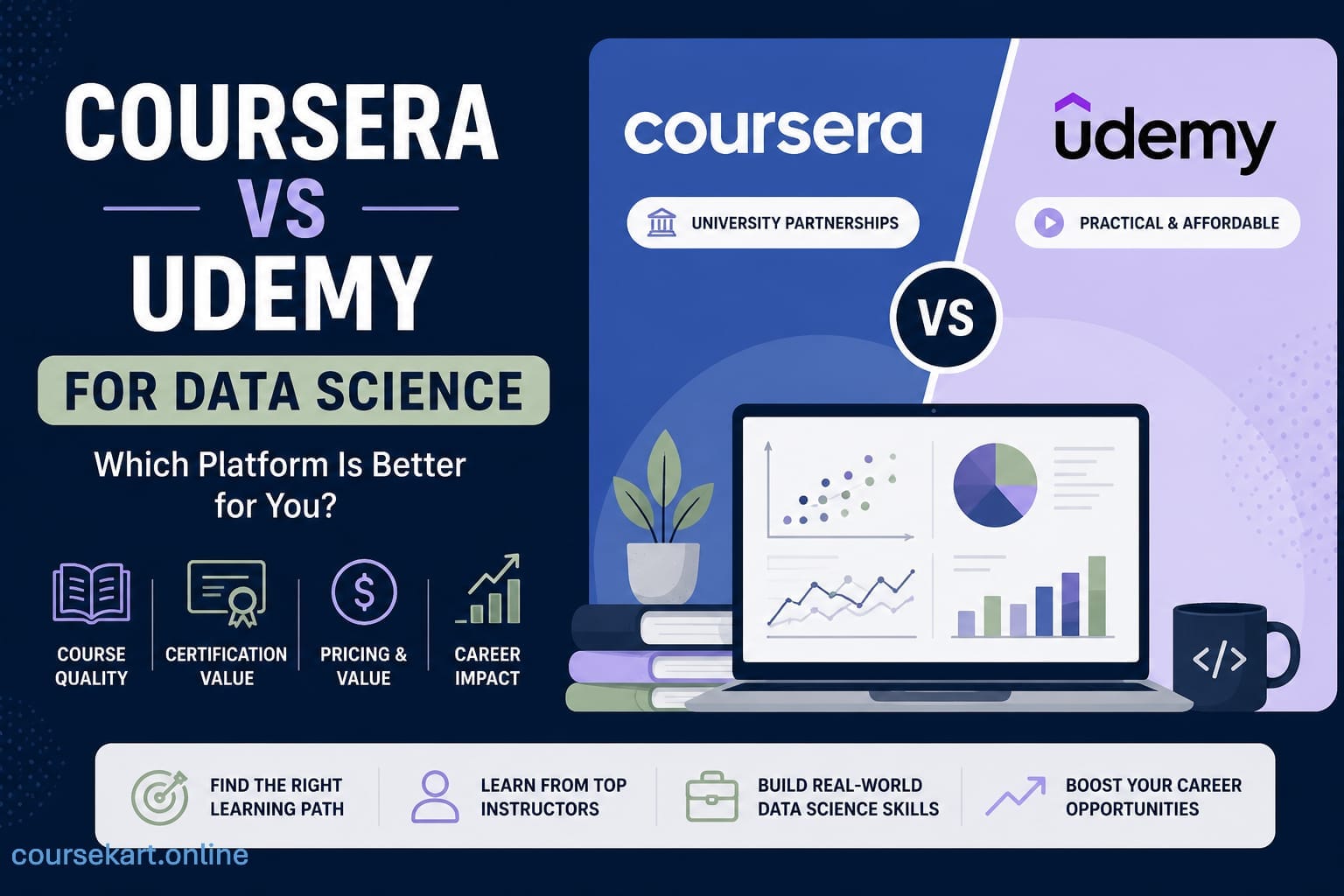
That’s exactly where the Coursera vs Udemy for data science debate gets interesting.
On the surface, both platforms offer hundreds of courses in data science, Python, machine learning, and everything in between.
But they’re built on fundamentally different philosophies. Coursera partners with universities and top companies like Google, IBM, and Stanford to offer structured, credential-backed learning paths.
Udemy is a marketplace, a massive, instructor-driven library where the focus is on practical, affordable, get-it-done learning.
Neither is universally better. But one of them is almost certainly better for you.
This guide breaks down exactly how these two platforms compare across the things that actually matter: course quality, instructors, certifications, pricing, career support, and the overall learning experience for data science specifically.
By the end of this comparison, you’ll know exactly which platform fits your goals, your budget, and the way you actually learn.
So keep reading.
Quick Comparison – Coursera vs Udemy for Data Science
Before we get into the details, here’s a straight, no-fluff look at how these two platforms stack up across the factors that matter most for data science learners.
| Feature | Coursera | Udemy |
|---|---|---|
| Pricing | Free to audit; Coursera Plus at ~$59/month or $399/year | One-time course purchase; frequent sales bring most courses to $10–$15 |
| Course Quality | Consistently high; university and industry-vetted | Varies by instructor; top courses are excellent, but quality isn’t guaranteed |
| Certification Value | Strong — backed by Google, IBM, Stanford, and other recognized names | Recognized for skill-building; less weight with traditional employers as a standalone credential |
| Beginner Friendliness | Excellent — structured learning paths guide you step by step | Good — huge variety for beginners, but you’ll need to pick your own path |
| Hands-On Projects | Included in most specializations and professional certificates | Heavily project-based; many courses are entirely hands-on |
| Instructor Quality | University professors and industry professionals | Ranges from world-class practitioners to average instructors — research before you buy |
| Career-Focused Learning | Strong — dedicated career certificates, resume tools, and job boards | Limited career support; the focus is skill acquisition, not job placement |
| Learning Flexibility | Self-paced within structured programs; deadlines are resettable | Fully self-paced; no deadlines, no structure unless the course provides it |
| Subscription Options | Yes — Coursera Plus covers most content for a flat fee | Premium subscription covers top-rated courses; pay per course |
| University Partnerships | Yes — 350+ universities, including Michigan, Duke, Johns Hopkins | No standard university partnerships |
| Best For | Career switchers, professionals seeking recognized credentials, structured learners | Budget-conscious learners, self-starters, professionals upskilling in specific tools |
What Is Coursera?
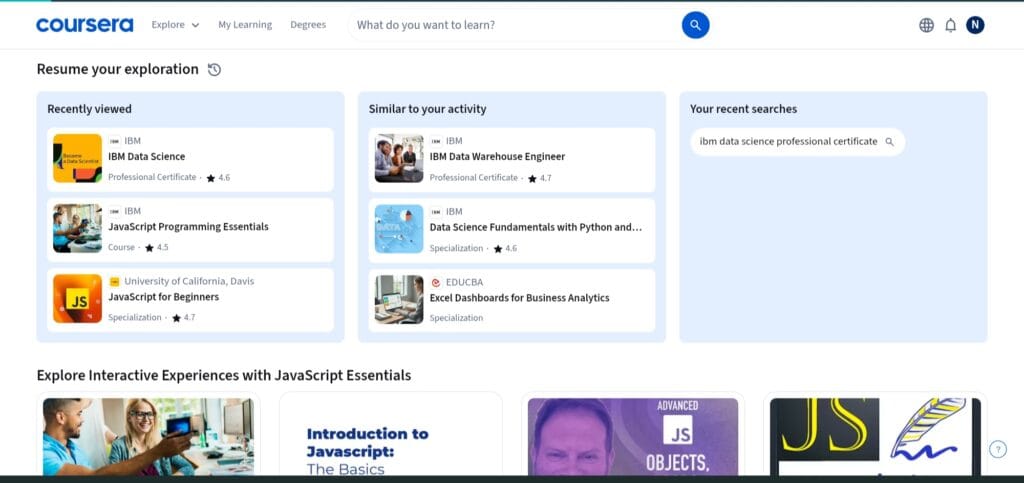
Coursera launched in 2012 out of Stanford University, and that origin story still defines what the platform is today.
It’s not a course marketplace, it’s a structured learning platform built around partnerships with over 350 universities and companies like Google, IBM, Meta, and DeepLearning.AI.
If you’ve ever searched for the best data science courses online, Coursera results are almost always near the top, and there’s a reason for that.
How Coursera Works
The core of Coursera’s model is its university-backed approach to online learning.
Instead of individual instructors building and selling courses independently, Coursera works directly with institutions to design a curriculum that meets real academic and industry standards.
That means when you enroll in a data science program on Coursera, you’re following a path that was deliberately structured.
Most data science content on Coursera is organized into Specializations (a series of 4–6 courses building toward a defined skill set) or Professional Certificates (career-ready programs designed to prepare you for a specific job role).
Both formats follow a guided sequence: you move through the material in a logical order, complete graded assignments, and finish with a hands-on capstone project.
Deadlines are flexible and resettable, so it’s self-paced in practice, but the structure is always there to keep you on track.
This model works especially well for online data science courses for beginners who don’t yet know what they don’t know.
When you’re starting from zero, having someone else figure out the learning sequence is genuinely valuable.

Popular Data Science Programs on Coursera
Coursera’s data science catalog has some of the most well-regarded programs available anywhere online. Here are some examples.
IBM Data Science Professional Certificate is one of the most completed data science programs on the platform. It covers Python, SQL, data visualization, machine learning, and applied data science across 12 courses.
It’s a practical, career-focused credential that carries real weight, particularly for entry-level roles.
Google Advanced Data Analytics Professional Certificate is Google’s answer to the growing demand for analytics talent. You’ll work through Python, regression modeling, and machine learning concepts with Google’s own instructional team.
For anyone eyeing a role in data analytics at a mid-to-large company, this one is hard to overlook.
DeepLearning.AI’s machine learning and AI courses, led by Andrew Ng, are widely considered some of the best machine learning courses online.
The Machine Learning Specialization and Deep Learning Specialization have collectively been taken by millions of learners.
Andrew Ng has a rare ability to make genuinely complex concepts feel approachable without dumbing them down, and the curriculum reflects decades of real AI research and teaching experience.
Related: Data Science Courses On Coursera To Help Land Your First Job
Pros of Using Coursera for Data Science
- Recognized certificates from Google and IBM signal a vetted, standardized curriculum to employers.
- Structured specializations sequence every topic intentionally, so you build skills without gaps.
- University partnerships with Stanford, Duke, and Michigan bring genuine academic credibility.
- Career-oriented programs include resume guidance, interview prep, and employer network access.
- Financial aid is available for qualifying learners.
Cons of Using Coursera for Data Science
Coursera Plus at $59/month adds up fast if you learn slowly. Some programs feel more theoretical than practical, frustrating learners who want to spend most of their time in code.
The subscription model is great when you’re consistent, but the moment life gets busy, you’re paying for access you’re not using.
What Is Udemy?
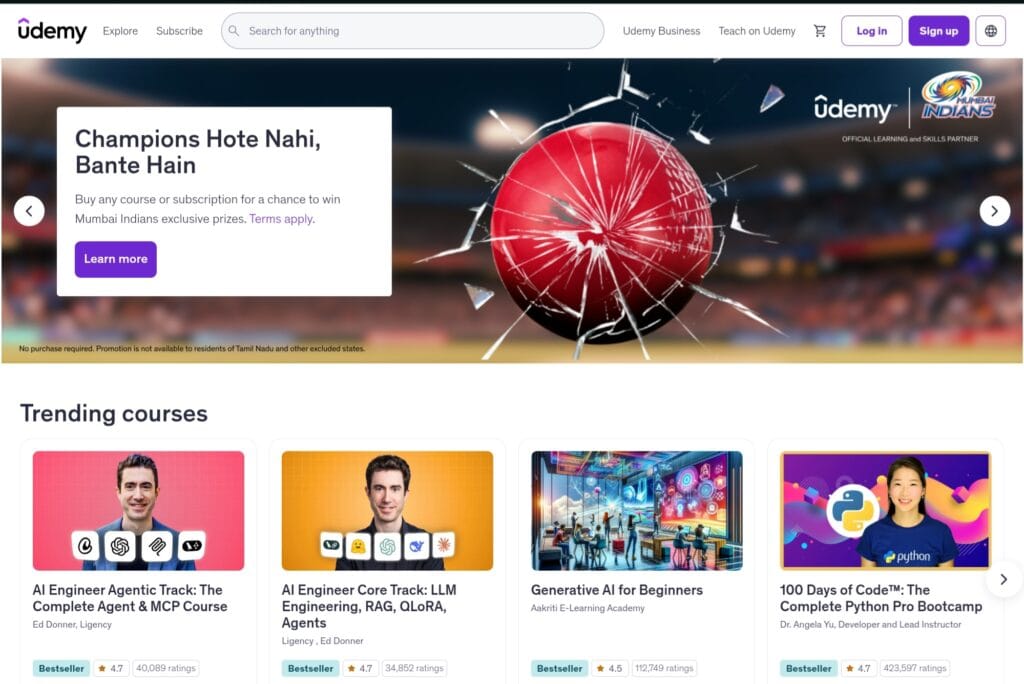
Udemy operates on a completely different philosophy than Coursera, and understanding that difference upfront will save you a lot of confusion.
Founded in 2010, Udemy is an open marketplace where independent instructors create and sell their own courses.
There’s no university partnership, no institutional curriculum review board, and no single learning path.
What there is, however, is one of the largest collections of Udemy data science courses on the internet, built by practitioners who are often actively working in the field they’re teaching.
How Udemy Works
Udemy is a pure marketplace. Any qualified instructor can build a course, set a price, and publish it to millions of potential students.
You browse, you buy, you learn. There’s no subscription required, no enrollment period, and no academic structure unless the course itself provides one.
The one-time purchase model is what sets Udemy apart financially. You pay once and own the course forever, including all future updates the instructor pushes.
That means a Python data science course you bought three years ago might have been refreshed with new content without you paying a cent extra.
Udemy also has a subscription model for top-rated courses in tech, business, and more, although most courses can be bought individually.
Learning is entirely self-paced. There are no deadlines, no cohorts, no weekly release schedules.
You move as fast or as slow as your schedule allows, jump between sections, rewatch anything you missed, and pick the course back up after a six-month gap without penalty.
For working professionals and self-taught learners, that kind of flexibility is hard to beat.
Related: Best Generative AI Courses on Udemy for Job-Ready Skills
Popular Data Science Courses on Udemy
Udemy’s data science catalog is massive, but a handful of courses consistently rise above the noise.
The Data Science Course: Complete Data Science Bootcamp is one of the most popular options on the platform.
It covers NumPy, Pandas, Matplotlib, Seaborn, Scikit-Learn, and more through hands-on exercises and real datasets.
It’s a go-to recommendation for anyone looking for online data science courses for beginners who want to learn by actually writing code rather than watching someone else do it.
Machine Learning A–Z by Kirill Eremenko and Hadelin de Ponteves is arguably one of the most recognized and best machine learning courses outside of formal university programs.
It walks you through supervised and unsupervised learning, reinforcement learning, and deep learning with both Python and R implementations.
The course has been updated consistently over the years and has helped hundreds of thousands of learners make the jump into ML.
Pros of Using Udemy for Data Science
- Unbeatable pricing: most courses drop to $10–$15 on sale, which happens constantly. You can buy three solid courses for less than one month of Coursera Plus.
- Massive variety covers every niche, from NLP to time series forecasting.
- Project-based teaching is the default — real datasets, working code, portfolio-ready outputs.
- Lifetime access means no subscription pressure; buy once, learn on your schedule.
- Beginner-friendly courses start from absolute zero and build patiently, treating new learners like capable adults.
Cons of Using Udemy for Data Science
- Quality is inconsistent — a “data science” search returns thousands of results, and plenty are outdated or mediocre. Always check ratings, review count, and last update date.
- Certificates carry little institutional weight with employers; they show initiative but not a standardized skill level.
- No built-in curriculum means beginners must figure out their own learning sequence, which is a genuine challenge when you don’t yet know what you don’t know.
Coursera vs Udemy – Detailed Comparison for Data Science Learners
The quick comparison table gives you a snapshot. This section will give you the full picture: the nuances that actually determine which platform fits your specific situation as a data science learner.
Course Quality and Depth
Structured University-Style Learning on Coursera
Coursera’s quality control starts before a course ever goes live. Programs are developed in partnership with institutions and companies that have reputational skin in the game.
The result is a curriculum that’s well-sequenced, peer-reviewed, and updated to stay relevant.
For data science specifically, that structure pays dividends. A Coursera specialization doesn’t just teach you how to run a machine learning model; it teaches you why it works, what assumptions it makes, and when to use it versus something else.
That conceptual depth is what separates learners who can follow tutorials from those who can solve problems they’ve never seen before.
Practical and Instructor-Driven Learning on Udemy
Udemy’s best instructors are practitioners first and teachers second, and in data science, that background shows up in the content.
You’re not studying data science from a textbook; you’re working through it the way someone at a tech company would approach a project.
The practical focus means you spend more time in code editors and Jupyter notebooks, and less time in lecture mode.
For learners whose goal is to build a portfolio or get comfortable with real tools quickly, that ratio is exactly right.
The depth ceiling, however, is lower than Coursera’s top programs. Most Udemy courses teach you how without always investing in why.
That’s fine for applied skill-building, but it can leave gaps if you eventually need to go deeper into theory for research, interviews, or advanced roles.
Data Science Certification Value
Are Coursera Certificates Respected by Employers?
The honest answer: it depends on the certificate, and it depends on the employer.
A Google Data Analytics or IBM Data Science Professional Certificate carries genuine recognition, as these are programs that hiring managers at tech companies, consulting firms, and analytics teams have seen before and have a positive association with.
They signal not just that you completed coursework, but that you met a standardized bar set by a name they trust.
Coursera vs Udemy certificates are one of the most practically important comparisons in this entire guide, and for career switchers especially, Coursera’s credential ecosystem is a real differentiator.
If you’re trying to get a first interview in data science without a traditional degree, a recognized professional certificate gives recruiters a concrete reason to take your application seriously.
Do Udemy Certificates Matter for Jobs?
Udemy completion certificates are not industry credentials. There’s no external standard they represent, no institution backing them, and most experienced hiring managers know that.
Listing a Udemy certificate on your resume as a primary qualification is unlikely to move the needle in your favor.
But that framing misses the more useful point: Udemy isn’t really a credentialing platform, and it was never designed to be one.
Its value is in the skills it builds and the projects those skills enable you to create.
A portfolio of three solid data science projects built while working through Udemy courses is far more impressive to most employers than a certificate from either platform.
Best Platform for Beginners
For a complete beginner, the right starting platform comes down to one question: Do you need someone to tell you what to learn next, or are you comfortable figuring that out yourself?
Ease of starting is comparable on both platforms; you can be watching your first data science lecture within minutes on either.
But Coursera immediately places you inside a structured program with a clear progression, while Udemy presents you with a search bar and thousands of options.
Learning curve on Coursera is gentler for the actual content, because programs like the IBM Data Science Professional Certificate are explicitly designed to start from zero and build systematically.
On Udemy, the learning curve depends almost entirely on which course you pick.
Teaching styles differ in a way that affects retention. Coursera leans toward structured video lectures, readings, and quizzes. a format that mirrors university learning and works well if that environment has helped you before.
Udemy’s top instructors tend to be more conversational, code-along heavy, and visually informal.
Many beginners find the Udemy style less intimidating, which matters when you’re learning something as unfamiliar as Python data science.
Beginner support tips in Coursera’s favor. Discussion forums are more actively moderated, peer review is built into assignments, and the structured nature of the programs means you’re less likely to get lost.
Udemy has Q&A sections in every course, and good instructors respond, but the consistency isn’t guaranteed the way it is on a platform with institutional oversight.
Hands-On Projects and Practical Skills
Real-World Assignments on Coursera
Coursera’s hands-on work has improved significantly over the years.
Most current specializations include labs hosted in cloud environments where you write real Python code in a Jupyter notebook, querying actual databases, and working with datasets that reflect genuine analytics challenges.
The IBM and Google programs, in particular, have put serious investment into their project components, and capstone projects are substantial enough to feature in a portfolio.
The structured nature of Coursera’s projects is both a strength and a mild limitation.
The problems are well-designed, but they’re also guided, so you’re often following a scaffolded workflow rather than solving a fully open-ended problem from scratch.
Coding Projects and Exercises on Udemy
Udemy’s project-based teaching is where the platform genuinely shines for data science learning in practical terms.
Top bootcamp-style courses drop you into real datasets early, give you exercises between every major concept, and build toward end-to-end projects that touch data cleaning, exploration, modeling, and visualization in a single workflow.
Because Udemy instructors are often building curriculum based on what they do day-to-day, the projects tend to feel less academic and more like actual work.
That practical texture is excellent preparation for what data science actually looks like on the job.
Pricing Comparison
Coursera Subscription Pricing

Coursera operates on a freemium model with a few layers. You can audit most individual courses for free, which means you get access to videos and readings, but not graded assignments or certificates.
To get the full experience, you either pay per specialization (typically $39–$79/month until completion) or subscribe to Coursera Plus, which runs approximately $59/month or $399/year and unlocks access to the vast majority of content on the platform.
Udemy One-Time Course Pricing
Udemy’s list prices look high, as most courses are nominally priced between $49.99 and $199.99. Ignore those numbers.
Udemy runs platform-wide sales so frequently that the effective price for most data science courses lands between $10 and $15 almost any time you check.
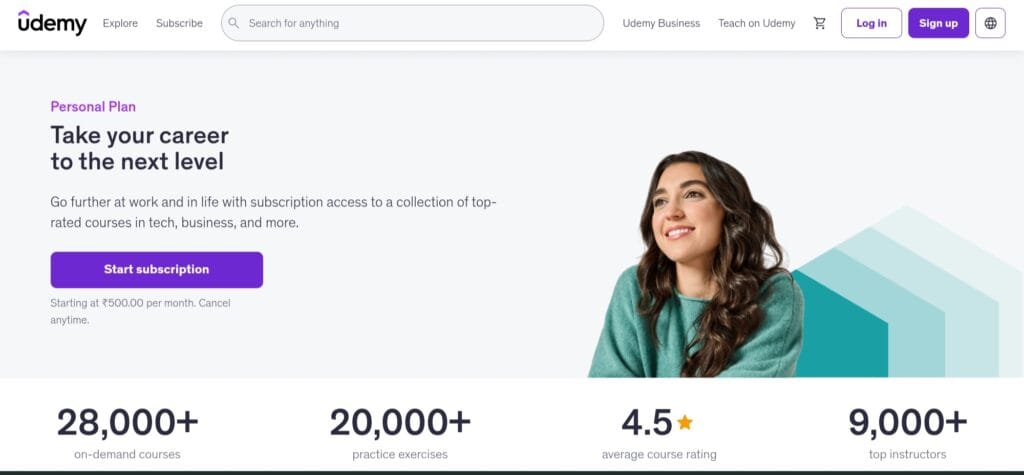
Udemy also runs a subscription model where you get unlimited access to a curated library of top-rated courses.
This costs $32 to $35 USD per month or $156 to $240 USD annually. It is INR 500 per month for Indian learners.
Coursera vs Udemy – Which One Should You Choose?
If you’ve read this far, you already know there’s no objectively correct answer to the Coursera vs Udemy for data science debate. There is, however, a correct answer for you based on where you’re starting, what you need to show for your learning, and how you work best.
Choose Coursera If You
Want structured learning that keeps you on track.
If left to your own devices, you’d spend three weeks debating which course to take instead of actually taking one. Coursera’s structured programs solve that problem for you.
Prefer certifications that carry real weight.
If you’re going to invest time learning data science, you want something to show for it that hiring managers actually respect.
Coursera’s professional certificates from Google, IBM, and DeepLearning.AI are the closest thing to industry-recognized credentials in the online learning space.
Need career-focused programs with support built in.
Learning the skills is half the battle; being able to articulate and demonstrate them in a hiring context is the other half.
Coursera’s career infrastructure exists precisely for learners who need the full bridge from “studying data science” to “working in data science.”
Choose Udemy If You
Want high-quality learning without the high price tag.
There’s no equivalent of a $12 Python data science bootcamp with 40 hours of content and 100,000 positive reviews anywhere on Coursera.
If budget is a real constraint, Udemy lets you access genuinely excellent best data science courses online at a price point that removes the financial risk entirely.
Prefer practical, hands-on learning over lectures and theory.
If your eyes glaze over during academic-style explanations and you come alive when you’re actually writing code and solving problems, Udemy’s instructor-practitioner model is built for you.
Learn on your own schedule without any external pressure.
No deadlines. No subscription running in the background. No cohort, you’re falling behind.
Udemy is genuinely consequence-free learning; you buy the course, it’s yours forever, and you engage with it entirely on your terms.
Want to acquire a specific skill quickly and move on.
Not every learning goal requires a six-course specialization. Sometimes you need to get comfortable with a specific library, fill a gap in your machine learning knowledge, or learn time series forecasting for a project you’re already working on.
Udemy’s course-level granularity means you can find exactly what you need, learn it, and apply it.
Can You Use Both Platforms Together?
Absolutely, and for serious learners, it’s the smartest approach. These platforms don’t compete; they complement each other at different stages of your journey.
Smart Learning Strategy for Data Science Students
Step 1: Start with Udemy for practical foundations.
A $12–$15 Python data science bootcamp gets you into real tools like Pandas, NumPy, and Scikit-Learn. Build momentum before investing in structure.
Step 2: Move to Coursera for depth and credentials.
Once you’ve seen the concepts in code, structured programs like IBM Data Science or Google Advanced Analytics land harder. This is where you earn credentials that actually matter to employers.
Step 3: Return to Udemy for targeted upskilling.
Post-certification, use Udemy to close specific gaps, wherever your next role demands it.
Step 4: Build portfolio projects throughout.
Not just at the end. Publish to GitHub consistently. That body of work speaks louder than any certificate from either platform.
Frequently Asked Questions
Is Coursera Better Than Udemy for Data Science?
Coursera is better if you want structured programs, recognized certifications, and career-focused support backed by universities and companies like Google and IBM. Udemy is better if you want affordable, practical, self-paced learning with the freedom to target specific skills without committing to a long program.
Are Coursera Certificates Worth It for Data Science Jobs?
Yes, with the right expectations. Coursera certificates from programs like the IBM Data Science Professional Certificate or Google Advanced Data Analytics carry genuine recognition with employers, particularly for career switchers who don’t have a traditional data science degree.
Can Udemy Help You Become a Data Scientist?
Absolutely, but it requires more self-direction than a structured platform like Coursera. Udemy’s top data science and machine learning bootcamps are genuinely comprehensive, covering Python, data wrangling, machine learning, visualization, and project work in a single course.
Which Platform Is Cheaper for Learning Data Science?
Udemy wins on price without much contest. Most Udemy data science courses sell for $10–$15 during the platform’s near-constant sales, and that one-time payment gives you lifetime access. Coursera Plus runs around $59/month or $399/year.
Is Coursera Good for Beginners in Data Science?
Yes, it’s one of the strongest options available for beginners specifically. Programs like the IBM Data Science Professional Certificate are explicitly designed for learners starting from zero, with no prior programming or statistics experience required.
Final Verdict
Final Recommendation Based on Learning Goals
Beginners
Coursera. Structured paths and vetted curriculum remove the guesswork that derails most new learners.
Professionals Upskilling
Udemy. You know how to learn, just buy the specific course you need and apply it immediately.
Budget Learners
Udemy. Build a solid Python and machine learning foundation for under $50 during sales.
Certification Seekers
Coursera. Google, IBM, and DeepLearning.AI credentials are in a different league from anything Udemy offers.
Career Switchers
Coursera first, Udemy second. The credential opens doors; the portfolio projects close them.
Coursera edges ahead for learners whose goal is employment. But Udemy is indispensable for affordable, practical skill-building that Coursera can’t match on price or flexibility.
The real winner is the learner who uses both intentionally. Coursera for structure and credibility. Udemy for speed and depth. Together, they cover everything.
Pick what fits where you are right now, and start learning.
More Articles
Best Deep Learning Courses Online [Beginner to Advanced] (Coursera)
Should You Learn Python Or R For Data Science?
What is Data Science Foundations Specialization on Coursera?

As an engineer with a passion for learning and sharing knowledge, I created CourseKart.online to help students, professionals, and lifelong learners choose the best online courses. With so many options available, finding the right one can be overwhelming. My goal is to simplify that process by offering insights, reviews, and recommendations on the top online learning resources. I hope my posts inspire you to keep growing, learning, and exploring new opportunities.
Discover more from coursekart.online
Subscribe to get the latest posts sent to your email.