
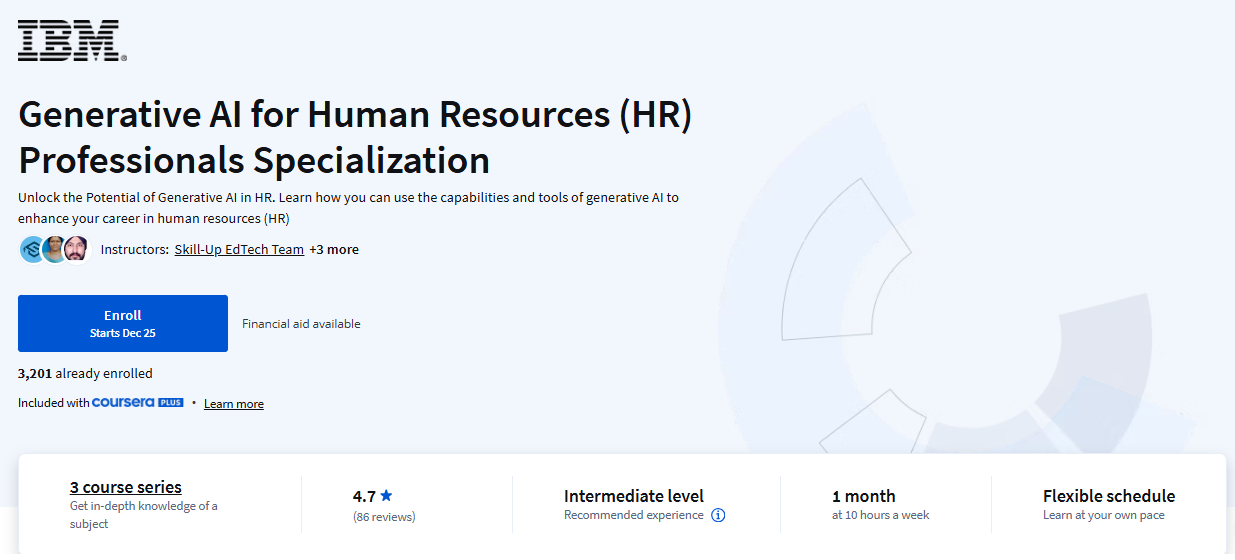
Explore the Generative AI for HR Professionals Specialization on Coursera. Learn syllabus, skills, pricing, career benefits, and whether it’s worth it for HR professionals.
Think about the last time you spent hours screening resumes, drafting onboarding emails, or piecing together a performance review template.
Now imagine getting all of that done in a fraction of the time, without sacrificing quality. That’s not a distant future. That’s what generative AI is making possible for HR professionals right now.
From automating repetitive administrative tasks to supporting big-picture decisions like workforce planning and succession strategy, generative AI is quietly transforming what it means to work in human resources.
And the HR professionals who understand how to use these tools? They’re not just keeping up; they’re pulling ahead.
The reality is that most HR professionals are not familiar with generative AI because the jargon is intimidating, the tools feel overwhelming, and it’s hard to know where to even start. That’s exactly the gap this course was built to fill.
The Generative AI for HR Professionals Specialization on Coursera, offered by IBM and SkillUp, is a 3-course program designed specifically for people who work in HR and want to start using AI in a way that’s practical, ethical, and genuinely career-advancing.
No coding background required. No prior AI experience needed. Just a willingness to learn how these tools can work for you in your day-to-day HR role.
If you’re in HR and you’ve been wondering how to actually get started with AI tools, not theoretically, but practically, this is one of the most focused and accessible courses you’ll find. It’s worth your time.
In this article, I will review this course based on the content, market trends, and career benefits. This will help you decide whether this course is suitable for you or not.
Course Overview at a Glance
If you’re the kind of person who likes to skim the highlights before diving in, fair enough. Here’s everything you need to know about this specialization.
| Course Name | Generative AI for HR Professionals Specialization |
| Platform | Coursera |
| Offered By | IBM & SkillUp |
| Number of Courses | 3 |
| Total Duration | ~4 weeks (10 hrs/week) or ~28 hours total |
| Level | Intermediate (basic HR knowledge required) |
| Certification | Yes – Shareable IBM Certificate |
| Scheduling | Flexible, self-paced |
| Key Tools Covered | ChatGPT, Google Gemini, IBM Watsonx Orchestrate |
| Prompt Engineering | Yes – dedicated course included |
| Financial Aid | Available |
| Included in Coursera Plus | Yes |
What You’ll Learn
Here is what you will acquire by completing this specialization.
- Use generative AI tools to automate and accelerate recruitment workflows, from writing job descriptions to shortlisting candidates.
- Apply prompt engineering techniques to get better, more relevant outputs from AI tools in real HR scenarios.
- Leverage AI for employee onboarding, training, and learning & development programs.
- Streamline performance management processes using AI-generated reviews and feedback frameworks.
- Use generative AI to support workforce planning and succession planning decisions.
- Understand the ethical and responsible use of AI in HR, including bias, data privacy, and compliance considerations.
- Build an AI adoption roadmap for your HR team or organization.
Course Curriculum Breakdown
The specialization is split into three well-sequenced courses. Here is a quick overview of those.

Course 1: Generative AI: Introduction and Applications
This is your foundation. You’ll get up to speed on what generative AI actually is, how it differs from other types of AI, and what it’s capable of. Think text generation, image creation, code writing, and how all of this connects to real-world HR applications.
Course 2: Generative AI: Prompt Engineering Basics
This is where things get hands-on. You’ll learn how to write prompts that actually work, using techniques like the Persona Pattern, Chain-of-Thought, and Tree-of-Thought approaches.
For HR professionals, this translates directly into drafting better job postings, policy documents, interview questions, and employee communications using AI tools.
Related: Best Prompt Engineering Courses Online [Prompting Mastery]
Course 3: Generative AI: Advance Your HR Career
The most HR-specific course of the three, and arguably the most valuable. This is where everything comes together. You’ll apply AI to recruitment, onboarding, L&D, performance reviews, and workforce planning.
You’ll also tackle the harder questions around ethics, bias, and what responsible AI implementation looks like in an HR context. The capstone project, “An AI-Driven Day for an HR Professional,” ties it all together in a realistic, applied scenario.
Tools & Technologies Covered
One of the things that makes this specialization stand out is that it doesn’t just talk about AI in the abstract; it actually walks you through tools you can open on your laptop today.
ChatGPT and similar generative AI tools: Used throughout the labs for drafting HR documents, generating interview questions, creating onboarding content, and more. These are the same AI tools for HR that professionals are already adopting across industries.
Related: Best ChatGPT Courses Online (Learn Prompting, AI Workflows & Real-World Use Cases)
Google Gemini: Explored as an alternative AI platform, giving you a broader view of the generative AI landscape rather than locking you into a single tool.
IBM Watsonx Orchestrate: IBM’s own enterprise-grade AI platform, which gives you a taste of how AI is being deployed at scale inside large organizations. This is a useful context if you work in or aspire to work in an enterprise HR environment.
Prompt Engineering Frameworks: Not a tool exactly, but a critical skill. You’ll learn structured approaches to prompting that work across all AI platforms, making you more effective regardless of which HR automation tools your organization ends up using.
Related: 30+ Best Generative AI Tools for Beginners to Try
Skills You Will Gain
By completing the Generative AI for HR Professionals Specialization, you will gain a concrete, resume-worthy skill set that sits at the intersection of HR expertise and AI literacy.
- Prompt engineering for HR workflows: knowing how to “speak AI” to get outputs that are actually useful in professional contexts
- AI-powered recruitment strategies: from job description generation to AI-assisted candidate screening
- Data-driven HR decision-making: using AI insights to support workforce planning, succession planning, and employee engagement strategies
- Workforce optimization using AI: identifying where AI can reduce manual effort and free up HR teams for higher-value work
- Responsible AI implementation: understanding bias, fairness, and compliance so you can advocate for ethical AI use in your organization
- AI adoption roadmapping: a strategic skill for HR leaders who need to bring their teams along on the AI journey
Also Read: How to Use ChatGPT for Blog Writing (With 50+ Practical, Workflow-Tested Prompts)
Who Should Take This Course?
This specialization was built with a specific type of learner in mind, and it’s worth being honest about who will get the most out of it.
- HR Professionals who are already in the field and want to modernize their toolkit.
- Recruiters and Talent Acquisition Specialists who want to use AI tools to screen faster, write better job posts, and improve the candidate experience.
- HR Managers and People Leaders who want to make smarter, data-backed decisions and understand how to build an AI-ready HR team.
- MBA HR Students and Fresh Graduates who want to enter the job market with a skill set that stands out.
- Career Switchers moving into HR who want a structured way to learn both HR fundamentals and AI applications at the same time.
Pros
- Purpose-built for HR professionals. The content is domain-specific, not generic AI theory
- Taught by IBM, one of the most credible names in enterprise AI
- Practical, hands-on labs that simulate real HR scenarios
- Covers ethical AI, which is often skipped in beginner AI courses
- IBM certificate is shareable on LinkedIn and recognized by employers
- Included in Coursera Plus, making it cost-effective if you’re already subscribed
Cons
- Doesn’t go deep on the technical side. If you want to understand how large language models actually work under the hood, you’ll need to look elsewhere.
Career Benefits of This Course
HR professionals who can bridge AI and people strategy are in high demand right now, and that combination is still rare enough to be genuinely valuable.
Finishing this specialization tells employers something concrete: you don’t just know AI exists, you know how to apply it in an HR context.
That translates to more strategic responsibilities, stronger performance conversations, and a more competitive profile in the job market.
On the role and salary front, AI-literate HR professionals are moving into titles like People Analytics Manager, HR Technology Lead, and Talent Intelligence Specialist; all of which command higher pay than traditional HR roles.
As for the future of HR with AI, the repetitive stuff, screening, scheduling, documentation, and reporting, is increasingly going to AI.
The professionals who thrive will be the ones directing those tools and acting on the insights. This course puts you in that position.

Is the Generative AI for HR Professionals Specialization Worth It?
Yes, this course is absolutely worth it, but it depends on the context.
If you’re an HR professional or recruiter already working in the field, yes, the course is worth your time investment.
If you’re a student or recent graduate entering HR, this course will help you stand out in the competitive job market.
If you’re a career switcher moving into HR, you can combine this with a fundamental HR course to get the context.
In addition, this is one of the most valued generative AI courses for HR I can find. It will surely add weight to your resume and increase your chances of getting a job.
Related: Best Generative AI Courses On Coursera That Explain Real-World Applications
Frequently Asked Questions
What is generative AI in HR?
Generative AI in HR refers to the use of AI tools that can create content, text, reports, templates, and communications to support and automate HR functions.
Is this course beginner-friendly?
It’s designed for intermediate-level learners with basic HR knowledge. You don’t need a technical or AI background to follow along. If you work in HR and know the basics of how the function operates, you’re ready for this course.
How long does it take to complete?
The specialization includes three courses totaling around 28 hours of content. At a pace of 10 hours per week, most learners complete it in about 4 weeks. Since it’s self-paced, you can also stretch it out over a few months if needed.
Does a Coursera certification have value?
Yes, especially when it’s backed by IBM. The certificate is shareable on LinkedIn, recognized by employers, and carries the credibility of one of the world’s leading technology companies.
Can AI replace HR professionals?
Not in any meaningful sense, and this course actually addresses that question directly. AI can handle repetitive, administrative tasks well. But the core of HR work, building trust with employees, navigating complex interpersonal situations, making nuanced hiring decisions, and leading cultural change, requires human judgment that AI simply can’t replicate.
Related Articles
Top 10 reasons to start learning generative AI today
Generative AI and You: What Can You Create with Generative AI?
Generative AI 101: What Is It and How Does It Work?

As an engineer with a passion for learning and sharing knowledge, I created CourseKart.online to help students, professionals, and lifelong learners choose the best online courses. With so many options available, finding the right one can be overwhelming. My goal is to simplify that process by offering insights, reviews, and recommendations on the top online learning resources. I hope my posts inspire you to keep growing, learning, and exploring new opportunities.
Discover more from coursekart.online
Subscribe to get the latest posts sent to your email.