
Last updated on May 16th, 2025 at 09:56 am
The Generative AI for Software Development Skill Certificate course is a comprehensive learning program offered by DeepLearning.AI on the Coursera platform. It is designed to help software developers incorporate generative AI into their work.
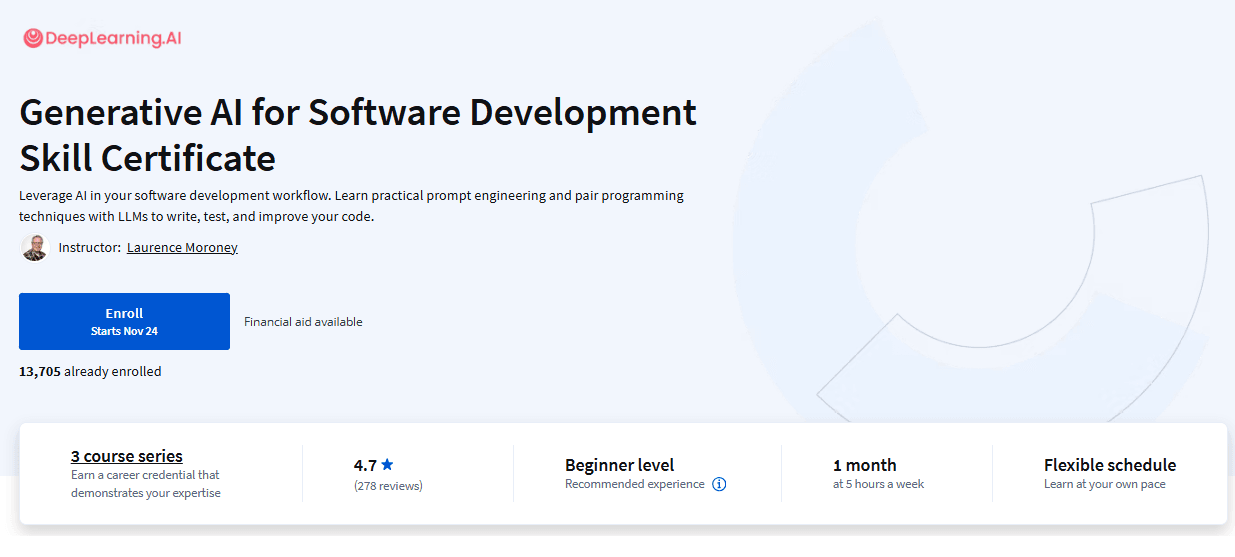
This skill certificate course contains a series of three courses taught by Laurence Moroney, a former AI professional at Google. The main motto of this certificate course is to prepare you for the AI revolution as a software developer.
What Is The Generative AI For Software Development Skill Certificate Course On Coursera?
Led by the former AI lead of Google, Laurence Moroney, the Generative AI for Software Development Skill Certificate is a unique course for software developers. The course explains the fundamental concepts of generative AI and large language models, focusing on the applications of generative AI in software development.
You will understand how Large Language Models (LLMs) can perform as your coding partners, software testers, and security advisors in the software development process.
In addition, you will do some applied learning projects in this course to gain practical experience and understand real-world viewpoints of implementing AI in software development workflows.
By the end of this course, you will gain insights about the new phase of software development where AI models help in your work. In addition, you will earn a skill certificate from DeepLearning.AI, which can be helpful for your career.
The three courses included in this skill certificate course are as follows.
- Introduction To Generative AI For Software Development
- Team Software Engineering With AI
- AI-Powered Software And System Design
What Will You Learn In The Generative AI For Software Development Skill Certificate Course?
In this course, you will understand the core concepts of generative AI and its working. You will learn how large language models work and how to use them effectively in the software development process.
You will explore the capabilities of artificial intelligence in prototyping your software and testing new features, enabling you to proceed with the further processes of coding.
Eventually, you will learn to work with AI as a team and leverage the power of large language models in your development tasks.
By completing this skill certificate course, you will develop skills in generative AI, software engineering, AI-powered software development, and machine learning.

Will You Get A Job By Taking The Generative AI For Software Development Skill Certificate Course On Coursera?
By joining the Generative AI for Software Development Skill Certificate course, you will gain job-ready skills and earn a skill certificate from DeepLearning.AI. This will enhance your employability and present you as a highly eligible candidate for related job openings. However, whether you acquire a job or not depends on various factors.
This course will prepare you for job posts demanding generative AI and industry-relevant skills. You can showcase these qualities in your portfolio and social media pages to connect with potential employers.
Also, you should focus on the right roles to increase your chances of getting a job. Job posts like AI software developer, AI consultant, and machine learning developer are the perfect fit for learners who complete this course.
What Concepts Are Taught In This Course?
As I mentioned earlier, this skill certificate course contains a series of three courses that describe the fundamentals of generative AI and how to implement it as a software developer.
The first course discusses what generative AI is and how to use generative AI tools in the software development process. It explains how to optimize code quality, enhance your coding, and fix bugs like an experienced developer using large language models.
Also, it discusses how to use LLMs to prototype and support your work as a software developer.
The next course explains how to work with AI and use the power of large language models in your software development projects. The course explains how to test and debug complex codes using AI assistance.
The third course covers the concepts of AI-powered software development and system design, explaining how to build software architectures with the guidance of AI. Also, it teaches the process of creating and optimizing databases from scratch using large language models.
Once you complete all the concepts taught in this certificate course, you will gain a better understanding of implementing generative AI in the field of software development.

Who Should Join The Generative AI For A Software Development Skill Certificate Course On Coursera?
The generative AI for software development skill certificate course is ideal for students and professionals who want to enhance their skills in incorporating generative AI into the software development process. Let’s discuss who would benefit from this course.
Software engineers and developers who want to use generative AI tools for coding, debugging, and software testing will benefit from this course. This course will boost their coding efficiency and prepare them for the competitive job market.
Professionals working in the software testing role can join this course to learn how to incorporate generative AI in the software testing process to enhance software quality. They will learn how to automate repetitive tasks and recognize vulnerabilities in the software using generative AI tools.
Students and individuals who are in the early stages of their software engineering careers should join this course to gain AI-related skills and strengthen their portfolio with experience in generative AI.
Apart from that, anyone who is curious to learn the capabilities of generative AI and the future of software development should join this course.
How Much Does This Course Cost?
The generative AI for software development skill certificate course can be accessed for free on Coursera with the Coursera Plus subscription plan. The subscription plan costs $59 per month and gives access to more than 7000 courses and specialized learning programs on Coursera.
If you choose an individual course, it will cost you around $49 per month.
How Long Does This Course Take To Complete?
This three-course series will take around 32 hours to complete. The first course, Introduction To Generative AI For Software Development, takes around 8 hours to complete.
The second course, Team Software Engineering With AI, takes 13 hours to complete, while the third course, AI-Powered Software And System Design, is 11 hours long.
Is it worth doing the generative AI for software development skill certificate course on Coursera?
Yes, it is worth pursuing the generative AI for software development skill certificate course on Coursera.
With the advancement of generative AI tools, the space of software development has transformed. You will get valuable insights from this course to stay competitive and productive in this field.
This course discusses real-world applications of generative AI in coding, debugging and software testing. If you want to gain these skills to incorporate generative AI in your work, this course is the right choice for you.
If you want to develop an AI-powered career and need a certificate for it, this course will be really helpful for you.
Overall, the generative AI for software development skill certificate course on Coursera is a valuable and insightful course that describes the uses of generative AI in software development. It will enhance your development skills and help you stay relevant in the industry.
Share Now:

Related Articles
Learn Generative AI With These 5 Innovative Generative AI Courses On Udemy
What will you learn in the Introduction to Generative AI Specialization on Coursera?
Top 10 reasons to start learning generative AI today
What Will You Learn In The Generative AI For Project Managers Specialization?

As an engineer with a passion for learning and sharing knowledge, I created CourseKart.online to help students, professionals, and lifelong learners choose the best online courses. With so many options available, finding the right one can be overwhelming. My goal is to simplify that process by offering insights, reviews, and recommendations on the top online learning resources. I hope my posts inspire you to keep growing, learning, and exploring new opportunities.
Discover more from coursekart.online
Subscribe to get the latest posts sent to your email.