

Last updated on February 10th, 2026 at 10:32 am
Developing a model is not the most difficult part of machine learning; rather, the most difficult part is getting it to function well in real-world scenarios. The MLOps | Machine Learning Operations Specialization excels in precisely that situation.
This curriculum teaches you how to turn models from the notebook into scalable solutions that organizations can rely on, bridging the gap between experimental data science and production-ready AI systems.
I learned how to oversee every phase of the machine learning lifecycle during the specialization, from versioning and automated pipelines to cloud deployment and post-launch model monitoring.
In order to prepare you for the type of work that real ML Engineers and MLOps professionals do on a daily basis, the teachers do more than simply teach theory; they also guide you through practical tools like MLflow, Docker, CI/CD, AWS, and Azure.
This course is a huge game-changer for anyone who enjoys creating models and wants to learn the skills needed to deploy, scale, and maintain them in production.
It changed my perspective on machine learning and demonstrated what it really takes to implement AI in practical settings.
What Skills Will You Learn in This MLOps Specialization?
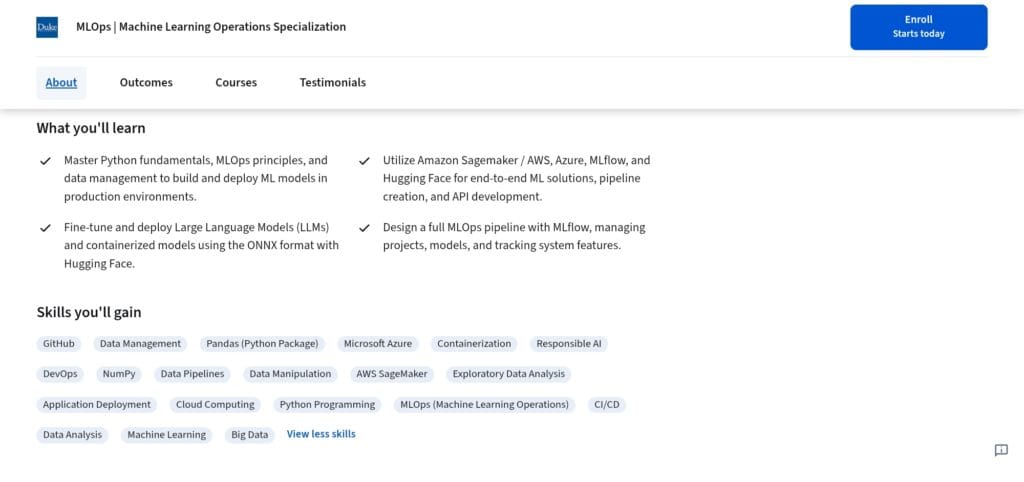
This course will completely change you into someone who not only creates models but also maintains them in real-world systems.
You’ll get a combination of cloud computing, DevOps, software engineering, and machine learning skills—exactly what contemporary AI teams need.
The capabilities you’ll acquire are outlined below.
Strong Software Engineering & Production-Grade Coding
The majority of data scientists produce single-use code. I learned how to write code that is always functional for all users in all environments, thanks to this training.
Python scripting that is both modular and scalable, packaging machine learning code into installable libraries, writing unit and integration tests for models and data pipelines, utilizing Git and version control as engineering teams actually do, and developing CLI tools and APIs to facilitate collaboration are all topics you will learn.
You will get trust in production settings just by changing your coding mindset.
Designing Robust ML Pipelines (Automated & Reproducible)
You will discover how to automate all of the repetitive processes, including data ingestion, training, validation, and deployment.
Thus, the process becomes error-resistant (automatic checks avoid failures), trackable (every version is documented), and reproducible (anyone may rerun your work).
Metadata and artifact tracking, pipeline orchestration, and modular machine learning workflows are some of the key strategies you’ll use in this process.
This ability guarantees that models remain intact as scale grows or datasets change.
Cloud-Native ML: Deploying Models Where Real Users Interact
At this point, theoretical machine learning turns into practical AI.
Model serving frameworks, Docker for containerized deployment, AWS and Azure ML platforms, and API hosting options will all be used to make this happen.
You will learn how to use cloud computing to train models, deploy and serve them with auto-scaling, and manage versioned releases and secure access.
You will really create machine learning (ML) systems from which users or apps can generate predictions in real time.
Experiment & Model Lifecycle Management (MLflow Expertise)
Experiment tracking, model versioning and registration, and model metadata and lineage will all provide you with extensive hands-on experience.
You’ll always be aware of which model worked best, why, and how to replicate it at any time.
This ability is essential for cooperative machine learning teams.
Data Engineering Foundations for MLOps
You won’t deal with clean competition data; instead, you’ll work with actual, messy datasets.
You will learn about data validation and drift detection, automated ETL and feature pipelines, and principles of scalable storage and streaming.
You will realize that data, not only algorithms, is the true source of machine learning success.
Monitoring, Observability & Post-Deployment Reliability
A model that functions well now could not work tomorrow. You learn how to avoid that in this course.
You will become proficient in logging, alerting, and retraining triggers; detecting performance decline and data drift; and continuously evaluating prediction quality.
Instead of treating models as projects that conclude with accuracy metrics, you will treat them like products that require maintenance.
Cross-Functional Mindset & Team Engineering Practices
Additionally, the course teaches you engineering-style communication. Writing technical documentation, creating reproducible environments (Conda, Docker), understanding CI/CD workflows for machine learning, and working with DevOps, product managers, and data scientists are all skills you will acquire.
This skill enables you to become the engineer who unifies everyone’s efforts.
Read Also: AutoML vs Manual ML: Which One Delivers Better Results (and When)?
What concepts are taught in the Machine Learning Operations Specialization?
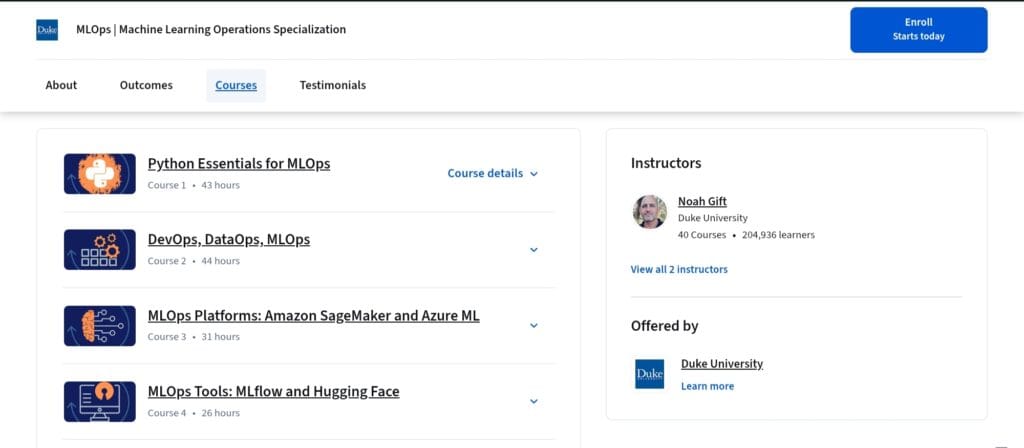
Software Engineering for Machine Learning
The first step in the specialization is to give you a foundation in software engineering for machine learning, which is frequently the largest gap for students who are data-focused.
You learn how to apply design patterns, manage environments, automate testing, organize machine learning code into reusable modules, and make good use of version control.
This idea enables you to transition from experimental notebooks to codebases that are resilient in real-world settings.
ML Pipelines
ML pipelines are a key conceptual pillar of the course. You learn how to automate the complete machine learning workflow for scalability and consistency rather than performing operations like training, validation, and assessment by hand.
Orchestration patterns, pipeline stages, experiment tracking, and the notion that all machine learning outputs, data, models, and metrics should be managed artifacts with traceability are all covered in the course.
Cloud-native Computing
After that, you investigate cloud-native computing, which focuses on how machine learning models function in practical systems. Infrastructure as a service, computational scaling, containerization (Docker), and API-based model serving are key concepts.
The course assists you in comprehending the architecture of model deployment on AWS and Azure, covering deployment methods that are both economical and efficient.
Model Lifecycle Management
Model Lifecycle Management is another fundamental concept. This is when you discover that a trained model is a living asset, not the end.
You can learn how models change over time while retaining governance and reproducibility by studying concepts like experiment versioning, model registry, dependency management, and controlled releases.
Data Management for MLOps
Data management for MLOps, including managing data drift, putting validation checks in place, and creating long-lasting feature pipelines, is another area covered by the expertise.
You learn why data frequently causes ML systems to malfunction in production and how to create procedures that automatically identify and address such problems.
Monitoring and Continuous Improvement
Lastly, the course focuses on continuous improvement and monitoring of deployed machine learning systems.
You gain knowledge of conceptual frameworks for real-time prediction quality tracking, identifying when models are out of date, and initiating automated retraining based on monitoring signals.
This gives you an overview of the operational tenet that machine learning systems must constantly adjust to changing surroundings and data.
Read Also: Soft Skills for Software Engineers: Beyond Coding and Debugging
Who Should Join This Course?
Anyone who wants to deliver machine learning that functions in actual products rather than just constructing models should take this course.
This specialization is perfect for you if you’re sick of seeing your models just exist in notebooks and want to acquire the abilities needed to deploy, scale, and sustain ML systems in production.
Data scientists and ML practitioners
For data scientists and machine learning practitioners who are already familiar with model development but wish to acquire the operational and engineering skills necessary to make their work meaningful in a real-world business setting, it’s an ideal fit.
This course offers the fundamental and practical ideas that ML engineering and MLOps positions require if you want to transition into those fields.
Software engineers
This course will be very helpful for software developers who wish to move into the field of artificial intelligence.
You will gain a comprehensive understanding of machine learning workflows, from data pipelines to deployment and monitoring, which will facilitate collaboration with data teams and broaden your skill set in one of the fastest-growing digital industries.
DevOps and Data Engineers
Additionally, it’s a great choice for DevOps and data engineers who wish to use machine learning in automated, scalable systems to increase their influence.
You will comprehend the behavior of models in production and how to build dependable infrastructure around them.
Read Also: Best Machine Learning Courses online
Will You Get a Job After Completing The Machine Learning Operations Specialization?
A job is not guaranteed by completing this specialization alone; no course can. However, it does equip you with the precise talents that employers seek in ML engineers, MLOps engineers, and AI infrastructure specialists.
The largest gap in the industry at the moment is not a lack of models but rather a shortage of personnel capable of deploying, overseeing, and maintaining those models in production.
That’s exactly what you’ll be able to achieve after completing this course. Your completed projects, such as developing automated machine learning pipelines, containerizing models, deploying with cloud services, and establishing monitoring, are practical examples that you can proudly display in your portfolio.
Read Also: IBM RAG and Agentic AI Professional Certificate – A Detailed Review
How Long Does This Course Take to Complete?
Your schedule and past experience will determine the precise time because the specialization is meant to be flexible. If they put in roughly 6–8 hours a week, most students can complete it in 3–4 months on average.
You could finish it in 6–8 weeks if you already know the fundamentals of DevOps, cloud technologies, and Python.
It may take you four to five months to fully understand the principles and complete the practical labs if you are new to production engineering or cloud deployment.
How much does this course cost?
The machine learning operations specialization on Coursera is available in a subscription model.

Specializations on Coursera typically cost around $49 per month. So you can calculate how much you have to spend on this course depending on how long you take to complete it.
Instead of taking this individual course, you can also join the Coursera Plus subscription for $59 per month. This will grant you access to 10,000+ courses, certificates, and specializations from reputed organizations and institutes on Coursera.
In my opinion, the Coursera Plus subscription is a worthwhile option for people who want to take multiple courses on Coursera by paying a lower fee.
Is It Worth Taking The Machine Learning Operations Specialization on Coursera?
Yes, this specialization is definitely worthwhile for the majority of students who want to work with real-world AI systems.
It focuses on the precise skill set that businesses seek out when implementing machine learning in real-world settings.
Professionals who can operationalize machine learning models, not merely create them, are needed by modern enterprises. This course equips you with the skills and mentality needed to fulfill that role.
Its concentration on end-to-end machine learning workflows is another factor that makes the investment worthwhile.
You learn how to create automated pipelines, version models, manage data, deploy to the cloud, and track performance after deployment, skills that help you move from theoretical machine learning to solutions that benefit actual users, rather than just focusing on accuracy metrics.
Additionally, it’s a fantastic fit for anyone looking to transition between software engineering, DevOps, and data science professions.
Many teams find it difficult to integrate various disciplines, and in technology-driven businesses, having that combined knowledge provides a real advantage.
Through practical projects and a recognized credential, the specialization establishes credibility, which is beneficial when applying for ML engineering or MLOps positions.
This specialization is a wise, forward-thinking investment if your career aim is to implement and maintain machine learning systems, or to go into ML Engineering or MLOps.
It provides you with useful, industry-relevant skills that are hard to acquire elsewhere in such a methodical and practical way. To completely experience the rewards for your career, be ready to work on actual projects.
FAQ
Does this course help you build real end-to-end ML projects?
Yes. Each lesson has practical laboratories where you can manage model updates, track experiments, develop pipelines, and distribute models utilizing cloud tools. You complete production-style projects that you can display in your portfolio.
Do you need strong ML knowledge before starting?
Not sophisticated, but knowing the fundamentals of model operation is undoubtedly helpful. Beginners who are determined can still succeed because the early classes refresh Python abilities and coding structure.
Will you learn cloud deployment even if you’ve never used AWS or Azure?
Yes. Even cloud novices may follow along and confidently launch their first actual ML service because the course walks them through each tool step-by-step.
What makes this specialization different from regular ML courses?
The majority of ML courses just cover model construction. Pipeline automation, version control, containerization, and monitoring, the fundamentals of practical AI engineering, are taught in this one.
Can you apply these concepts to real job interviews immediately?
Of course. Deployment, CI/CD, model registries, and data pipeline architecture are common interview topics for ML Engineer and MLOps positions. These subjects are all covered in this course with real-world examples.
Share Now

More Articles
Machine Learning Specialization by the University of Washington – A Detailed Review
What Is The Machine Learning Specialization By DeepLearning AI On Coursera?
Mathematics for Machine Learning Specialization – A Detailed Review

As an engineer with a passion for learning and sharing knowledge, I created CourseKart.online to help students, professionals, and lifelong learners choose the best online courses. With so many options available, finding the right one can be overwhelming. My goal is to simplify that process by offering insights, reviews, and recommendations on the top online learning resources. I hope my posts inspire you to keep growing, learning, and exploring new opportunities.
Discover more from coursekart.online
Subscribe to get the latest posts sent to your email.