
Discover the best cloud AI courses online to master AWS, Google Cloud, and Azure. Compare top certifications, skills covered, and career outcomes to become a job-ready Cloud AI Engineer.
Artificial intelligence is no longer experimental. It is operational. Businesses aren’t only creating models; they’re deploying them at scale. And that deployment layer exists in the cloud.
Machine learning models are now taught, optimized, and deployed on platforms such as Amazon Web Services, Microsoft Azure, and Google Cloud.
Cloud infrastructure serves as the foundation of modern AI systems, including recommendation engines, fraud detection systems, generative AI applications, and predictive analytics pipelines.
This is why AI and Cloud have emerged as one of the most future-proof tech skill pairings.
Knowing machine learning theory is no longer enough. Companies need professionals who understand the following.
- How to build models
- How to deploy them on cloud infrastructure
- How to monitor performance
- How to scale workloads
- How to manage MLOps pipelines
This shift has created strong demand for specialized roles such as:
- AI Engineers – designing and deploying intelligent systems
- Machine Learning Engineers – building production-grade ML pipelines
- Cloud AI Architects – architecting scalable AI solutions on cloud platforms
- MLOps Engineers – managing model lifecycle, CI/CD, and monitoring
Recruiters are increasingly looking for individuals with hands-on experience with cloud-native AI tools like SageMaker, Vertex AI, Azure AI services, and containerized ML workflows.
This is exactly where the best cloud AI courses online make a difference.
Cloud AI certification courses teach more than just algorithms; they also educate you on how to design, deploy, and scale AI in real-world cloud environments.
If you want to be job-ready in this fast-expanding field, you’ll need structured training that combines AI theory and cloud implementation.
Let’s look at the best cloud AI courses to help you get into the sector.
What Is Cloud AI?
Cloud AI is fundamentally defined as artificial intelligence models that are built, trained, deployed, and managed on cloud infrastructure rather than on local workstations.
Traditionally, machine learning models were built on personal computers or on-premise servers. While this is effective for experimenting, it does not scale effectively.
Massive datasets, high-performance GPUs and TPUs, distributed training environments, and production-grade deployment pipelines are all required for modern AI systems. Cloud systems are becoming increasingly important in this context.
In simple terms:
Cloud AI = AI models powered by cloud computing infrastructure.
AI Models Running on Cloud Infrastructure
When you use cloud platforms such as Amazon Web Services, Google Cloud, or Microsoft Azure, your machine learning models are no longer restricted to your local hardware.
Instead, you get access to:
- Scalable computing clusters
- On-demand GPUs and TPUs
- Distributed training
- Managed data pipelines
- Automated deployment infrastructure
Cloud AI Services: AutoML, APIs, and ML Deployment
Cloud companies provide specialized AI services that abstract infrastructure complexity. Some of the most crucial components are:
AutoML
Automated machine learning techniques that enable you to create high-performance models without requiring extensive algorithmic modification. Perfect for beginners and speedy prototyping.
Pre-built AI APIs
Ready-to-use services for:
- Natural language processing
- Speech recognition
- Computer vision
- Translation
- Chatbots
These APIs allow developers to integrate AI features without building models from scratch.
Managed ML Deployment
Once a model is trained, it needs to be deployed as an API endpoint, monitored, versioned, and scaled. Cloud AI platforms provide managed services to handle:
- Model hosting
- Real-time inference
- Batch predictions
- Monitoring and drift detection
- CI/CD for ML pipelines (MLOps)
This is what differentiates theoretical AI learning from job-ready AI engineering.
Also Read: AutoML vs Manual ML: Which One Delivers Better Results (and When)?
Best Cloud AI Courses Online (Detailed Reviews)
| Sl No. | Course Name | Duration | Level |
|---|---|---|---|
| 1 | Google Cloud AI Infrastructure Specialization — Best for Cloud AI Fundamentals & Career Launch | 4 Weeks | Intermediate |
| 2 | AI Technologies and Tools in the Cloud Specialization — Best for Practical Tool Mastery & Certification Readiness | 4 Weeks | Beginner |
| 3 | Digital Transformation Using AI & ML with Google Cloud — Best for Real-World Application & Business Impact | 4 Weeks | Beginner |
| 4 | Oracle Cloud and AI Specialization — Best for Enterprise-Level Cloud AI Foundations | 4 Weeks | Beginner |
| 5 | Building AI Cloud Apps with Microsoft Azure Specialization — Best for Azure-Centric AI Developers | 2 Months | Intermediate |
| 6 | Generative AI for AWS Cloud Engineers — Best for Practitioners Focused on Generative AI in Production | 7 Hours | Intermediate |
| 7 | AWS AI Practitioner Certification Course — Best Budget-Friendly AWS AI Foundation Course | 11 Hours | Intermediate |
| 8 | Google Cloud Certified Generative AI Leader Course — Best for Leadership & Strategy in Cloud AI | 4 Hours | Beginner |
| 9 | Modern Cloud AI Bootcamp — Best for Hands-On Project-Driven Learning | 2 Hours | Intermediate |
| 10 | Google Cloud Generative AI Leader Certification Course — Best for Strategic Generative AI with Google Cloud | 4 Hours | Intermediate |
1. Google Cloud AI Infrastructure Specialization — Best for Cloud AI Fundamentals & Career Launch
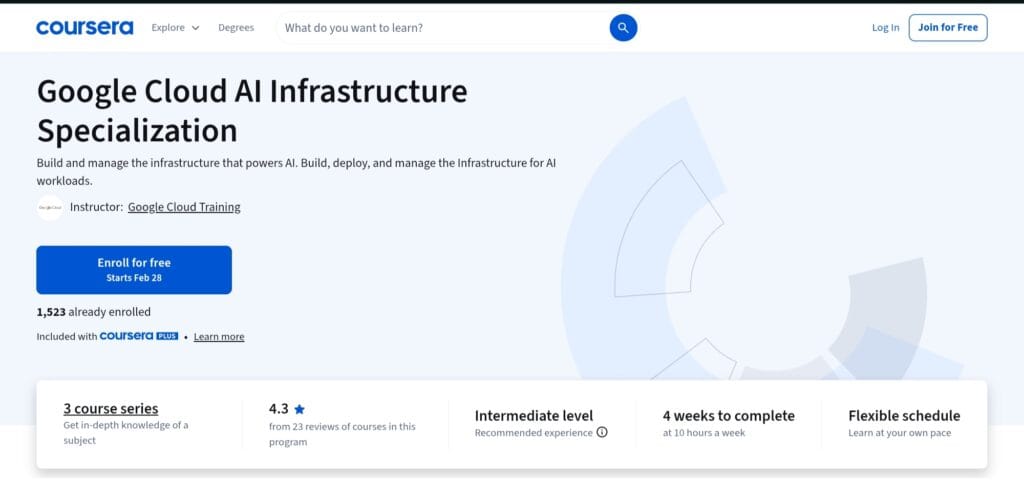
The Google Cloud AI Infrastructure Specialization on Coursera is a highly practical, industry-aligned curriculum aimed to provide students with cloud-native skills required for modern AI systems.
This specialization, created by Google Cloud, focuses on the entire life cycle of AI in production, from model development and training to large-scale deployment and monitoring on cloud infrastructure.
You will not only learn theory, but also how to execute real-world ML workloads with professional technologies such as Vertex AI, Cloud Storage, and Tensor Processing Units (TPUs). This training is especially useful for those looking to bridge the gap between data science and scalable cloud deployment.
Key Skills Covered
- Cloud AI Architecture: Understand core cloud infrastructure components and how they support AI workloads.
- Managed ML Workflows: Deploying and managing models on Vertex AI.
- Distributed Training: Leverage TPUs and scalable compute for large datasets.
- Data Engineering for AI: Data ingestion and preprocessing with cloud services.
- MLOps Fundamentals: Monitoring, versioning, CI/CD for machine learning pipelines.
Who Should Enroll
The Google Cloud AI Infrastructure Specialization is ideal for aspiring AI/ML engineers, developers, data scientists, and cloud practitioners.
This course helps develop hands-on experience deploying models on production-grade cloud platforms.
2. AI Technologies and Tools in the Cloud Specialization — Best for Practical Tool Mastery & Certification Readiness
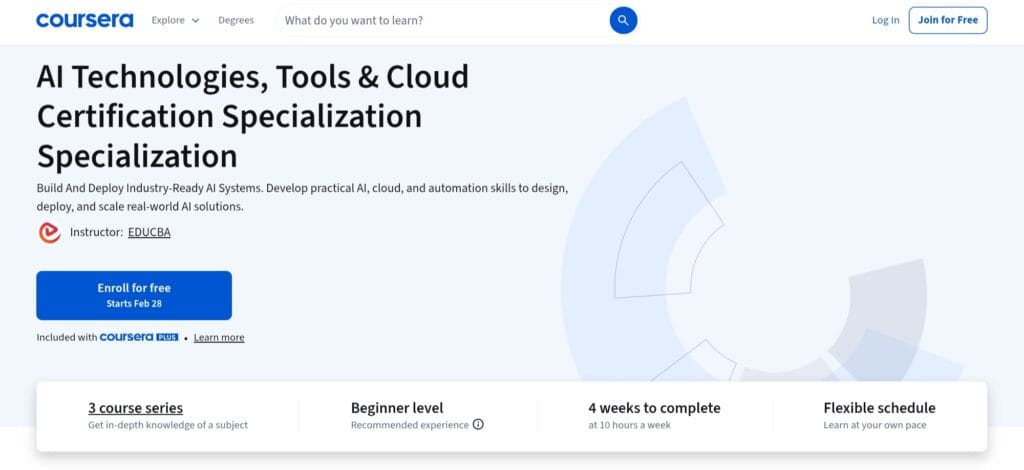
Coursera’s AI Technologies and Tools in the Cloud Specialization is a hands-on curriculum designed to help students master the tools and services that drive cloud-based artificial intelligence.
Unlike purely theoretical courses, this specialization examines how prominent cloud platforms offer key AI activities such as scalable training, automated model construction, hosted AI APIs, and end-to-end deployment pipelines.
It provides you with hands-on experience configuring and exploiting cloud AI tools, which are frequently utilized in modern enterprise environments.
This makes it especially useful for students who want to gain skills using relevant technologies while still working toward cloud AI certification.
Key Skills Covered
- Cloud AI Toolchains: Practical use of cloud-native AI services and platforms.
- Automated Machine Learning (AutoML): Building and deploying models with minimal manual tuning.
- Cloud APIs for AI: Leveraging pre-built APIs for vision, language, recommendation, and more.
- Model Hosting & Serving: Deployment of ML models as scalable, secure endpoints.
- Cloud Data Integration: Ingesting and preparing data for AI workloads on cloud storage.
Who Should Enroll
Aspiring cloud AI engineers, data practitioners, and professionals who want to learn practical applications and ready-to-use cloud AI tool skills can join this course.
3. Digital Transformation Using AI & ML with Google Cloud — Best for Real-World Application & Business Impact
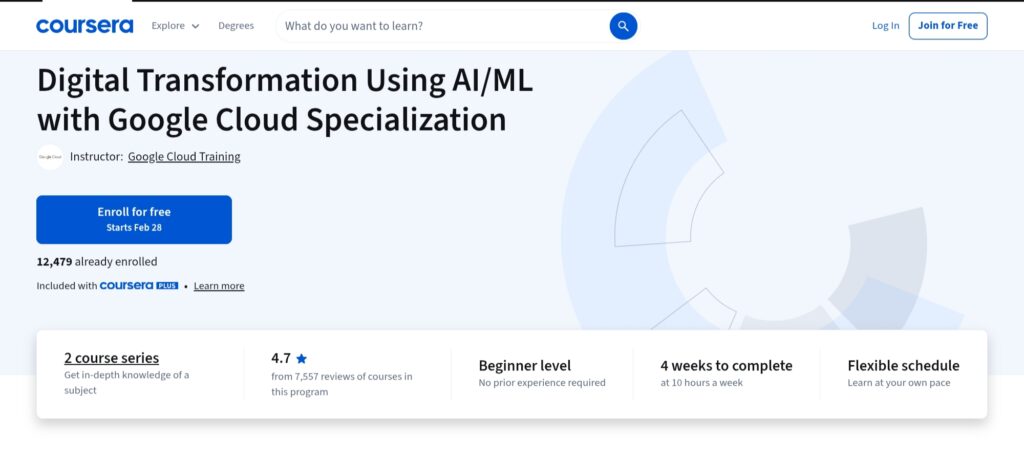
Coursera’s Digital Transformation Using AI & ML with Google Cloud course is intended to demonstrate how cloud AI technologies produce corporate value rather than just educate them.
This program connects technical implementation with strategic impact. You’ll discover how Google Cloud AI/ML is being used to revolutionize operations, automate procedures, and gain a competitive advantage.
This makes it an ideal alternative for students looking for hands-on experience and context for using AI in real-world business settings.
Key Skills Covered
- AI-Driven Business Strategy: How AI/ML initiatives align with organizational goals.
- Google Cloud AI Services: Utilizing Vertex AI and other cloud tools for scalable solutions.
- ML Workflow Implementation: From data ingestion to model deployment on Google Cloud.
- Solution Design: Architecting AI-enabled systems that solve real business problems.
- Change Leadership: Understanding how AI adoption impacts processes, teams, and decision-making.
Who Should Enroll
Learners who want a strategic understanding of cloud AI for real business usage can consider enrolling in this course. It is perfect for tech leaders, aspiring cloud AI practitioners, product managers, data professionals, and entrepreneurs.
Also Read: Best Machine Learning Courses online
4. Oracle Cloud and AI Specialization — Best for Enterprise-Level Cloud AI Foundations
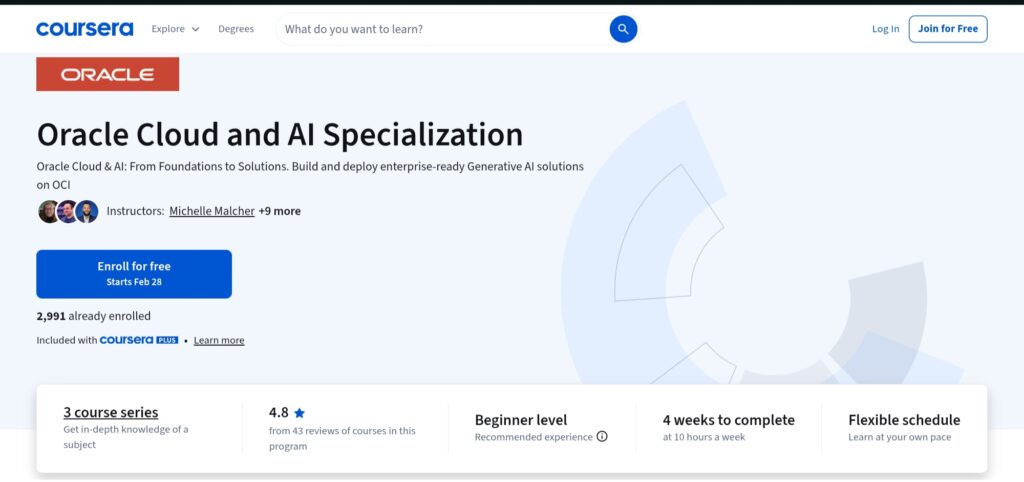
The Oracle Cloud and AI Specialization on Coursera is a comprehensive cloud AI program designed to address real-world industry use cases.
Instead of focusing solely on one cloud ecosystem, it integrates Oracle’s cloud infrastructure expertise with actual AI applications in data, automation, and business processes.
You’ll learn not just how to deploy models, but also how cloud AI integrates into larger enterprise infrastructures, making this specialty especially useful for individuals pursuing enterprise cloud jobs or those looking for a greater understanding of how AI performs across complex systems.
Key Skills Covered
- Cloud AI Fundamentals: Core architecture and services in Oracle Cloud Infrastructure (OCI) for AI workflows.
- Data Management for AI: Techniques for handling data pipelines and analytics in cloud environments.
- AI Model Integration: Deploying and integrating AI services within enterprise applications.
- Intelligent Automation: Using AI to enhance business processes and decision systems.
- Cloud Deployment & Scaling: Best practices for scalable and resilient AI system deployments.
Who Should Enroll
This specialization is a compelling choice for learners who want to learn practical cloud AI skills and how these technologies are applied in enterprise settings.
Tech leaders, data professionals, and professionals working in AI-centric cloud roles can join this course.
Also Read: best AI courses online [AI Career Guide]
5. Building AI Cloud Apps with Microsoft Azure Specialization — Best for Azure-Centric AI Developers
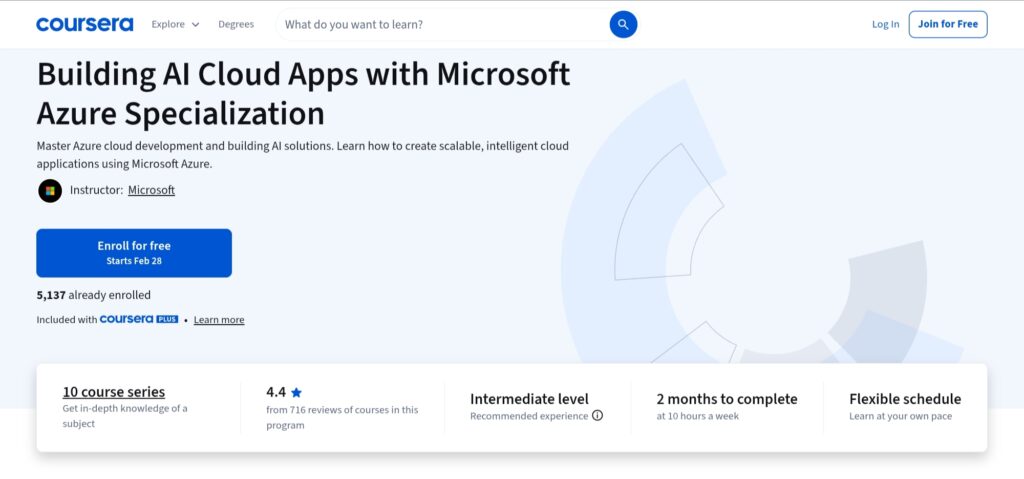
The Building AI Cloud Apps with Microsoft Azure Specialization on Coursera is a focused and practical curriculum that teaches students how to build, deploy, and scale intelligent applications utilizing Azure’s cloud AI services.
This specialization focuses on application development with AI capabilities (such as cognitive services, real-time analytics, and conversational AI) within the Microsoft Azure ecosystem.
This makes it a fantastic solution for developers and engineers looking to create production-ready cloud AI systems that can be applied directly to enterprise use cases.
Key Skills Covered
- Azure AI Services: Practical use of Azure Cognitive Services, Language Services, Vision APIs, and more.
- Application Integration: Embedding AI features into web and mobile applications.
- Cloud Deployment: Publishing scalable AI applications using Azure App Services and Functions.
- Real-Time Data Processing: Using Azure Event Hubs and Stream Analytics for live insights.
- Security & Monitoring: Best practices for securing and maintaining cloud AI applications.
Who Should Enroll
Software engineers, AI developers, and cloud engineers who want to build usable, scalable AI systems on a major cloud platform (Azure) can consider joining this course.
6. Generative AI for AWS Cloud Engineers — Best for Practitioners Focused on Generative AI in Production
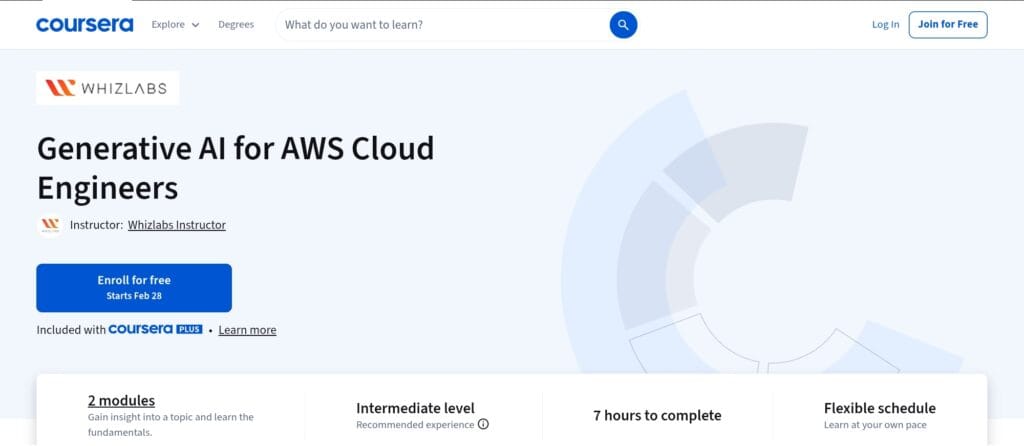
Generative AI for AWS Cloud Engineers is a Coursera curriculum designed for engineers who want to use generative AI techniques in Amazon’s cloud environment.
Rather than teaching theoretical AI principles in isolation, this course focuses on real-world applications of large language models and generative systems utilizing AWS services such as Amazon SageMaker, Bedrock, and other AI-driven APIs.
You’ll learn how to design, construct, and deploy generative AI solutions to practical problems ranging from automated content generation to intelligent assistants, all within scalable cloud architecture.
Key Skills Covered
- Generative AI Fundamentals: Understanding architectures like transformers and large language models.
- AWS AI Services Implementation: Using SageMaker and Bedrock for training and deployment.
- Cloud Deployment Patterns: Best practices for containerized inference and serverless AI endpoints.
- Prompt Design & Optimization: Techniques to get reliable outputs from generative models.
- Integration Workflows: Connecting generative AI services with production applications.
Who Should Enroll
This course is ideal for AWS cloud engineers, AI enthusiasts, and ML practitioners.
Also Read: Best Generative AI Courses On Coursera That Explain Real-World Applications
7. AWS AI Practitioner Certification Course — Best Budget-Friendly AWS AI Foundation Course
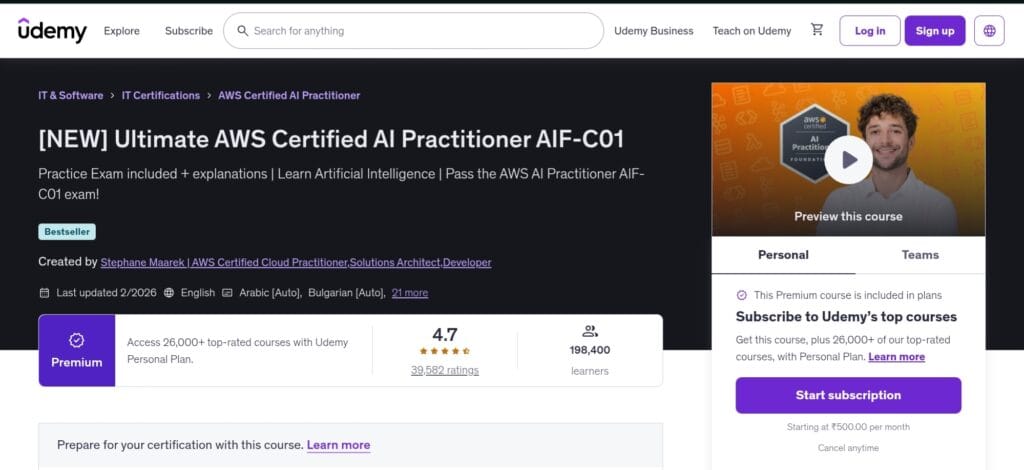
The AWS AI Practitioner Certification Course on Udemy is a high-value, low-cost program that provides students with a solid foundation in artificial intelligence and machine learning concepts as they are implemented on Amazon Web Services.
This course, which focuses on practical understanding, prepares you for entry-level cloud AI roles as well as the AWS Certified AI-Powered Cloud Practitioner exam.
It is suitable for students who desire a solid foundation in AWS’s AI ecosystem without the additional cost of some specialty paths.
Key Skills Covered
- AWS AI Services Overview: Clear, practical introductions to tools like Amazon SageMaker, Rekognition, Polly, Lex, and Comprehend.
- AI Concepts on AWS: How foundational AI/ML concepts translate into cloud-based services and infrastructure.
- Hands-On Demonstrations: Real examples of deploying basic models and working with AWS AI APIs.
- Certification Prep: Focused review of AWS AI Practitioner topics and exam-aligned insights.
- Infrastructure Integration: Understanding how AI services fit within broader AWS workflows.
Who Should Enroll
This Udemy course is ideal for beginners in cloud AI, aspiring AWS AI practitioners, IT professionals, and learners who want strong foundational skills in cloud AI can opt for this course.
8. Google Cloud Certified Generative AI Leader Course — Best for Leadership & Strategy in Cloud AI
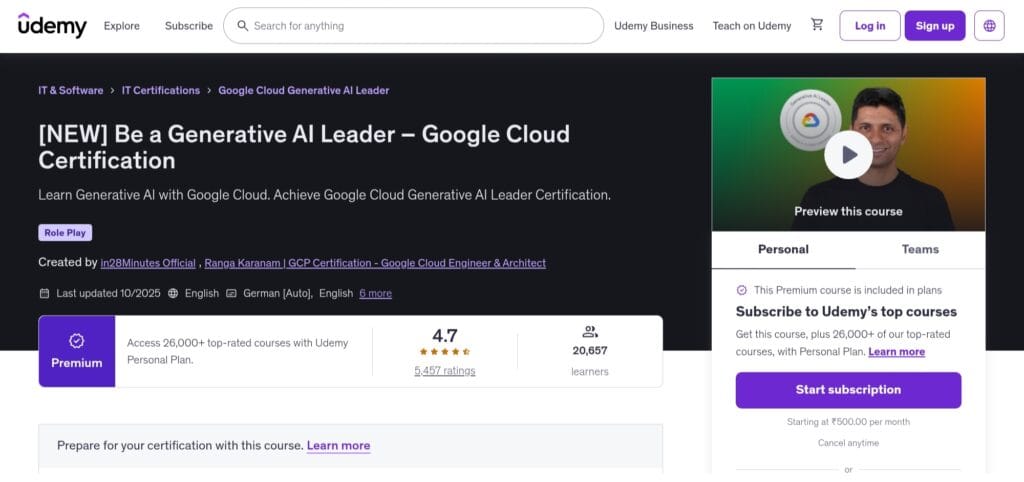
The Google Cloud Certified Generative AI Leader Course on Udemy is a purpose-built program for professionals who wish to lead AI initiatives rather than simply building models.
This course focuses on how generative AI fits into cloud strategy, governance, and business outcomes.
You will learn about Google Cloud’s generative AI ecosystem, realistic deployment patterns, and leadership-oriented frameworks for scaling AI ethically and successfully.
This makes the course especially beneficial for students pursuing administrative or strategic responsibilities that connect with cloud AI adoption.
Key Skills Covered
- Generative AI Concepts: Understanding how generative models work and where they add business value.
- Google Cloud AI Ecosystem: Practical insight into Google Cloud’s generative AI tools and services.
- Cloud AI Strategy & Deployment: Frameworks for planning and overseeing AI projects at scale.
- Risk, Governance & Ethics: Best practices for responsible generative AI implementation in the cloud.
- Leadership & Communication: How to articulate AI initiatives to stakeholders and influence technology decisions.
Who Should Enroll
The Generative AI Leader course on Udemy is perfect for aspiring cloud AI leaders, tech managers, product owners, and enterprise professionals who want strategic and technical fluency in generative AI.
Also Read: Best Agentic AI Courses Online [Build Job-Ready AI Agent Skills]
9. Modern Cloud AI Bootcamp — Best for Hands-On Project-Driven Learning
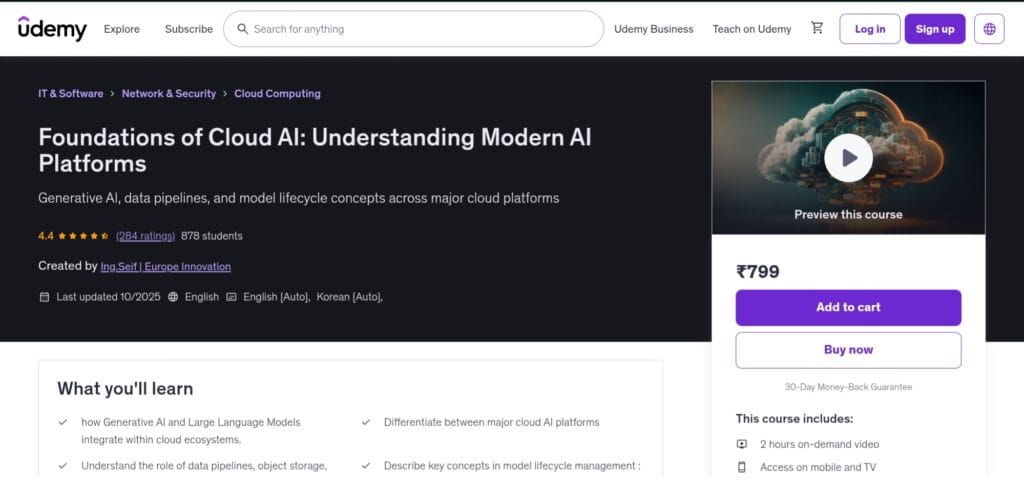
The Modern Cloud AI Bootcamp on Udemy is a thorough, project-based program that immerses students in real-world cloud AI development from the start.
This course focuses on practical execution, creating real systems, deploying them on major cloud platforms, and understanding how AI workflows work in modern environments.
You’ll learn not just what cloud AI tools do, but also how practitioners utilize them to tackle real-world challenges, such as data ingestion and model training, as well as scalable deployment and monitoring.
Key Skills Covered
- Cloud AI Project Execution: Deploy data pipelines and ML workflows on cloud infrastructure.
- Multi-Platform Proficiency: Work with services commonly found across AWS, Azure, and Google Cloud ecosystems.
- End-to-End ML Ops: From feature engineering and training to deployment and lifecycle management.
- API Integration: Embed AI/ML capabilities into applications via cloud AI APIs.
- Real-World Use Cases: Practical projects that mirror industry systems rather than theoretical examples.
Who Should Enroll
Engineers, developers, and hands-on learners who want a project-based course to learn modern cloud AI concepts can join this Udemy course.
10. Google Cloud Generative AI Leader Certification Course — Best for Strategic Generative AI with Google Cloud
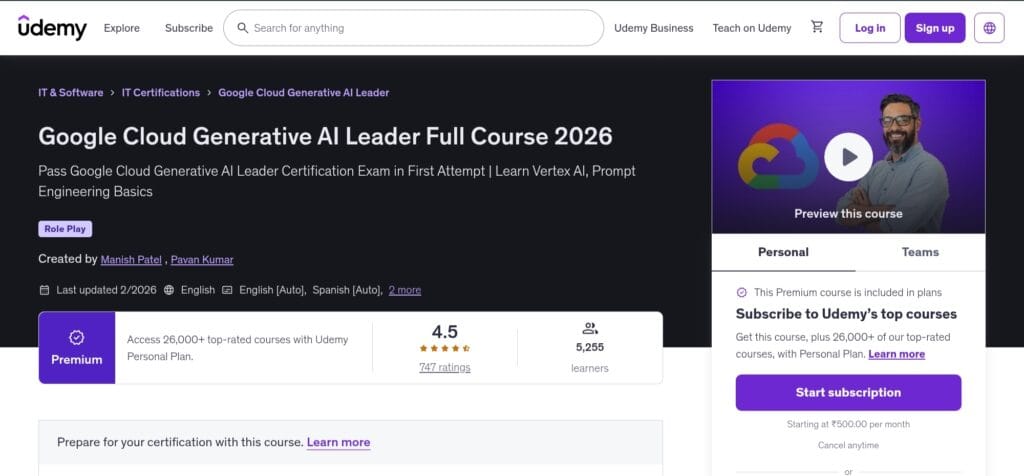
The Google Cloud Generative AI Leader Certification Course on Udemy is a focused program designed to help students prepare for the Google Cloud Generative AI Leader certification test while also developing a strategic grasp of generative AI within the Google Cloud ecosystem.
This course focuses on how generative models are implemented in cloud environments to solve real-world business problems, such as automating workflows and improving user experiences.
It combines conceptual clarity with operational understanding, making it suitable for professionals seeking both certification and real-world application experience.
Key Skills Covered
- Generative AI Concepts: How large language models (LLMs) and generative frameworks operate at scale.
- Google Cloud AI Services: Practical use of Vertex AI and related cloud tools for building generative solutions.
- Architecting AI Solutions: Best practices for designing scalable, maintainable generative AI systems on Google Cloud.
- Exam Preparation: Focused guidance on the domains and topics covered in the official certification exam.
- Deployment & Governance: Strategies for deploying generative AI models responsibly in enterprise environments.
Who Should Enroll
This Udemy course is ideal for cloud AI professionals, architects, tech strategists, and experienced learners who want to specialise in generative cloud solutions.
Also Read: Best Deep Learning Courses Online [Beginner to Advanced] (Coursera)
FAQs – Best Cloud AI Courses Online
Is AWS or Google Cloud better for AI?
Both are strong, but their strengths differ.
AWS
- Broadest cloud adoption globally
- Mature ML ecosystem
- Deep integration with enterprise infrastructure
- Strong for scalable production systems
Google Cloud
- Strong AI/ML research heritage
- Advanced tooling around Vertex AI
- Cleaner ML workflow integration
- Popular among AI-first companies
If your goal is research-backed ML and streamlined AI workflows, Google Cloud is compelling.
If your goal is enterprise-scale AI systems with deep infrastructure control, AWS is dominant.
Can beginners learn cloud AI?
Beginners should start with:
- Cloud fundamentals (compute, storage, networking basics)
- Core AI concepts (supervised learning, neural networks, NLP basics)
- Hands-on beginner cloud AI courses online
How long does it take to become a Cloud AI Engineer?
It depends on your starting point.
- From beginner (no cloud, no AI): 8–12 months of consistent learning and project work
- From developer background: 4–6 months
- From a data science background: 3–6 months
What is the salary after cloud AI certification?
Salary depends on region, experience, and technical depth, but cloud AI roles are among the highest-paid in tech.
India (Approximate Ranges):
- Entry-Level Cloud AI Engineer: ₹8–15 LPA
- Mid-Level ML/Cloud Engineer: ₹15–30 LPA
- Senior AI Architect / MLOps Engineer: ₹30 LPA+
Global Markets (USD ranges):
- Entry-Level: $90,000–$120,000
- Mid-Level: $120,000–$160,000
- Senior/Architect Roles: $160,000+
Certification increases earning potential, but your ability to design, deploy, and scale AI systems on cloud platforms ultimately determines salary growth.
Final Verdict – Best Cloud AI Course for You
Choosing the best cloud AI courses online is based on where you are now and where you want to be in the next 12-24 months. Cloud AI is more than just learning algorithms; it also entails mastering deployment, scalability, and production workflows across platforms like AWS, Google Cloud, and Azure.
Cloud AI is a skill that grows over time. The sooner you combine machine learning knowledge with cloud deployment experience, the more powerful your career standing will become.
Share Now

More Articles
Soft Skills for Software Engineers: Beyond Coding and Debugging
Will AI take over data science jobs? A balanced perspective
5 Real-World Machine Learning Use Cases That Boost Revenue

As an engineer with a passion for learning and sharing knowledge, I created CourseKart.online to help students, professionals, and lifelong learners choose the best online courses. With so many options available, finding the right one can be overwhelming. My goal is to simplify that process by offering insights, reviews, and recommendations on the top online learning resources. I hope my posts inspire you to keep growing, learning, and exploring new opportunities.
Discover more from coursekart.online
Subscribe to get the latest posts sent to your email.