

Last updated on February 10th, 2026 at 10:31 am
The course Applied Machine Learning in Python offers a structured and useful introduction to modern Python machine learning.
The course is intended for students who wish to move beyond studying the fundamentals of Python programming to creating actual, useful machine learning models.
The curriculum continues to prioritize practical skills over theory. You learn how to prepare data, use scikit-learn to create predictive models, assess the models’ performance, and comprehend when and why a particular approach is suitable.
By the end of the course, you will have a solid grasp of how machine learning procedures function in real-world scenarios and the self-assurance to apply them to actual datasets.
What skills will you learn in this course?
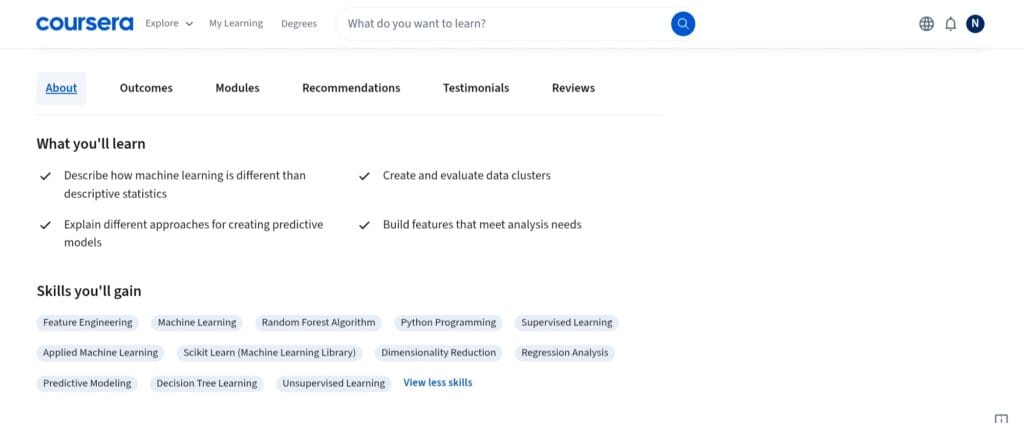
You gain a comprehensive set of useful skills that are necessary for working on actual machine learning projects by finishing Applied Machine Learning in Python.
First, you learn how to create and assess machine learning models using Python and the scikit-learn module.
You will gain a thorough grasp of how machine learning workflows function in real-world scenarios by learning how to manage feature matrices, organize data for modeling, and work with training and test splits.
You become highly proficient in supervised learning, including regression and classification methods.
You gain a practical understanding of how algorithms like ensemble methods, decision trees, support vector machines, and linear models work, and more crucially, how to use them appropriately.
In order to help you discover patterns in unlabeled data, the course also presents unsupervised techniques with a focus on clustering.
A substantial portion of the course is devoted to model validation and evaluation. Metrics like accuracy, precision, recall, ROC curves, and error scores allow you to analyze performance.
You learn how to compare several models, use cross-validation, and choose the strategy that best applies to fresh data.
Additionally, you gain expertise in feature engineering, which involves converting unprocessed data into representations that are more instructive.
This entails knowing when to add new features, scale, or encode them, as well as how these modifications affect model behavior.
Lastly, you learn how to identify and deal with typical problems, including data leaking, underfitting, and overfitting.
You gain confidence in identifying issues, improving models, and making choices that enhance predictive performance by completing coding assignments and practical exercises.
After completing the course, you will be able to use industry-standard tools to design, implement, and assess whole machine learning systems. This skill set provides a solid basis for further study and prepares you for real-world data science work.
Read Also: AutoML vs Manual ML: Which One Delivers Better Results (and When)?
What concepts are taught in the Applied Machine Learning in Python course?
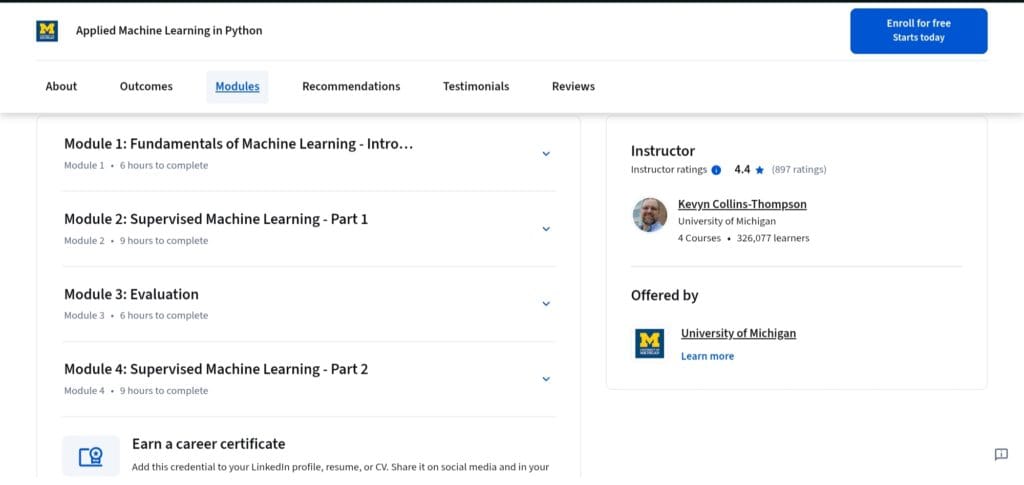
The course walks you through the whole lifecycle of applied machine learning using a clear and targeted set of principles.
The basics are covered first, including the definition of machine learning, how it varies from conventional statistical analysis, and how data is structured for modeling.
You discover that every process is built on feature matrices, target variables, and training-test splits.
The fundamental concepts of supervised learning, like classification and regression, are then covered throughout the course.
You learn about the practical applications of models, including support vector machines, decision trees, k-nearest neighbors, linear models, and ensemble techniques.
Instead of focusing on mathematical derivations, the focus is on comprehending the behavior of these algorithms, the assumptions they make, and when they are suitable.
Additionally, an introduction to unsupervised learning with a focus on clustering is covered in the course. You gain knowledge about how to use clustering techniques to examine structure in unlabeled data and how to analyze the groupings that are produced.
Model evaluation and selection take up a large amount of the course. You grasp the significance of metrics like ROC curves, accuracy, precision, and recall, as well as the importance of cross-validation in assessing generalization.
Additionally, the course addresses diagnosing problems like overfitting, comparing competing models, and making well-informed decisions concerning model complexity.
The foundations of feature engineering and preprocessing are also covered, including how to scale, encode, and convert features to enhance model performance.
The course concludes with a discussion of more complex supervised learning ideas, such as ensemble techniques like gradient boosting and random forests.
Additionally, it draws attention to real-world issues like data leaking and model interpretability, providing you with a practical understanding of applicable machine learning tasks.
All things considered, the course teaches you the fundamental ideas required to construct, assess, and improve machine learning models with Python in a methodical and useful manner.
Read Also: Data Mining in Python – A Detailed Review
Who should join this course?
For students who are already proficient in Python and wish to go into applied machine learning without delving into complex mathematics, this course is ideal.
For those who prefer a hands-on, practical approach and wish to learn how actual machine learning workflows function with scikit-learn, it is a great fit.
The people who stand to gain the most are those who are new to data science, analysts moving into predictive modeling, and developers looking to use machine learning.
It is also suitable for professionals and students who have a basic understanding of statistics and wish to learn how to create, evaluate, and compare models using actual datasets.
All things considered, this course will be helpful to anyone wishing to acquire a comprehensive, practical grasp of Python machine learning techniques.
Will you get a job after completing the Applied Machine Learning in Python course?
While completing this course alone won’t guarantee a job, it will make you more qualified for entry-level data positions.
You will gain hands-on experience with supervised and unsupervised learning, feature engineering, model evaluation, and scikit-learn—skills that employers want for applicants working in machine learning and data analysis.
However, the majority of employment decisions call for a more comprehensive background that includes projects, experience with real-world datasets, and exposure to subjects like SQL, data cleansing, and visualization.
What this course does offer is a solid practical grasp of machine learning operations and the capacity to create and evaluate Python prediction models.
It becomes a significant step toward positions like data analyst, junior data scientist, or machine learning trainee when paired with extra coursework, a portfolio of projects, or pertinent experience.
To put it briefly, the training increases your employability, but it should be seen as part of a more comprehensive preparation process.
How long does this course take to complete?
If you adhere to the recommended pace of roughly ten hours per week, the course is intended to be finished in about three weeks. However, because it is completely self-paced, the timeline is adaptable.
While learners who desire more practice with the programming tasks might take longer, those who are already at ease with Python and understand fundamental data principles might advance more rapidly.
Practically speaking, depending on their schedule and study habits, most students complete the course in two to four weeks.
Read Also: Best Machine Learning Courses online
How much does the Applied Machine Learning in Python course cost?
Coursera follows a subscription model to grant access to its courses. The individual course subscriptions range from $39 to $49 per month.

It also has a Coursera Plus subscription plan, which costs $59 per month and gives access to 10,000+ courses and certifications from top universities and organizations.
In my opinion, opting for the Coursera Plus subscription plan is a more worthwhile investment than subscribing to individual courses.
Is it worth taking the Applied Machine Learning in Python course on Coursera?
Yes, if your objective is to develop a practical grasp of machine learning using Python, this Coursera course is worthwhile.
You learn how to prepare data, train models, assess performance, and make well-informed decisions regarding various algorithms because the curriculum is built around practical implementation rather than theory.
The training provides you with an organized, supervised method to practice these abilities, which are immediately applicable in industry.
For students who already have a fundamental knowledge of Python and data processing, the course is quite beneficial.
The course offers practical exercises and comprehensive explanations of how machine learning workflows function in real applications.
It bridges the gap between coding expertise and understanding how to apply that expertise to create predictive solutions.
All things considered, the course is a good investment if you want a solid, useful foundation in machine learning and intend to keep developing your abilities through projects and further education.
FAQ
How much Python experience do you need before starting this course?
You should be familiar with working with arrays and data frames, utilizing libraries like NumPy and pandas, and basic Python syntax. Prior knowledge is crucial for keeping up with the assignments because the course does not reteach these foundations.
Does the course focus more on theory or application?
The focus of the course is on application. You discover how to use scikit-learn for model implementation, evaluation, and refinement. Discussions of theory are restricted to what is required to comprehend the behavior of models.
Will you work with real datasets in this course?
Yes. The assignments require you to prepare features, choose models, and evaluate performance using real-world datasets. You gain familiarity with workflows that replicate actual machine learning jobs as a result.
How challenging are the programming assignments?
The difficulty of the assignments is moderate. They are doable if you follow the lectures and go over the scikit-learn material when necessary, but they do demand a thorough understanding of Python and attention to detail.
Is this course suitable if you plan to study deep learning later?
Yes. The course offers a solid foundation in feature engineering, model evaluation, and supervised and unsupervised learning. These abilities naturally serve as a springboard for more complex subjects like deep learning frameworks and neural networks.
Share Now

More Articles
Fundamentals of Machine Learning and Artificial Intelligence – A Detailed Review
Will AI take over data science jobs? A balanced perspective
IBM Machine Learning Professional Certificate – A Detailed Review

As an engineer with a passion for learning and sharing knowledge, I created CourseKart.online to help students, professionals, and lifelong learners choose the best online courses. With so many options available, finding the right one can be overwhelming. My goal is to simplify that process by offering insights, reviews, and recommendations on the top online learning resources. I hope my posts inspire you to keep growing, learning, and exploring new opportunities.
Discover more from coursekart.online
Subscribe to get the latest posts sent to your email.