

Last updated on February 10th, 2026 at 10:33 am
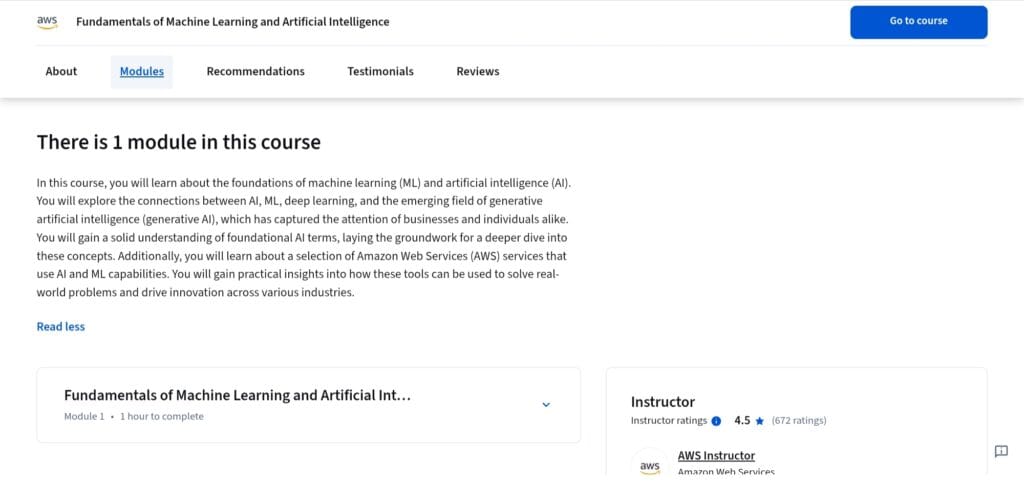
The foundation of how modern technology learns, adapts, and resolves issues at scale is artificial intelligence and machine learning. Amazon Web Services’ Fundamentals of Machine Learning and Artificial Intelligence exposes students to the key concepts underlying this change.
It illustrates how these technologies enable actual cloud-based solutions in the AWS ecosystem and make connections between AI, ML, Deep Learning, and even the rapidly expanding field of Generative AI.
The course provides a brief but insightful introduction to how intelligent systems work and the direction that contemporary industries are taking. It is designed as a condensed, high-impact learning experience.
With just one lesson and an estimated hour of learning time, including a quick reflective activity, it is ideal for busy professionals or inquisitive beginners who wish to grasp the fundamentals of AI before delving into more complex technical routes.
This course gives you the clarity to start your AI journey with confidence, whether you’re a professional assessing AI-driven innovation, a student investigating emerging tech, or just someone fascinated by how machines are getting smarter. It’s led by one of the top cloud providers in the world.
What skills will you learn in this course?
Understanding of AI & ML fundamentals
You can develop a fundamental conceptual vocabulary by taking this course. You will discover the differences between “Artificial Intelligence (AI)” and “Machine Learning (ML), as well as how Deep Learning and Generative AI fit into this larger context.
Additionally, you will gain an understanding of fundamental building pieces, such as the types of machine learning (ML) that exist (supervised, unsupervised, and reinforcement) and the basic definitions of “training data,” “models,” and “neuronal networks/neural networks.”
Broad exposure to AI/ML ecosystem — including cloud-based tools & services
You will also see how ML/AI may be applied in cloud infrastructures because the course is provided by Amazon Web Services (AWS). This includes knowing why cloud computing is important for machine learning and what makes AWS a suitable platform for workloads, including AI and ML.
This enables you to understand not only “what machine learning is,” but also how and where it is used in actual systems, particularly in cloud and enterprise settings.
Awareness of modern trends: Deep Learning and Generative AI
The course touches on Deep Learning and Generative AI, providing you with a high-level overview of advanced AI.
It doesn’t go into great mathematical detail, but it gives you an idea of what these concepts represent, why they are important, and how they vary from “classic ML.”
Because generative models, text generation, image creation, and basic models are becoming more and more important in AI discussions and applications, this is useful today.
Ability to distinguish between different ML approaches & methods (at a conceptual level)
You will learn about several forms of learning, including supervised, unsupervised, and reinforcement learning, in addition to “ML in general.” This implies that you will be able to choose which type of machine learning is best for a certain issue.
Additionally, you will learn what “foundation models” (such as “large language models,” “diffusion models,” or “multimodal models“) are in contemporary AI jargon, which will be useful if you intend to keep up with the most recent advancements in AI.
Read Also: Will AI Take My Job or Create a New One? A Deep Dive into the Post-AI Job Market
What concepts will you learn in the Fundamentals of Machine Learning and Artificial Intelligence Course?
In the Fundamentals of Machine Learning and Artificial Intelligence course, you will learn the following concepts.
Distinguishing Artificial Intelligence (AI) vs Machine Learning (ML) vs Deep Learning vs Generative AI
The first part of the course explains popular, but frequently perplexing, terms, such as what constitutes “AI,” how machine learning falls under that category, and the roles of deep learning (DL) and generative AI.
This conceptual clarity aids students in avoiding confusing concepts, which is an essential initial step if you want to study more complex texts, create systems, or even just critically follow AI/ML news.
Basic definitions and fundamental building blocks (data, models, neural networks, etc.)
Definitions of key terminology are provided, such as what “data” and “training data” imply in the context of machine learning, what a “model” is, and what “neural networks” mean when discussing deep learning.
Additionally, the course discusses the relationships between these building elements, such as how data + algorithms → model → predictions or judgments. This provides you with the theoretical framework for the construction of AI/ML systems.
Overview of different types of learning: supervised, unsupervised, and reinforcement learning
Classifying machine learning approaches takes up a significant amount of conceptual space.
The course describes supervised learning (using data with labels), unsupervised learning, which involves identifying patterns without clear labels, and reinforcement learning, which is learning through interaction with the environment and feedback.
Introduction to Generative AI and “foundation models.”
The course covers the fundamental concept of “foundation models” (big language models, diffusion models, multimodal models) and discusses contemporary advancements by defining generative artificial intelligence.
This is useful if you want to comprehend, conceptually, why tools like text generators and image generators are considered “AI” and how they connect to traditional ML or DL.
How AI/ML concepts connect to cloud-based services (especially Amazon Web Services — AWS)
Because the course is provided by AWS, it provides an explanation of how cloud infrastructure and managed services are used to deploy AI and ML. This implies that you have a grasp of how AI/ML is used in actual systems, not just theory.
This link raises awareness of the fact that AI and ML are technologies used by businesses to address actual issues, frequently via cloud platforms.
Read Also: Best Machine Learning Courses online
Who Should Join This Course?
Beginners and curious newcomers to AI/ML
This course is a great place to start if you have little or no experience with AI, machine learning, or data science. It lowers the barrier to entry because it is brief, concept-focused (only one module, about one hour), and does not require much prior knowledge.
You’ll gain a thorough understanding of key terminologies (AI, ML, deep learning, generative AI, models, data, cloud-based AI), which will help demystify a field that is frequently overtaken by hype and jargon.
Students or working professionals evaluating whether to go deeper into AI/ML.
This course offers a low-commitment “taste test” if you’re considering whether AI/ML is a path worth investing time in, either for more study or to change career direction.
You’ll acquire sufficient conceptual understanding to choose between a more practical or technical course or specialization.
Without devoting months to learning, it helps you establish the foundation for evaluating your own preparedness (interest, aptitude, comfort with abstraction).
Non-technical individuals or professionals from other domains wanting AI/ML literacy
To get the benefits, you don’t need to be an aspiring coder or data scientist. This course provides you with conceptual literacy if you have a background in business, design, management, the humanities, or another non-computer science field, yet you want to know what AI/ML actually means because you see its effects wherever you look.
You may interact more effectively with AI-driven projects, communicate with technical teams, and even make well-informed decisions about implementing AI in your field (business strategy, product planning, etc.) thanks to this literacy.
Professionals exploring how AI/ML ties to cloud and enterprise-scale applications (especially via Amazon Web Services — AWS)
The course also discusses how AI/ML connects to cloud infrastructure and practical enterprise applications because it is offered via AWS.
This course provides a helpful conceptual foundation if you work in IT, software, DevOps, cloud, or corporate architecture and want to understand how ML/AI forms part of scalable cloud systems.
Anyone interested in staying current with AI/ML trends but short on time
The course’s short duration and flexible schedule make it ideal for anyone who is busy with school, work, or other obligations but wants a brief introduction to AI/ML, and now generative AI. It provides a “big picture” without requiring a significant time commitment.
Will you get a job after completing the Fundamentals of Machine Learning and Artificial Intelligence course?
The quick answer to this is that the course doesn’t guarantee you a job, but it will equip you with AI and ML concepts, which will help you get job opportunities.
The skills you learn in this course will strengthen your foundation in machine learning and be helpful for further learning.
It is a short, 1-hour-long learning program that discusses the new concepts in technology. It is not a degree or professional certificate that will prepare you for the workforce.
You can take this course just for learning the fundamentals and learn further to secure a job in AI or machine learning.
How long does this course take to complete?
The fundamentals of Machine Learning and Artificial Intelligence course on Coursera is a quick overview of the fundamentals of AI and ML, and how cloud platforms like AWS use these technologies.
This course takes one hour to complete.
How much does the Fundamentals of Machine Learning and Artificial Intelligence course cost?
You can access this course on Coursera for free. This course is also available with the Coursera Plus Subscription plan.

This subscription plan costs $59 per month and gives access to 10,000+ courses and certifications on the platform.
Is it worth taking the Fundamentals of Machine Learning and Artificial Intelligence course on Coursera?
This course is really worthwhile for many students, particularly those who are just starting out in AI and ML.
It provides a soft and approachable entrance point into an area that can otherwise feel daunting because it is brief, focused, and low-commitment (approximately one module, roughly one hour altogether).
It provides clarity and context for people who are interested in AI, ML, deep learning, or generative AI but don’t know where to begin.
You’ll learn basic definitions, see how AI/ML interacts with cloud platforms (like AWS or Amazon Web Services), and start to understand how these technologies are used in practical situations.
The course is especially useful for non-technical learners or professionals from other domains (business, management, design, etc.) who desire AI/ML literacy—not necessarily to build models, but to comprehend what’s going on “under the hood”—because of its conciseness and conceptual nature.
For instance, if you work in a team where AI/ML conversations or choices are important, this course will help you communicate effectively, ask well-informed questions, and work more effectively with technical colleagues.
However, and this is critical, it is insufficient if your goal is to construct genuine ML/AI systems, work on data-driven projects, or pursue a career as a data scientist, ML engineer, or AI developer.
The course does not address hands-on programming, model training, data preprocessing, or any other practical skills required for developing and delivering AI solutions.
For those objectives, you’ll require more in-depth courses or specialties (including coding, datasets, and projects).
FAQ
Is this course suitable for complete beginners in AI and Machine Learning?
Sure. This is an introductory course that doesn’t require any prior knowledge. It provides clear and understandable explanations of basic terms, including AI, ML, deep learning, and generative AI.
How long does it take to finish this course?
The course consists of one module that consists of a 60-minute reading and a 3-minute reflective task. The majority of students finish it in an hour or so.
Does this course include hands-on machine learning practice?
No. Coding, datasets, and model-building activities are not included; it merely offers conceptual understanding. Students who want to learn practical machine learning skills will have to take more advanced courses.
Share Now

More Articles
10 Soft Skills for Software Engineers: Beyond Coding and Debugging
IBM Machine Learning Professional Certificate – A Detailed Review
AutoML vs Manual ML: Which One Delivers Better Results (and When)?

As an engineer with a passion for learning and sharing knowledge, I created CourseKart.online to help students, professionals, and lifelong learners choose the best online courses. With so many options available, finding the right one can be overwhelming. My goal is to simplify that process by offering insights, reviews, and recommendations on the top online learning resources. I hope my posts inspire you to keep growing, learning, and exploring new opportunities.
Discover more from coursekart.online
Subscribe to get the latest posts sent to your email.