
Last updated on February 9th, 2026 at 09:10 am
Data is omnipresent, but making sense of it may be daunting. What if you had an assistant who could write SQL queries, organize your cluttered spreadsheets, and even help you communicate the story behind your numbers?
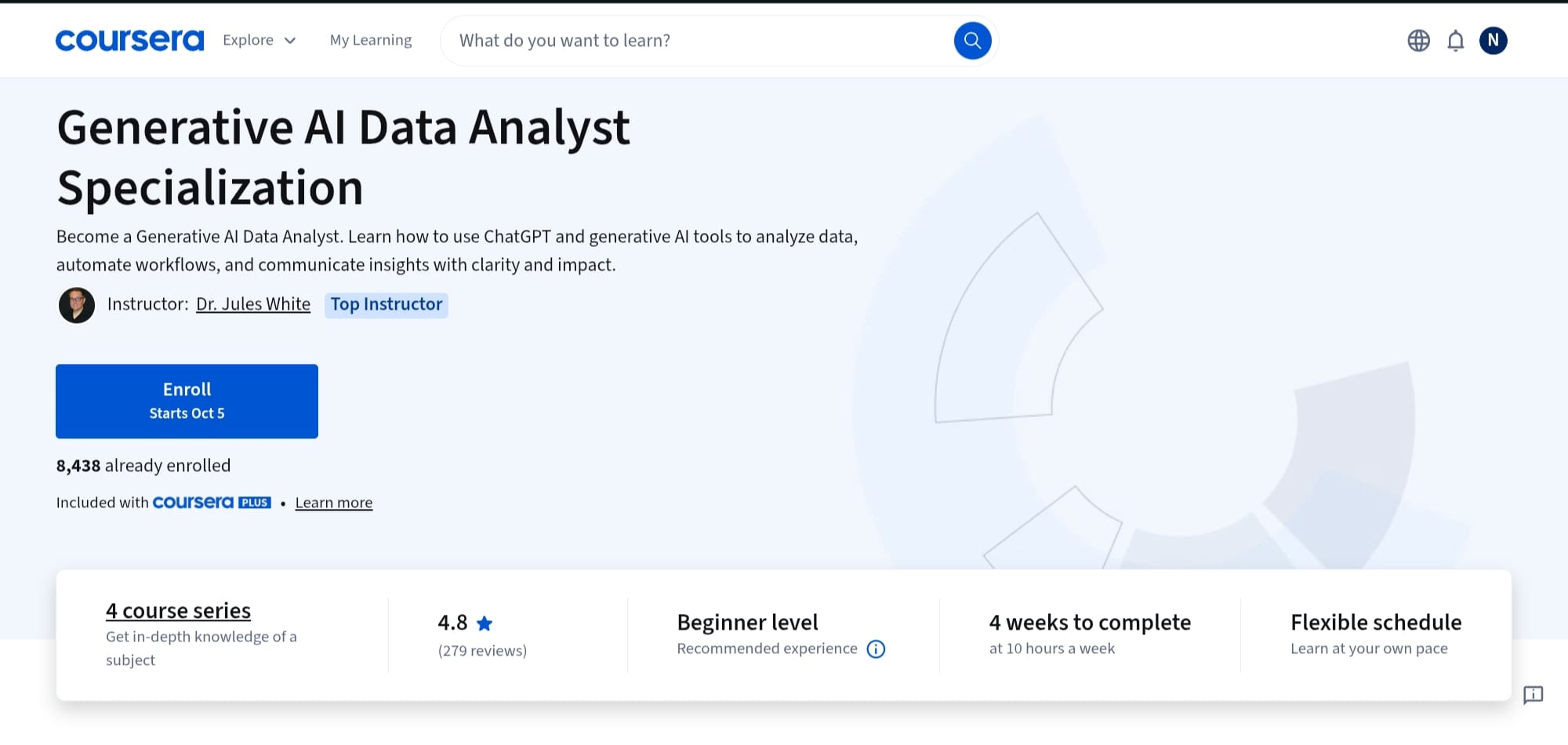
That is exactly what the Generative AI Data Analyst Specialization on Coursera provides.
Developed by Vanderbilt University, this program combines the fundamentals of data analysis with the capabilities of AI tools such as ChatGPT.
It’s not just about memorizing formulae and charts; it’s about changing the way you interact with data and making analysis faster, smarter, and more creative.
What skills will you learn in this course?
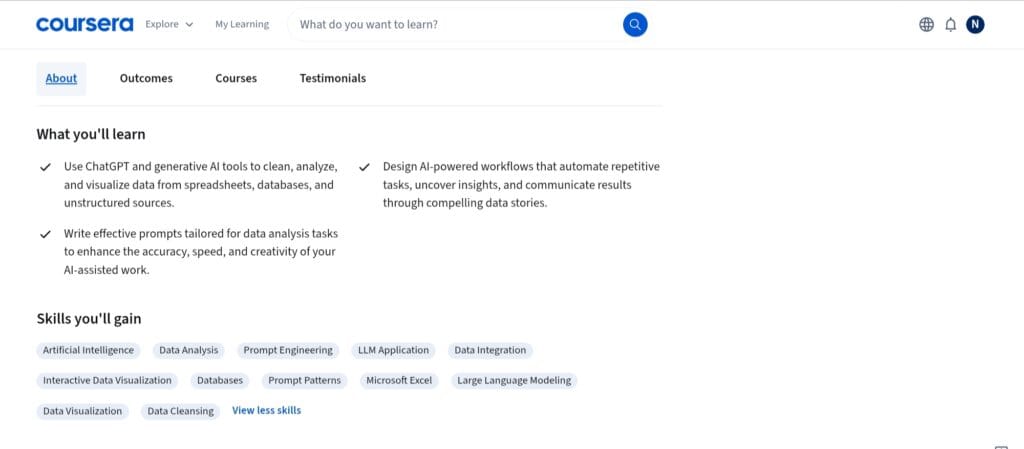
The Generative AI Data Analyst Specialization gives you a special set of skills that combine the power of AI with conventional data analysis methods.
Learning how to use AI to create SQL queries from simple English prompts will be among your first lessons.
With AI writing the SQL code for you, you can save time and cut down on errors by asking questions like “Show me the top 10 products by revenue last quarter.”
Using AI to help you learn Excel is another essential skill. Instead of wasting hours organizing formulas or cleaning up cluttered spreadsheets, you’ll learn how ChatGPT can automate repetitive operations and improve your data organization.
Your process becomes more efficient as a result, and you can concentrate on creating insights instead of resolving formatting problems.
Additionally, the course emphasizes data visualization and storytelling. When you learn how to use artificial intelligence (AI) to produce charts, dashboards, and compelling tales, your data comes to life.
By using these storytelling approaches, you can make sure that your findings are not only correct but also interesting and simple for decision-makers and coworkers to understand.
Prompt engineering, the art of asking the appropriate questions to maximize the effectiveness of AI technologies, will also be covered.
This skill is becoming crucial in all fields, and the course provides practical experience in creating prompts that get accurate, practical responses.
The application then delves deeper with sophisticated data management. You will investigate ChatGPT’s Code Interpreter and discover how to handle various file formats, including presentations, photos, Excel sheets, and PDFs.
This enables you to automate reporting chores that would typically take hours, as well as swiftly prepare summaries and extract insights.
After completing the specialization, you will not only be at ease handling data, but you will also understand how to use AI to your advantage.
In today’s data-driven environment, these abilities help you become faster, more productive, and more creative—qualities that every employer loves.
What concepts are taught in the Generative AI Data Analyst Specialization?
The combination of AI and SQL is one of the fundamental ideas covered in this specialization. Writing SQL queries traditionally involves learning syntax and reasoning by heart.
Here, you’ll learn how generative AI can help. You’ll learn how to use AI to convert common business inquiries into database queries, then transform the output into insightful analysis and graphics.
Because it makes dealing with databases easier and analysis more effective, this idea is very potent.
AI-enhanced Excel analysis is another key concept. Although Excel has always been a preferred tool for analysts, its use with AI elevates it to a new level.
You’ll learn how artificial intelligence (AI) can clean data, recommend formulas, and even automate tedious tasks like creating reports or formatting.
In addition to saving time, the course highlights how this connection lowers errors and transforms Excel into a tool for decision-making rather than merely a spreadsheet.
Data storytelling is another topic covered in depth in the curriculum. Numerical analysis is insufficient; you also need to give the results context.
With the help of visual aids like charts, dashboards, and reports, you will discover how to leverage AI to create compelling narratives around your discoveries.
An ability that any contemporary analyst must possess is the ability to transform unstructured data into narratives that impact business choices.
Prompt engineering is another important topic discussed. The course gives you organized methods to create better prompts because generative AI systems like ChatGPT mainly depend on the way you phrase your inputs.
Prompt patterns, iterative improvement, and accuracy-boosting techniques will all be covered. Since it can be used with any AI tool, not only for data analysis, this is one of the most transferable talents.
Finally, the specialization presents sophisticated analysis aided by AI. Utilizing tools such as ChatGPT’s Code Interpreter, you will discover how AI can manage various file types (such as Excel, PDFs, PowerPoint, and pictures) and even automate some tasks in your workflow.
According to this idea, artificial intelligence (AI) can play a major role in handling, analyzing, and presenting data on many platforms.
Read Also: Best Generative AI Courses On Coursera That Explain Real-World Applications
Who should join this course?
For individuals who wish to enter the field of data analysis without becoming bogged down by complex arithmetic or extensive coding, the Generative AI Data Analyst Specialization is perfect.
This course provides you with a light introduction to cutting-edge AI tools and answers your questions about how data can be utilized to make smarter decisions if you’re a beginner.
To begin, you only need a basic understanding of spreadsheets and fundamental logic; you don’t need to be a coder.
Professionals in the workforce who now handle data in marketing, finance, operations, human resources, or sales will also find it ideal.
If you frequently find yourself drowning in Excel spreadsheets or having trouble understanding reports, this specialization demonstrates how to utilize AI to expedite the process, clean up messy data, and produce insightful findings.
Basically, it helps you stand out as someone who is ahead of the curve while also making your job easier.
This course might serve as a stepping stone for people who are switching careers.
Learning how to integrate AI with traditional data analysis will put you in a solid position if you’re looking to transition into analytics or business intelligence.
Nowadays, employers want workers who can use AI to execute tasks more quickly and efficiently, not simply analysts who can crunch data.
Even recent grads and students can gain from this. This specialization gives your resume a contemporary, in-demand skill set that is beneficial if you are still determining your professional path.
Being able to use AI for data analysis and presentation provides you with an advantage from the beginning.
Will you get a job after completing this course?
No short course can guarantee a job, and completing the Generative AI Data Analyst Specialization alone won’t do that. What it does give you, though, is a set of really useful skills that can increase your employability.
People who can use AI to undertake data analysis more effectively are in high demand by businesses nowadays.
Learning how to integrate AI technologies like ChatGPT with SQL, Excel, and storytelling will help you establish yourself as a person who is ahead of the curve.
Imagine this: a lot of individuals know how to create SQL queries or use Excel, but many fewer know how to incorporate generative AI into their workflow.
Gaining these new abilities can help you advance more quickly if you currently hold a data-related position.
With projects, a portfolio, and possibly more advanced training, the specialization offers a strong platform upon which to build if you’re changing careers.
The certificate from Vanderbilt University via Coursera is yet another significant benefit.
Despite not being equivalent to a degree, it demonstrates to hiring managers and recruiters that you have made an investment in acquiring employable, real-world skills.
Your chances of getting a job as a data analyst or business intelligence specialist might be significantly increased by combining this with your personal projects or internships.
How long does the Generative AI Data Analyst Specialization take to complete?
The Generative AI Data Analyst Specialization is designed to be flexible, so you can learn at your own pace. On average, it takes about four weeks to complete if you dedicate 10 hours per week. That’s because the specialization is broken into four separate courses, each with videos, quizzes, and hands-on projects.
How much does this course cost?
The Generative AI Data Analyst Specialization on Coursera is priced at $59 per month through a Coursera Plus subscription. This means you pay monthly, and the total cost depends on how quickly you complete the course.
The Coursera Plus subscription also offers access to 10,000+ courses and certifications to help you learn new skills and advance your career.

Additionally, you can subscribe to an individual course on Coursera on a monthly basis by paying a fee. The subscription cost usually varies from country to country, and typically it ranges from $29 to $49.
Is it worth taking the Generative AI Data Analyst Specialization?
Combining knowledge of AI with data analysis is a significant advantage in today’s rapidly changing employment environment.
That is precisely what this specialization is intended to accomplish. In addition to being proficient with SQL, Excel, and data visualization by the end of the program, you will also understand how to use generative AI tools like ChatGPT to improve the speed, accuracy, and intelligence of your workflow.
These abilities are becoming more and more necessary in a variety of sectors, including marketing, finance, operations, and human resources.
The practical, hands-on approach of the course is one of its greatest advantages.
Every lesson contains applied projects that allow you to practice applying AI in practical settings, such as producing dashboards and reports, automating Excel processes, or generating SQL queries.
This implies that, in addition to learning theory, you are also developing a portfolio of work that you can present to possible employers.
This practical learning is quite beneficial for someone who wants to have an effect in a data-focused role.
It’s also worth taking because of its accessibility and versatility. To take advantage of this expertise, you do not require a degree in computer science or a strong foundation in programming.
You can easily learn how to use the AI tools if you know the basics of databases or Excel. This makes it an excellent option for those who are new to the field, are employed, or are changing careers.
Finally, the course is supported by Vanderbilt University and Coursera’s organized learning environment. The certification lends credibility and demonstrates to companies that you have invested in a modern, practical skill set.
While finishing this course alone does not guarantee a job, it does considerably improve your employability, especially when combined with projects, portfolio work, or internships.
FAQ
Do I need prior coding experience to take this course?
No. The course is beginner-friendly and focuses on practical AI-assisted data analysis. Basic Excel and familiarity with databases are helpful, but advanced coding is not required.
Can I use what I learn for real-world projects?
Absolutely. The course includes hands-on projects that let you apply AI tools to clean data, generate insights, and create reports. These are the skills directly applicable in the workplace.
Will this course help me save time on data tasks?
Yes. By learning how to automate Excel workflows, generate SQL queries with AI, and quickly visualize data, you can complete tasks faster and more efficiently.
How does this course make me stand out to employers?
It teaches AI-powered analysis, a skill few analysts currently have. Combining traditional data skills with generative AI makes you more innovative, productive, and in-demand in today’s job market.
Share Now

More Courses
Generative AI for Sales Professionals Specialization – A Detailed Review
Is the Python for Data Science AI and Development Course On Coursera Worth It?
Data Analyst Vs Data Scientist Vs ML Engineer: Which Role is Right for You?

As an engineer with a passion for learning and sharing knowledge, I created CourseKart.online to help students, professionals, and lifelong learners choose the best online courses. With so many options available, finding the right one can be overwhelming. My goal is to simplify that process by offering insights, reviews, and recommendations on the top online learning resources. I hope my posts inspire you to keep growing, learning, and exploring new opportunities.
Discover more from coursekart.online
Subscribe to get the latest posts sent to your email.