
Discover the best online statistics courses for data science beginners. Learn probability, regression, and data analysis with top courses from Coursera and Udemy.
A key component of data science is statistics. A strong grasp of statistical concepts is necessary whether you want to develop machine learning models, examine business data, or extract insights from massive datasets.
Regression, probability, and hypothesis testing are among the subjects that many novices find challenging to understand when learning independently.
The good news is that statistics are significantly more accessible thanks to contemporary educational resources.
Online courses from sites like Coursera and Udemy use practical exercises, real-world data science examples, and visual explanations to simplify difficult statistical concepts.
Based on student assessments, instructor reputation, content quality, and practical learning value, I’ve chosen the Best Online Statistics Courses for Data Science Beginners in this guide.
You can develop a solid statistical foundation for your data science journey with the aid of these courses.
Why Statistics Is Important for Data Science
Data scientists rely heavily on statistics to comprehend and manipulate data. Professionals need statistical techniques to accurately assess information, validate assumptions, and analyze patterns before developing models or making conclusions.
Determining whether insights from data are significant or merely random noise becomes challenging without a strong grasp of statistics.
Practically speaking, statistics helps with a number of essential data science jobs. It facilitates the study and interpretation of data, enabling experts to compile enormous databases and identify practical patterns.
Additionally, it serves as the basis for numerous machine learning algorithms that use statistical principles to generate predictions.
While methods like A/B testing aid in the assessment of trials and commercial decisions, concepts like probability are essential for predictive models.
10 Best Online Statistics Courses for Data Science Beginners
| Sl No. | Course Name | Best For | Duration | Level |
|---|---|---|---|---|
| 1 | Statistics with Python Specialization – Coursera | Best for learning statistics with Python | 1 Month | Beginner |
| 2 | Business Statistics and Analysis Specialization – Coursera | Best for business analytics and data analysis | 3 Months | Beginner |
| 3 | Methods and Statistics in Social Sciences Specialization – Coursera | Best for research methods and statistical analysis | 3 Months | Beginner |
| 4 | Advanced Statistics for Data Science Specialization – Coursera | Best for advanced statistical concepts in data science | 1 Month | Advanced |
| 5 | Statistics and Data Analysis with Excel Specialization – Coursera | Best for statistics using Excel for analysis | 1 Month | Beginner |
| 6 | Statistics For Data Science – Coursera Project Network | Best for quick hands-on statistics learning project | 2 hours | Beginner |
| 7 | Become a Probability & Statistics Master – Udemy | Best for mastering probability and statistics fundamentals | 15+ Hours | Beginner |
| 8 | Probability and Statistics: Complete Course – Udemy | Best for comprehensive probability and statistics course | 16+ Hours | Beginner |
| 9 | Master Statistics Using R: Coding, Concepts, Applications – Udemy | Best for learning statistics with R programming | 28+ Hours | Beginner |
| 10 | Learn Statistics & Biostatistics Data Analysis From Scratch – Udemy | Best for beginners learning statistics from scratch | 10+ Hours | Beginner |
1. Statistics with Python Specialization – Coursera
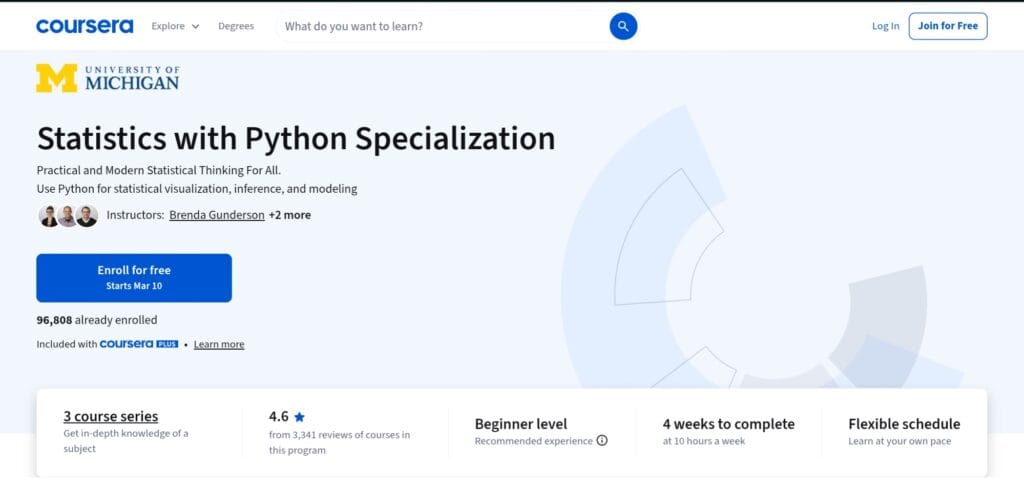
This specialization teaches how to use Python to apply statistical thinking to real-world datasets. The curriculum, which is offered by the University of Michigan via Coursera, covers fundamental statistical ideas as well as useful data analysis methods.
It is intended for students who wish to use Python tools and actual data examples to establish solid statistical foundations for data science.
Course Details
Platform: Coursera
Instructor: Brenda Gunderson, Brady T. West, Kerby Shedden
Duration: Approximately 1–2 months (self-paced specialization)
Level: Beginner to Intermediate
Certificate: Yes, shareable certificate upon completion
Also Read: Best Data Analytics Courses Online
Why This Course Is Good for Data Science
Aspiring data scientists will find this specialization very useful as it emphasizes statistical ideas in addition to Python-based data processing.
Students employ statistical modeling approaches that are frequently utilized in contemporary data science processes, deal with actual datasets, and investigate data visualization.
2. Business Statistics and Analysis Specialization – Coursera
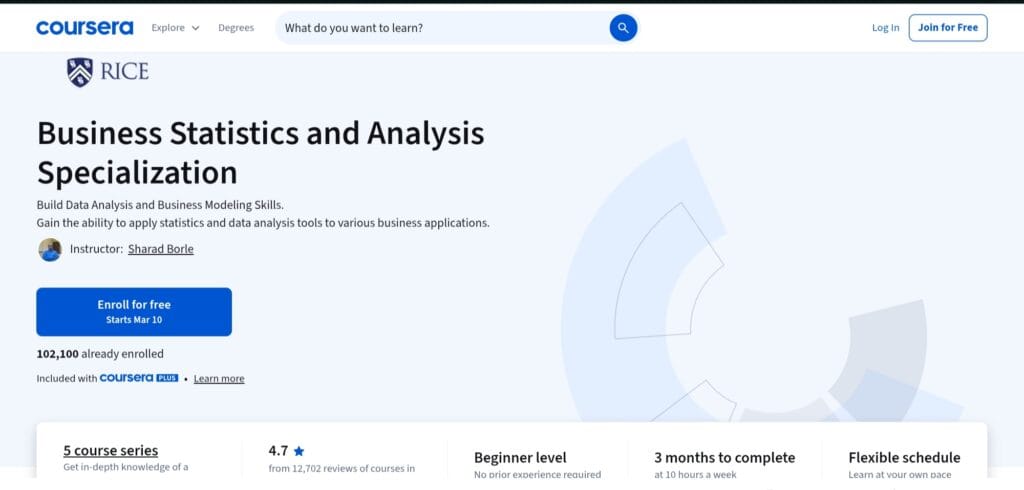
This specialization presents statistical ideas that are utilized in data-driven decision-making and business analytics.
Rice University’s Coursera program teaches students how to examine datasets, comprehend probability, and use regression approaches with Excel. Beginners who wish to gain useful statistics abilities for data science and analytics will find it ideal.
Course Details
Platform: Coursera
Instructor: Sharad Borle (Rice University)
Duration: Approximately 3 months (about 10 hours per week)
Level: Beginner
Certificate: Yes, shareable certificate upon completion
Why This Course Is Good for Data Science
In order to assist students in understanding how statistics support useful data analysis, this specialization focuses on applying statistical techniques to actual business information.
For novices hoping to go into data science or analytics positions, it offers a solid statistical foundation by covering topics like probability distributions, hypothesis testing, and linear regression with practical Excel exercises.
3. Methods and Statistics in Social Sciences Specialization – Coursera
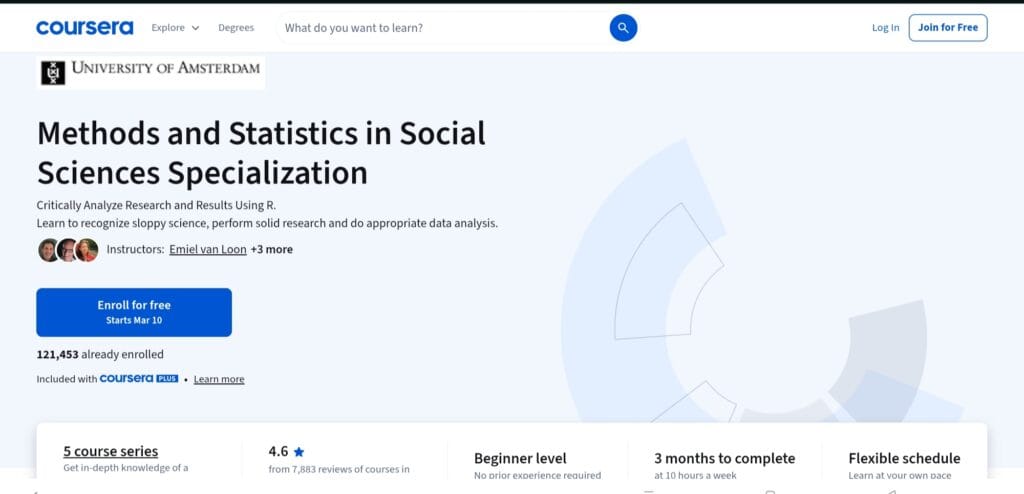
In order to assess actual social science data, this specialization introduces statistical methodologies and research approaches.
The curriculum, offered by the University of Amsterdam on Coursera, teaches students how to organize research, analyze datasets, and interpret results using statistical tools like R. It is appropriate for those who are new to data analysis and research-based statistics.
Course Details
Platform: Coursera
Instructor: Faculty from the University of Amsterdam
Duration: Approximately 3–4 months (self-paced specialization)
Level: Beginner
Certificate: Yes, shareable certificate upon completion
Also Read: Best Machine Learning Courses online
Why This Course Is Good for Data Science
This specialization helps students understand how statistical reasoning is used in real-world situations by concentrating on study design and statistical analysis using actual datasets.
It is helpful for novices who wish to establish a strong foundation in statistics before delving deeper into data science and machine learning because it also introduces tools like R for data analysis.
4. Advanced Statistics for Data Science Specialization – Coursera
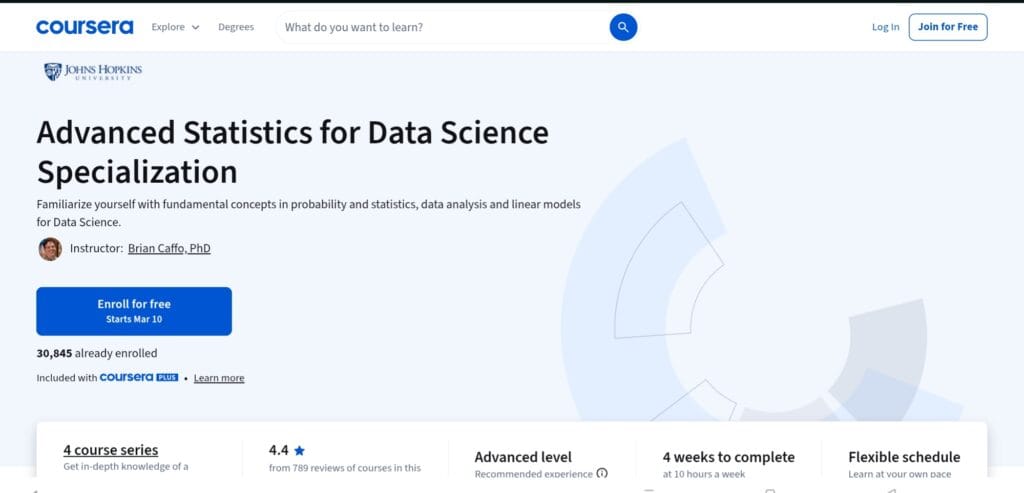
Deeper statistical ideas utilized in professional data science workflows are the main emphasis of this specialization.
The curriculum, which is available on Coursera from Johns Hopkins University, covers advanced subjects like probability distributions, statistical inference, and linear models.
It is intended for students who want to improve their analytical abilities for practical data science applications but already have a basic understanding of statistics.
Read Full Review – Is The Advanced Statistics For Data Science Specialization On Coursera Worth It?
Course Details
Platform: Coursera
Instructor: Faculty from Johns Hopkins University
Duration: Approximately 1–2 months (self-paced specialization)
Level: Advanced
Certificate: Yes, shareable certificate upon completion
Why This Course Is Good for Data Science
The mathematical fundamentals of statistical models employed in data science are explored in greater detail in this specialization.
It helps students grasp the inner workings of data science algorithms by covering subjects including probability distributions, statistical inference, and regression modeling.
These skills are particularly helpful for creating and assessing predictive models in practical applications.
5. Statistics and Data Analysis with Excel Specialization – Coursera
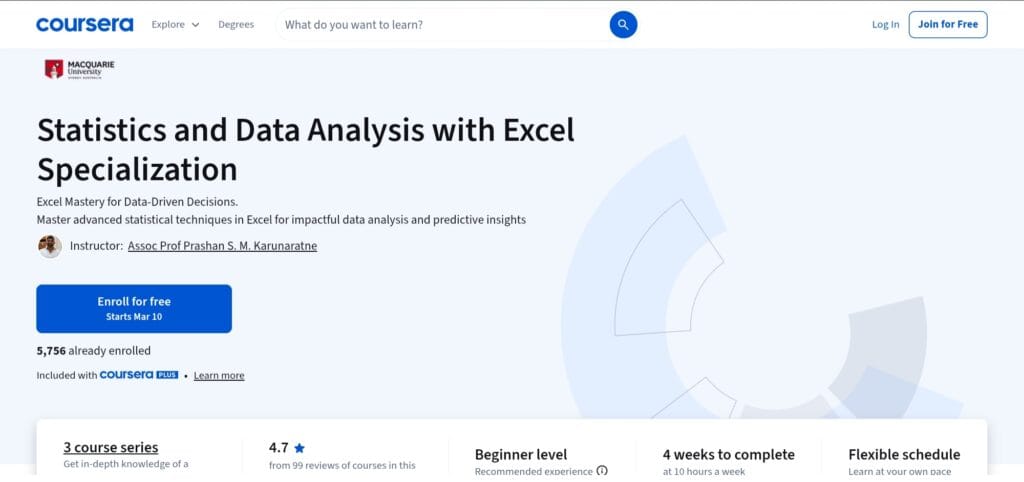
With this specialization, students learn how to use Microsoft Excel for statistical analysis. The program covers fundamental statistical principles and shows how to apply them using Excel’s analytical tools and visualizations.
It is intended for novices and early-career analysts. For students who wish to work with real-world datasets while learning statistics, it’s perfect.
Course Details
Platform: Coursera
Instructor: Faculty from Macquarie University
Duration: Approximately 1 month (self-paced specialization)
Level: Beginner to Intermediate
Certificate: Yes, shareable certificate upon completion
Also Read: Best Cloud AI Courses Online
Why This Course Is Good for Data Science
This specialization makes it simpler for novices to view and analyze data by teaching statistical principles through practical Excel analysis.
While working with actual datasets, learners practice methods like statistical inference, forecasting, and regression modeling, which help them build essential data analysis abilities for data science workflows.
6. Statistics For Data Science – Coursera Project Network
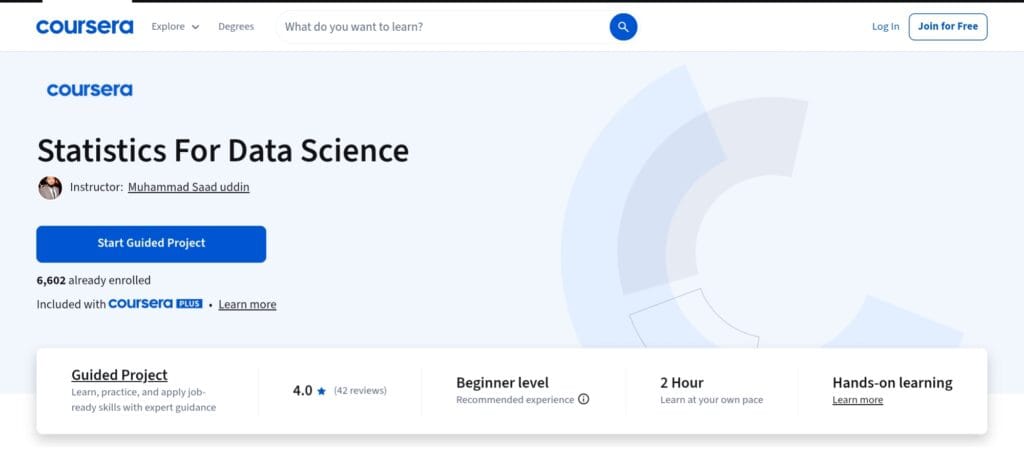
This guided project offers a brief overview of the practical applications of statistical techniques in data science workflows.
The project, which is intended for novices, guides students through fundamental statistical analysis ideas and shows them how to examine and evaluate information. It’s perfect for people who want a quick, practical introduction to statistics in the context of data science.
Course Details
Platform: Coursera
Instructor: Muhammad Saad Uddin
Duration: Approximately 2 hours (guided project)
Level: Beginner
Certificate: Yes, shareable certificate upon completion
Why This Course Is Good for Data Science
With this guided project’s emphasis on hands-on learning, novices can rapidly grasp how statistics facilitates data analysis.
Working with datasets allows learners to practice concepts like correlation analysis, probability distributions, and descriptive statistics, making it a useful place to start for those just starting out in data science.
7. Become a Probability & Statistics Master – Udemy
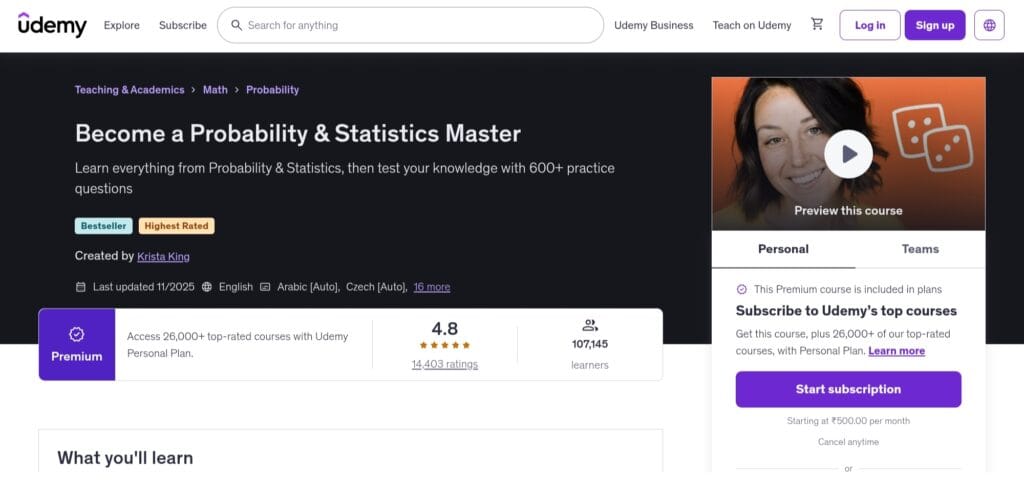
The fundamental ideas of probability and statistics are taught in an organized, approachable manner in this extensive Udemy course.
The course, which was created by Krista King, covers everything from probability distributions and hypothesis testing to data visualization and descriptive statistics.
For students who wish to have a solid mathematical foundation before pursuing data science or machine learning, it is perfect.
Course Details
Platform: Udemy
Instructor: Krista King
Duration: 15+ hours of video content
Level: Beginner to Intermediate
Certificate: Yes, certificate of completion available
Why This Course Is Good for Data Science
This course gives students a thorough understanding of statistical distributions, probability, and data analysis methods that are frequently applied in data science.
It is a great option for novices who wish to develop strong analytical abilities before working with actual datasets because it has hundreds of practice problems and exercises that support statistical thinking.
8. Probability and Statistics: Complete Course – Udemy
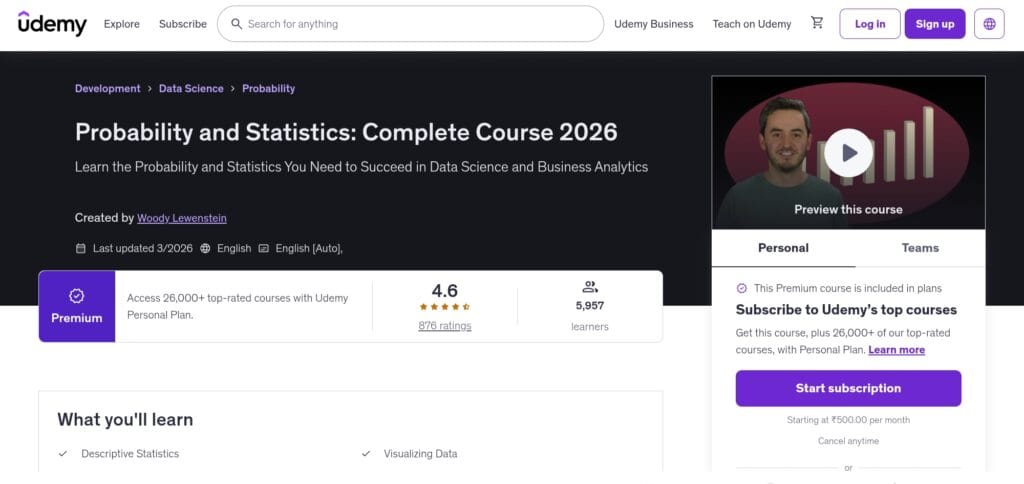
An organized introduction to probability and statistics is given in this Udemy course, along with useful explanations and problem-solving activities.
The course, developed by Woody Lewenstein, covers statistical ideas that are frequently applied in data science and business analytics. It is intended for novices who wish to grasp statistical reasoning and use it to solve actual analytical issues.
Course Details
Platform: Udemy
Instructor: Woody Lewenstein
Duration: 16+ hours of video content
Level: Beginner to Intermediate
Certificate: Yes, certificate of completion available
Also Read: Best Python Courses Online
Why This Course Is Good for Data Science
Data science requires a solid conceptual foundation in probability and statistical analysis, both of which are developed in this course.
Learners gain the capacity to analyze datasets, comprehend probability distributions, and apply statistical reasoning to real-world data problems by fusing theory with hands-on activities.
9. Master Statistics Using R: Coding, Concepts, Applications – Udemy
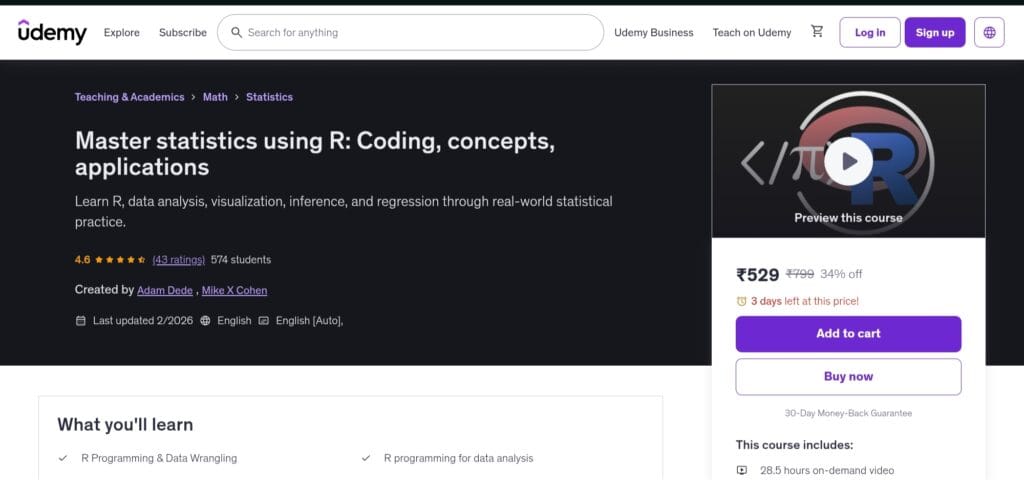
Using the R programming language, this Udemy course focuses on teaching statistics through practical data analysis. It teaches students how to apply statistical inference techniques, manage datasets, and visualize data.
Both novices and experts who wish to learn statistics and get useful coding skills for data analysis might benefit from this course.
Course Details
Platform: Udemy
Instructor: Data science instructor on Udemy
Duration: 28+ hours of on-demand video lessons with coding exercises
Level: Beginner to Intermediate
Certificate: Yes, certificate of completion available
Why This Course Is Good for Data Science
By fusing theory with R coding tasks, this course teaches statistics in a practical approach. Students practice regression modeling, examine statistical inference ideas like sampling distributions and confidence intervals, and work with actual datasets.
This practical method aids novices in comprehending how statistical methods are used in actual data science initiatives.
10. Learn Statistics & Biostatistics Data Analysis From Scratch – Udemy
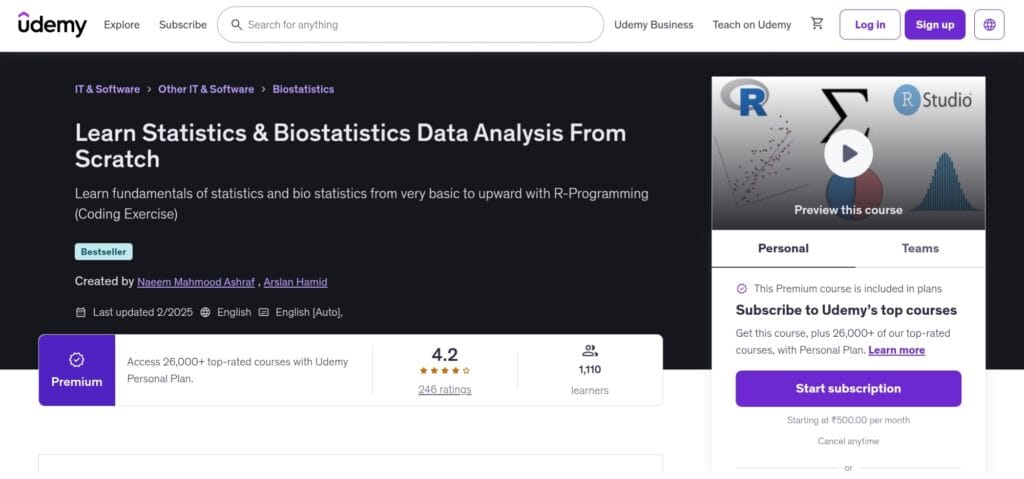
This Udemy course teaches students how to use the R programming language to analyze data while introducing the principles of statistics and biostatistics.
Beginning with fundamental ideas like data types and sampling techniques, the course progressively advances to statistical analysis and visualization. For those who wish to learn statistics from scratch, it is appropriate.
Course Details
Platform: Udemy
Instructor: Naeem Mahmood Ashraf, Arslan Hamid
Duration: Around 10+ hours of on-demand video lectures
Level: Beginner
Certificate: Yes, certificate of completion available
Why This Course Is Good for Data Science
In order to assist students in grasping how statistical principles are used in actual data analysis tasks, this course integrates statistical theory with hands-on R coding assignments.
It provides novices with a useful way to begin working with data in data science projects by covering subjects like probability, regression, sampling techniques, and hypothesis testing in addition to R programming.
FAQs – Best Statistics Courses for Data Science
Can I learn statistics online for data science?
Yes, many online platforms offer high-quality statistics courses designed specifically for data science beginners. Websites like Coursera and Udemy provide structured lessons, practical exercises, and real datasets.
Do data scientists need strong statistics skills?
Statistics is a core skill for data scientists because it helps them analyze data, build predictive models, and interpret results accurately. Concepts such as probability distributions, regression analysis, and hypothesis testing are widely used in machine learning and analytics.
How long does it take to learn statistics for data science?
The time required depends on the depth of learning and prior math knowledge. Beginners can understand basic statistical concepts in about 4–8 weeks through structured online courses.
What statistics topics are most important for data science?
Some of the most important statistics topics for data science include probability theory, descriptive statistics, hypothesis testing, regression analysis, and statistical inference. These concepts help data scientists understand data distributions, evaluate models, and interpret analytical results.
Final Verdict – Best Statistics Courses for Data Science Beginners
Your learning experience with data science can be greatly enhanced by selecting the appropriate statistics course. It is easier to evaluate datasets, create prediction models, and accurately interpret outcomes when you have a solid grasp of probability, statistical inference, and regression. These days, a lot of beginner-friendly programs use real datasets and useful technologies like Python to illustrate these ideas.
If you want a well-structured and practical program, the Statistics with Python Specialization on Coursera is one of the best choices because it teaches statistical analysis and hypothesis testing using Python and real data.
For learners who prefer step-by-step explanations and lots of practice, the Become a Probability & Statistics Master course on Udemy is a great option. It includes many lessons, quizzes, and exercises to strengthen statistical understanding.
Your learning style and job objectives will ultimately determine which course is ideal for you. Gaining proficiency in statistics through one of these online courses will provide you with a solid basis for working with data if you want to work as a data scientist or analyst.
Share Now

More Articles
A Day in the Life of a Data Scientist: What to Expect?
Roadmap to Become A Data Scientist In 6 Months (Step-by-Step Guide)
Will AI take over data science jobs? A balanced perspective

As an engineer with a passion for learning and sharing knowledge, I created CourseKart.online to help students, professionals, and lifelong learners choose the best online courses. With so many options available, finding the right one can be overwhelming. My goal is to simplify that process by offering insights, reviews, and recommendations on the top online learning resources. I hope my posts inspire you to keep growing, learning, and exploring new opportunities.
Discover more from coursekart.online
Subscribe to get the latest posts sent to your email.