

Generative AI is a category of artificial intelligence that generates new content, such as text, photos, audio, video, or code, based on patterns discovered in massive volumes of existing data. Instead of just analyzing or categorizing data, it can produce unique outputs that closely resemble human-created work.
In simple words, we can say that generative AI takes your input (a prompt, question, or instruction) and generates an output based on learned patterns from huge datasets.
In this article, we will have a deep insights into what can you create with generative AI?
How Generative AI Is Different from Traditional AI
Traditional AI systems are usually rule-based or predictive. They work on tasks including identifying people in photographs, recommending products, detecting spam emails, and anticipating trends. These systems evaluate data and produce results, but they do not generate anything new.
In contrast, generative AI is designed to create content rather than simply assess it. It does not merely choose from prepared responses.
Instead, it generates fresh text, images, or code dynamically, ensuring that each result is unique to the user’s request. This creative capability is what distinguishes generative AI from previous AI approaches.
Real-World Examples of Generative AI You Already Know
ChatGPT, Gemini, Claude, etc., help generate human-like content for articles, conversations, emails, explanations, etc.
Midjourney and DALL-E 3 help produce original images and artwork from simple text descriptions.
GitHub Copilot helps write and suggest code snippets in real-time to developers.
These are a few examples of generative AI tools that perform way beyond automation, where humans give instructions, and the AI system generates outputs.

Read Also: Top 16 Best Generative AI Courses On Coursera That Explain Real-World Applications
How Generative AI Works
Understanding how generative AI really works will give you more freedom and excitement to use it.
At its foundation, generative AI learns by analyzing huge volumes of existing content such as books, articles, photographs, code, music, and so on.
During training, the system is exposed to billions of samples in order to grasp how words, pictures, and symbols are typically used together. Unlike a database, it discovers patterns and relationships within the data rather than memorizing it.
Learning Through Patterns and Probabilities
One helpful approach to think about generative AI is to consider it as a highly powerful autocomplete system. When you input a prompt, the model guesses what should happen next using probability.
It keeps asking itself, “Given everything I’ve learned, what is the most likely next word, pixel, note, or line of code?” This method generates whole paragraphs, photos, or programs when repeated multiple times in quick succession.
This pattern-based prediction explains why generative AI can adapt to many styles, tones, and forms, whether you request a professional report, a casual explanation, or creative fiction.
Why the Output Feels “Human-Like”
Generative AI typically sounds human since it has learned from large amounts of human-created content. It recognizes syntax, context, tone alterations, and typical ways individuals explain concepts or tell tales.
It cannot, however, think, reason, or understand in the same way that humans do. It generates convincing findings because it excels at anticipating what appears or sounds correct based on previous examples.
In other words, it imitates human communication patterns but lacks human knowledge or intent.
Important Limitations to Keep in Mind
Despite the outstanding capabilities, Generative AI has several limitations that you have to keep in mind.
- Hallucinations
As it is learned from huge datasets, it can generate fabricated or incorrect information with confidence. This can happen if you enter a vague prompt.
So we can say that the output quality of Generative AI depends on the clarity and intent of the prompt you provide.
- Bias
Bias is another problem with generative AI output. Since it learns from vast datasets, it may reflect the existing biases in the training data.
So, you have to be vigilant when using generative AI content in real-world scenarios.
- Lack of judgment
As we discussed above, generative AI can’t think, apply common sense, verify truth, or understand real-world consequences as humans do. Therefore, it is impractical to expect that it can give judgments without human oversight.
This is why generative AI is best used as a support tool rather than a final authority. Human inspection, context, and critical thinking are still necessary to ensure accuracy and responsible use.
What Can You Create with Generative AI?
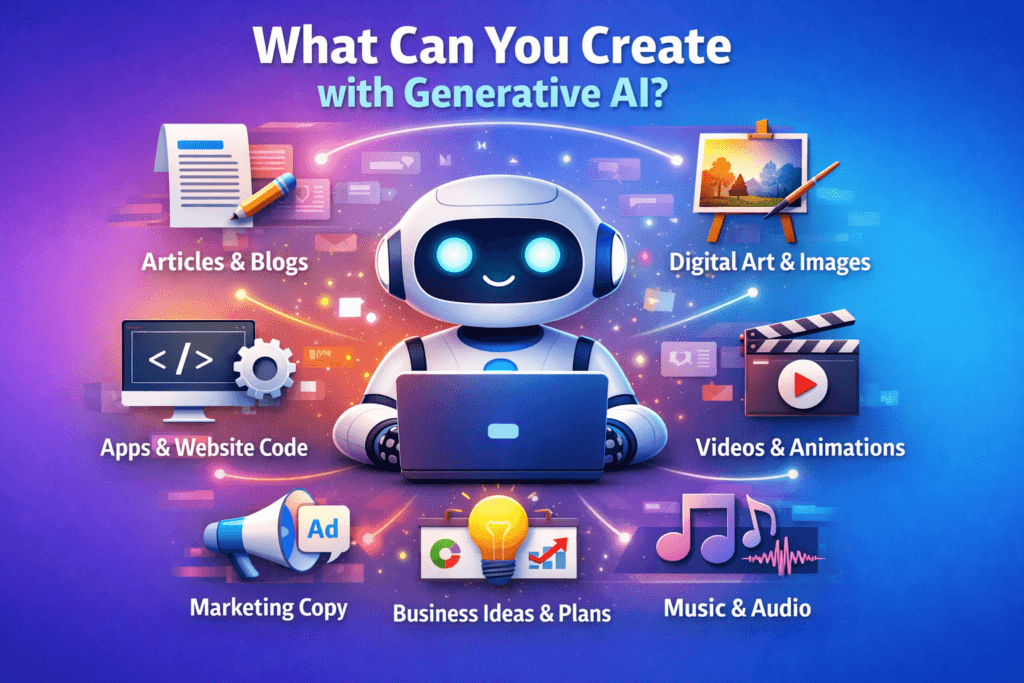
One of the main reasons why generative AI has gained popularity is its capacity to convert ideas into practical material in minutes.
Whether you’re working on an assignment, operating a business, or developing your own brand, generative AI can help you through the full content production process, from rough drafts to polished outputs.
Here I am listing the content types that generative AI can create.
Create Text Content with Generative AI
Generative AI excels at creating high-quality written material across formats and industries. With the correct prompts, you can structure thoughts, polish language, and maintain consistency without having to start from scratch.
Here is a list of text content types that generative AI can help you with.
Blog posts and articles
Generative AI helps in writing blog posts by creating article outlines and long-term drafts. It helps in producing structured articles for improved readability and clear flow.
Social media captions
Helps create platform-specific captions with balanced clarity, engagement, and brevity.
Emails and reports
AI helps produce professional emails, summaries, and internal reports tailored for specific tones and audiences.
Resumes and cover letter
It helps generate role-specific resumes and customized cover letters that showcase relevant skills and experience to potential employers.
Scripts and storytelling
Generative AI produces podcast outlines, short stories, video scripts, and brand narratives with appropriate structure and voice.
Rather than replacing human writing, generative AI serves as a collaborative writing assistant, handling structure and language while you concentrate on ideas, accuracy, and intent.
Who Benefits Most from AI-Generated Text?
By using AI tools that generate text content, students, content creators, marketers, and professionals can produce quality content with less effort.
Create Images and Visual Designs
Generative AI is no longer only about text. It can also transform written descriptions into images, making design more accessible to those without specialized graphic design training.
Users can make graphics that might otherwise take hours of human labor by stating what they desire in simple terms.
For instance, you can generate images, banners, thumbnails, and custom artwork for social media posts, blog posts, product packaging, etc.
These visual representations are usually created using text-to-image tools, where you give a structured prompt with clear instructions to the AI tool, and the AI tool generates the image.
You can keep changing the prompt until you get the refined output you need.
Image creation tools don’t replace professional designers, but they dramatically enhance the creative exploration phase, enabling designers to transform their imaginations into visual forms with minimal effort.
Create Videos, Audio, and Voice Content
Generative AI has advanced beyond static content to support video, audio, and voice creation, creating new opportunities for producers who want to create rich media without big production teams. Users may now create multimedia material that used to require specialist tools and abilities using simple instructions or scripts.
AI video creation tools are used to create short explainer videos, presentations, avatar-based videos, YouTube Shorts, Instagram Reels, etc.
AI voiceover tools are used for creating voices for tutorials, ads, audiobooks, royalty-free music, and more.
Who Uses AI-Generated Audio and Video Content?
AI-generated audio and video tools are in demand among YouTubers, educators, and small businesses to create promotional content or product demos.
Create Code and Software with Generative AI
Generative AI has evolved into a significant support tool for software development, allowing engineers to write, comprehend, and improve code more quickly.
Users can generate functional code snippets, logic flows, or whole components across several programming languages just by stating what the application should perform.
Typical use cases of generative AI in this sector include creating website code, app logic, bug fixing, and code explanation.
These capabilities are very useful for automating repetitive processes and shortening development cycles, allowing developers to spend more time on system design, performance, and issue solving rather than writing boilerplate code.
Create Business Ideas, Plans, and Marketing Assets
Generative AI is becoming increasingly used as a commercial strategy and execution tool. It can aid in the transformation of rough notions into structured ideas and ready-to-use assets, making early-stage planning faster and easier.
You can use generative AI to generate business ideas, market research summaries, Ad copy, landing page content, sales scripts, etc.
These tools usually come in handy for startups, freelancers, and solopreneurs who want to generate high-quality content with minimal effort and time commitment.
In this context, generative AI acts as a business co-pilot, speeding up planning and execution while leaving strategic decisions, creativity, and judgment firmly in human hands.
Read Also: Will AI Take My Job or Create a New One? A Deep Dive into the Post-AI Job Market
Generative AI in Everyday Life
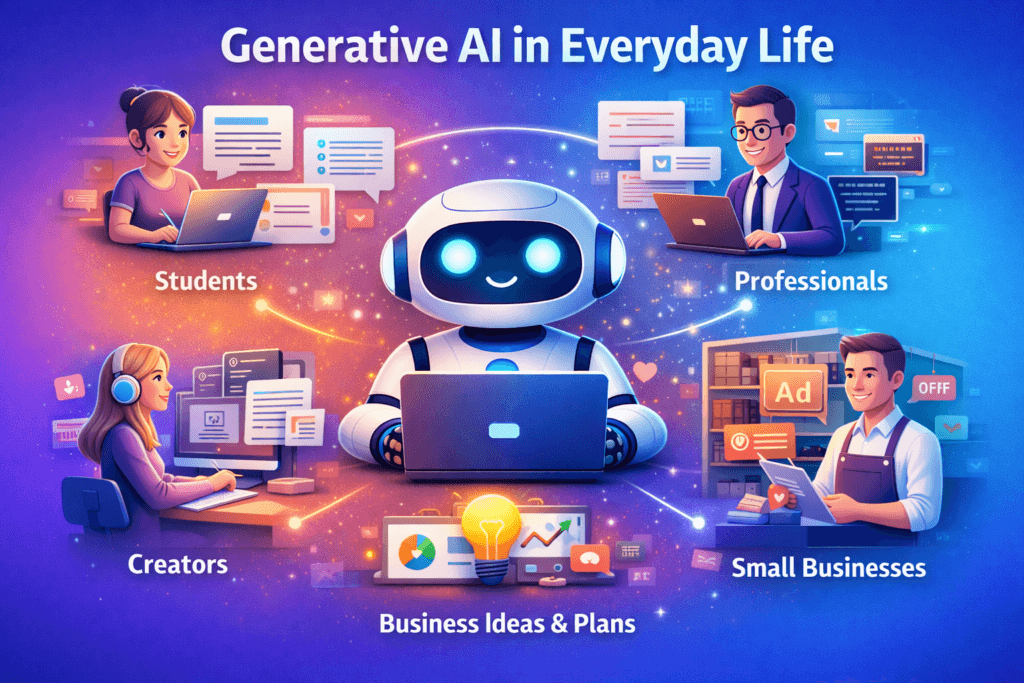
Generative AI is no longer limited to tech labs or huge corporations. It has quietly become a part of normal processes, allowing workers to save time, minimize effort, and concentrate on higher-value tasks. Its impact is most noticeable when applied to simple, real-world tasks rather than sophisticated experiments.
Students: Smarter Learning, Less Overwhelm
Students are increasingly using generative AI to organize and comprehend knowledge, rather than merely for answers.
It assists in converting large chapters into succinct study notes, explaining difficult concepts in easier language, and producing practice problems for revision.
When used wisely, it serves as a tailored study helper, enhancing comprehension and clarity rather than replacing learning.
Professionals: Better Productivity, Clearer Communication
Generative AI increases daily efficiency for working professionals. It can help with email drafting, meeting note summarization, report preparation, and presentation refinement.
Professionals should spend less time on routine writing and paperwork and focus more on decision-making, teamwork, and strategic work.
Creators: Faster Content Without Creative Burnout
Generative AI is used by content creators to speed up the creative process. It aids in concept generating, outlining, scripting, captioning, and cross-platform content repurposing.
Instead of struggling with consistency or creative blocks, creators may keep momentum while still adding their own unique voice and judgment to the final product.
Small Businesses: Doing More with Fewer Resources
Generative AI is critical for small firms in terms of cost savings and scalability.
It allows owners to develop marketing text, product descriptions, customer responses, and basic images without relying substantially on third-party agencies. This allows for professional-quality communication even on a tight budget.
Benefits of Using Generative AI
Generative AI has tangible benefits that go beyond novelty. When utilized wisely, technology enhances how people and organizations work, create, and communicate. The primary benefits are listed below and discussed in a straightforward and actionable manner.
- Generative AI helps save time by automating repetitive and time-consuming tasks like summarizing, drafting, and formatting content so that you can use your time on more valuable work.
- It boosts creativity by generating ideas, variations, and alternative perspectives.
- AI helps scale the content production process by generating content for different platforms consistently.
- It allows people with minimal technical, writing, and design skills to generate quality content, lowering the skill barrier.
- Improves productivity by streamlining workflows across writing, designing, coding, and planning.
Limitations and Ethical Considerations of Generative AI
While generative AI has enormous powers, responsible application necessitates a thorough grasp of its limitations and ethical consequences.
Acknowledging these elements is critical for establishing trust, particularly in educational, professional, and corporate settings.
Accuracy and Reliability Issues
Generative AI does not verify facts or understand the concept of truth. It anticipates outputs based on patterns, which means it can sometimes provide reliable but erroneous information.
These mistakes, often known as hallucinations, are more frequent when the instructions are ambiguous or when current data is required. As a result, AI-generated content should never be used as the last source of truth.
Originality and Ownership Concerns
Although generative AI generates novel results, training on existing data raises concerns about originality and intellectual property.
Even if the text was not directly copied, it may reflect existing ideas or styles. Users are responsible for ensuring originality, correct attribution (where applicable), and compliance with copyright guidelines.
Data Privacy and Sensitive Information
When using generative AI technologies, data and suggestions must be shared. Risks to privacy and compliance might arise from entering proprietary, personal, or private information, particularly when the tool’s data handling regulations are ambiguous.
Strict criteria about what information is safe to share should be followed by both organizations and people.
Risk of Over-Reliance
Overuse of generative AI can lead to skill decline, decreased critical thinking, and generic results. When users rely on AI for every decision or creative endeavor, they risk losing domain knowledge and personal voice. AI should complement, not replace, human judgment.
The Need for Human Review
Human oversight is still necessary. Examining AI-generated content for accuracy, tone, bias, and context provides responsible and high-quality results. The most effective application of generative AI blends machine efficiency with human judgment, ethics, and responsibility.
Read Also: 30+ Best Generative AI Tools for Beginners to Try
Best Generative AI Tools to Try (Beginner-Friendly)
Explore the practical, use-case-focused generative AI technologies listed below today. These options allow newcomers to get started quickly without requiring extensive technical knowledge, while also providing genuine creative value.
Text Generation Tools
Some popular text generation tools include ChatGPT, Gemini, Jasper AI, Notion AI, Claude, etc.
You can use these tools to write and refine content and brainstorm ideas.
Image and Visual Design Tools
Stable Diffusion, DALL-E 3, Adobe Firefly, and Midjourney are some of the popular image generation tools.
You can give shape to your imagination with text descriptions using these tools. Even with no graphic skills, you can generate excellent visuals from these tools.
Video and Multimedia Tools
Popular Generative AI tools for video generation include OpenAI Sora, Runway Gen-4, Google Veo 3, Invideo AI, Canva, etc.
These tools simplify video creation by transforming scripts and prompts into visual content.
Code and Development Tools
Tools like Code LLaMA, DeepSeek Coder, StarCoder, GitHub Copilot, Tabnine, and Cursor are popular AI coding tools.
They assist developers in fixing bugs, building software, and comprehending complex code.
FAQs – Generative AI Explained
What is generative AI used for?
Generative AI generates new content such as text, photos, videos, audio, and code. Common uses include content writing, design creation, video scripting, software development aid, business planning, and learning support. It enables individuals and companies to save time, increase output, and explore ideas more effectively.
Can generative AI replace human creativity?
Generative AI cannot supplant human imagination. It produces outputs based on previously acquired patterns rather than original thought or emotion. While it can help with conception and execution, creativity still relies on human intent, judgment, and context. The best outcomes are obtained through teamwork, in which humans guide ideas, and AI supports with speed and structure.
Is generative AI safe to use?
When utilized carefully, generative AI is relatively safe. Users may face risks when they provide sensitive data, depend on unverified results, or utilize it for immoral purposes. Following best practices, such as not disclosing confidential information and reviewing results, can help ensure safe and appropriate use in personal, academic, and professional settings.
Do I need technical skills to use generative AI?
The majority of generative AI technologies don’t require any technical knowledge. Many platforms are targeted at novices and use simple text prompts. While domain knowledge might help with complex use cases, non-technical users can readily do fundamental tasks like writing, image generation, and content planning.
Final Verdict – How Generative AI Can Empower You
Generative AI represents a revolution in the way work and creativity occur, but its true value rests in empowerment rather than replacement.
Human contribution is not eliminated; rather, it is strengthened with this technology. Generative AI frees humans to focus on ideas, judgment, and uniqueness by managing repetitive tasks and speeding up execution.
Generative AI works best as a capability multiplier. Students learn faster, professionals speak more effectively, artists produce consistently, and corporations move more quickly. Technology adapts to how you work, not the other way around.
Generative AI is not about replacing humans—it’s about amplifying what you can create.
Share Now:

Related Articles
What will you learn in the Introduction to Generative AI Specialization on Coursera?
What will you learn in the Generative AI for Everyone course on Coursera?
What is Data Science? A Beginner’s Guide to This Thriving Field
Discover more from coursekart.online
Subscribe to get the latest posts sent to your email.