
Last updated on February 10th, 2026 at 10:34 am
Machine learning has silently embedded itself into the fabric of modern life, powering the suggestions we trust, the decisions businesses make, and the breakthroughs driving the future of technology.
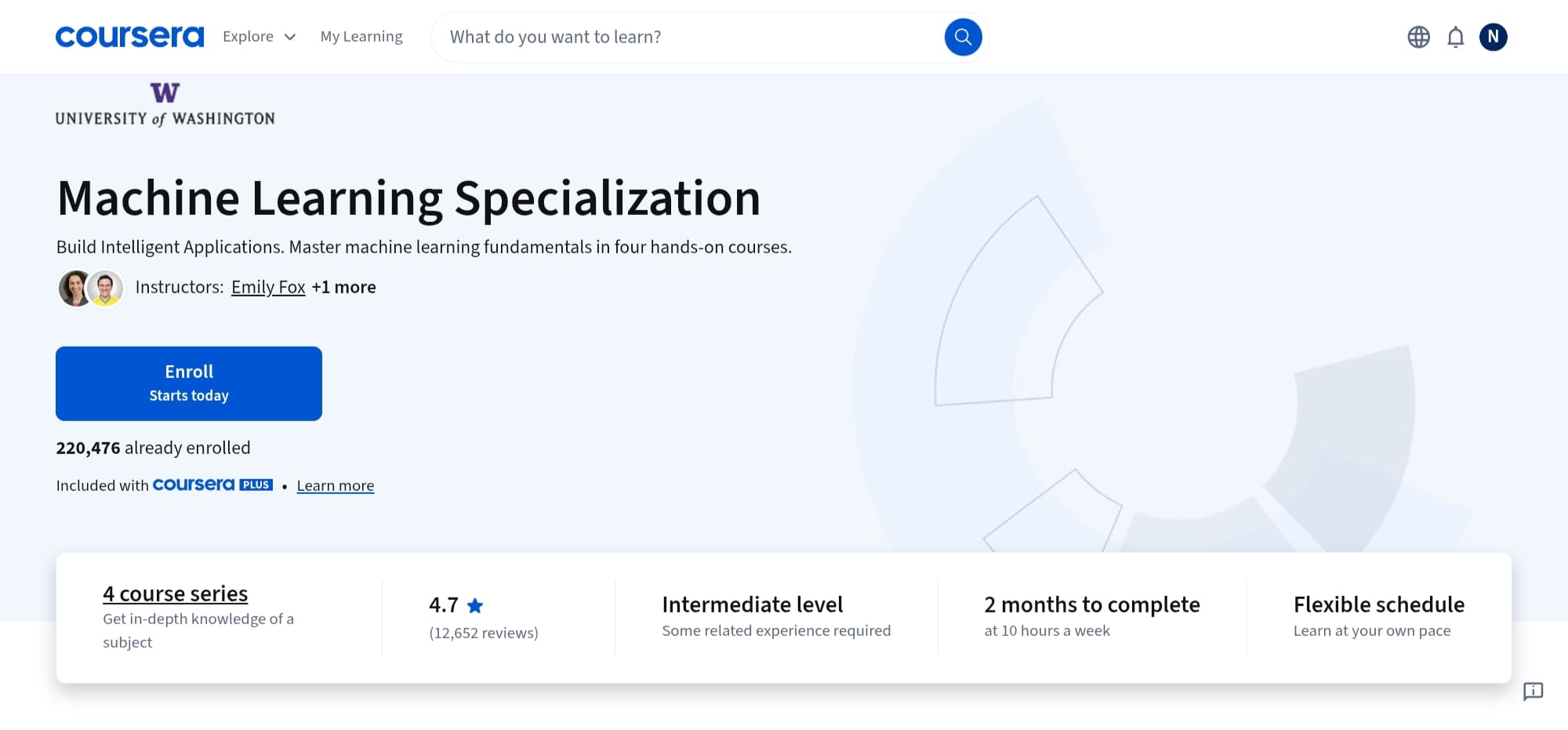
For learners who aspire to move beyond surface-level interest and actually comprehend how intelligent systems think, learn, and adapt, the Machine Learning Specialization on Coursera offers a remarkably structured point of entry.
Developed by prominent experts from the University of Washington, this four-part program does more than explain algorithms.
It walks you through the theoretical foundations of machine learning while firmly establishing each idea in useful, real-world applications.
You start with basic concepts and work your way up to creating systems that can identify patterns, categorize data, predict outcomes, and extract pertinent information from enormous collections.
Every course is designed to assist you in converting abstract theory into useful ideas and workable code.
Whether you are a student charting your academic path, a professional preparing for the next jump in your career, or a curious learner seeking to grasp the mechanics underlying today’s intelligent technology, this specialization offers a balanced blend of depth and accessibility.
It gives you the analytical mentality, technical confidence, and problem-solving approach required to engage with machine learning in an educated and impactful way.
This specialization offers a sophisticated and useful beginning point for anyone prepared to enter the field of intelligent systems in a world that is becoming more and more shaped by data.
What skills will you learn in this course?
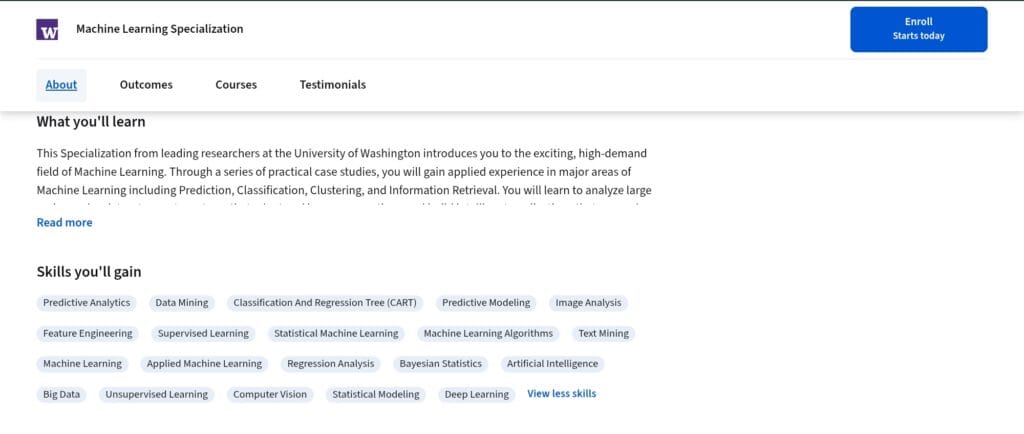
The Machine Learning Specialization gives you a potent blend of theoretical understanding, practical modeling capabilities, and real-world problem-solving talents.
In conclusion, you’ll be comfortable not just discussing machine learning but also creating intelligent systems from the start. Here’s what you’ll walk away with.
Predictive Modeling & Data-Driven Decision Making
You’ll learn how to use data to forecast outcomes, from housing prices to customer behavior. This includes understanding patterns, testing accuracy, and picking the correct type of model for the job.
Building Regression Models
You’ll grasp linear and regularized regression approaches, discover how to prevent overfitting, and understand the math that supports real business predictions.
These skills are crucial for banking, marketing analytics, real estate, and any job involving numerical forecasting.
Classification Techniques
Expect to go hands-on with classification models like logistic regression, decision trees, and boosted models.
You’ll learn how to educate machines to make yes/no choices, categorize data, and find patterns – the backbone of email filtering, fraud detection, and medical diagnosis.
Clustering & Unsupervised Learning
You won’t be afraid of unlabeled data anymore. You’ll learn to group comparable things, find hidden structures, and design recommendation-friendly clusters. This is crucial for customer segmentation, content grouping, and customisation systems.
Information Retrieval & Similarity Search
You’ll work with algorithms that power search engines, document matching, and content recommendation systems. This comprises nearest-neighbor search, similarity metrics, and scalable retrieval algorithms.
Machine Learning Pipelines & Model Optimization
You will discover how to transform an unprocessed problem into an ML task, prepare the features, train the model, fine-tune it, validate it, and confidently implement it. You are prepared for the workforce with these end-to-end abilities.
Feature Engineering & Data Pre-processing
You’ll learn how to turn unorganized, real-world data into clear, useful characteristics that enhance model performance, an essential ability for every prospective data scientist.
Read Also: How to Do Feature Engineering in Machine Learning: Step-by-Step Tips for Better Results
Practical Python Skills
Throughout the specialization, you will improve your Python skills, interact with popular machine learning frameworks, and build code that addresses real-world issues rather than exercises from textbooks.
Statistical Thinking & Model Evaluation
You will get an understanding of variance, bias, scalability, error metrics, cross-validation, and the “why” behind each model’s behavior. This is the kind of thinking that distinguishes skilled machine learning practitioners from mediocre ones.
Real-World Problem Solving
Most significantly, you’ll learn how to confidently select the best machine learning strategy when faced with complex business problems like sentiment analysis, recommendations, pricing, text search, and image recognition.
Read Also: Data Science Courses On Coursera To Help Land Your First Job
What Concepts Are Taught in The Machine Learning Specialization?
The Machine Learning Specialization simplifies the field of machine learning into easily understood ideas that complement one another. Instead of overwhelming you with algebra, it gives you the things you truly need to understand how intelligent systems work.
Supervised Learning Fundamentals
Supervised learning is the heart of modern machine learning, and this course makes sure you understand it in detail. You will discover that algorithms learn from labeled examples in the same way that students learn from solved problems.
This course explains how input features influence predictions, how algorithms learn patterns hidden within data, and why training data matters. Learning these concepts will strengthen your ML knowledge.
Regression Models & Optimization Techniques
Regression is one of the most popular machine learning concepts since it allows you to predict continuous values.
In this section, you will learn about loss functions and how models decrease errors, the effective use of features to improve prediction accuracy, and linear & polynomial regression for modeling trends.
By understanding these concepts, you will come to know how models function and why they function like that.
Classification Algorithms & Decision Boundaries
Here, you discover how ML systems make decisions when the outcome is a category rather than a number. Classification is used everywhere, from fraud detection to medical diagnosis.
This section teaches logistic regression, decision trees, boosting methods that combine weak models with strong ones, how algorithms separate classes, the concept of decision boundaries, and how to handle messy real-world problems.
Unsupervised Learning: Clustering & Pattern Discovery
Not all data comes with labels – and that’s where unsupervised learning shines. You’ll learn how to find natural groupings within raw data.
Here, you will learn K-means clustering, hierarchical clustering, mixture models, and how to use clustering for segmentation, recommendation, and trend analysis.
These techniques help data scientists understand hidden stories in datasets that humans often miss.
Information Retrieval & Similarity Search
One of the most fascinating and useful aspects of the specialization is this. It focuses on how algorithms extract pertinent content from enormous datasets, which is the fundamental concept underlying Netflix match-making, Google Search, and Amazon recommendations.
This section of the specialization teaches how to identify similarity between items, retrieve documents efficiently from large collections, rank algorithms and relevance scoring, and find the best match quickly from a search.
These techniques are helpful to build search engines, recommender systems, and content matching tools.
Machine Learning Evaluation & Improvement Strategies
Understanding a model’s performance is just as crucial as constructing it. In this section, you learn how to criticize, enhance, and validate your ML models using industry-standard methodologies.
This includes topics like cross-validation to measure reliability, bias vs variance tradeoff, error metrics, overfitting & underfitting, and diagnosing model issues via residual and error patterns.
End-to-End Machine Learning Pipelines
Finally, everything comes together. You study how machine learning works as a full system, from analyzing a problem to giving an actual solution.
You will go through topics like problem framing, data cleaning, feature engineering, preprocessing, interpreting and presenting results, choosing the right algorithms based on data types and objectives, etc.
This will make you job-ready and help you prepare end-to-end ML models on your own.
Read Also: Best Machine Learning Courses online
Who Should Join This Course?
Anyone who wants to learn how intelligent systems operate can enroll in Coursera’s Machine Learning Specialization, regardless of whether they are interested in AI, have aspirations of becoming a computer professional, or want to improve their existing abilities.
This course invites learners from diverse backgrounds, as long as they’re eager to learn by doing.
Students exploring data science and AI careers can join the specialization to get a solid foundation in machine learning.
Career switchers who come from a non-tech background and want to thrive in the tech world can join this course.
Working professionals who want to upskill to get better opportunities should enroll in this specialization.
Developers who want to learn machine learning to enhance their skillset can join this specialization.
Apart from that, entrepreneurs, business owners, and curious learners who want to understand AI and machine learning should join this specialization.
Read Also: Will AI Take My Job or Create a New One? A Deep Dive into the Post-AI Job Market
Will You Get a Job After Completing The Machine Learning Specialization?
The short answer: This course alone won’t guarantee you a job, but it will give you the exact abilities you need to start your path into machine learning and data science.
Consider this specialization to be the cornerstone of a home. It provides you with the framework, resources, and self-assurance to construct something solid, but you still need to work hard to make that foundation a profession.
This specialization will build a solid understanding of ML fundamentals, give you hands-on experience in building ML models, help you build portfolio-worthy projects, strengthen your resume and online presence, and make you eligible for entry-level jobs.
How Long Does This Course Take to Complete?
The Machine Learning Specialization is designed to fit nicely into a busy student or working professional’s schedule. The majority of students finish the full specialization in roughly two months on average, though this can vary based on your pace, past experience, and weekly study time.
How much does this course cost?

Coursera follows a subscription model, allowing learners to subscribe to a course on a monthly basis depending on the requirement.
Individual course subscriptions on Coursera cost around $39 to $49 per month.
The Coursera Plus subscription costs $59 per month, which gives access to 10,000+ courses, specializations, and certificates on Coursera.
This subscription is completely worth it if you want to take a series of courses without paying more fees.
Is it worth taking the Machine Learning Specialization on Coursera?
Yes – the Machine Learning Specialization on Coursera is highly worth studying, especially if you’re starting your path into data science or contemplating a career transition into AI.
What makes this course worthwhile is the balance it offers between strong academic underpinnings and practical, hands-on learning. You don’t simply learn how algorithms operate – you use them, assess them, and understand how they address real-world issues like prediction, classification, clustering, and retrieval.
Additionally, the specialisation is made to be accessible and adaptable. Since it’s self-paced, learners can easily manage it with college, a job, or other commitments.
Compared to offline bootcamps or university programs, it’s surprisingly economical, and the monthly subscription model allows you to manage how much you spend based on your speed.
Plus, the certificate you obtain adds legitimacy to your résumé and informs employers that you’ve completed formal training from a respectable university.
If you take this specialization seriously, complete all assignments, and follow it up with personal projects or internships, it becomes a highly valuable stepping stone.
It establishes the strong ML foundation you need and enhances your confidence to investigate more advanced topics like deep learning, NLP, MLOps, or computer vision.
For students, professionals in India, and anyone transferring careers, it’s a smart, economical, and impactful starting point. Overall, this course is well worth taking – as long as you see it as the beginning of your machine learning adventure, not the end.
FAQ
What is the main focus of the Machine Learning Specialization?
This specialization focuses on teaching the key concepts of machine learning—regression, classification, clustering, and information retrieval—through real-world applications and hands-on projects.
Do you need prior experience to take this course?
Basic programming abilities (ideally Python) and experience with high school–level math are desirable, but the course is meant to assist newcomers through the foundations.
What kind of projects will you build?
You’ll work on practical challenges, including predicting numeric values, categorizing text or images, grouping unlabeled data, and constructing similarity-based retrieval systems.
Does the course go beyond theory?
Sure. The specialization stresses application. You learn by constructing models, evaluating them, tuning them, and addressing real-world problems.
Who benefits most from this course?
Students, developers, career-switchers, and professionals who wish to create a strong foundation in applied machine learning will gain the greatest value from this specialization.
Share Now

More Articles
Soft Skills for Software Engineers: Beyond Coding and Debugging
Mathematics for Machine Learning Specialization – A Detailed Review
Machine Learning With Python – A Detailed Review
Discover more from coursekart.online
Subscribe to get the latest posts sent to your email.