

Last updated on February 12th, 2026 at 08:10 pm
With its ability to retrieve knowledge, reason through complex tasks, and even work alongside humans, generative AI is rapidly transforming how software interacts with the outside world.
More than just a basic understanding of AI is required to create such intelligent systems; developers also need to become proficient in multi-agent orchestration, LangChain, LangGraph, and Retrieval-Augmented Generation (RAG).
This is precisely what the IBM RAG and Agentic AI Professional Certificate on Coursera is meant to address.
This certificate lets students move beyond theory and develop useful GenAI applications driven by agentic workflows and contemporary LLM stacks, with a significant emphasis on experiential, project-based learning.
This course claims to give you job-ready abilities that reflect the state-of-the-art in AI development, regardless of your background—developer, data scientist, or machine learning engineer.
What Will You Learn in This Course?
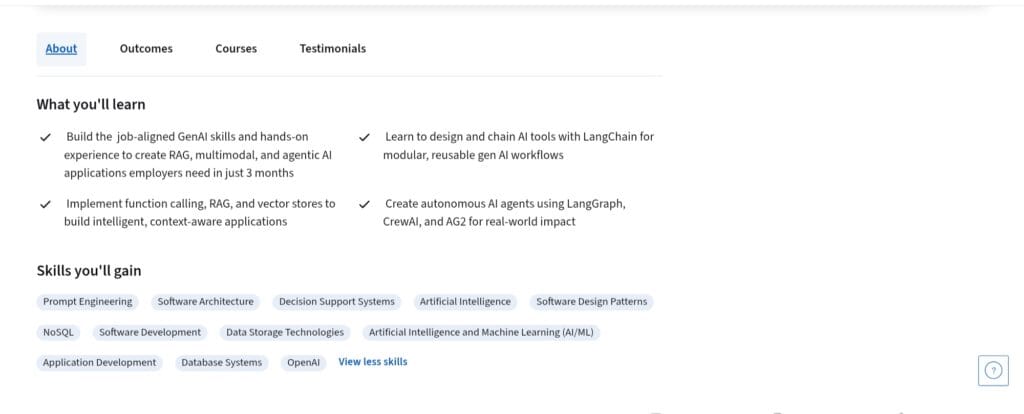
You will gain in-depth, practical experience with the tools that underpin contemporary generative AI applications with the IBM RAG and Agentic AI Professional Certificate. Using well-known open-source technologies like Flask for web-based deployment, Gradio for developing AI interfaces that are easy to use, and LangChain for building LLM pipelines, you will first learn how to create practical GenAI applications. The development of useful AI applications is based on these tools.
After that, you’ll explore Retrieval-Augmented Generation (RAG), a method that improves LLM replies by linking them to unique data sources. To help your AI models respond more precisely and contextually, you’ll work with vector databases like FAISS and ChromaDB as well as data frameworks like LlamaIndex to store, retrieve, and semantically search pertinent content.
You will learn more about the rapidly developing field of agentic AI as the course goes on. Using frameworks such as LangChain Agents, LangGraph, CrewAI, AutoGen, and BeeAI, you will discover how to develop multi-step, clever AI agents. These agents are extremely useful in enterprise-grade applications since they can call tools, recall past interactions, and even work together with other agents to accomplish challenging tasks.
The certificate teaches you how to create multimodal applications that process text, graphics, audio, and video in addition to text-based systems. This is an essential ability for creating next-generation user experiences. You will see how to construct sophisticated, interactive apps by integrating models such as DALL·E (for picture creation), Whisper (for speech), and other fundamental models.
Lastly, this program focuses heavily on teaching you how to organize and coordinate agentic workflows, which include decision-making, memory, reasoning, and cooperation amongst tools or agents. Using LangGraph, an orchestration framework that permits sophisticated agent behavior including looping, branching, and conditional execution, you will practice putting these workflows into effect.
Project-based challenges that mimic real-world situations, graded assignments, and interactive labs complement each module in the professional certificate. Not only will you comprehend the theory underlying sophisticated GenAI systems at the end of the course, but you will also have a portfolio of real-world projects to show potential employers or clients your abilities.
What Concepts Are Taught in This Course?
The IBM RAG and Agentic AI Professional Certificate is organized into eight thoroughly focused courses that build on one another to provide a comprehensive understanding of the modern generative AI stack.
As you advance through the specialization, you can acquire both breadth and depth because each course covers a distinct area of GenAI development, ranging from agent orchestration to prompt engineering.
1. Develop Generative AI Applications: Get Started
The fundamental ideas of generative AI, such as prompt engineering methods and in-context learning, are covered in this course. You’ll discover how to create basic yet useful web apps with Gradio and Flask, as well as how to use LangChain to organize interactions with LLMs.
By concentrating on fundamental techniques and tools for interacting with big language models in a programmable manner, it lays the foundation for the creation of increasingly complex GenAI applications.
2. Build RAG Applications: Get Started
Here, you explore Retrieval-Augmented Generation (RAG), a potent technique that adds outside information sources to LLMs. You will learn how to integrate custom documents and create retrieval routines in order to construct RAG pipelines using LangChain.
It covers things like document loaders, embeddings, and simple retrievers. By enabling your models to pull in pertinent, context-aware data, this course teaches you how to go beyond static prompts.
3. Vector Databases for RAG: An Introduction
The foundations of vector search, an essential part of RAG systems, are the main topic of this course. You will learn about vectorization methods, indexing strategies, and similarity measures, and get practical experience with FAISS and ChromaDB.
Additionally, you will learn how to effectively store and search through embeddings. Building scalable, effective GenAI applications requires these abilities.
4. Advanced RAG with Vector Databases and Retrievers
This module builds on the prior course by examining more complex retrieval strategies such as multi-query retrieval, semantic filtering, and reranking procedures.
You’ll focus on fine-tuning performance, integrating intricate retrieval chains, and optimizing retrievers for speed and accuracy. To help you grasp the concepts, real-world examples are presented, such as knowledge bases and enterprise document search.
5. Build Multimodal Generative AI Applications
By teaching you how to handle multimodal inputs, this course broadens your toolkit. In order to enable richer, more interactive AI systems, you will learn how to develop apps that integrate text, graphics, audio, and video.
You will explore with tools such as DALL·E for picture production, Whisper for speech-to-text, and models that analyze numerous input formats—all of which are becoming more and more important in industries like media, education, and healthcare.
6. Fundamentals of Building AI Agents
You will learn about agentic AI systems for the first time in this course. In order to understand how to set up tool use, design prompt templates, and control response formats, you will first create basic AI agents using LangChain.
You’ll also learn how agents use tools (such as document retrievers, search APIs, and calculators) to accomplish things other than providing static answers. This lays the theoretical groundwork for later in the specialization, more intricate agent orchestration.
Read Also: Advanced Data Science Courses On Coursera For Experienced Professionals
7. Agentic AI with LangChain and LangGraph
Things become more sophisticated at this point. Using LangGraph, you will investigate stateful workflows that let your agents plan tasks, remember things, and make judgments over a number of steps.
There is discussion of ideas like conditional branches, looping, and multi-agent cooperation. Like human processes, this course teaches you how to create really intelligent systems that can reason, adapt, and iterate across tasks.
8. Agentic AI with LangGraph, CrewAI, AutoGen, BeeAI
You will learn about a variety of robust open-source multi-agent frameworks, including CrewAI, AutoGen, and BeeAI, in the last course. You’ll work with modular agents that cooperate on tasks, evaluate and contrast these tools, and investigate orchestration methods for practical GenAI applications.
This course concludes the specialty by giving you the ability to select the most appropriate framework for your use case, while also showcasing the state-of-the-art technologies that tech businesses currently employ.
Who Should Join This Course?
Developers and software engineers wishing to create AI-native applications will find this professional credential perfect.
Moreover, ML engineers and data scientists prepared to expand their knowledge of generative AI, AI aficionados and job changers with fundamental Python skills, and IT specialists hoping to work on agentic workflows and retrieval-based systems will find this course valuable.
Basic Python programming skills and a fundamental comprehension of AI/ML principles are required for this course. There is no requirement for extensive prior knowledge of agentic design or LangChain.
Will You Get a Job After Completing the IBM RAG and Agentic AI Professional Certificate?
While no course can guarantee employment, this program provides job-relevant, project-based learning that aligns closely with roles, such as Generative AI Developer, AI/ML Engineer, LLM Application Engineer, RAG Specialist, and Agentic AI Developer.
You will graduate with a shareable IBM credential, many portfolio projects, and practical lab experience—all of which enhance your employability in the GenAI-driven job market of today.
For best exposure during interviews, upload your completed capstone projects on GitHub or use Hugging Face/Gradio.
Read Also: Best RAG Courses Online [Expert Choices]
How Long Does This Course Take to Complete?
This professional certificate is self-paced, and you can complete this course in 2 to 3 months at a pace of 5 to 6 hours per week.
How Much Does This Course Cost?
This course is available on Coursera, which allows you to access this course with a monthly subscription. This will take around 3 months to complete, so you can subscribe to this course for 3 months at a cost of around $32 per month (total $96).
If you can give more time and complete this course in one month, you can subscribe to this course for one month at a cost of $49.
Otherwise, you can opt for the Coursera Plus subscription plan, which will cost you around $59 per month and offer access to 10,000+ courses on the platform.
Depending on your learning goals, you can decide which subscription model is perfect for you.

Is It Worth Taking the IBM RAG and Agentic AI Professional Certificate on Coursera?
Yes, particularly if you want to work directly with the newest frameworks and tools for generative AI. This IBM-taught certificate emphasizes project-based learning and offers enterprise-level content from a reputable IT leader.
In addition to watching videos, you will use popular tools like FAISS, CrewAI, LangChain, LangGraph, and others to create functional applications. The program is extremely useful for positions in GenAI and AI agent development because it closely reflects industry demands.
Additionally, the stackable IBM certificate enhances the value of your LinkedIn profile and CV. It’s crucial to remember that the software calls for a fundamental grasp of AI ideas as well as intermediate-level Python proficiency.
There may be a learning curve with some of the tooling, like CrewAI or LangGraph, which makes it less appropriate for total novices. That said, this specialty is well worth the investment if you’re serious about future-proofing your AI career and want to go beyond simple LLM APIs into sophisticated RAG and agentic systems.
Frequently Asked Questions
Do I need to know Python before taking this course?
Yes. You’ll be dealing with databases, utilizing LangChain APIs, and creating AI pipelines; thus, having a solid understanding of Python is crucial.
Are there coding assignments and projects?
Of course! Labs and practical projects utilizing Flask, Gradio, Jupyter Notebooks, and actual LLM APIs are included in every lesson.
What tools will I learn?
LangChain, LangGraph, CrewAI, BeeAI, AutoGen, LlamaIndex, FAISS, ChromaDB, Whisper, DALL·E, and many others.
Can beginners take this course?
Although it’s not impossible, novices should try this professional certificate after finishing core GenAI or AI programming classes.
Share Now

Related Articles
Generative AI and You: What Can You Create with Generative AI?
How generative AI can help you land your dream job? 7 Steps to Follow
30+ Best Generative AI Tools for Beginners to Try in 2025

As an engineer with a passion for learning and sharing knowledge, I created CourseKart.online to help students, professionals, and lifelong learners choose the best online courses. With so many options available, finding the right one can be overwhelming. My goal is to simplify that process by offering insights, reviews, and recommendations on the top online learning resources. I hope my posts inspire you to keep growing, learning, and exploring new opportunities.
Discover more from coursekart.online
Subscribe to get the latest posts sent to your email.