
Discover the best PyTorch courses online to master deep learning, build real-world AI projects, and boost your career with beginner-to-advanced learning paths.
PyTorch has emerged as one of the most popular frameworks for deep learning, artificial intelligence, and modern machine learning development.
PyTorch is an established framework among researchers, startups, and large technology businesses due to its straightforward design, dynamic computation graphs, and strong Python integration.
PyTorch is used to train neural networks and build computer vision models, as well as to power natural language processing and generative AI systems.
I created this tutorial with a broad but focused audience in mind. Students and beginners will benefit from planned learning routes that help them master fundamental PyTorch ideas without feeling overwhelmed.
Data scientists can utilize this resource to improve their deep learning abilities and transition from experimentation to real-world model creation.
Machine learning engineers and AI experts will benefit from course recommendations that focus on performance optimization, scalability, and practical use cases that are relevant to industry expectations.
By the end of this post, you will have a solid understanding of the best PyTorch online courses available today, including which ones are best for beginners, professionals, and advanced learners.
What Is PyTorch and Why Is It So Popular?
PyTorch is an open-source deep learning framework built on top of Python, widely used for developing, training, and deploying neural networks.
It offers a versatile and user-friendly environment for working with tensors, automatic differentiation, and GPU acceleration, making it easy to test sophisticated machine learning models.
PyTorch is particularly praised for its dynamic computation graph, which enables developers to design and debug models in a way that seems natural and closely aligned with traditional Python programming practices.
One of the main reasons PyTorch is preferred above many other deep learning frameworks is its simplicity and transparency. The framework stresses readability and control, allowing learners and professionals to comprehend how models are built and trained.
PyTorch has become widely used in both academic research and production applications. It is the most often used framework in AI research, appearing in both published papers and experimental models.
Simultaneously, PyTorch has grown into a production-ready platform with capabilities for scale training, model optimization, and deployment on cloud and edge devices.
PyTorch’s blend of research independence and industrial stability has made it a long-term choice for enterprises developing AI-powered products.
PyTorch is widely employed in a variety of high-impact sectors in the real world. It is used in computer vision systems for picture classification, object detection, and video analysis.
PyTorch is an important tool in natural language processing for creating language models, chatbots, translation systems, and transformers.
It also has a significant impact on generative AI, allowing the creation of text, image, audio, and multimodal generation models.
These broad application cases explain why knowing PyTorch is becoming seen as a necessary skill for anybody interested in a career in AI and deep learning.
List of the Best PyTorch Courses Online
| Sl No. | Course Name | Best For | Duration | Skill Level |
|---|---|---|---|---|
| 1 | PyTorch for Deep Learning Professional Certificate | Best Comprehensive PyTorch Deep Learning Certification Online | 2 Months | Intermediate |
| 2 | IBM Deep Learning with PyTorch, Keras, and TensorFlow Professional Certificate | Best Multi-Framework Deep Learning Professional Program Available | 2 Months | Intermediate |
| 3 | Deep Learning with PyTorch | Best Practical PyTorch Course for Learners | 3 Weeks | Intermediate |
| 4 | Machine Learning with PyTorch and Scikit-Learn | Best Combined Machine Learning and PyTorch Training | 4 Weeks | Intermediate |
| 5 | PyTorch for Deep Learning and Computer Vision (Udemy) | Best Applied PyTorch Computer Vision Training Online | 15 Hours | Beginner |
| 6 | Deep Learning for Beginners: Core Concepts and PyTorch (Udemy) | Best Foundational PyTorch Deep Learning Course | 10 Hours | Beginner |
| 7 | PyTorch for Deep Learning (Udemy) | Best Hands-On Practical PyTorch Learning Path | 53 Hours | Intermediate |
| 8 | Complete Computer Vision Bootcamp With PyTorch & TensorFlow — Course Review | Best Full-Stack PyTorch and Vision Bootcamp | 60 Hours | Intermediate |
| 9 | PyTorch for Deep Learning & Machine Learning – Full Course (YouTube) | Best Free Full-Length PyTorch Deep Learning Tutorial | 26 Hour | Beginner |
| 10 | PyTorch & AI Engineering Full Course — YouTube Tutorial Review | Best Practical PyTorch Coding Tutorial Online | 5 Hours | Beginner |
1. PyTorch for Deep Learning Professional Certificate
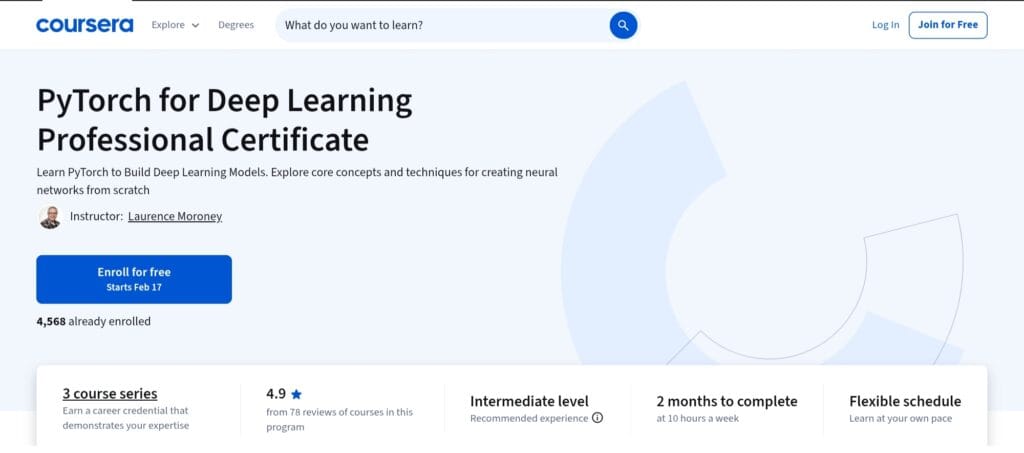
The PyTorch for Deep Learning Professional Certificate is a three-course program offered by DeepLearning.AI on Coursera that teaches students how to develop, train, optimize, and deploy deep learning models with PyTorch.
The curriculum is designed to take you from basic PyTorch ideas to sophisticated architectures and real-world deployment strategies.
Throughout the program, you will gain hands-on experience with computer vision and natural language processing projects, fine-tune pretrained models, and optimize models for deployment with tools such as ONNX and MLflow.
Key Concepts Covered
- Fundamentals of PyTorch, such as tensors, neural networks, training loops, and model evaluation.
- Transfer learning and fine-tuning for computer vision and NLP tasks.
- Hyperparameter tuning and optimization to improve model performance.
- Advanced architectures like ResNet, DenseNet, Siamese networks, and Transformers.
- Model deployment with ONNX, pruning, quantization, and experiment tracking with MLflow.
- Real-world project applications, including classification, image segmentation, and text tasks.
Who This Course Is Best For
- Aspiring deep learning engineers
- Intermediate learners
- Data scientists and ML professionals
2. IBM Deep Learning with PyTorch, Keras, and TensorFlow Professional Certificate
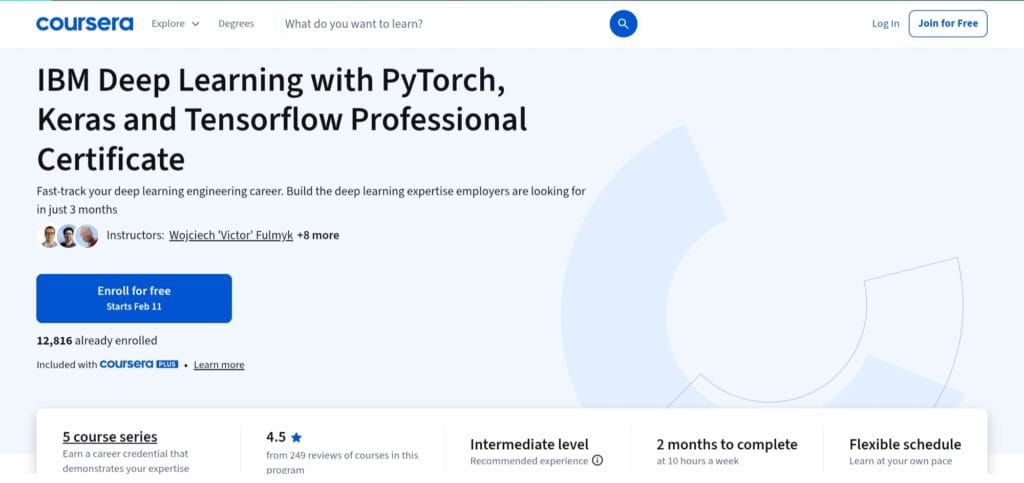
The IBM Deep Learning with PyTorch, Keras, and TensorFlow Professional Certificate is an intermediate-level, multi-course program that will provide you with comprehensive, hands-on experience with deep learning utilizing three of the industry’s most powerful frameworks: PyTorch, Keras, and TensorFlow.
This professional certificate, which is delivered over 5 courses and culminates in a capstone project, teaches you how to develop, train, and deploy neural networks for real-world tasks such as vision, language, and sequence modeling.
Throughout the curriculum, you will use foundational models, advanced structures, and practical tools that are based on real-world industrial procedures.
Key Concepts Covered
- Building and training deep learning models like linear, logistic regression, and feedforward networks using PyTorch.
- Basic neural network and deep learning concepts.
- Developing advanced convolutional and transformer-based models.
- Techniques of supervised, unsupervised, and reinforcement learning.
- Deploying deep learning modules and evaluating model performance.
Who This Course Is Best For
- Aspiring AI and deep learning engineers
- Intermediate learners with basic Python and machine learning understanding
- Data scientists and ML professionals
Read Also: Best Deep Learning Courses Online [Beginner to Advanced] (Coursera)
3. Deep Learning with PyTorch

Deep Learning with PyTorch on Coursera provides a structured and hands-on introduction to creating and training deep neural networks using the PyTorch framework.
It is designed as a targeted, stand-alone course that takes students from essential deep learning ideas to hands-on model implementation.
You will get experience with neural network designs through a number of courses, as well as learn how to train, verify, and optimize models for popular tasks like image classification and sequence learning.
Interactive assignments, laboratories, and evaluations are used in the course to promote practical understanding.
Key Concepts Covered
- Deep learning and neural network fundamentals, including activation functions and forward/backward propagation.
- Using PyTorch to build and train models.
- Concepts of convolutional neural networks and recurrent neural networks.
- Optimization techniques like transfer learning and regularization.
- Model evaluation, performance, tuning, and real-world implementation techniques.
Who This Course Is Best For
- Intermediate learners and aspiring deep learning engineers.
- Students and professionals who want to apply PyTorch coding skills to their projects.
4. Machine Learning with PyTorch and Scikit-Learn

This course brings together the fundamental principles of traditional machine learning with PyTorch’s contemporary deep learning capabilities. It is hosted on Coursera and was created in partnership with Packt course instructors.
It takes students on a full tour of scikit-learn and PyTorch, two of the most popular Python ecosystems for machine learning and deep learning.
The curriculum mixes theory, hands-on experiments, and real-world examples to teach participants how to create predictive models, implement neural networks, and investigate advanced approaches like transformers and graph neural networks.
It is divided into 19 parts that address important data processing operations and modern model implementations.
Key Concepts Covered
- Machine learning fundamentals, including supervised and unsupervised learning techniques.
- Methods of data processing, feature engineering, dimensionality reduction, and neural network implementation.
- Doing image and sequence tasks with convolutional and recurrent neural networks.
- Basics of modern architectures, such as transformers and advanced learning models.
Who This Course Is Best For
- Python developers
- Aspiring data scientists
- Intermediate learners with basic Python and machine learning knowledge
Read Also: Best TensorFlow Courses Online to Master Deep Learning and AI
5. PyTorch for Deep Learning and Computer Vision (Udemy)

PyTorch for Deep Learning and Computer Vision is a beginner-friendly, project-oriented Udemy course that teaches you how to use PyTorch to create machine learning and deep learning applications, with a focus on computer vision problems.
The course, which follows a “learn by doing” concept, starts with the principles of PyTorch and progresses to hands-on activities that entail creating neural networks, using sophisticated pre-trained models, and addressing real-world computer vision challenges.
With over 14,000 students enrolled and outstanding learner evaluations, this course is ideal for anyone seeking an applied grasp of PyTorch in visual AI domains.
Key Concepts Covered
- Fundamentals of PyTorch tensors and automatic differentiation
- Building neural networks from scratch and implementing machine learning and deep learning workflows
- Applications of computer vision include image classification and advanced imagery tasks.
- Liveraging pre-trained models to solve complex vision problems.
Who This Course Is Best For
- Beginners and aspiring AI developers
- Students and professionals who want to implement PyTorch in real-world visual AI tasks.
- Self-learners and entrepreneurs who want to upskill
6. Deep Learning for Beginners: Core Concepts and PyTorch (Udemy)

Deep Learning for Beginners: Core Concepts and PyTorch provides a simple and easy introduction to the fundamental ideas of deep learning while also grounding students in practical PyTorch processes.
This Udemy course will help you visualize and comprehend how deep neural networks function under the surface, including computational graphs and gradient-based learning.
You’ll design neural networks from scratch using PyTorch and PyTorch Lightning, combining conceptual explanations with hands-on coding activities, preparing you to confidently explore more advanced models and real-world AI applications.
Key Concepts Covered
- Basic mathematical topics used in deep learning operations
- Fundamentals of deep learning and neural network mechanics
- Developing neural networks from scratch with PyTorch and PyTorch Lightning.
- Concepts of computational graphs and how PyTorch implements them.
- Basic concepts of advanced architectures like CNNs, RNNs, and Transformers
Who This Course Is Best For
- Beginners who want a math-friendly course on deep learning with PyTorch.
- Students and professionals who want to understand deep learning fundamentals and computational concepts.
- Python developers who want to enter the realm of AI and PyTorch with confidence.
Read Also: best AI courses online [AI Career Guide]
7. PyTorch for Deep Learning (Udemy)

PyTorch for Deep Learning is a beginner-friendly course on Udemy that teaches fundamental PyTorch skills and the fundamentals of deep learning using code-based lessons and hands-on projects.
The course is aimed at helping students build a solid foundation for constructing neural network models using PyTorch, covering everything from basic tensor operations to training and assessing models for real-world situations.
The curriculum blends hands-on coding activities with conceptual explanations, making it perfect for students who want to swiftly transition from theory to practice with real-world PyTorch applications.
Key Concepts Covered
- Fundamentals of PyTorch tensors and Autograd differentiation.
- Development of neural networks using torch.nn module and model architecture design.
- Using backpropagation and optimizers to train and optimize models.
- Real-world use cases like image classification and regression tasks
- Application of regularization techniques and performance tuning.
Who This Course Is Best For
- Beginners who want a structured and friendly introduction to PyTorch.
- Students and self-learners who want to build fundamental skills in PyTorch.
- Developers and professionals who want to upskill with essential PyTorch skills.
8. Complete Computer Vision Bootcamp With PyTorch & TensorFlow — Course Review

Complete Computer Vision Bootcamp with PyTorch & TensorFlow is a thorough Udemy training program that takes students from basic computer vision ideas to sophisticated deep learning applications utilizing two of the most powerful frameworks in the AI ecosystem.
This bootcamp, which is based on hands-on project work and real-world implementations, teaches students how to construct and deploy computer vision models, ranging from analyzing picture data and using convolutional neural networks (CNNs) to mastering object detection and transfer learning techniques.
With approximately 60 hours of information and practical exercises, this course is designed to help both beginners and intermediate practitioners master visual AI workflows.
Key Concepts Covered
- Comprehensive knowledge of CNNs, data processing, augmentation, and model building using both PyTorch and TensorFlow.
- Implementation of object detection models such as YOLO and Faster R CNN.
- Understanding of image data, pixel structures, and color spaces for visual inputs.
- Data augmentation and processing methods to enhance model performance.
- Application of transfer learning with pretrained networks like VGG and ResNet.
Who This Course Is Best For
- Beginner learners in computer vision
- Aspiring data scientists and ML engineers
- Professionals who are looking to expand their skills into visual AI
9. PyTorch for Deep Learning & Machine Learning – Full Course (YouTube)
This free, thorough PyTorch video course on YouTube is provided by freeCodeCamp.org, one of the most reputable online learning channels for programming and AI topics.
It’s a comprehensive deep learning tutorial that covers everything from initial principles to real PyTorch model training and processes.
This resource, which spans over 20 hours of thorough content, guides learners through foundational machine learning principles, PyTorch fundamentals, neural network implementations, training loops, and assessment methodologies, making it an ideal free alternative to paid courses.
This style is ideal for students who prefer self-paced video training with detailed coding demonstrations and explanations at every step.
Key Concepts Covered
- Fundamentals of PyTorch, including tensors, automatic differentiation, and computational basics.
- PyTorch workflow, like dataset creation, training splits, training loops, and optimizer
- Building neural networks, including model architecture, activation functions, loss functions, and evaluation metrics.
- Classification tasks, such as the implementation of classification models from scratch and evaluating performance.
- Practical coding demonstrations and extended deep learning projects
Who This Video Course Is Best For
- Beginner learners in the domain of PyTorch and deep learning
- Students and self-learners who are looking for a long-form video course for step-by-step guidance.
10. PyTorch & AI Engineering Full Course — YouTube Tutorial Review
This PyTorch-focused AI engineering course on YouTube provides a full-length, systematic walkthrough of deep learning topics, from fundamental machine learning principles to actual model training and implementation using PyTorch.
It’s designed as a free, start-to-finish video resource for students who wish to improve their PyTorch skills without enrolling in a costly class.
The content is organized logically, starting with AI and machine learning principles and progressing to PyTorch installation, tensor manipulation, training loops, neural network building, and convolutional models for computer vision tasks.
The style is ideal for self-paced learners who appreciate detailed explanations and hands-on code examples.
Key Concepts Covered
- Basics of AI, the difference between machine learning and deep learning, and essential workflow concepts.
- PyTorch setup process and Tensor basics
- Model training and Autograd concepts
- Concepts of computer vision with CNNs
- Concepts of neural networks and model building
Who This Video Course Is Best For
- Self-learners and beginners who want to learn PyTorch without paying a cost
- Students and professionals who want to learn the theoretical and practical contexts of code workflows.
PyTorch vs TensorFlow – Which Should You Learn?
Choosing between PyTorch and TensorFlow is a popular question for anyone getting started with deep learning and artificial intelligence. Both frameworks are effective, extensively used, and supported by robust ecosystems.
However, the best option is determined by how you study, what you intend to build, and where you want to go with your career.
Ease of Learning
PyTorch’s Python-first design and intuitive coding style make it a popular choice among beginners. Its dynamic computation graph enables you to develop and debug code in a natural manner, making it easier to comprehend how models work step by step.
This is why many students prefer to start with PyTorch when they wish to learn deep learning online without becoming overwhelmed by framework complexity.
While TensorFlow is highly powerful, beginners will face a higher learning curve.
Its ecosystem comprises numerous abstractions and tools, which can appear confusing at first. However, once mastered, TensorFlow provides robust structure and consistency, particularly for large-scale systems.
Research vs Production
PyTorch rules the research community. The majority of cutting-edge AI research, including work on transformers, generative models, and massive language models, is created and published with PyTorch.
Its versatility makes it excellent for experimentation, rapid prototyping, and architecture modification throughout research.
TensorFlow has generally performed better in production settings, especially for large organizations. Its tools for deployment, mobile inference, and distributed systems are mature and well-integrated.
PyTorch, on the other hand, has greatly addressed this gap by providing tools for scalable training and production-ready deployment, making it a viable option beyond research.
Career Opportunities
Both frameworks are useful for careers, but PyTorch has seen a surge in popularity. Machine learning engineers, deep learning engineers, AI researchers, and generative AI specialists are increasingly listing PyTorch as a desired or essential talent.
Learning PyTorch is very useful if you want to work in research, startups, or with teams developing advanced AI models.
TensorFlow is still significant in enterprise settings and product-focused teams, so being familiar with both frameworks can be advantageous. However, starting with PyTorch typically makes it easier to switch to other frameworks later on.
When PyTorch Is the Better Choice
A comprehensive PyTorch deep learning course can give a strong basis for learners who subsequently want to use other frameworks and tools.
PyTorch is a better choice for students and beginners who want a smoother learning experience with a focus on deep learning, research, or generative AI.
PyTorch offers flexibility with model design and helps build a strong foundation before moving into production settings.
Career Opportunities After Learning PyTorch
Mastering PyTorch opens the door to a variety of fast-growing careers in artificial intelligence, machine learning, and data science.
As corporations increasingly rely on deep learning to create intelligent systems, knowledge of PyTorch has become one of the most valuable technical talents in the AI job market.
Machine Learning Engineer
Machine Learning Engineers create, develop, and implement predictive models to enable intelligent applications. With PyTorch knowledge, you can build neural networks, streamline training operations, and incorporate deep learning models into scalable applications.
This profession combines software engineering approaches with machine learning expertise, and it frequently collaborates with data engineers, product teams, and DevOps to develop solid AI solutions.
Deep Learning Engineer
Deep Learning Engineers concentrate on creating and fine-tuning deep neural networks for specialized applications, including computer vision, natural language processing, and generative AI.
PyTorch’s versatility and strong research emphasis make it suitable for this function, which frequently requires experimentation with architectures such as CNNs, RNNs, and transformers.
Professionals in this field are required to have a strong technical background and the ability to apply cutting-edge models in real-world scenarios.
AI Researcher
AI researchers investigate innovative approaches, systems, and algorithms that propel the field forward. PyTorch is popular among research labs and academic groups because of its dynamic computation graph and simplicity of prototyping.
PyTorch is used by researchers to develop novel algorithms, execute controlled experiments, and contribute to open-source AI work, with many papers published and future frameworks influenced.
Data Scientist
Data Scientists use domain knowledge, statistical analysis, and machine learning to derive insights from data and solve business challenges.
While data scientists use a variety of methodologies, those with deep learning experience, particularly in PyTorch, can tackle challenging problems that go beyond typical models, such as image recognition, sequence generation, and recommendation systems.
PyTorch proficiency improves a data scientist’s capacity to work on complex analytics projects.
FAQs – Best PyTorch Courses Online
Is PyTorch beginner-friendly?
Yes. PyTorch is considered one of the most beginner-friendly deep learning frameworks due to its intuitive Python syntax and dynamic computation graph, which makes experimentation and debugging easier.
How long does it take to learn PyTorch?
The time required to learn PyTorch depends on your prior experience with Python and machine learning. For someone with a basic understanding of Python and algebra, you can grasp the fundamentals within 4–8 weeks with consistent study. Becoming proficient and ready for professional projects typically takes 3–6 months of practice, project work, and deeper course engagement.
Is PyTorch better than TensorFlow?
Both frameworks are powerful, but they serve slightly different audiences:
PyTorch is widely preferred by researchers and learners for its readability and ease of experimentation.
TensorFlow has traditionally been stronger in production deployment and enterprise environments.
If your focus is research, rapid prototyping, or deep learning experimentation, PyTorch is often the better choice. For large-scale production systems that require robust deployment tooling, TensorFlow remains a strong option.Can I get a job after learning PyTorch?
Yes. PyTorch is widely used in roles such as machine learning engineer, deep learning engineer, AI researcher, and data scientist.
Final Verdict – Which PyTorch Course Should You Choose?
The ideal PyTorch course is determined by your present level of experience, learning objectives, and how you intend to utilize PyTorch, whether for academic study, career growth, or real-world AI creation.
Beginners require structured instruction and clear explanations, but experts benefit from advanced workflows, optimization strategies, and project-based learning.
Share Now

More Articles
Will AI take over data science jobs? A balanced perspective
AutoML vs Manual ML: Which One Delivers Better Results (and When)?
How to Do Feature Engineering in Machine Learning: Step-by-Step Tips for Better Results
Discover more from coursekart.online
Subscribe to get the latest posts sent to your email.