
A new stage of development is being reached by artificial intelligence. Prompt-based AI systems are still essentially reactive, despite their remarkable performance in conversational tasks, coding assistance, and content creation.
They follow instructions, work one task at a time, and are largely dependent on constant human input. Agentic AI is a clear deviation from this constraint.
Agentic AI systems are made to behave independently, plan multi-step processes, make decisions, and use tools to accomplish predetermined goals with little supervision, as opposed to only reacting to instructions.
This shift from prompt-driven models to autonomous AI agents represents a fundamental shift in the development and implementation of intelligent systems.
AI agents can function more like digital collaborators than passive aides thanks to agentic AI, which integrates large language models with reasoning, memory, tool usage, and feedback loops.
The focus shifts from discrete outputs to end-to-end issue solutions, whether an AI agent is managing data pipelines, carrying out business procedures, or organizing software development chores.
This post is intended for developers, AI engineers, data scientists, and founders who wish to learn how to design, construct, and implement autonomous AI systems rather than just use AI on a surface level.
This guide will assist you in navigating the landscape of the best agentic AI courses online and selecting learning pathways that deliver useful, future-ready skills, whether you are already working with large language models and want to understand how agents think, act, and collaborate, or if you are getting ready for the next wave of AI-driven roles.
What Is Agentic AI? A Clear and Practical Explanation
In order to comprehend the current state of artificial intelligence, a fundamental question must be addressed: What is agentic AI?
Agentic AI, to put it simply but accurately, refers to AI systems that are capable of autonomously planning, making decisions, and acting to accomplish particular objectives as opposed to only reacting to specific cues.
Agentic AI functions as a self-directed system that can handle complicated, multi-step tasks with little human assistance, in contrast to classic AI models that carry out discrete instructions.
The fundamental idea behind agentic AI is agency. These systems are made to function as independent issue solvers. They are given a goal, tools, and contextual knowledge, and they figure out how to get there.
Because of this, agentic AI is especially effective for real-world applications where activities are interconnected, dynamic, and call for ongoing decision-making as opposed to one-time replies.
Best Agentic AI Courses Online
| Sl No. | Course Name | Best For | Level | Duration |
|---|---|---|---|---|
| 1 | Agentic AI and AI Agents for Leaders Specialization | Business leaders and product decision-makers who want to understand how agentic AI creates strategic advantage without deep coding. | Beginner | 4 Weeks |
| 2 | IBM RAG and Agentic AI Professional Certificate | Developers and AI engineers aiming to build production-grade agentic AI systems using RAG, vector databases, and modern agent frameworks. | Advanced | 8 Weeks |
| 3 | Building AI Agents and Agentic Workflows Specialization | Intermediate learners who want hands-on experience designing structured, multi-agent workflows with memory and orchestration. | Intermediate | 4 Weeks |
| 4 | Building AI Agents with OpenAI Specialization | Developers looking to build real-world AI agents using OpenAI models, memory systems, RAG pipelines, and multi-agent communication. | Intermediate | 4 Weeks |
| 5 | AI Agents and Agentic AI in Python: Powered by Generative AI Specialization | Python developers who want to implement autonomous AI agents through code-first, framework-driven workflows. | Beginner | 4 Weeks |
| 6 | Microsoft AI Agents: From Foundations to Applications Professional Certificate | Professionals targeting enterprise and cloud-based AI agent roles within the Microsoft and Azure AI ecosystem. | Intermediate | 8 Weeks |
| 7 | Agentic AI Performance & Reliability Specialization | AI engineers and MLOps professionals focused on deploying reliable, monitored, and scalable agentic AI systems in production. | Intermediate | 4 Weeks |
| 8 | Agentic Prompt Engineering | Learners who want to master prompt design specifically for autonomous agents and goal-driven AI workflows. | Beginner | 1 Hour |
| 9 | Building AI Agents – Fundamentals to Advanced | Practitioners interested in practical AI agent automation using real workflows like scheduling, email handling, and event pipelines. | Intermediate | 5 Hours |
| 10 | Agentic AI Full Course 2025 | AI Agents Tutorial For Beginners | Edureka | Beginners seeking a broad conceptual introduction to agentic AI before committing to structured, hands-on courses. | Beginner | 7 Hours |
1. Agentic AI and AI Agents for Leaders Specialization
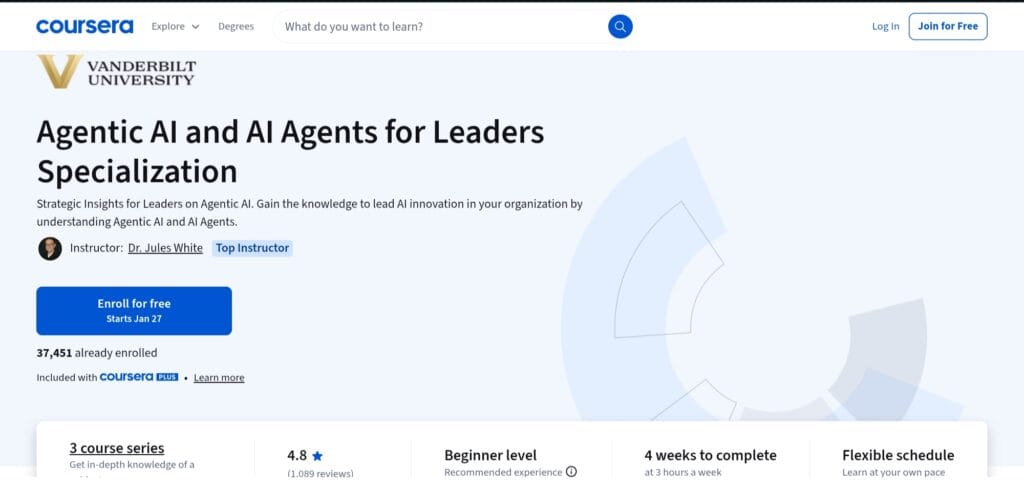
The Agentic AI and AI Agents for Leaders Specialization combines agentic AI concepts with leadership and strategic decision-making.
Rather than focusing solely on coding or architectural details, it empowers professionals to critically assess when and how autonomous AI agents should be applied in a business context.
It emphasizes meaningful context for leaders, helping learners determine the why and where of agentic AI deployment, not just the how.
Key Topics Covered
- Fundamentals of agentic AI and how autonomous AI agents differ from traditional AI systems
- Strategic evaluation of AI solutions and distinguishing innovation from hype
- Building basic AI agents using custom GPTs to perform goal-oriented tasks
- Integration of AI agents into organizational workflows for automation and productivity gains
- Leadership-level insights into AI product strategy, automation practices, and AI-enabled work systems
Who this course is best for
This specialization is perfect for business leaders, product managers, technical strategists, executives, and professionals who want to integrate autonomous AI into organizational strategy.
2. IBM RAG and Agentic AI Professional Certificate

The IBM RAG and Agentic AI Professional Certificate stands apart because it blends advanced generative AI techniques with autonomous agent development and contextual retrieval systems.
It covers RAG, vector databases, multimodal AI, and agentic systems in the curriculum.
This professional certificate ensures you not only understand the agentic AI meaning in theory but also how to implement these systems in scalable, real-world contexts.
Key Topics Covered
- Design and implement AI systems that retrieve and leverage external data to enable context-aware responses.
- Practical experience with ChromaDB, FAISS, and embeddings to power intelligent retrieval.
- Build applications that integrate text, speech, and visual modalities using state-of-the-art frameworks.
- Create agentic AI systems that reason, plan, and act using tool calling and workflow chaining.
- Hands-on experience with LangChain, LangGraph, CrewAI, AutoGen, and related tools for structuring agentic workflows.
Who this course is best for
The IBM RAG and Agentic AI Professional Certificate is ideal for software developers, machine learning professionals, and data scientists who want to understand sophisticated AI systems with reasoning, retrieval, and autonomous execution.
Read Full Review: IBM RAG and Agentic AI Professional Certificate – A Detailed Review
3. Building AI Agents and Agentic Workflows Specialization
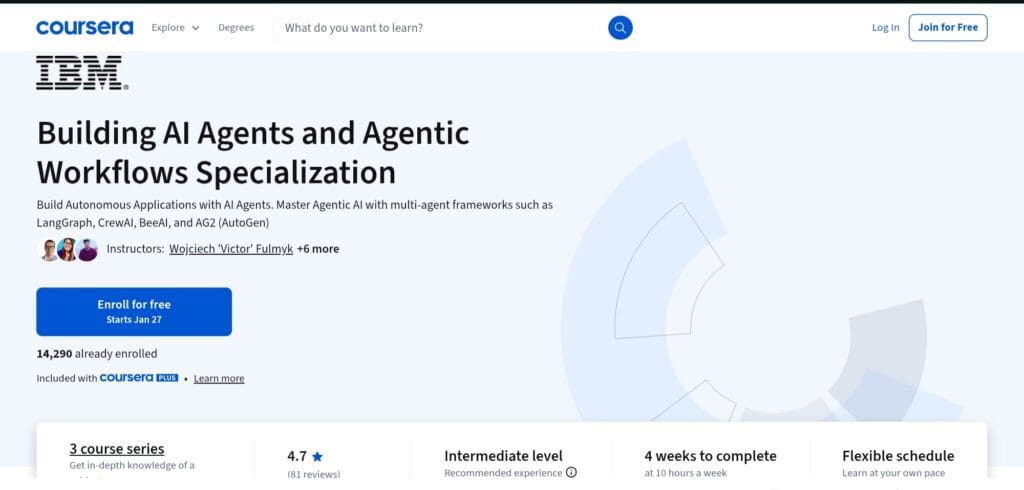
The Building AI Agents and Agentic Workflows Specialization emphasizes agentic AI theory with hands-on system construction.
This course not only explains what autonomous systems are, but it also teaches how to build them using modern frameworks and workflow orchestration patterns that reflect current industry practices.
The inclusion of multi-agent orchestration, memory management mechanisms, and retrieval-augmented systems positions this course as an excellent choice for learners who want to understand not only how to design individual agents but how to integrate them into scalable AI workflows.
Key Topics Covered
- How to develop AI agents that independently reason and execute tasks within structured workflows.
- Implementing tool calling and chaining to create efficient AI workflows that integrate multiple AI components.
- Practical use of LangChain agents for data analysis, visualizations, and database interaction.
- Techniques for building memory and conditional logic into agents using frameworks like LangGraph.
- Multi-agent orchestration and agentic RAG systems that manage retrieval-enhanced reasoning and dynamic task assignment.
Who this course is best for
AI engineers, developers, and professionals who are interested in advanced AI systems and want to build production-level agentic AI systems should consider this course.
4. Building AI Agents with OpenAI Specialization
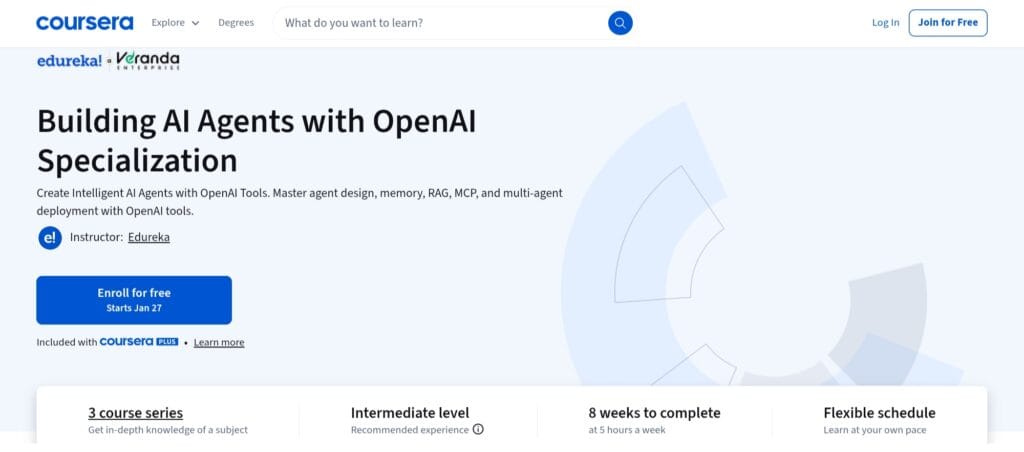
A strong emphasis on building production-grade AI agents using OpenAI’s latest frameworks makes this course a standout choice.
Instead of focusing merely on theory, this specialization explains memory design, RAG integration, multi-agent communication, and real-world deployment workflows.
With a focus on both reasoning mechanics and deployment patterns, this program provides a robust bridge between conceptual understanding and practical implementation.
Key Topics Covered
- Designing intelligent, agentic AI agents using foundational OpenAI models, AgentKit, and structured reasoning workflows.
- Implementing advanced memory systems such as short-term and long-term memory, embeddings, and hybrid retrieval-augmented generation (RAG) pipelines.
- Constructing multi-agent communication flows using Model Context Protocol (MCP), shared context fields, and agent-to-agent messaging.
- Deploying AI applications with interactive interfaces (like Streamlit) and cloud-ready multi-agent system architectures.
- Integrating tool APIs and secure development practices for scalable agentic AI systems.
Who this course is best for
AI engineers, intermediate developers, and professionals who want to develop skills in autonomous AI agent architectures should join this course.
Read Also: Best Python Courses Online
5. AI Agents and Agentic AI in Python: Powered by Generative AI Specialization
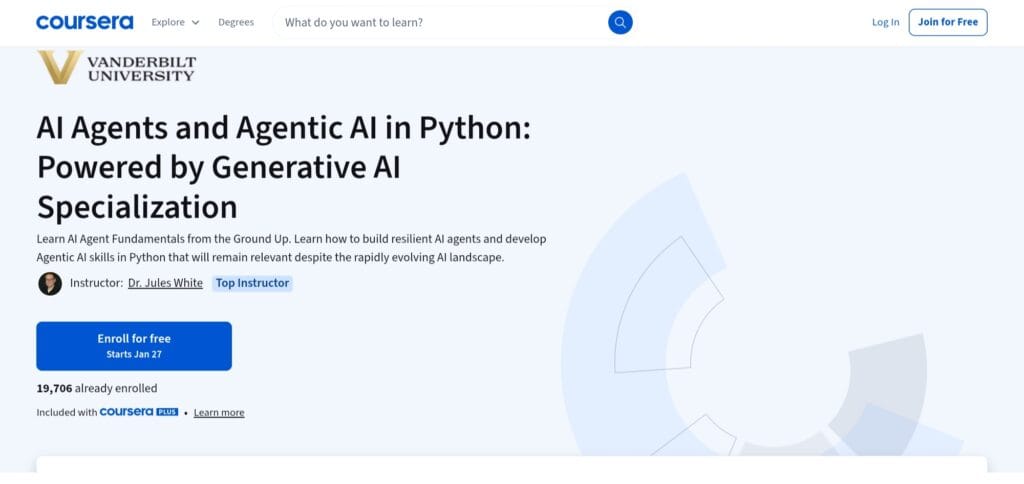
With a hands-on, Python-centric approach to agentic AI development, this specialization stands out as a top learning program.
It teaches actual coding practices and engineering patterns used to build autonomous AI systems.
Moreover, this specialization allows learners to understand what agentic AI is and implement it from scratch by combining generative AI capabilities with practical Python workflows.
Key Topics Covered
- Building agentic AI agents with Python using modern frameworks such as LangChain and AutoGen.
- Structuring autonomous workflows with conditional logic, persistence, and memory design.
- Integrating tool usage such as external APIs, database interaction, and custom function triggers.
- Utilizing retrieval-augmented systems (RAG) for context-aware reasoning.
- Developing multi-agent orchestration where several AI agents collaborate toward shared goals.
Who this course is best for
AI engineers, Python developers, and learners who want to advance their skills and understand agentic AI engineering concepts, including building and deploying autonomous agents.
6. Microsoft AI Agents: From Foundations to Applications Professional Certificate
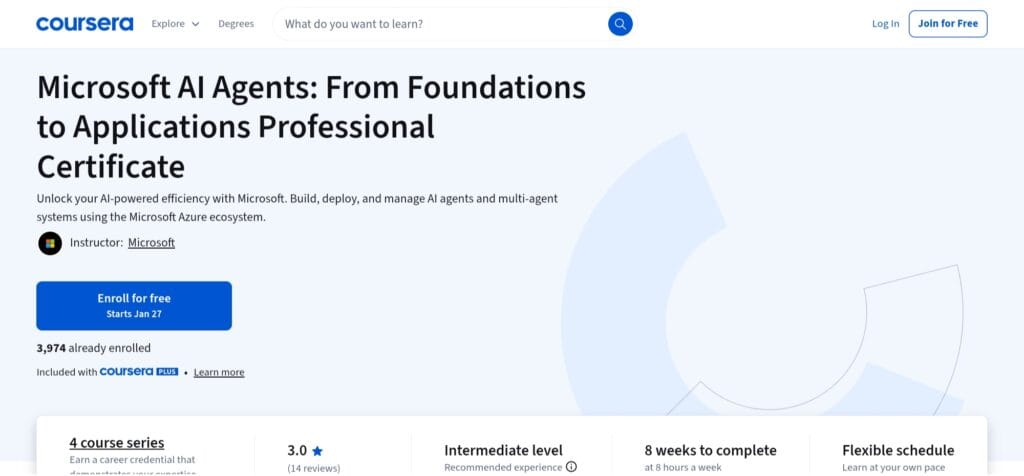
The Microsoft AI Agents: From Foundations to Applications Professional Certificate is a structured learning program with a series of four sequentially arranged courses.
It explains the theoretical concepts of agentic AI, along with building an experience of building robust systems using Azure AI Foundry, Semantic Kernel, and multi-agent frameworks aligned with real enterprise environments.
The curriculum’s balanced focus on both foundational reasoning and code-based deployment equips learners with skills directly applicable to AI agent developer and AI solutions engineer roles.
Key Topics Covered
- Learn how autonomous agents differ from traditional AI models and how to architect them using Azure AI Foundry and core agent frameworks.
- Design structured workflows where agents reason, act, and orchestrate multi-step tasks.
- Develop agents using Python, Bot Framework, and Microsoft tools with real code examples and system integrations.
- Construct and deploy systems of coordinated agents that solve complex business problems through distributed task execution.
- Integrate enterprise-grade practices such as secure coding, governance, and ethical AI considerations within agent development.
Who this course is best for
This course is ideal for learners who are preparing for careers in AI systems design, enterprise AI integration, or AI-driven automation engineering.
7. Agentic AI Performance & Reliability Specialization
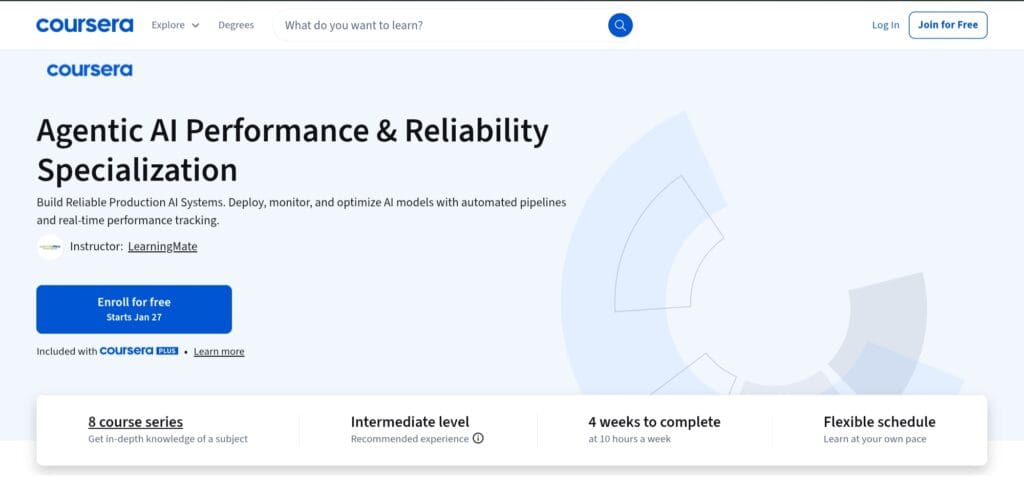
While the majority of agentic AI courses focus primarily on agent design, reasoning, and capability creation, the Agent AI Performance & Reliability specialization addresses the performance and reliability aspects essential for real-world deployment of autonomous systems.
This course prioritizes MLOps, monitoring, drift management, and feedback loops so that learners will develop the skills needed to ensure that agentic AI not only acts autonomously but also performs consistently and reliably under production pressures.
Key Topics Covered
- Building automated MLOps pipelines for deployment, continuous monitoring, and retraining of AI models in production.
- Implementing real-time anomaly detection and performance tracking with KPI dashboards and automated alerts.
- Designing feedback loops and reproducible workflows that ensure long-term reliability and continuous improvement for AI systems.
- Monitoring drift, partitioning data for fairness and stability, and applying statistical methods to validate system robustness and resilience.
Who this course is best for
People who want to deepen their understanding of how autonomous AI agents perform under real-world conditions and maintain reliability over time will benefit from this course.
AI engineers, developers, and MLOps practitioners will also get valuable insights from this course.
Read Also: Best Deep Learning Courses Online [Beginner to Advanced]
8. Agentic Prompt Engineering
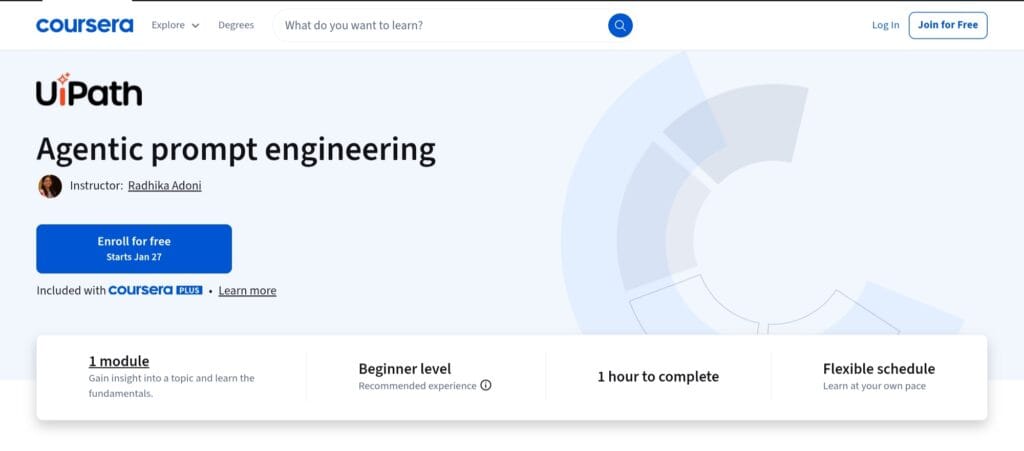
Unlike generic prompt engineering programs that focus solely on text generation for chatbots or simple utilities, Agentic Prompt Engineering zeros in on how prompts function as directive frameworks for agentic AI.
These prompts don’t just request output but actively shape agent actions and strategies.
This makes it especially relevant for anyone looking to understand the intersection of prompt design and autonomous decision-making in modern AI agents, helping bridge the gap between generative responses and goal-oriented AI behavior.
Key Topics Covered
- Fundamentals of effective prompt engineering with a focus on interacting with large language models (LLMs) and autonomous agents.
- Techniques for crafting prompts that improve agent decision-making, task automation, and context-aware responses.
- Prompting patterns and tools that optimize behavior in AI workflows, including multimodal contexts and responsible AI usage.
- Integration of prompt designs with business processes, AI automation challenges, and adaptive agentic systems.
- Key concepts in agentic systems, including how prompts drive planning, reasoning, and tool invocation in autonomous AI pipelines.
Who this course is best for
Learners who want to develop agentic AI prompting skills that go beyond basic LLM interactions can join this course.
Product managers, analysts, automation specialists, AI practitioners, and developers who want to learn to write effective prompts for AI agents to get reliable results should consider this course.
9. Building AI Agents – Fundamentals to Advanced
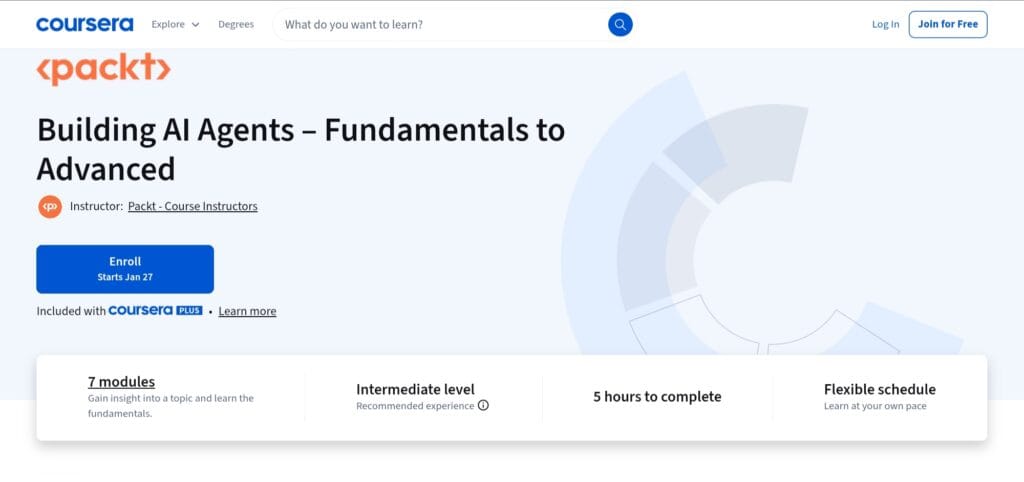
Combining agentic AI theory and hands-on automation practice, this course guides learners through building functional AI agents integrated with workflow automation platforms.
This connects the gap between the definition of agentic AI and its practical application.
It includes task automation examples such as calendar scheduling and real-world pipeline design to equip learners with immediately applicable skills.
This is a valuable skill for professionals aiming to automate workflows and integrate AI agents into business processes.
Key Topics Covered
- Fundamental principles of AI agents, including autonomy, adaptability, and intelligent task execution.
- Integration of AI agents with workflow automation tools such as N8N to enhance real-world process efficiency.
- Step-by-step guidance on setting up AI agents, including credential management and data flow handling.
- Designing multi-level event pipelines and constructing agents that perform tasks like email automation and calendar scheduling.
- Ethical considerations, security implications, and emerging trends in agentic AI deployment.
Who this course is best for
This compact course is a perfect choice for learners who are looking for a practical and application-focused introduction to building agentic AI systems with real use cases.
Read Also: Best Generative AI Courses On Coursera That Explain Real-World Applications
10. Agentic AI Full Course 2025 | AI Agents Tutorial For Beginners | Edureka
This is a YouTube tutorial by Edureka that explains the agentic AI landscape to beginners by combining conceptual explanation with a broad overview of related AI areas, such as deep learning, transformers, and NLP.
The foundational nature of this course makes it suitable for learners to gain context for how agentic systems fit into the larger AI ecosystem, making it a useful starting point for those who plan to later enroll in more formal, hands-on training.
Key Topics Covered
- Core concepts behind agentic AI, including what it is and how it differs from generative or reactive models.
- Comparison of agentic systems with traditional generative AI approaches.
- An educational roadmap outlining the progression from basic AI concepts up through deep learning and LLM principles that support autonomous agents.
- Supplementary AI foundations, such as deep learning, neural networks, transformers, and natural language processing, will give learners an essential background.
Who this course is best for
Beginners, AI enthusiasts, and learners who want an introductory overview of autonomous AI agents before pursuing more advanced or structured agentic AI courses.
Career Opportunities After Learning Agentic AI
As enterprises transition from experimenting with generative AI to deploying autonomous, goal-driven systems, the demand for agentic AI professionals grows significantly.
Learning how to create, analyze, and deploy AI agents opens the door to a new set of job opportunities that combine software engineering, AI system design, and intelligent automation.
The following are some of the most relevant agentic AI roles growing in startups, corporations, and product teams.
AI Agent Engineer
After understanding agentic AI, one of the most clear job pathways is as an AI agent engineer. Professionals in this field work on developing autonomous agents that can plan, reason, use tools, and collaborate with other agents.
Typical responsibilities include creating agent architectures, integrating memory and retrieval systems, implementing multi-step workflows, and ensuring agents act consistently in real-world scenarios.
This function is especially important in organizations developing internal AI copilots, automation systems, and AI-first products.
Applied AI Engineer
Applied AI engineers are responsible for converting agentic AI concepts into practical, business-ready systems. Rather than focusing solely on research, this function stresses implementation—the deployment of agentic AI systems that solve real-world operational challenges.
AI agents may be integrated into current software stacks, workflows optimized for performance, and autonomous systems aligned with corporate objectives.
Agentic AI skills are especially useful in this context because they enable the development of systems that run continuously, adapt to change, and require less manual involvement.
LLM Systems Architect
As the complexity of AI systems grows, so does the demand for LLM system architects. This position entails creating end-to-end architectures in which massive language models, agentic workflows, retrieval systems, and external tools all function together flawlessly.
Scalability, reliability, and system-level decision-making are all important to professionals in this role.
A solid grasp of agentic AI is required, as these systems frequently rely on autonomous agents to organize tasks, manage state, and coordinate across many services.
Automation and AI Workflow Specialist
Automation specialists with agentic AI knowledge are in high demand among businesses seeking intelligent process automation.
Unlike traditional rule-based automation, agentic AI workflows may learn, reason, and improve over time. Professionals in this area create artificial intelligence-driven processes that automate research, reporting, customer interactions, internal operations, and data analysis.
Mastery of agentic AI enables these specialists to create systems that go beyond simple task performance and provide long-term operational efficiencies.
FAQs About Agentic AI Courses
Is Agentic AI hard to learn?
Agentic AI is not intrinsically difficult, but it necessitates a shift in how you view AI systems. Instead of focusing solely on prompts or model outputs, you’ll learn how to create autonomous, goal-driven workflows.
Do I need deep AI or ML knowledge?
To get started with agentic AI, you do not need deep machine learning experience. Most agentic AI courses concentrate on using big language models rather than training them from the start. A basic familiarity with Python, APIs, and how LLMs operate theoretically is typically sufficient.
Are Agentic AI skills future-proof?
Yes, agentic AI skills are widely considered future-proof. As organizations move beyond experimentation and demand AI systems that can act autonomously, plan tasks, and operate at scale, agentic AI becomes foundational.
Which frameworks should I learn first?
Most learners benefit from starting with widely adopted and well-documented frameworks. LangChain provides a solid foundation for understanding agent logic, tool usage, and workflow chaining. LangGraph expands upon this by incorporating organized, stateful agent workflows. As you progress, frameworks like AutoGen, CrewAI, and Semantic Kernel become useful for multi-agent collaboration and enterprise-grade applications.
Final Verdict: Are Agentic AI Courses Worth It?
Agentic AI is swiftly emerging as one of the most valuable talents in today’s AI market.
As the industry progresses from prompt-based experimentation to autonomous, goal-driven systems, the ability to build and deploy AI agents is becoming a fundamental capability rather than a niche specialization.
Agentic AI combines large language models, system architecture, automation, and decision-making, making it particularly helpful for professionals who want to work on real-world, high-impact AI applications rather than isolated demos.
When selecting the top agentic AI courses online, prioritize programs that emphasize hands-on projects, modern agent frameworks, and real-world applications.
Courses that cover tools such as LangChain, LangGraph, AutoGen, Semantic Kernel, and enterprise-grade platforms enable students to turn theory into production-ready capabilities.
Real-world projects not only increase learning, but they also provide real proof of expertise, which is increasingly vital in AI-focused professions.
Agentic AI courses are an excellent investment for developers, AI engineers, data scientists, and product builders looking to keep current in a quickly changing profession.
With the proper course and a project-driven approach, learning agentic AI can open up new job prospects, accelerate innovation, and put you at the forefront of how intelligent systems will be constructed in the future.
Share Now

More Articles
How Generative AI Can Help You Land Your Dream Job: 7 Practical Steps To Follow
Generative AI and You: What can you create with Generative AI?
Best Machine Learning Courses online

As an engineer with a passion for learning and sharing knowledge, I created CourseKart.online to help students, professionals, and lifelong learners choose the best online courses. With so many options available, finding the right one can be overwhelming. My goal is to simplify that process by offering insights, reviews, and recommendations on the top online learning resources. I hope my posts inspire you to keep growing, learning, and exploring new opportunities.
Discover more from coursekart.online
Subscribe to get the latest posts sent to your email.