
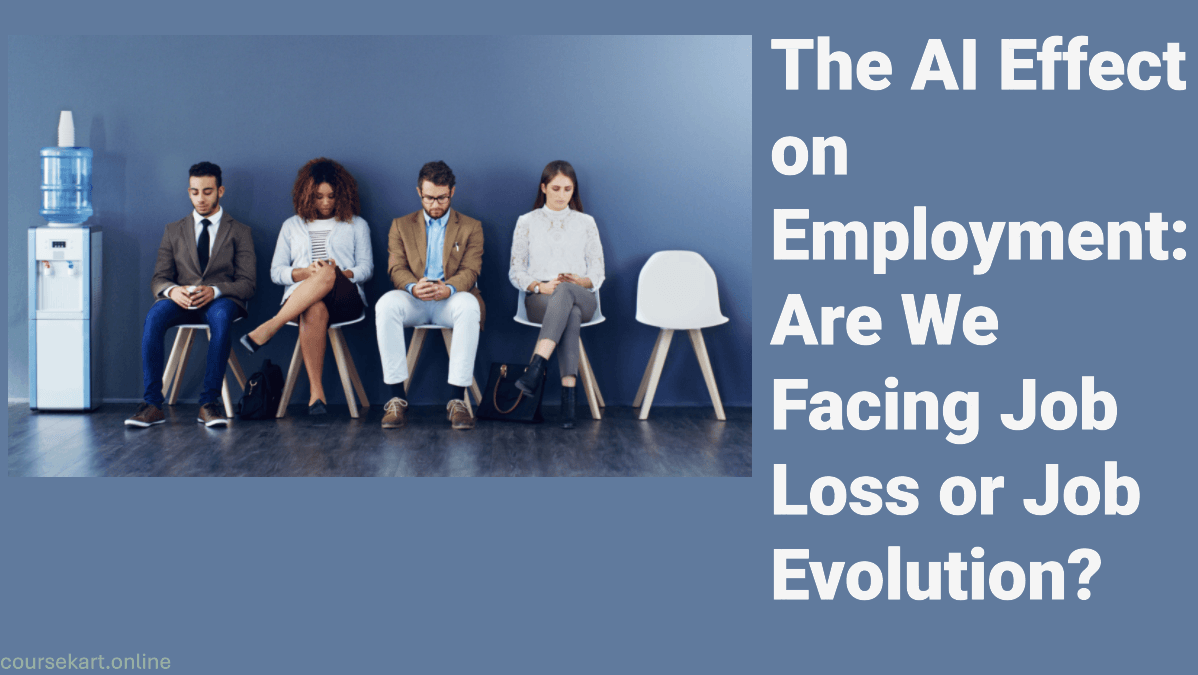
Discover the true AI effect on employment—will AI replace jobs or create new opportunities? Explore trends, risks, reskilling strategies, and the future of work in this comprehensive guide.
The Tipping Point of Change
Rajesh was a factory worker in the 1980s who worked on an assembly line, tightening bolts. His work was steady, monotonous, and predictable—until robots came along. His job was taken over by machines overnight, and the stability of a lifetime of work was gone.

Now fast-forward to today and meet data analyst Ananya. Making decisions, analyzing trends, and gaining insights are all essential to her work. However, she is also shaken by a new disruption: the emergence of artificial intelligence (AI).
Every significant technical advancement throughout history, from steam engines to the internet, has changed the nature of work. Each wave raised concerns about widespread unemployment but eventually gave rise to previously unthinkable new sectors and occupations.
Similar trends are being seen in the AI effect on employment, but with a twist: rather than just expediting procedures, AI is also questioning the fundamental nature of work.
AI is no longer a sci-fi fantasy; it permeates every aspect of our lives, from driverless cars to tailored shopping suggestions.
AI has the ability to automate cognitive tasks that were previously believed to be solely human, in contrast to previous advancements that replaced physical labor.
This makes it the most revolutionary wave to date—a force that has the potential to either reshape careers or abolish millions of jobs.
The truth? AI is not just automating work; it’s redefining what work means. The question is, are we facing widespread job loss—or the dawn of job evolution? In this article, I will go through the effect on the job market because of AI evolution and figure out how the job market is transforming.
The Rise of AI: More Than Just Automation
Most people imagine algorithms replacing customer service representatives or robots taking over factory floors when they hear the term artificial intelligence. However, the AI effect on employment extends well beyond automation. We must examine where it began and where it is going in order to comprehend why.
Early automation was mechanical in nature. On assembly lines, repetitive physical jobs like sorting products or welding car frames were replaced by machines. Though predictable, these inventions were important since they substituted regular work while ignoring cognitive and creative duties.
Today, artificial intelligence (AI) encompasses more than merely carrying out tasks; it also involves creativity, prediction, and decision-making.
AI is making its way into fields that need judgment, flexibility, and even a dash of creativity, from chatbots that can comprehend human language to prediction algorithms influencing financial markets.
This is where the effect of AI on employment becomes truly transformative. It plays a dual role:
- Efficiency Booster: AI reduces human error, processes data at lightning speed, and takes over time-consuming tasks. For example, healthcare AI can analyze thousands of medical images in seconds, aiding doctors in faster diagnosis.
- Innovation Enabler: Beyond saving time and cost, AI enables entirely new possibilities. Autonomous vehicles, personalized education, and AI-powered drug discovery are creating industries that didn’t exist before.
AI alters the character of the work itself, in contrast to classical automation, which concentrates on doing the same task more quickly. Not only does it make businesses more efficient, but it also makes possible innovations that were previously only found in science fiction.
The current question is not simply, “Will AI replace us in our jobs?” but, “What new jobs will AI create, and how can we prepare for them?”
Automation Anxiety: The Job Loss Debate
Real concerns have been raised about the AI effect on employment, particularly the cliché that “robots are taking over jobs.” Many workers, including call center representatives, industrial operators, and retail cashiers, fear that machines may replace them. These worries are legitimate, and the information emphasizes the danger.
- Retail cashiers, ticket clerks, and bank tellers are particularly vulnerable. According to the World Economic Forum, employment in such roles is expected to decline by around 13% by 2030.
- Data entry clerks and administrative assistants face a shrinkage of 20–24% globally as AI automates scheduling, correspondence, and document processing.
In the past, repetitive labor was reduced by early automation. However, with AI, white-collar jobs like basic bookkeeping, paralegal research, secretarial work, and customer service inquiries are also in danger. According to a frequently referenced McKinsey report, up to 70% of labor tasks that currently take up human time can be automated by AI systems.
📊 Credible Findings & Trends
- The World Economic Forum’s Future of Jobs Report 2025 projects 92 million jobs displaced by 2030, with 170 million new roles created, resulting in a net gain of 78 million. But displacement remains real for routine jobs.
- A Reuters‑reflected WEF/CNBC report found that as many as 41% of employers plan to downsize the workforce due to AI, particularly affecting clerical, paralegal, and basic accounting roles. Yet 77% of employers intend to upskill existing workers, and 47% plan to transition them into new roles.
🎯 The Nuance: Who’s Most at Risk?
It’s not that entire professions vanish—it’s particular routine and repetitive tasks that are most vulnerable.
- Manufacturing workers, especially in assembly and warehousing, are affected by robotics (impacting millions globally).
- Clerical and customer support roles—where workers perform standardized, rule-based tasks—are being automated with chatbots, robotic processing systems, and predictive tools.
The Flip Side: Innovation and Job Creation
There is another, equally significant story—one of innovation and job creation—while much of the discussion about the AI effect on employment is on job loss. AI is creating completely new sectors and professions that did not exist ten years ago, in addition to displacing existing ones.
New Roles Born from AI
Consider positions that were essentially unheard of ten years ago, such as prompt engineers, data scientists, machine learning professionals, and AI engineers. These experts are in high demand right now as companies scramble to incorporate AI into their operations.
The World Economic Forum projects that in the upcoming years, AI-related jobs will account for millions of new jobs worldwide, making them one of the fastest-growing job categories.
Expansion of Entire Sectors
Beyond technical roles, AI has given rise to entire ecosystems:
- AI Ethics and Compliance Officers: Ensuring AI systems are fair, unbiased, and legally compliant.
- Automation Designers and Workflow Architects: Crafting intelligent systems to optimize business operations.
- AI Trainers: Teaching models to understand human language, tone, and cultural nuances.
These sectors didn’t just emerge—they’re thriving, attracting investment and talent at an unprecedented scale.
Case Study: AI in Healthcare
Consider the medical field. In addition to improving patient care, AI-driven solutions for predictive diagnostics and medical imaging analysis have opened up new career paths for telemedicine coordinators, health data analysts, and AI professionals.
Instead of replacing human expertise, doctors now work together with AI to evaluate results more quickly and concentrate on challenging patients.
The delivery of knowledge has also changed as a result of AI-powered platforms for individualized learning in education, which have increased the need for edtech developers, learning experience designers, and AI curriculum specialists.
Reskilling Revolution: The Human Advantage

One fact comes out as the AI effect on employment changes industries: while computers may surpass humans in speed and accuracy, human creativity, empathy, and critical thinking are still invaluable. The true issue is skill obsolescence rather than job elimination. And reskilling is the solution.
Why Human Skills Still Matter
Terabytes of data may be processed by AI in a matter of seconds, but moral reasoning, emotional intelligence, and nuanced judgment cannot be replicated. These skills—adaptability, problem-solving, and teamwork—are essential for future employment. Indeed, according to LinkedIn’s Future of Work Report, soft talents like resilience, creativity, and leadership are more in demand than ever.
The Role of Reskilling and Lifelong Learning
Lifelong learning has shifted from a buzzword to a survival strategy. As routine roles decline, organizations and governments are investing heavily in reskilling programs.
- Corporate Initiatives: Tech giants like Amazon and Microsoft have pledged billions toward upskilling employees for AI-driven roles.
- Government Programs: Countries like Singapore and India have launched large-scale digital literacy missions to prepare their workforce for the AI era.
A Story of Transformation
Take Ravi, a 12-year warehouse supervisor. He faced an uncertain future as automation reduced his responsibilities. Ravi chose to embrace change by enrolling in his employer’s data analytics certification program.

He now works as a logistics data analyst, optimizing supply chains with AI tools, a profession that did not exist when he began his career. His experience demonstrates that flexibility is the new form of job security.
Industry Deep Dive: Who Wins and Who Loses?
Different industries experience the AI effect on employment in different ways. A number of industries are changing in unexpected ways, while others are prospering.
Winners: Industries Riding the AI Wave
- Technology
This is not surprising. Machine learning engineers, AI ethicists, and data architects are in greater demand than ever before due to AI advancement, cloud computing, cybersecurity, and automation design.
- Healthcare
Drug discovery, predictive analytics, and diagnostics have all been transformed by AI. AI imaging tools are being used alongside radiologists, and new positions like telemedicine coordinators and health data analysts are growing in popularity.
- Finance
AI is used by banks and fintech businesses for algorithmic trading, fraud detection, and consumer personalization, generating jobs in regulatory compliance and AI risk management.
- Creative Industries
In industries like marketing, game design, and film production, AI technologies are becoming co-producers rather than displacing creativity, allowing content creators to accomplish more tasks in less time.
Losers: Roles Facing Maximum Disruption
- Traditional Manufacturing: Assembly line workers have been under pressure since the first wave of automation. AI-powered robotics accelerates that trend.
- Clerical Jobs: Data entry, routine bookkeeping, and administrative roles are at high risk as AI automates repetitive paperwork.
- Basic Customer Service: AI chatbots and virtual assistants can handle standard queries 24/7, reducing the need for large call-center workforces.
Hybrid Roles: Humans + AI = Augmented Intelligence
The future isn’t fully human or fully machine—it’s collaborative.
- Doctors are using AI for diagnostics, but applying human judgment for treatment plans.
- Teachers are leveraging AI for personalized learning while focusing on mentorship and emotional support.
- Marketers are using AI analytics to design strategies, but adding the creativity only humans can bring.
Ethical and Social Implications
What happens to individuals who are left behind when the AI effect on employment picks up speed? It is a crucial topic. Opportunities for education, technology, and reskilling are not equally available to everyone. This brings up moral and societal issues that transcend economics.
The Reskilling Divide
While some people move seamlessly into AI-related professions, millions of others run the risk of being permanently displaced due to a lack of digital literacy or the inability to pay for retraining.
An IT specialist in a city has more possibilities than an industrial worker in a distant area. This could lead to a two-tiered workforce if left unchecked: those who will survive the AI era and those who will prosper.
AI and Inequality
If low-skilled individuals are left with fewer chances and new occupations require highly specialized abilities, the AI effect on employment could increase economic disparities.
Global labor studies indicate that towns and places with the least educational opportunities are most at risk of being left out of the AI-driven economy.
Responsible AI: Balancing Efficiency with Social Good
The debate isn’t just about innovation—it’s about inclusion. Governments and corporations must adopt responsible AI strategies:
- Fair access to training programs, especially for vulnerable workers.
- AI systems are designed to minimize bias, ensuring hiring and decision-making are ethical.
- Policy frameworks like universal basic income or job transition support to cushion displaced workers.
If AI is the engine of progress, humanity must be the driver, ensuring that efficiency does not come at the cost of equity.
The Future of Work: Jobs Reimagined
Every technological advancement changes the nature of labor, and the AI effect on employment is no exception. This is something that history has taught us. However, in contrast to previous revolutions, AI alters not just what we do but also how we do it.
Emerging Trends
- Human-AI Collaboration: The future workplace won’t be man versus machine—it will be man + machine. Doctors will diagnose faster with AI-powered imaging. Journalists will craft deeper stories using AI-driven research. Creativity and computation will merge like never before.
- The Gig Economy 2.0: AI platforms are already powering freelance ecosystems. From AI-assisted design to voice-over generation, gig workers are leveraging AI tools to expand their reach and productivity.
- Remote Work Reinvented: Intelligent virtual assistants, AI-driven project management, and real-time language translation will make remote work more seamless and inclusive, connecting talent across the globe.
Predictions for the Next Decade
- 50% of work tasks automated by 2035, but complemented by 50 million new AI-driven roles in emerging sectors like robotics, AI governance, and creative tech.
- Traditional job descriptions will fade, replaced by fluid roles that blend technical, analytical, and creative skills.
- Education systems will pivot to skills-based learning, emphasizing adaptability and digital fluency.
Conclusion: From Fear to Opportunity
Fear and fascination frequently dominate the discourse about the AI effect on employment. Will AI replace us in our jobs? The reality is more complex. AI is the start of work reimagined, not the end of it.
Every technological revolution, as demonstrated by history, creates new positions while dislodging others. This wave is no exception.
Indeed, repetitive and ordinary jobs are in danger. However, AI is also opening doors in fields that were unthinkable ten years ago, such as creative tech, data ethics, AI engineering, and digital health. The true question is, “Am I prepared to work with AI?” rather than, “Will AI replace me in my job?”
The route forward is straightforward: adapt, learn, and innovate. Develop soft skills, embrace lifelong learning, and view AI as a partner rather than a rival. Businesses, governments, and people who embrace this change will prosper in the new economy.
The future isn’t about humans vs. AI—it’s about humans with AI.
FAQ
Will AI take over all jobs eventually?
No. AI won’t likely replace all occupations, but it will automate a lot of monotonous and routine chores. Rather, it will change positions, which will change the skills needed. More than the complete destruction of jobs, the AI effect on employment is about human-machine collaboration.
Which jobs are most at risk from AI?
The most vulnerable jobs are those that require repetitive, rule-based tasks. These include basic customer service, clerical work, data entry, and some manufacturing positions. However, it is more difficult to automate tasks that need complex decision-making, emotional intelligence, and creativity.
What jobs will AI create in the next 5 years?
AI is expected to generate roles such as:
AI engineers and developers
Machine learning specialists
Data scientists and AI trainers
AI ethics and compliance officers
Automation designers and prompt engineers
The AI effect on employment is creating new career paths in almost every industry.How can I future-proof my career in the age of AI?
Focus on continuous learning and reskilling. Develop skills in:
Data literacy and digital tools
Critical thinking and problem-solving
Creativity and emotional intelligence
Staying adaptable and learning how to work with AI tools will secure your place in the future workforce.Is AI good or bad for employment?
It presents both an opportunity and a challenge. While the AI effect on employment will result in the loss of some jobs, it will also generate millions of new positions in growing industries. To promote equitable growth, reskilling, adaptation, and responsible AI deployment are crucial.
Share Now

Related Articles
The AI Impact on Jobs: New Careers, New Challenges
What Is The AI for Everyone Course By DeepLearning AI On Coursera?
Generative AI in Business: From Hype to Enterprise Value

As an engineer with a passion for learning and sharing knowledge, I created CourseKart.online to help students, professionals, and lifelong learners choose the best online courses. With so many options available, finding the right one can be overwhelming. My goal is to simplify that process by offering insights, reviews, and recommendations on the top online learning resources. I hope my posts inspire you to keep growing, learning, and exploring new opportunities.
Discover more from coursekart.online
Subscribe to get the latest posts sent to your email.