

Last updated on January 8th, 2026 at 11:01 am
Improve your knowledge of AI, ML, and big data by taking one of the top 10 advanced data science courses on Coursera. Choose the finest program by comparing its duration, salient features, and top career paths.
Data science is now much more than just the basics. Organizations increasingly require experts who can create sophisticated algorithms, construct scalable AI systems, and derive insights that directly influence company strategy. They no longer merely want analysts who can clean data and run models. Advanced data science courses can help with that.
Beyond theory, advanced courses assist students in applying machine learning, deep learning, natural language processing, reinforcement learning, and big data engineering in practical settings.
Gaining expertise in cutting-edge fields like healthcare, finance, and technology can help you remain competitive and relevant in these fields.
One of the leading online learning environments for advanced data science is now Coursera. With the support of leading academic institutions and digital corporations like Google Cloud, DeepLearning.AI, Stanford, and the University of Michigan, Coursera offers well-organized, empirically supported programs that strike a balance between academic rigor and real-world applicability.
Whether you want to lead data teams, drive AI projects, or publish research, Coursera provides professional credentials, specialty tracks, and even entire degrees.
This guide is designed for academics who want to apply advanced AI and ML principles to real-world and academic challenges, mid-career professionals who want to advance into senior data roles, and advanced learners who want to hone their skills. This article is for you if you’re ready to advance your data abilities beyond the introductory level.
Let’s now move further and explore the top 10 advanced data science courses on Coursera.
List Of The Advanced Data Science Courses On Coursera
1. Google Advanced Data Analytics Professional Certificate

This professional certification is intended for intermediate professionals and advanced students who already possess a basic understanding of statistics and Python.
It’s perfect for those who desire a well-organized, skill-rich path to positions like data scientist, analytics lead, or AI product manager.
The curriculum consists of eight in-depth classes and should take about six months, assuming you put in ten hours a week. It covers a lot of subjects, including statistics, regression, machine learning, Python programming, and the fundamentals of data science.
Because of its advanced nature, the material is ideal for those who wish to go further but already understand the fundamentals.
The courses are organized with a focus on real-world applications. You’ll discover how to do ethical data analysis, EDA in Python, Tableau visualization, regression analysis, and machine learning model building. With a focus on interpretation and explanation, each topic links to practical skills.
It incorporates experiential learning. There are a lot of projects and labs that help you create portfolio-quality artifacts, particularly in exploratory data analysis and the capstone project, according to Reddit reviewers.
But other students point out that if they already have a lot of experience in statistics, the statistics portion could feel a little introductory.
You can be flexible with the self-paced format, but it also requires self-control.
Redditors point out that the certificate offers sample code to assist when you run into problems, but they advise against copying it to get through the tasks because true learning occurs when you put your all into them.
Although the instructor and course materials are clear, each student’s pace is unique.
This topic has real-world significance and is related to careers. You will graduate with highly sought-after Python, machine learning, statistical analysis, and data storytelling skills, and the completed certificate can be shared on LinkedIn and resumes.
Additionally, this professional certificate is part of Coursera Plus and is supported by Google. It has a solid 4.8 rating from more than 5,000 reviews, is widely translated (in 11 languages), and is acknowledged as advanced-level.
This certificate offers structure, rigor, and clarity for committed intermediate-to-advanced learners who want to develop real-world analytics and machine learning skills with a Google credential.
It is a solid option because it strikes a balance between Python, statistics, data visualization, and practical applications.
Read Full Review – What Is The Google Advanced Data Analytics Professional Certificate On Coursera?
2. Advanced Statistics for Data Science Specialization (Johns Hopkins University)
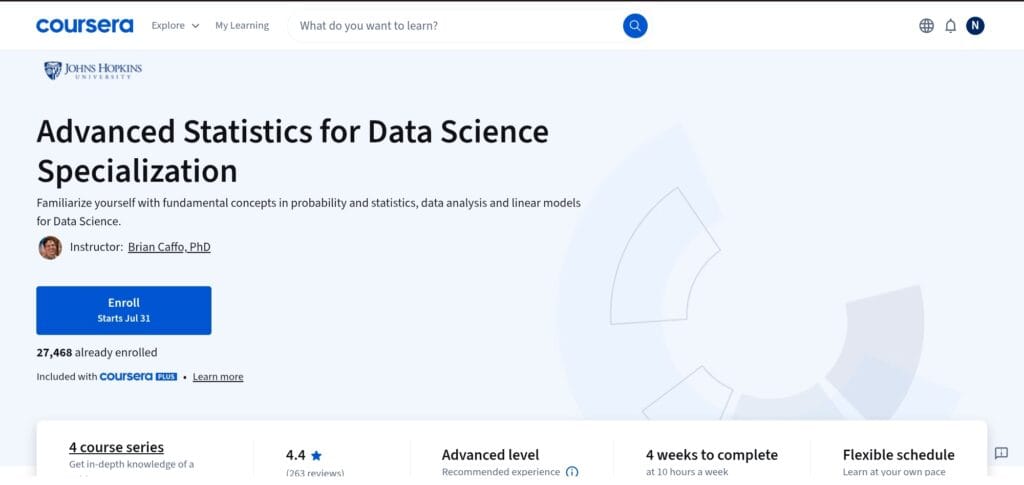
This specialization is designed for professionals in their mid-career and advanced education who have a firm understanding of linear algebra, calculus, and basic statistics.
If you want to improve your theoretical knowledge of probability, regression, and linear models, especially using R, this is quite helpful.
This bundle includes four courses that provide a thorough coverage of probability principles, including bootstrapping, distributions, confidence intervals, and conditional probabilities.
It then moves on to linear regression theory using matrix algebra. It assumes mathematical maturity and is designed at an advanced level.
The course may be finished in around a month at a normal pace of 10 hours per week, which strikes a good balance between digestibility and depth.
Under the direction of Brian Caffo, PhD, the content is methodical and focuses on clear explanations that are grounded in mathematical clarity.
Although some have pointed out that the biostatistics framing can feel specialized, albeit not purely biological in focus, it will be quite evident to learners looking for solid theoretical support.
This specialization focuses more on conceptual mastery than portfolio creation, in contrast to programs that are heavily project-driven. Nevertheless, driven students continue to produce their own notes and code repositories, as in this GitHub project of a learner’s journey.
This is a self-paced program that gives you flexibility but puts the discipline on you. Although there are no lengthy peer-reviewed assignments or live instructor support, the content is sensibly organized. You’ll have to rely on your own study schedule and community forums.
After completing this specialization, you will receive a Coursera certificate that you can share on your résumé or LinkedIn. The true benefit is its statistical rigor, which provides you with the in-depth knowledge required for research, positions involving advanced analytics, or PhD-level employment.
Coursera Plus offers this specialization, which is taught by Brian Caffo and offered by Johns Hopkins University. It also supports financial aid and is taught in English across 22 languages.
Even if it means fewer projects or interactive elements, this specialization is a powerful tool for expert researchers or learners looking to strengthen their statistical foundations with mathematically precise content.
When combined later with application-driven learning, it is particularly effective. For portfolio development or machine learning practice, project-based courses might be a good addition. But this specialization performs remarkably well for sheer statistical strength.
Read Full Review – Is The Advanced Statistics For Data Science Specialization On Coursera Worth It?
3. More Applied Data Science with Python Specialization
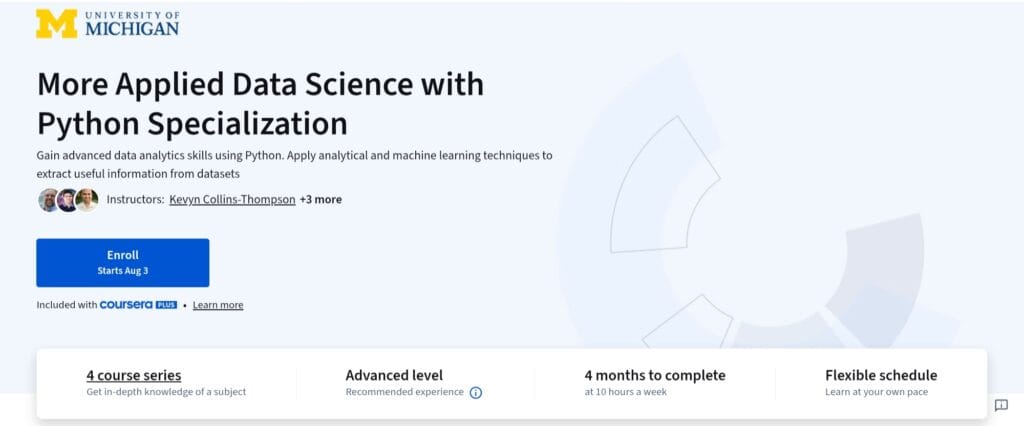
This is designed for mid-career professionals and advanced learners who have already finished the core “Applied Data Science with Python” specialization or have similar expertise.
Perfect if you want to advance your knowledge of Python and machine learning to tackle data mining, network modeling, unsupervised learning, and NLP entity extraction.
There are four advanced-level courses in this specialization. It offers in-depth analytics approaches, such as data mining patterns, clustering, topic modeling, diffusion simulation, and named entity recognition using contemporary methodologies like Transformer-based pipelines, at a rate of about 10 hours per week for four months. It is well-designed for students looking for more rigor than basic machine learning.
Kevyn Collins-Thompson and colleagues from the University of Michigan lead the instruction team. As of June 2025, the presentation has been modified to ensure its current relevance.
In order to uncover useful patterns and insights, the modules primarily concentrate on applying sophisticated algorithms to messy, real-world datasets, such as textual data, social network data, and health data.
The main page lists the many kinds of datasets (such as emojis, genomics, epidemics, and restaurant feedback); however, it skips over the specifics of project pipelines and deliverables. Nonetheless, practical analytics tasks are to be expected, particularly in the areas of mining, network graphing, subject modeling, and NER employing Transformers. Building applied intuition for sophisticated Python-based analysis is the true strength.
The training is still self-paced, flexible, and demands self-discipline. It is advanced, so instead of depending on supervised handholding, students should be ready to use forums, self-study documentation, and synthesis abilities.
A shareable certificate that is perfect for demonstrating sophisticated analytical skills is awarded upon completion. In fields including social media, bioinformatics, and recommendation systems, the methods taught, particularly unsupervised learning, data mining, NLP extraction, and network analysis, are becoming more and more in demand.
Your technical profile is essentially elevated beyond simple machine learning use cases by the specialization.
This specialization greatly expands your toolkit if you’ve previously established a strong foundation in Python-driven data science and wish to move into applied, advanced analytics, and AI-related techniques.
It presents useful methods that match the complexity of the real world, such as network modeling, entity recognition with Transformer pipelines, and clustering.
However, you should be prepared for rigorous, independent study, possibly without well-designed project templates. This is a good next step for anyone who wants to deepen their analysis.
Read Full Review – Is The More Applied Data Science with Python Specialization On Coursera Worth It?
4. IBM RAG and Agentic AI Professional Certificate
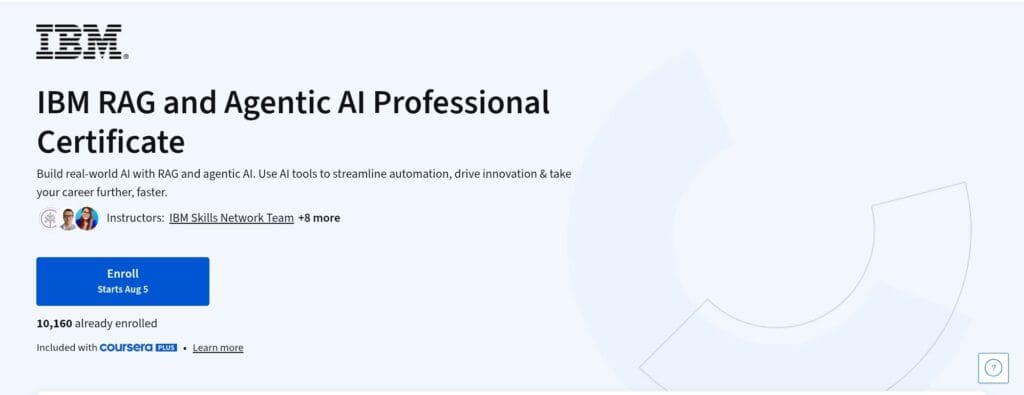
This multi-course IBM credential is designed for advanced learners, AI engineers, and data scientists who possess strong Python and software development skills.
For professionals working with autonomous, context-aware AI in real-world scenarios, it prepares them to create RAG pipelines, multimodal AI systems, and agentic AI applications.
This advanced-level, self-paced program consists of eight courses and is intended to be completed in around eight weeks at three hours per week; however, the actual completion time may vary based on the complexity of the project.
Foundations of generative AI, RAG pipelines, vector databases, multimodal integration, and the development of agentic systems with frameworks such as LangChain, LangGraph, CrewAI, BeeAI, auto-agents, and others are all covered in the program.
The course materials are presented in IBM’s distinctive format, which consists of tool-focused, modular lectures combined with practical labs utilizing platforms such as Flask, Gradio, and LangChain frameworks.
Everything has an industrial vibe and is geared toward developing practical skills. Faranak Heidari, Victor Fulmyk, the IBM Skills Network team, and others are among the instructors.
This series isn’t just about theory. Developing prompt engineering pipelines, interactive AI apps, vector database management, RAG systems, and a final capstone project that demonstrates your abilities are some of the concrete outputs you will produce.
Although the self-paced approach is very flexible, it requires self-discipline. IBM’s method tends to prioritize tool-centric learning over in-depth theory, which some students find useful for speed, while others complain about the lack of context or depth.
A shareable IBM professional credential is awarded upon completion, expanding your portfolio in the rapidly developing fields of generative, agentic, and RAG AI. The skills you acquire, such as CrewAI, vector databases, LangChain, and LangGraph, are becoming more and more in demand across sectors.
This credential offers a financial aid option, is part of Coursera Plus, and offers a curriculum that was updated as recently as May–July 2025. Additionally, you will create a practical capstone project and obtain a certification supported by IBM’s infrastructure and name.
This curriculum offers useful tooling, applicable workflows, and credit with a respectable supplier if you want to advance quickly in agentic AI and RAG engineering.
It’s a great accelerator, particularly for practical learners interested in AI that is ready for production. For maximum impact, combine it with more in-depth conceptual analysis or individual coding research.
Read Full Review – IBM RAG and Agentic AI Professional Certificate – A Detailed Review
5. Google Business Intelligence Professional Certificate
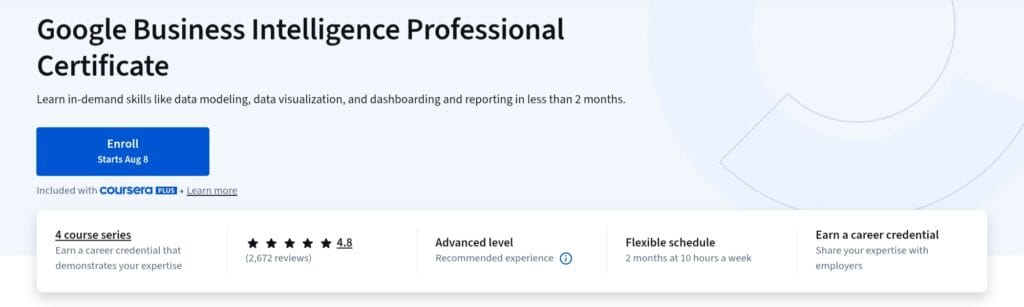
This advanced, four-course certificate is designed for data analysts, mid-career professionals, or students who wish to specialize in business intelligence (BI) professions like business intelligence analyst or engineer and already possess foundational skills like SQL, basic analytics, and data visualization.
It is particularly appropriate for people with a comparable background or who have earned the Google Data Analytics credential.
This advanced-level course covers everything from BI basics to ETL procedures, data modeling, dashboard design, and even AI-powered job search preparation. It is expected to take two months at a rate of about ten hours per week.
It is organized and useful, making it ideal for students who are prepared to apply BI concepts without being overloaded with introductory material.
Professionals from Google, BI analysts, and product managers lead the courses with a clear structure and practical examples of roles, stakeholder requirements, and BI workflows. The information is interesting, easy to understand, and persuasively based on business significance.
This credential is entirely self-paced, flexible, and demands self-control. Practice exercises and video lectures are good, but there isn’t much opportunity for in-person interaction or tailored feedback. Instead of receiving direct instruction, learners frequently rely more on forums and independent study.
Graduates have access to a recruiting consortium of more than 150 companies, including Deloitte, Verizon, Target, and others, as well as a Google-branded certificate that they can display on LinkedIn.
75% of participants reported positive movements (jobs, increases, or promotions) after completion, indicating solid career results. You get skills in ETL, BigQuery, Tableau, dashboarding, and data storytelling from the program, all of which are extremely applicable to BI-centric companies.
Building on an analytics foundation and seeking a tool-rich, career-ready path into business intelligence (BI), this credential offers great structure, practical learning, and employer exposure.
The content includes everything from storytelling to modeling, and the Google logo offers credibility and access to employment channels. Simply be ready for a self-directed path with little opportunity for individualized input, and think about adding soft skills or domain-specific projects to further enhance your profile.
Read Full Article – Google Business Intelligence Professional Certificate – A Detailed Review
6. Foundations of Data Structures and Algorithms Specialization (University of Colorado Boulder)
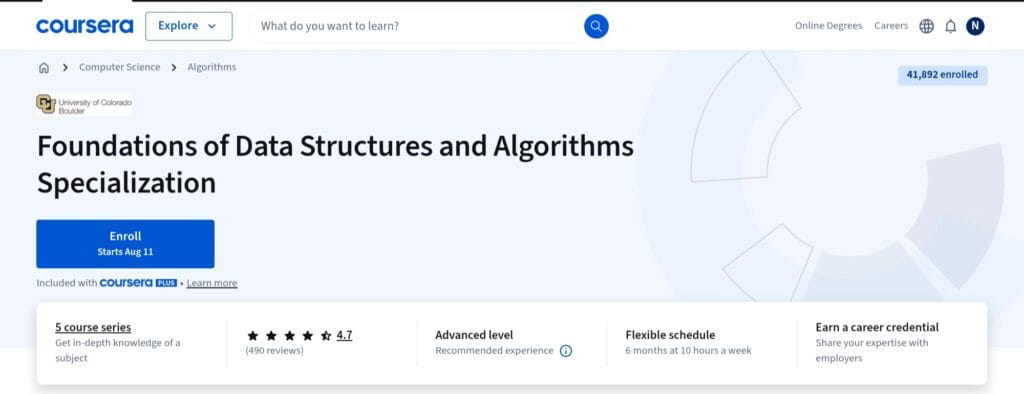
This specialization is designed for professionals in their mid-career or higher education who are proficient in Python, calculus (integrals and derivatives), and fundamental probability theory.
This is a great, academically rich bridge if you want to increase your knowledge of effective algorithms and data structures, particularly for jobs requiring rigorous technical thinking.
With five courses and an Advanced accreditation, this specialization should be finished in around six months at a weekly rate of ten hours. Arrays, hash tables, heaps, trees, and graphs are among the fundamental structures it methodically covers.
Other topics include sorting, searching, traversal, dynamic programming, greedy methods, approximation, and even more complex subjects like RSA and quantum algorithms. Beyond the standard “interview prep” material, it delves deeply into graduate-level algorithmic theory.
Under the direction of Professor Sriram Sankaranarayanan, the curriculum is organized around practical coding, logic, and proofs. The structure, which combines theoretical rigor with Python implementations, is reminiscent of graduate-level lectures.
This feels like a “grad-level course”—much more thorough than typical DSA courses, as one student rightly observed.
The specialization focuses on the design, analysis, and effective implementation of algorithms in Python, which is perfect for developing methodical knowledge. You’ll tackle ever more sophisticated real-world situations and come across coding assignments with performance constraints.
The ideas you will learn are fundamental for creating scalable systems or being ready for complex technical tests, even if it doesn’t emphasize extensive real-world case studies or domain-specific projects.
You receive a shareable certificate upon completion. More significantly, the computational abilities you acquire can be applied to a variety of domains, including research, data science, software engineering, and more.
It’s particularly effective if you intend to pursue or bolster a graduate algorithm portfolio or are hoping to get interviews at significant tech companies.
This specialization provides the structure, rigor, and credentials you require if you’re serious about developing deep algorithmic mastery as opposed to superficial coding abilities.
It has the academic weight of a graduate-level curriculum and is particularly beneficial if you’re planning to pursue additional computer science education or are developing advanced technical fluency.
Read Full Article – Foundations of Data Structures and Algorithms Specialization- A Detailed Review
7. The Path to Insights: Data Models and Pipelines

Advanced students and professionals in their mid-career who have a solid foundation in data analytics—especially those who have taken the Google Data Analytics or BI Foundations course—are the target audience for this course.
This session helps you become more technically proficient in database modeling, ETL design, and pipeline automation if you’re moving into positions like BI Engineer or Data Pipeline Specialist.
This two-week course, which is divided into four advanced-level courses and requires roughly 10 hours each week, strikes a balance between depth and digestibility. Aside from practical expertise with tools like BigQuery and Dataflow, expect a curriculum that focuses on data modeling, ETL procedures, and pipeline development.
The curriculum is well-written and industry-focused, and it is taught by Google Career Certificates. With insights gleaned from actual Google BI practitioners, each subject is concise and well-organized. It is intended to replicate work-related duties in a neat, organized manner.
With 19 tasks, case studies (such as the pipeline-building scenario from Wayfair), tests, and interactive plugins, this course is unique. In addition to learning theory, you will also develop pipelines with data validation and performance testing at their core, design ETL schemas, and carry out BigQuery activities.
It is self-paced, which allows you flexibility but also requires self-control. Although there isn’t much live help, the organized flow makes learning easy. If you run into technical difficulties, forums are your best friend.
This course, which is offered through Coursera Plus and is part of the Google Business Intelligence Professional Certificate, supports eleven languages and comes with a shareable certification.
Designing and optimizing ETL workflows and data models that generate business insight is made easier with this powerful, advanced BI hands-on training.
It’s a powerful, career-boosting curriculum for students who are prepared to delve deeper into the workings of data systems rather than merely looking at dashboards.
Read Full Review – The Path to Insights: Data Models and Pipelines Course – A Detailed Review
8. Data Warehousing for Business Intelligence Specialization (University of Colorado System)
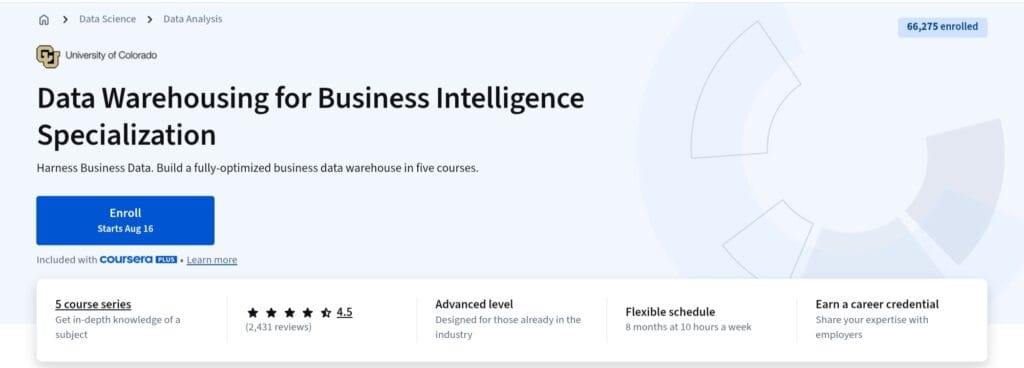
The ideal candidates for this advanced-level specialization are mid-career professionals, data engineers, and analytics practitioners who already possess strong backgrounds in technical BI, SQL, or software engineering.
For individuals who want to go beyond the fundamentals of analytics to designing complete data warehouses and business intelligence solutions, this course is ideal.
In-depth mastery of database management, integration, BI tools, and architecture design is provided by this eight-month, ten-hour-per-week series of five complete courses. It is a thorough, graduate-level program that is extremely useful and demanding.
It has a clear, multi-layered structure under the direction of Michael Mannino and Jahangir Karimi. Basic DBMS ideas are covered first, followed by design and ETL methodologies, relational database support, BI tools, and finally, creating a fully functional data warehouse. The pace of gradual learning is well-suited to the course.
Practical experience is a part of every course. You work on creating schemas, coding SQL, investigating OLAP, and using MicroStrategy dashboards for visualization.
Your own data warehouse can be designed, constructed, and populated for the final capstone, and dashboards can be used to display the findings. These artifacts for the portfolio are powerful.
This specialization offers career objectives, rigorous material, and incremental mastery for those who are prepared to graduate from building simple analytics or SQL to creating actual business intelligence solutions. It’s a strong option for people who are dedicated to honing their data warehousing skills.
Read Full Review – Data Warehousing for Business Intelligence Specialization – A Detailed Review
9. Advanced Machine Learning on Google Cloud Specialization
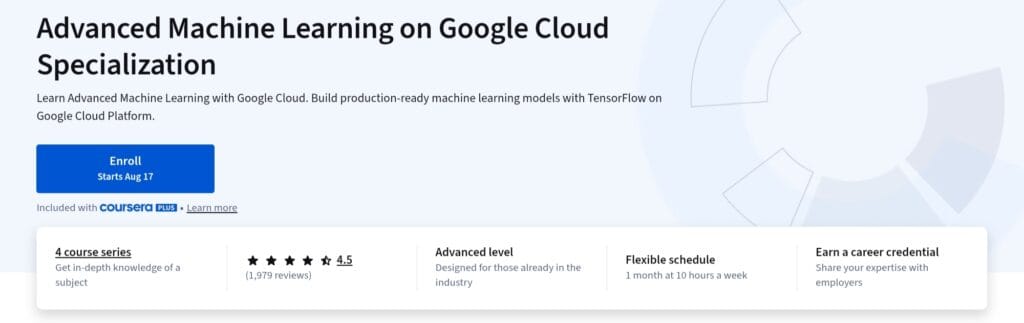
The course is designed for data scientists or advanced learners who already possess a strong understanding of cloud environments, machine learning fundamentals, and TensorFlow.
It’s perfect if you’re prepared to work with production-quality machine learning systems, such as Google Cloud recommendation engines, image modeling, and sequence learning.
The four advanced-level courses make up the series, which learners usually finish in four weeks at a rate of five to ten hours each week. Among the subjects covered in the curriculum are:
- A quick review with labs on end-to-end machine learning with TensorFlow on GCP.
- Explore the architectures of machine learning systems used in real-world applications.
- Using augmentation and hyperparameter adjustment, create and improve CNNs for image classification with TensorFlow on GCP.
- Use RNNs and encoder-decoder models for tasks like text categorization and summarization when working with sequence models for time series and natural language processing.
- GCP Recommendation Systems Using TensorFlow: Discover how to create customization systems with neural, content-based, and collaborative methods.
The Google Cloud Training team provides the content, guaranteeing well-designed, tool-driven training that replicates actual enterprise machine learning processes.
Although it is well-organized, targeted, and packed with examples, some students feel that it focuses more on describing Google’s ecosystem than on the underlying theory.
This specialty is practical and results-oriented. You may anticipate labs that walk you through creating CNNs and RNNs, working with real datasets, constructing ML architectures, and deploying models on GCP. GitHub offers source code, which encourages active learning and review.
This specialization is excellent for expert practitioners looking for a tool-driven, GCP-centric in-depth exploration of production machine learning. It provides hands-on lab experience in image modeling, recommendation systems, sequential data, and the deployment of machine learning pipelines.
Read Full Review – Advanced Machine Learning on Google Cloud Specialization – A Detailed Review
10. Data Mining in Python
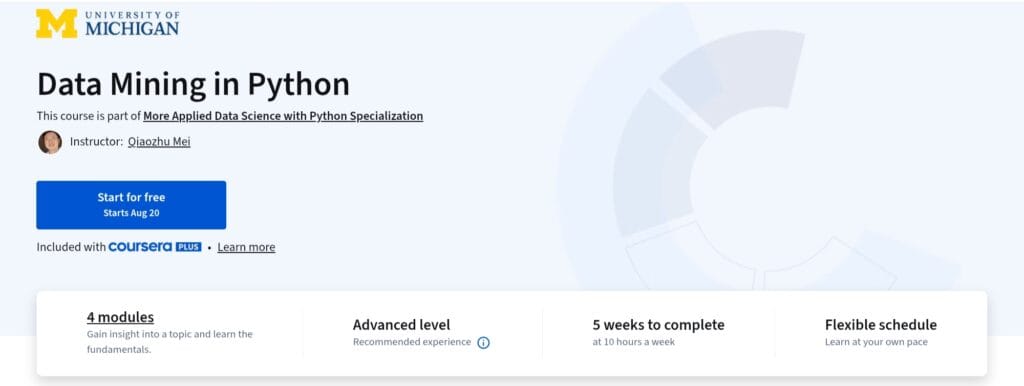
Advanced students or professionals in the middle of their careers with a solid background in Python and data analytics, particularly those who have already finished the “Applied Data Science with Python” specialization or have comparable experience, will find this course excellent.
This course serves as an advanced bridge into the fields of unsupervised learning, pattern recognition, and real-world data mining.
This advanced course, which is offered as part of the “More Applied Data Science with Python” program, was most recently revised in June 2025.
Key topics covered by the four courses include implementing mining tasks that find patterns and similarities in complex datasets and encoding real-world information (itemsets, vectors, matrices, sequences, time series, networks, and streams).
There are roughly 20 assignments in the course, which combine theoretical and coding tasks that require in-depth participation.
The instructional design is neat and well-thought-out. Module 1 is notable for its twelve videos, nine readings, several tests, one programming task, and interactive features including conversation starters and plugins. Both practical experience and intellectual clarity are enhanced by the organized delivery.
Students evaluate a variety of real-world datasets utilizing representations such as itemsets, vectors, and sequences, ranging from social media and corporate processes to supermarket transactions and restaurant reviews.
You will gain knowledge about mining common patterns, assessing their importance, and calculating similarity measures like the Jaccard index. These methods are fundamental to comprehending unsupervised learning pipelines and creating ML-ready features.
If you’re already familiar with Python-based data science and want to learn unsupervised, pattern-driven analytics, this course offers sophisticated, hands-on lessons.
It’s not for novices, but it’s a strong and employable resource for experienced students who want to hone their mining toolbox via practical investigation and significant datasets.
Read Full Review – Data Mining in Python – A Detailed Review
Conclusion
Your current level of experience with data science will determine which advanced course is best for you. Andrew Ng’s Deep Learning Specialization is a good choice if you want to focus on deep learning.
Better options include MLOps or Data Science at Scale if you want to scale and deploy in the real world. There are other choices specifically for specialized knowledge, such as reinforcement learning or healthcare AI.
Choose a course that fits your career objectives and then take the risk. Your career in data science will involve more than just studying data; it will involve influencing how artificial intelligence is used worldwide.
FAQ
Are Coursera’s advanced data science courses worth the investment?
Yes. Coursera offers in-depth information and practical projects in collaboration with leading universities and businesses. Professionals frequently find that the skills they acquire directly translate into higher-paying positions in data engineering, AI, and machine learning.
Do I need a strong math background for advanced courses?
A strong foundation in linear algebra, probability, statistics, and calculus is required for the majority of advanced courses. The specialization in Mathematics for Machine Learning is an excellent way to brush up on your knowledge before delving into more complex subjects.
Can I get a job after completing one of these specializations?
Advanced specializations develop the expertise that companies need, yet no course ensures a job. Your chances of landing a job will significantly increase if you combine your course certifications with internships, GitHub portfolios, and personal projects.
How long does it usually take to complete an advanced data science specialization on Coursera?
If you put in 5–10 hours a week, most advanced programs take 3–6 months to complete. Nonetheless, Coursera provides flexible learning, allowing you to progress at your own pace based on your schedule.
What’s the difference between beginner and advanced data science courses on Coursera?
Python fundamentals, statistics, and basic machine learning are the main topics of beginner courses. For students who already understand the basics, advanced courses cover subjects like deep learning, reinforcement learning, MLOps, and scalable AI systems.
Are there any advanced data science courses focused on real-world applications?
Of course. High-applied programs like AI for Medicine and Data Science at Scale concentrate on resolving practical issues in big data, healthcare, and production-level machine learning systems.
Share Now

Related Articles
The AI Effect on Employment: Are We Facing Job Loss or Job Evolution?
How to Transition into a Data Science Career from a non-tech background: Tips for Professionals
8 Soft Skills Every Data Scientist Needs to Succeed
Discover more from coursekart.online
Subscribe to get the latest posts sent to your email.