

Last updated on February 10th, 2026 at 10:30 am
When working on current digital products, it is no longer enough to approach machine learning as a “black box” that only data scientists may access.
This gap is specifically addressed in Machine Learning Foundations for Product Managers.
As per my understanding from this course, I can attest that it focuses on developing understanding, judgment, and confidence in ML-driven solutions rather than on writing code.
The course teaches machine learning from the perspective of a product manager, covering how models are created, reviewed, and refined, as well as how these decisions affect product outcomes.
You’ll understand what machine learning can really do, where it frequently fails, and how to ask the proper questions when working with engineering and data science groups.
Rather than overloading you with formulae, the course stresses intuition, trade-offs, and real-world decision-making.
This course is particularly helpful because of its balance of theory and practice. It takes you through the whole lifespan of a machine learning model, from defining the problem and selecting the best strategy to evaluating performance using relevant metrics.
By the end, you are not only familiar with ML terminology but also capable of successfully participating in roadmap discussions, model reviews, and AI-related strategic decisions.
This course offers a solid and practical basis to begin your path if you are a product manager, product owner, or business professional who wants to work efficiently on AI-powered products without becoming a machine learning expert.
What skills will you learn in this course?
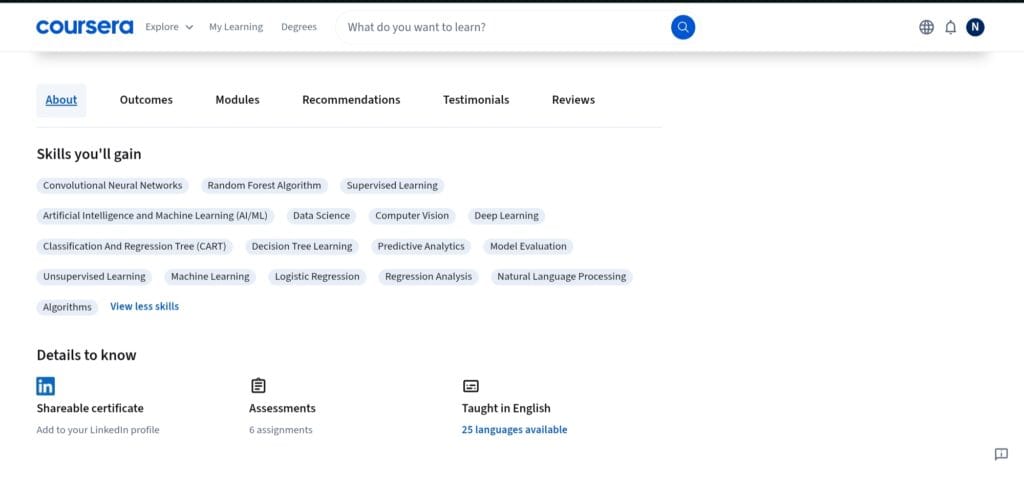
One of the best things about Machine Learning Foundations for Product Managers, in my opinion as a student, is how it consciously develops decision-oriented, practical skills rather than theoretical technical knowledge.
By the end of the course, you will be fully equipped to make ML-driven product choices and work well with technical teams, but you won’t be required to train complicated models by yourself.
Here is a detailed summary of the essential abilities you will acquire.
Machine Learning Literacy for Product Managers
You acquire a practical grasp of machine learning and how it varies from conventional rule-based software.
Without using code, the course teaches you how to communicate in the language of machine learning (ML), including supervised versus unsupervised learning, models, features, training, and validation.
Instead of viewing ML as a mystery, this literacy enables you to contribute significantly to conversations.
Problem Framing and Use-Case Selection
Understanding when machine learning is appropriate and when it is not is a crucial skill you acquire.
Framing business challenges into ML-solvable tasks like regression, classification, or clustering is a key component of this course.
This helps you, as a product manager, steer clear of expensive blunders like using ML when more straightforward fixes would work better.
Understanding the Machine Learning Lifecycle
You gain knowledge of the entire process of developing a machine learning system, including feature selection, data gathering, model training, evaluation, and iteration.
This ability is particularly crucial for creating schedules, communicating expectations to stakeholders, and comprehending why ML projects sometimes call for experimentation rather than specific delivery deadlines.
Model Evaluation and Metric Selection
One of the most important skills taught is how to evaluate machine learning models using appropriate metrics. You get knowledge about how to evaluate regression metrics, accuracy, precision, recall, and error rates in a business setting.
This gives you the ability to ask well-informed questions, such as what trade-offs are acceptable for your product goals and whether a model is “good enough” for launch.
Interpreting Model Performance and Trade-offs
Beyond measurements, the course teaches you how to understand why a model works the way it does.
You discover the effects of feature selection, data quality, and model complexity.
Instead of aiming blindly for greater accuracy, this ability enables you to make well-informed decisions about whether to enhance data, modify the model, or alter product expectations.
Familiarity with Core ML Algorithms
You become well-versed in widely used algorithms, including decision trees, ensemble approaches, clustering strategies, linear models, and fundamental deep learning.
Understanding what each approach is good at, its weaknesses, and where it fits in actual product scenarios is the main focus, not mathematical implementation.
Data-Centric Thinking
Data quality matters more than model sophistication, as the course emphasizes. You discover how imbalance, bias, noise, and data accessibility impact results.
Product managers can use this ability to prioritize data strategy, instrumentation, and feedback loops, which are frequently the actual bottlenecks in the development of ML products.
Collaboration with Data Science and Engineering Teams
Learning to work well with ML teams is a useful ability you acquire. You know how to transform business requirements into machine learning limitations, what questions to ask, and how to interpret technical responses.
This increases the speed at which AI-powered features are executed and decreases misalignment.
Decision-Making Under Uncertainty
Instead of being deterministic, machine learning results are probabilistic.
Through an awareness of acceptable risk, error tolerance, and confidence levels, the course develops the ability to make product decisions in the face of ambiguity.
Launching, iterating, and scaling ML-powered features responsibly requires this.
Read Also: Roadmap to Become A Data Scientist In 6 Months (Step-by-Step Guide)
What concepts are taught in the Machine Learning Foundations for Product Managers course?
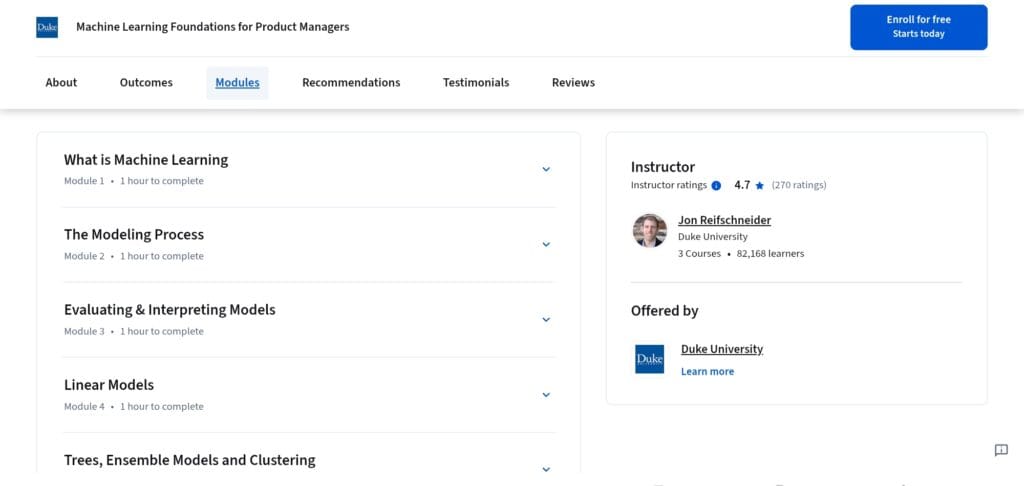
As a seasoned student, I can state that, especially for product managers, this course is designed to develop conceptual clarity before moving on to practical understanding.
Each of the principles is presented in relation to how it affects product choices, deadlines, and results. The main ideas discussed in the course are explained in detail and clearly below.
What Machine Learning Really Is (and Is Not)
The first part of the course simplifies machine learning. You discover the fundamental principle that machine learning systems do not rely on predetermined rules, but rather learn patterns from data.
The course also dispels common fallacies, such as the notion that machine learning models should behave deterministically or be flawlessly correct. Product managers can use this idea to help stakeholders set reasonable expectations.
Types of Machine Learning
You’re introduced to the main categories of machine learning:
- Supervised learning for prediction tasks such as classification and regression.
- Unsupervised learning for finding patterns and groupings in data.
The emphasis is on understanding which type corresponds to which product problem, rather than the underlying math.
Framing Business Problems as ML Problems
A key idea addressed is how to translate product and company objectives into machine learning-friendly formulations. You discover how challenges relate to activities like forecasting values, categorizing results, and clustering users.
This is an important conceptual talent that prevents the misuse of ML in product design.
Bias, Variance, and Model Complexity
The notion that models may be overly straightforward or overly complicated is presented to you.
The course demonstrates how underfitting and overfitting impact performance in the real world and provides an intuitive explanation of these problems.
Understanding the trade-offs between model accuracy and generalization depends on this idea.
Model Evaluation and Performance Metrics
This concept discusses how to evaluate models correctly. You will learn topics like accuracy, precision, recall, error rates, regression evaluation metrics, etc.
Instead of just learning the theories, you will understand how to implement these concepts in business and product contexts.
Linear Models
Linear regression and linear classification are introduced in the course as fundamental machine learning techniques.
The focus is on knowing when linear models are adequate, why they are frequently used in the early stages of product development, and what their drawbacks are.
Tree-Based Models and Ensembles
You gain an understanding of the reasoning behind ensemble techniques like random forests and decision trees.
The course illustrates how these models balance interpretability and performance, a crucial factor in product decisions, and why they frequently perform well in real-world applications.
Clustering and Unsupervised Pattern Discovery
In order to categorize users, products, or behaviors without labeled data, the course discusses clustering. This idea is especially pertinent to exploratory product analysis, segmentation, and customisation.
Introduction to Deep Learning
A high-level introduction to deep learning is given, emphasizing when neural networks are suitable and the trade-offs they entail with regard to data requirements, interpretability, and cost.
This makes it easier for product managers to distinguish between situations where simpler models work better and situations where deep learning is necessary.
Interpreting and Improving Model Performance
Beyond evaluation, the course teaches how to analyze why a model doesn’t work well and what levers may be changed, such as expectations, features, data quality, or model selection. This idea is essential to iterative product development.
Applied Learning Through a Hands-On Project
A practical project that connects all the ideas is the course’s capstone. Without the need for coding knowledge, you apply the entire modeling process, assess outcomes, and make well-informed decisions that reflect real-world ML product scenarios.
Read Also: Best Machine Learning Courses online
Who should join this course?
Machine Learning Foundations for Product Managers, in my opinion, is most suited for professionals who wish to work with machine learning with confidence, rather than necessarily creating models themselves.
The training was specifically created with decision-makers and collaborators in ML-driven teams in mind.
Here are the people who will benefit the most from this course.
- Product managers and product owners
- Aspiring product managers entering AI-driven roles
- Technical program and project managers
- Business and strategy professionals working with ML teams
- Professionals transitioning into AI or ML-focused product work
- UX, Design, and research professionals in data-driven products
Read Also: Entry-Level Data Science Jobs: What Recruiters Really Want
Will you get a job after completing the Machine Learning Foundations for Product Managers course?
Based on my experience, the honest response to this crucial and extremely useful question is no, this course won’t help you land a job on its own. However, when applied appropriately, it can greatly increase your preparation for the workforce.
How this course will help in your career
This course is meant for people who work in product and business profiles. If you are working in such roles and want to understand AI and ML concepts without the coding part, you will benefit from this course.
After completing this online course, you can expect positions in AI or data-focused teams in your organization.
The course basically emphasizes explaining ML concepts to business professionals who think that machine learning is only for data scientists.
How long does this course take to complete?
The Machine Learning Foundations and Product Managers course on Coursera usually takes around 2 weeks to complete if you study at a pace of 10 hours a week.
However, Coursera courses are self-paced, so the actual course completion time will depend on your time commitment each week.
How much does this course cost?
Coursera courses are priced with a monthly subscription option, and this can vary depending on location, currency, ongoing offers, and the actual time you take to complete a course.

Typically, individual Coursera courses cost $39 to $49 per month. Based on this, you can calculate how much you have to spend on this course.
If you want to take multiple courses by paying a lower fee, I would recommend joining the Coursera Plus subscription plan.
This subscription gives access to 10,000+ courses and certifications on Coursera for $59 per month.
Is it worth taking the Machine Learning Foundations for Product Managers course on Coursera?
Yes, it is worthwhile to enroll in Coursera’s Machine Learning Foundations for Product Managers course, as long as your expectations match the course’s objectives.
From the standpoint of an experienced learner, the value of this course is not in teaching you how to create machine learning models, but rather in assisting you in comprehending how ML functions in actual product environments and how product managers ought to see it.
The course is especially beneficial since it develops a solid conceptual understanding of machine learning without overloading you with arithmetic or coding.
It discusses why ML initiatives act differently from traditional software projects, what ML can realistically do, and where it frequently falters.
When working on AI-powered solutions, product managers must prioritize features, define expectations, and make well-informed trade-offs.
The course’s strong product-oriented framing is another factor that makes it worthwhile. Every idea is discussed in terms of how it affects product choices, whether it be model evaluation, data quality, or algorithm selection.
This makes the knowledge immediately useful. You will be better able to assess if a model is ready for launch, contribute to roadmap discussions, and interact effectively with data science and engineering teams after finishing the course.
However, not everyone is a good fit for the course. This course won’t be enough if you want to study Python, become a machine learning engineer, or gain a thorough understanding of the mathematical underpinnings of algorithms.
Its strength is in intellectual and strategic understanding rather than technical proficiency.
In conclusion, whether you are a product manager, an aspiring product manager, or a business professional who works with ML-driven teams and wants to make smarter judgments on AI products, this training is worthwhile.
It provides a solid basis and boosts confidence, particularly when paired with practical product experience or more advanced education.
FAQ
Do I need a technical or programming background to take this course?
No, the course is intended especially for non-technical professionals. Python, statistics, and machine learning algorithms are not required. Every idea is presented intuitively, emphasizing comprehension over application.
Will this course help me communicate better with data science teams?
Yes. Learning how to ask the proper questions regarding data, models, and evaluation measures is one of the most important lessons this course teaches. Discussions with data scientists become more organized, fruitful, and in line with product objectives after finishing the course.
How practical is the learning if there is no coding involved?
From a product perspective, the knowledge is useful. Through practical examples and a final project that mimics how ML decisions are made in real products, you apply ideas. Decision-making, judgment, and trade-offs, rather than coding, are where the practicality is found.
What should I learn next after completing this course?
After completing this course, you can either pursue technical learning or expand your product-focused AI knowledge. To supplement this conceptual basis, many students pursue advanced AI product planning courses or introductory applied machine learning courses.
Share Now

More Articles
Machine Learning Operations Specialization – A Detailed Review
How to Do Feature Engineering in Machine Learning: Step-by-Step Tips for Better Results
Data Analyst Vs Data Scientist Vs ML Engineer: Which Role is Right for You?
Discover more from coursekart.online
Subscribe to get the latest posts sent to your email.