

Last updated on February 10th, 2026 at 10:34 am
Machine learning is more than just a technical word; it’s the driving force behind faster decision-making, better software, and the future of all data-driven professions.
The IBM Machine Learning Professional Certificate on Coursera provides a clear and organized route if you’ve ever wondered how to get started in this discipline without getting bogged down in difficult math or never-ending theory.
Even if you’re not a coding prodigy, this curriculum, created by IBM industry specialists, lets you go from grasping the fundamentals of data to creating actual, functional machine-learning models.
This course is unique because it strikes a balance between simplicity and depth.
You work directly with real datasets, gain useful machine learning abilities, and progressively construct a portfolio that demonstrates your capacity to address real-world issues rather than only watching lectures.
This certification offers you a guided tour into the realm of machine learning without overwhelming jargon or needless complexity, regardless of whether you are a student, a career switcher, or a tech worker looking to upskill.
The IBM Machine Learning Professional Certificate is one of the most reputable and well-organized options accessible today if you’re searching for a beginner-friendly yet career-focused approach to enter the ML industry.
What Skills Will You Learn in This Course?
By the end of this professional certificate, you will acquire the following skills.
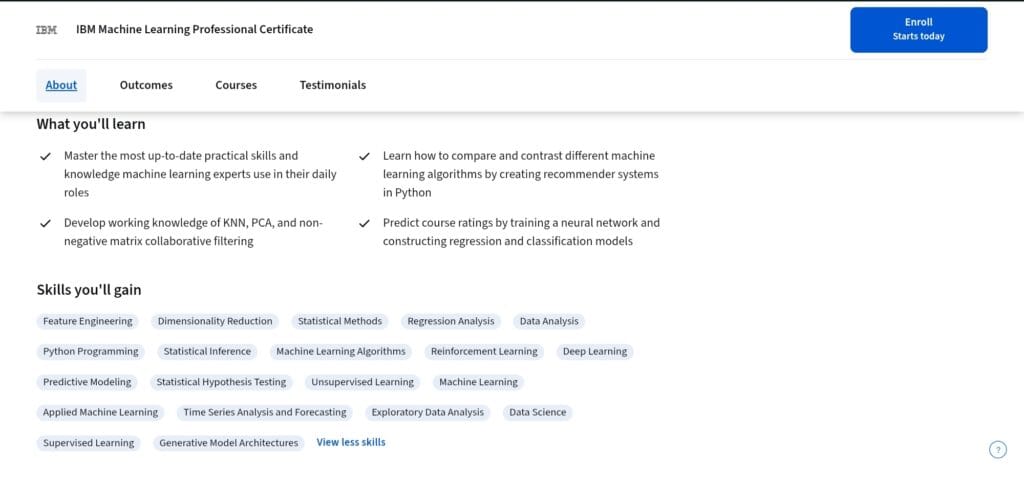
Exploratory Data Analysis (EDA)
Before creating any models, you will learn how to clean, comprehend, and prepare raw data. This includes addressing missing values, resolving inconsistencies, identifying trends, and utilizing visualizations to gain understanding.
Why it matters: Data preparation accounts for 70–80% of the labor in real projects. Better, more precise models are the result of good EDA.
Data Preprocessing & Feature Engineering
Scaling, encoding categorical data, eliminating outliers, choosing significant features, and converting unprocessed inputs into formats suitable for models are all included in this.
Why it matters: The quality of models depends on the features you provide them. This ability greatly improves model correctness.
Regression Modeling
You will learn how to create machine learning models that forecast data, such as demand, sales, or prices. Additionally, you investigate methods like Lasso and Ridge regularization.
Why it matters: Every industry uses regression, including retail, forecasting, marketing, finance, and product analytics.
Classification Techniques
This includes creating models that forecast categories, such as fraud detection, spam detection, or customer attrition. You will work with ensemble methods, decision trees, and logistic regression.
Why it matters: Since classification tasks make up the majority of business ML problems, this skill is extremely essential to the workplace.
Model Evaluation & Validation
Discover how to evaluate the success of your model using metrics such as R-squared, accuracy, precision, recall, and more. Learn about excellent techniques like cross-validation and train/test splits.
Why it matters: Evaluating a model’s performance is just as crucial as creating it. Candidates who can assess models appropriately are valued by employers.
Unsupervised Learning
You study methods for finding patterns without labeled data, dimensionality reduction (PCA), and clustering (K-means, DBSCAN).
Why it matters: Ideal for organizing big datasets, detecting anomalies, and segmenting customers—all important industrial use cases.
Deep Learning Basics
Neural networks, activation functions, and deep learning model construction with frameworks like TensorFlow or Keras are all covered in this course.
Why it matters: Computer vision, speech recognition, and contemporary AI systems are powered by deep learning, which is an essential ability for aspiring machine learning specialists.
Reinforcement Learning Foundations
Discover the fundamentals of training agents that learn through rewards, a notion that is also used in recommendation systems, robotics, and gaming.
Why it matters: Numerous new AI applications are built on reinforcement learning.
Python for Machine Learning
Through experiments and practical notebooks, you can improve your Python, NumPy, Pandas, Matplotlib, and scikit-learn skills even though the course is intermediate.
Why it matters: Learning Python makes all ML workflows easier. Python is the universal language of data and machine learning.
ML Pipelines & Practical Problem-Solving
Preprocessing, modeling, assessment, and tuning are all integrated into actual, end-to-end machine learning workflows.
Why it matters: In their actual professions, ML professionals perform precisely this. It helps you get ready for portfolio projects and interviews.
Real-World Project Experience (Capstone)
You use all of your abilities to develop a complete machine-learning project, like a predictive model or recommender system, utilizing actual datasets.
Why it matters: Portfolio projects are a favorite of recruiters. This capstone demonstrates that you can do more than just follow instructions; you can really create something useful.
Read Also: Foundations of Data Structures and Algorithms Specialization- A Detailed Review
What Concepts Are Taught in The IBM Machine Learning Professional Certificate Course?
The IBM Machine Learning Professional Certificate covers a wide range of topics that will enable you to comprehend not only how machine learning operates but also the practical applications of each technique. The main concepts you’ll learn are broken down here.
Foundations of Machine Learning
You begin with the fundamentals of machine learning, including what it is, how it varies from conventional programming, and how models learn from data.
Additionally, you will also get familiar with important topics such as features, labels, model training, prediction, and the ML workflow.
Data Wrangling & Exploratory Data Analysis (EDA)
You gain knowledge about how to manage missing numbers, correct errors, clean up data, and analyse variables to find patterns and connections.
Correlation analysis, statistical summaries, and visualization techniques are taught in the course.
Supervised Learning
In this section, you will learn algorithms that learn from labeled data. It is further divided into two major categories – regression concepts and classification concepts.
Regression concepts include linear regression, regularization, and error metrics.
Classification concepts include logistic regression, ensemble methods, decision trees, bias-variance tradeoff, confusion matrix, and performance metrics.
Unsupervised Learning
Unsupervised learning explains how models learn from unstructured data.
This includes concepts like clustering, dimensionality reduction, and distance metrics.
Deep Learning Principles
This professional certificate gives an introduction to the fundamentals of neural networks.
It covers topics like neurons, layers, activation functions, forward and backward propagation, loss functions & optimizers, and building simple neural networks with TensorFlow and Keras.
Reinforcement Learning Basics
You explore how an “agent” interacts with its surroundings through incentives and penalties in order to learn.
This includes topics like Markov decision processes, exploration vs exploitation, and value functions.
Model Evaluation & Optimization
How to assess and enhance ML models is the main topic of this section.
It covers concepts like cross-validation, hyperparameter tuning, underfitting, and overfitting.
Real-World ML Pipeline Concepts
You will learn practical ML workflows like data processing, feature engineering, training, validating & deploying models, and monitoring model performance.
Ethics & Responsible AI (Light Introduction)
You get a light introduction to biases in datasets, fairness, and responsible use of machine learning.
Who Should Join This Course?
The IBM Machine Learning Professional Certificate is intended for students who wish to have a hands-on, organized, and business-ready introduction to machine learning.
Anyone who wants to develop genuine machine learning skills from the bottom up can use it, not just programmers or math specialists. Here is who will gain the most.
Students Exploring Data Science or AI Careers
This course is a great place to start if you are a college student or recent graduate hoping to work in data science, machine learning, or artificial intelligence.
You’ll develop practical projects, study the basics, and obtain a certificate from IBM, which will boost your resume’s credibility.
Working Professionals Looking to Upskill
This curriculum is very helpful for engineers, analysts, IT specialists, or software developers who wish to move into machine learning.
Without being overly theoretical, it bridges the gap between fundamental coding knowledge and practical ML applications.
Career Switchers Entering the Tech Industry
This course offers a guided route into the expanding topic of machine learning for those transitioning from non-tech backgrounds like business, finance, or operations.
It’s one of the safest ways to get started with technology because the content is useful and easy for beginners.
Data Analysts Who Want to Level Up
This course helps you broaden your skill set if you’re already familiar with data and want to go beyond spreadsheets and dashboards to predictive modeling.
Strong new technologies like TensorFlow, scikit-learn, and end-to-end ML pipelines will be taught to you.
Beginners with Basic Python Knowledge
If you have a basic understanding of Python, you can easily follow along even if you are unfamiliar with machine learning.
The course uses practical laboratories to reinforce concepts and simplify difficult concepts in a way that is easy to understand.
Freelancers and Tech Enthusiasts
The capstone project provides you with a showcase-worthy machine learning application that you can share with clients, employers, or on GitHub if you enjoy building projects or exploring AI tools.
Anyone Curious About How ML Works in Real Life
This course shows you how contemporary AI systems operate behind the scenes, from forecasting and recommendation systems to categorization models used in commonplace applications, even if you don’t want to pursue a career in data science.
Also Read: Best Machine Learning Courses online
Will You Get a Job After Completing This Course?
Although it provides you with practical projects, industry recognition, and solid core skills, the IBM Machine Learning Professional Certificate is not a guarantee of a job.
Employment cannot be guaranteed by any one online course, and this one is no different. However, if you use it properly, it can greatly increase your likelihood of succeeding.
After completing this course, you can become job-ready for entry-level positions by creating a portfolio of practical projects.
Recruiters value the IBM and Coursera certificates, so you can increase your chances of getting a job when you combine your certificate with a portfolio of practical projects.
Read Also: Will AI Take My Job or Create a New One? A Deep Dive into the Post-AI Job Market
How Long Does This Course Take to Complete?
If you study regularly for eight to ten hours a week, the IBM Machine Learning Professional Certificate is officially designed to take about three months. The actual completion time, however, varies based on your experience, speed, and desired level of practice.
How much does the IBM Machine Learning Professional Certificate Cost?

Signing up for a Coursera Plus subscription is the perfect option to access courses on Coursera. This costs $59 per month, which varies in different locations depending on currency and exchange rates.
With a Coursera Plus subscription, you will get access to 10,000+ courses, certificates, and specializations on Coursera.
Additionally, you can also enroll in individual courses for one month, three months, or six months, depending on the requirement. This usually costs $39 to $49 per month.
Is It Worth Taking The IBM Machine Learning Professional Certificate on Coursera?
Yes — the IBM Machine Learning Professional Certificate is definitely worth taking if you want a practical and structured introduction to machine learning.
From data cleaning and exploratory analysis to regression, classification, clustering, and even fundamental deep learning, the course covers all the key topics.
The practical approach, which involves working with actual datasets, finishing coding labs, and creating a final capstone project that can bolster your portfolio, is what makes it worthwhile.
For the majority of students, understanding machine learning in a practical setting is made possible by this combination of theory and practice.
But it’s crucial to be practical. You won’t become an ML expert overnight with this course, and it won’t get you a job by itself.
You’ll need to practice frequently, create projects outside of the assignments, and keep studying more complex ideas after you’re done if you want to get the most out of it.
Consider this course a solid place to start rather than a comprehensive road map for a career in machine learning.
Overall, it is worth taking if you want a reliable foundation, practical experience, and a recognized certificate. But the real value comes from how much effort you put in outside the course.
FAQ
What is the IBM Machine Learning Professional Certificate?
IBM offers a six-course program on Coursera that uses real datasets, practical laboratories, and a capstone project to teach students practical machine learning abilities.
Is this course good for beginners?
Yes, beginners can follow it as long as they know basic Python. The lessons are simple, guided, and build concepts step by step.
Do you need strong math skills for this course?
No, you don’t need sophisticated math. To understand the ideas, a basic background of linear algebra and statistics is sufficient.
Will this certificate help you get a job?
It increases your prospects by providing you with useful abilities and a legitimate credential, but it also requires additional projects and ongoing practice to land a job.
What tools and libraries will you learn?
You’ll work with Python, pandas, NumPy, scikit-learn, Matplotlib, and the basics of TensorFlow/Keras.
Is the course worth the monthly cost?
Yes, because the content is practical, industry-relevant, and more affordable than most offline programs.
Share Now

More Articles
Machine Learning With Python – A Detailed Review
Will AI take over data science jobs? A balanced perspective
Advanced Data Science Courses On Coursera For Experienced Professionals
Discover more from coursekart.online
Subscribe to get the latest posts sent to your email.