

Last updated on February 9th, 2026 at 09:09 am
The speed at which generative AI is altering our workflow is likely something you have observed if you have been following the tech industry recently.
AI is no longer only for researchers; it’s becoming a necessary ability for anyone working with data, from writing code and making graphics to expanding data pipelines.
Coursera’s Generative AI for Data Engineers Specialization aims to teach just that.
This specialization was developed by IBM specialists to assist students in comprehending how generative AI can speed up, improve the intelligence, and increase the efficiency of data engineering jobs.
Whether you want to master the fundamentals of prompt engineering, are interested in how AI can clean and convert data, or just want to advance your career, this program provides a hands-on, guided approach to get started.
What skills will you learn in this course?
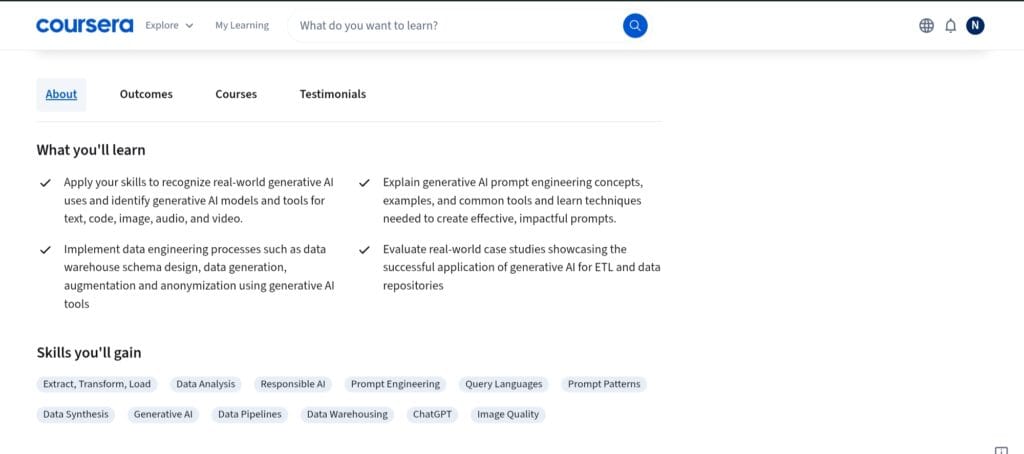
Here is a breakdown of essential skills you will acquire in the Generative AI for Data Engineers Specialization on Coursera.
Foundational skills of generative AI
Learn the fundamental concepts of generative models, how they are different from “discriminative” models, the types of output that large language models (LLMs) and other generative models can produce, including text, code, graphics, audio, and video, as well as common real-world applications.
This provides you with the mental map to determine the areas in which generative AI truly contributes and those that do not.
Prompt engineering basics to get desired results from LLMs
The program’s main practical component is learning how to create prompts that elicit precise and useful answers.
To ensure that the model generates consistent, targeted outputs, this involves iterative prompt refining and practical patterns (zero-/few-shot prompts, persona patterns, chain-of-thought, and tree-of-thought techniques).
These strategies will be practiced in labs, where you will observe how little phrasing modifications impact outcomes.
Generative AI applications for data engineering tasks
The “how” for data engineers is to employ generative AI to build/augment synthetic datasets, automate or speed up ETL procedures, develop data validation rules, and assist in designing data-warehouse schemas and pipelines.
This is the next skill you will learn. You will gain knowledge of tangible patterns such as enriching sparse datasets, creating synthetic rows programmatically, and leveraging models to recommend mappings and transformations in an ETL pipeline. Case studies and practical labs are used to teach these.
Data generation, augmentation & anonymization skills
With examples and exercises, you will learn how to create realistic data for testing or training, enhance datasets to lessen class imbalance, and anonymize or mask sensitive variables to allow for secure data sharing or use.
When you require test data but are unable to reveal production data, this is helpful.
Query languages & model-assisted querying
You’ll learn how generative models can help with database queries (for example, by automatically generating SQL from natural language or recommending query forms) and how to consider secure, dependable methods of incorporating LLMs into workflows for data access.
Practices to verify model-generated queries before execution are part of that.
Hands-on tooling & practical workflows
Anticipate guided exposure to genuine tools and prompt platforms (the course cites IBM Watsonx and popular prompt-engineering tools as examples), as well as labs where you test prompts, try patterns, and create tiny projects that illustrate the ideas from beginning to end.
It is that hands-on experience that transforms ideas into something you can demonstrate to a potential employer.
Evaluation, case studies & decision skills
In addition to developing, the course teaches how to assess the applicability of a generative technique (cost/benefit, quality, risk), monitor the accuracy and dependability of model outputs, and analyze case studies that demonstrate successful applications of GenAI in ETL or data repositories.
This aids in the formulation of logical suggestions for a group or project.
What concepts are taught in the Generative AI for Data Engineers Specialization?
Here are the main concepts you will go through in this specialization.
Generative AI Basics
The first part of the program explains the basics of generative AI, its operation, and how it varies from traditional (discriminative) AI.
In addition to learning about the main categories of generative models, such as large language models (LLMs) for text and code, and other models for images, audio, and video, you will also examine the practical applications in which they are useful.
This provides you with the groundwork to comprehend the significance of technology in data engineering.
Prompt Engineering Principles
The art and science of creating compelling prompts for AI models, known as prompt engineering, encompass a significant portion of the expertise.
The use of structured patterns, iterative refinement, and zero-shot and few-shot prompting is discussed.
This enables you to go from a methodical approach where you are prompted by trial and error to one where you are aware of how to obtain dependable results from generative AI tools.
Generative AI in Data Engineering Tasks
You will learn how generative AI can improve ETL (extract, transform, load), data transformation, schema design, and pipeline automation—all essential data engineering activities.
Concepts like creating synthetic data for testing, employing AI to clean data automatically, and proposing schema and query designs are all covered in the course.
Data Generation, Augmentation, and Anonymization
Creating synthetic data using generative AI is another important concept. You’ll discover how AI can amplify small datasets through augmentation, anonymize sensitive data to adhere to privacy rules, and produce realistic datasets in the absence of real data. This is particularly helpful when handling huge, controlled datasets.
Data Pipelines and Data Warehousing
You will also learn about the principles of creating and maintaining data warehouses and pipelines through this specialization.
You will show how artificial intelligence (AI) technologies can be used to optimize searches, automate repetitive activities, and even recommend changes to data architecture.
Responsible and Ethical AI in Data Engineering
The program covers key ethical and governance ideas in addition to the technical content, such as bias in generative models, the dangers of synthetic data, privacy issues, and the appropriate application of AI in business contexts.
These ideas encourage critical thinking regarding safe and reliable AI applications.
Case Studies and Practical Applications
The course culminates with case studies that demonstrate the application of generative AI in actual data engineering applications.
These examples teach you how to assess tools and techniques in real-world situations by highlighting both what is achievable and where AI has limitations.
Who should join this course?
The Generative AI for Data Engineers Specialization is an excellent option to future-proof your skills if you are a data engineer and want to stay ahead of the competition.
Aspiring data engineers and data professionals who work in related fields like data analysis or database management will benefit from this course.
Students studying in computer science, IT, and related domains can join this course to understand the applications of Generative AI in the field of data engineering.
Moreover, career switchers, tech professionals, managers, and decision makers who are curious about the abilities of generative AI in data-related tasks can join this specialisation.
Will you get a job after completing the Generative AI for Data Engineers Specialization?
Completing this specialization is not enough to get a job in related fields, although it will strengthen your resume.
You can think of this course as a career booster that will enhance your skillset and prepare you for employment, but it won’t guarantee a job after completion.
By completing this course, you will know the fundamental concepts of generative AI and how to use it for data pipelines, ETL, and synthetic data creation.
The projects and practical activities in the course will showcase your abilities to employers and set you apart from traditional data engineers who don’t have AI exposure.
Read Also: Best Generative AI Courses On Coursera That Explain Real-World Applications
How long does this course take to complete?
With three related courses stacked together, the Generative AI for Data Engineers Specialization takes around 8 weeks to complete if you study for 2 hours a week.
The entire course takes around 30 hours to complete. So if you study 1 hour a day, you can easily complete this course within a month. Depending on your convenience, you can progress this course at your own pace.
How much does this course cost?
Just like other specializations on Coursera, this specialization is available with a subscription model on Coursera. This means you pay a monthly fee while taking the course on Coursera.
This usually costs $29 to $49 per month, depending on the location and ongoing offers.
Additionally, Coursera also has a Coursera Plus subscription plan that gives access to 10,000+ courses and certifications. This costs $59 per month or $399 per year.

Depending on your learning needs, you can either go with an individual course or choose the Coursera Plus subscription plan.
Is it worth taking the Generative AI for Data Engineers Specialization on Coursera?
The simple answer is that this specialization can be quite beneficial if you are a data engineer or plan to work with data in the future.
This course teaches you how to use generative AI specifically in the context of data engineering, which is quickly changing the game across sectors.
It provides practical use cases, such as automating ETL procedures, creating synthetic data, or creating more intelligent data pipelines, rather than merely theory.
The lesson is readily applicable to daily duties because of its practical orientation.
This course is unique in another way because it was developed by IBM professionals.
Credibility is increased, and topics are guaranteed to be in line with current trends when material is created by experts with relevant industry experience.
Because of the practical labs, you won’t just be watching videos; instead, you’ll be practicing data transformation, prompt engineering, and AI-powered processes.
If you want to demonstrate your practical talents to companies or construct a portfolio, this applied approach is essential.
It’s crucial to maintain realistic expectations, though. This specialization won’t make you an expert in AI research or suddenly earn you a job.
Rather, it is an excellent introductory course that emphasizes applications and builds on your prior understanding of data engineering.
The best results will come from those who have some prior experience with databases, ETL, or Python. Although they might require additional time or education to keep up, beginners are still welcome to participate.
The certification and the practical skills you acquire might help you stand out in the job market, especially with the increasing demand for data professionals with AI capabilities.
FAQ
What kind of projects will I complete in this course?
You’ll work on hands-on labs and projects like designing AI-assisted ETL pipelines, generating synthetic datasets, practicing prompt engineering, and evaluating AI outputs for real-world data scenarios. These projects give you portfolio-ready examples.
Do I need programming skills to take this course?
Basic programming knowledge, especially in Python, is recommended but not strictly required. Most exercises are designed to guide you step-by-step, though familiarity with code and databases will help you move faster.
Which industries can benefit from these skills?
Skills from this specialization are useful in tech, finance, healthcare, retail, and any field where data pipelines, AI, and automation play a role. Companies adopting generative AI for analytics or workflow optimization will value these abilities.
Can I apply what I learn immediately at work?
Yes. Many labs focus on realistic scenarios like automating ETL, data augmentation, and prompt-based querying. With some adaptation to your organization’s infrastructure, you can apply these techniques directly in professional settings.
Share Now

More Courses
Generative AI Leadership and Strategy Specialization – A Detailed Review
Top 10 Free Generative AI Courses On Udemy
Foundations of Data Structures and Algorithms Specialization- A Detailed Review
Discover more from coursekart.online
Subscribe to get the latest posts sent to your email.