
TensorFlow is one of the most popular and industry-relevant deep learning frameworks backed by Google and widely adopted across startups, enterprises, and research labs.
It is currently the go-to choice for building scalable and production-ready AI models.
TensorFlow is an important tool for transforming machine learning theories into real-world applications, from computer vision and natural language processing to recommendation systems and generative AI.
Whether you are a student, working professional, or career switcher, this article is for you.
I prepared a list of the best TensorFlow courses online to help you get proper guidance on TensorFlow and use this tool effectively for your deep learning workflows.
Whether you want to learn deep learning from scratch, create real-world AI projects, or develop your ML career, this curated list of the finest TensorFlow courses online will help you take the next step with clarity and confidence.
List of the Best TensorFlow Courses Online
| Sl No. | Course Name | Best For | Duration | Level |
|---|---|---|---|---|
| 1 | DeepLearning.AI TensorFlow Developer Professional Certificate – Coursera | Best for structured TensorFlow beginners | 2 Months | Intermediate |
| 2 | IBM Deep Learning with PyTorch, Keras, and TensorFlow Professional Certificate – Coursera | Best for multi-framework deep learning | 2 Months | Intermediate |
| 3 | TensorFlow: Advanced Techniques Specialization – Coursera | Best for advanced TensorFlow practitioners | 2 Months | Intermediate |
| 4 | TensorFlow 2 for Deep Learning Specialization – Coursera | Best for applied TensorFlow mastery | 3 Months | Intermediate |
| 5 | Natural Language Processing in TensorFlow – Coursera | Best for TensorFlow-based NLP skills | 2 Months | Intermediate |
| 6 | Analyze and Build Deep Learning Models with TensorFlow – Coursera | Best for hands-on model building | 5 Hours | Beginner |
| 7 | AI Deep Learning Projects with TensorFlow Specialization – Coursera | Best for real-world TensorFlow projects | 4 Weeks | Beginner |
| 8 | Probabilistic Deep Learning with TensorFlow 2 – Coursera | Best for uncertainty-aware deep learning | 5 Weeks | Advanced |
| 9 | TensorFlow Crash Course for Beginners – YouTube Video | Best free TensorFlow crash course | 23 Hours | Beginner |
| 10 | TensorFlow Full Course 2026 – YouTube Video | Best free beginner TensorFlow overview | 6 Hours | Beginner |
1. DeepLearning.AI TensorFlow Developer Professional Certificate – Coursera
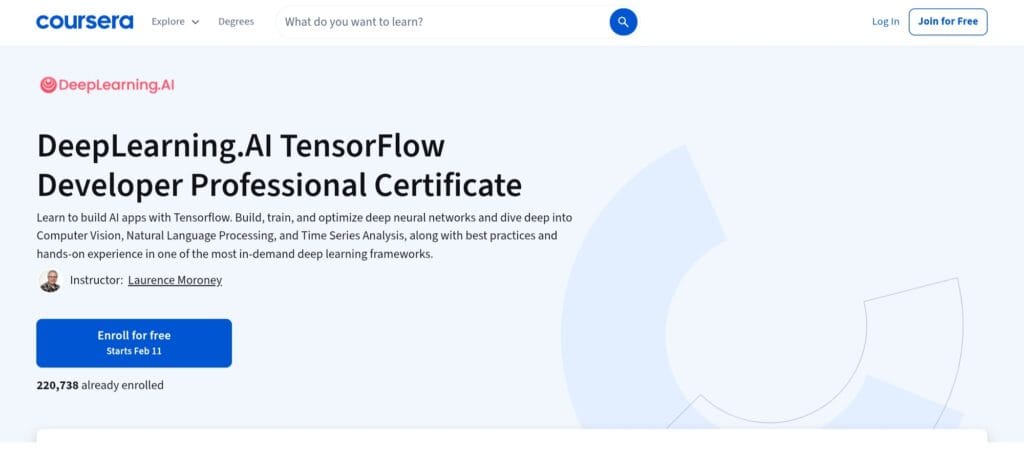
This is a four-course Professional Certificate program that will take you from fundamental TensorFlow ideas to applied deep learning abilities with one of the most popular AI frameworks available today.
DeepLearningAI’s course on Coursera combines theory with hands-on Python assignments and practical projects that represent real-world deep learning difficulties.
Upon completion, you will not only receive a shareable industry certificate but also be well-prepared to utilize TensorFlow in production-oriented situations and even take Google’s official TensorFlow Developer certification test.
Skill Level: Intermediate (suitable for learners with basic Python and some machine learning exposure)
Key TensorFlow Concepts Covered
- TensorFlow fundamentals, including core workflows, basic neural network construction, and deep learning paradigms.
- Computer vision concepts with convolutional neural networks
- NLP concepts such as text tokenization, embedding techniques, RNNs/LSTMs/GRUs, and generation tasks.
- Time series prediction topics covering sequence modeling, forecasting with RNNs, and 1D convolutional approaches.
- Applied machine learning workflows such as data processing, model evaluation, and iterative improvement with TensorFlow and Keras APIs.
Who This Course Is Best For
- Aspiring machine learning engineers
- Data scientists and AI developers
- Learners preparing for the TensorFlow Professional Certificate
- Professionals upskilling from Python or data analytics roles
2. IBM Deep Learning with PyTorch, Keras, and TensorFlow Professional Certificate – Coursera
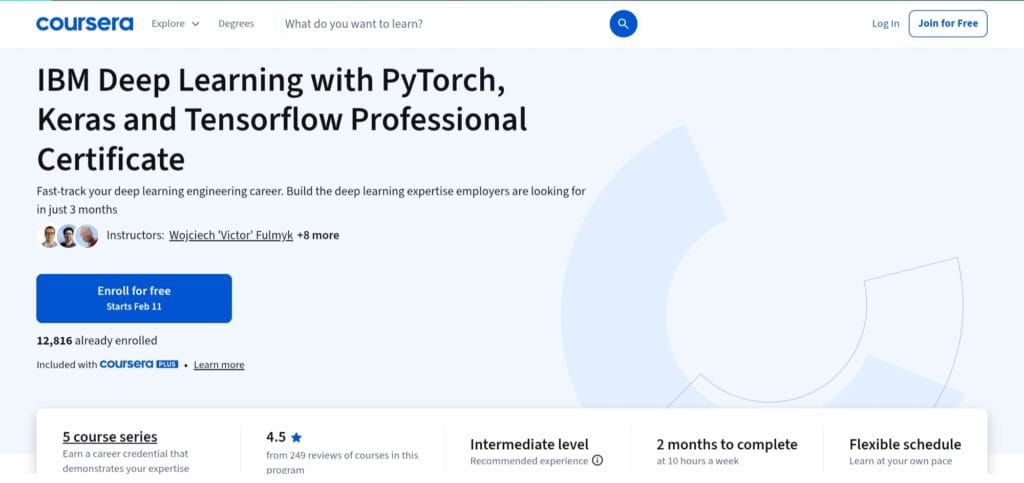
This comprehensive 5-course Professional Certificate focuses on deep learning frameworks used to develop modern AI systems, such as TensorFlow, Keras, and PyTorch.
Designed by IBM, the curriculum provides you with practical, job-focused skills through guided projects and hands-on laboratories, culminating in a capstone that allows you to apply your knowledge to real-world challenges.
Over a two-month period, you’ll examine many aspects of deep learning, from neural network basics to advanced architectures and deployment methods, preparing you for deep learning engineering employment.
Skill Level: Intermediate (best suited for learners with basic Python and foundational machine learning knowledge).
Key TensorFlow Concepts Covered
- Keras and TensorFlow integration for building and training models.
- Advanced convolutional neural networks and model optimization techniques.
- Transformer and sequential model training for NLP and time series tasks.
- Data processing, model evaluation, and performance tuning.
Who This Course Is Best For
- Aspiring deep learning engineers
- AI practitioners and professionals who know Python
- Career switchers and upskillers who are looking for higher roles
Read Also: Best Prompt Engineering Courses Online [Prompting Mastery]
3. TensorFlow: Advanced Techniques Specialization – Coursera
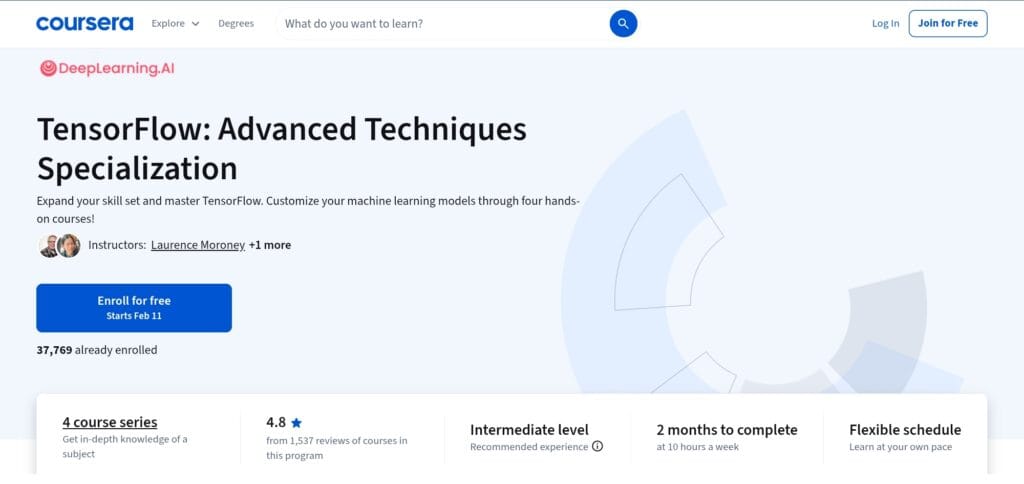
TensorFlow: Advanced Techniques Specialization is a four-course series on Coursera that will advance your TensorFlow skills beyond the fundamentals and into cutting-edge, real-world deep learning operations.
This specialization, which is based on hands-on projects and practical applications, focuses on advanced model development, performance optimization, and specialized deep learning tasks like object detection, generative algorithms, and custom training loops.
It’s great for students who want to have extensive technical control over TensorFlow models or who want to work on big, production-level AI projects.
Skill Level: Intermediate to Advanced (best suited for learners who already have a solid foundation in TensorFlow basics or have completed introductory TensorFlow courses).
Key TensorFlow Concepts Covered
- Custom models, layers, and loss functions that build non-sequential architectures with the Functional API of TensorFlow.
- Distributed and optimized training methods using custom training loops, GradientTape, and multi-processor strategies.
- Advanced computer vision topics such as object detection, image segmentation, and convolution interpretation.
- Generative deep learning topics like Style Transfer, Autoencoders, VAEs, and GANs in TensorFlow.
Who This Course Is Best For
- Developers focused on computer vision and generative AI
- AI and machine learning engineers
- Learners preparing for specific roles in deep learning or machine learning workflows
- Intermediate TensorFlow practitioners.
4. TensorFlow 2 for Deep Learning Specialization – Coursera
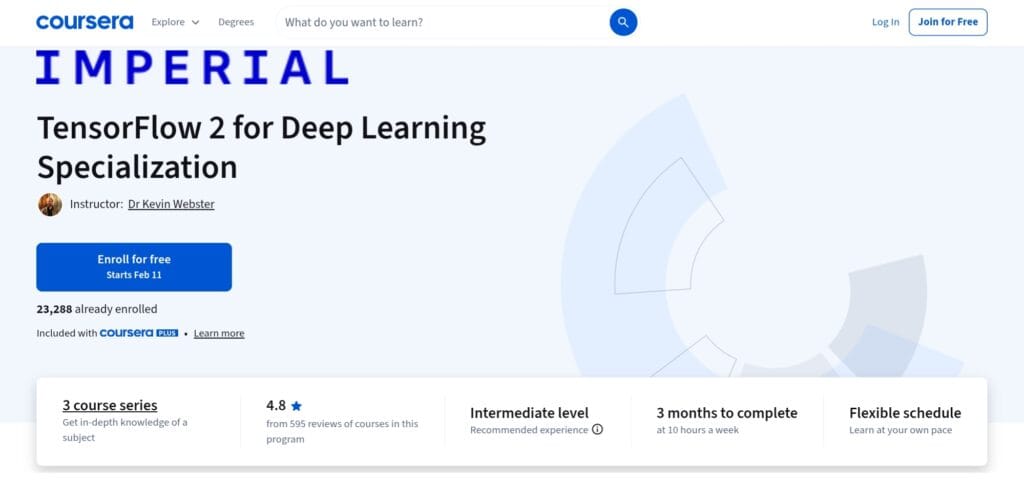
TensorFlow 2 for Deep Learning Specialization is a three-course series that combines foundational deep learning knowledge with advanced TensorFlow 2 implementations.
In a flexible three-month timeframe, you’ll learn how to create and train neural networks, customize architectures, handle complex data flows, and include probabilistic deep learning approaches using TensorFlow and associated libraries.
You’ll develop experience that can be applied to real-world AI tasks through practical assignments and projects like image categorization and sequence modeling.
Skill Level: Intermediate (ideal for learners with basic Python, machine learning concepts, and a willingness to explore deeper TensorFlow skills).
Key TensorFlow Concepts Covered
- End-to-end model workflows, including building, training, evaluating, and deploying deep learning models using high-level APIs of TensorFlow 2.
- Customization with lower-level APIs, such as building complex architectures and data pipelines beyond surface-level sequential models.
- Techniques to work with temporal and language data for natural language processing tasks.
- Understanding probabilistic approaches in neural models.
Who This Course Is Best For
- AI practitioners who want practical experience with TensorFlow 2
- Intermediate deep learning developers who want to upskill
- Machine learning engineers who want to handle real-world problems
Read Also: Best Agentic AI Courses Online [Build Job-Ready AI Agent Skills]
5. Natural Language Processing in TensorFlow – Coursera
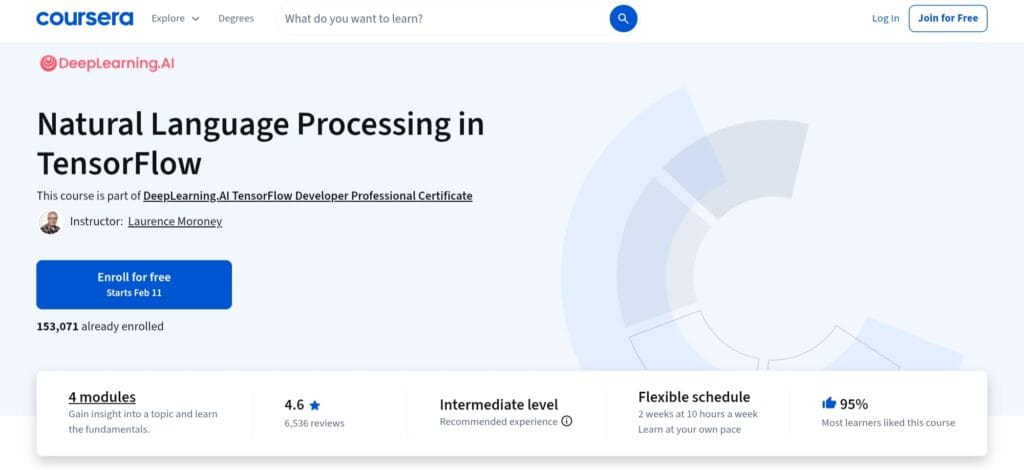
This Coursera course focuses on Natural Language Processing (NLP) with TensorFlow, giving students the skills and techniques they need to process, understand, and generate text data using deep learning models.
As part of the DeepLearning AI program, the TensorFlow Developer Professional Certificate combines intellectual clarity with practical TensorFlow code labs.
You’ll learn to translate raw text into understandable numeric representations, create recurrent neural networks, and even train models to generate original text by working on fascinating assignments and real datasets.
Skill Level: Intermediate (recommended for learners with basic Python, TensorFlow fundamentals, and some machine learning experience).
Key TensorFlow Concepts Covered
- Methods to convert raw text into sequences that TensorFlow models can understand.
- Vector representation and embedding topics that map words or sentences into dense vectors to capture semantic meaning.
- Core sequence models to handle text data, such as RNNs, GRUs, and LSTMs.
- Building, training, and evaluating sequence models in TensorFlow.
Who This Course Is Best For
- Intermediate TensorFlow learners who want to specialize in NLP.
- Machine learning engineers
- Data scientists and developers who want hands-on experience with the NLP capabilities of TensorFlow.
6. Analyze and Build Deep Learning Models with TensorFlow – Coursera
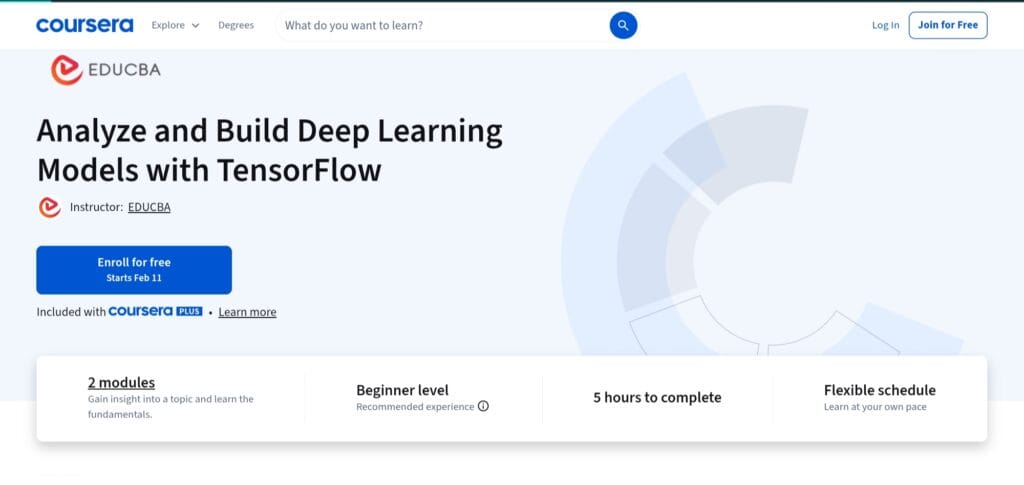
Analyze and Build Deep Learning Models with TensorFlow is a hands-on, project-based Coursera course that teaches you how to develop, assess, and improve deep learning models with TensorFlow and its integrated high-level APIs, including Keras.
Throughout the learning process, you will move beyond beginning ideas and concentrate on real-world analytical tasks, performance evaluation, and hands-on model construction for advanced image recognition, sequential data prediction, and reinforcement methods.
The course emphasizes controlled experimentation and debugging, which will teach you how to analyze model results and create systematic improvements.
Skill Level: Intermediate (best suited for learners with foundational Python and introductory TensorFlow knowledge who want to build real deep learning models).
Key TensorFlow Concepts Covered
- Creating custom models using TensorFlow and Keras Functional APIs.
- Using advanced convolutional neural networks (CNNs) for image processing.
- Training transformer and sequential modes for text and time series data.
- Unsupervised learning and generative models such as autoencoders and diffusion-based approaches.
- Model optimization techniques, such as custom training loops and performance tuning.
- Reinforcement learning basics with deep Q-networks in real-world TensorFlow workflows.
Who This Course Is Best For
- Intermediate TensorFlow learners who want to go beyond basic concepts.
- Developers and AI engineers who want practical experience with model building.
- Students and professionals who want to build project portfolios.
Read Also: best AI courses online [AI Career Guide]
7. AI Deep Learning Projects with TensorFlow Specialization – Coursera
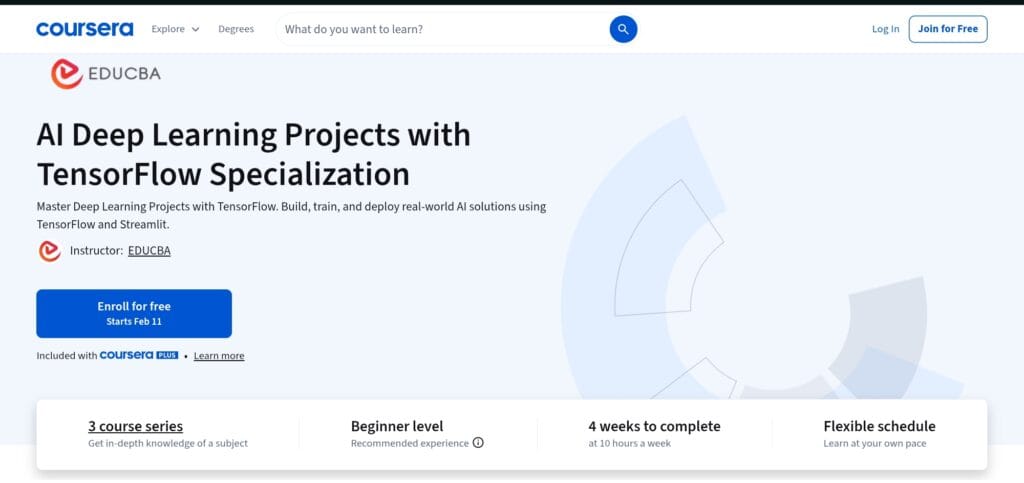
This specialization focuses on TensorFlow deep learning projects, taking you through the design, training, and deployment of AI applications that tackle real-world challenges.
Across three unique courses, you’ll work on real-world projects including neural network development, image captioning system development, and real-time face mask detection app development, earning a full cycle of experience from modeling to implementation.
Skill Level: Beginner to Intermediate — designed for learners with basic Python programming and foundational machine learning knowledge who want to build real AI systems.
Key TensorFlow Concepts Covered
- Neural network construction and training concepts using TensorFlow and Keras API.
- Topics of convolutional neural networks.
- Concepts of transfer learning and model optimization.
- Recurrent models and sequence learning for image captioning.
- Deploying AI models using tools like Streamlit and cloud services like AWS EC2.
Who This Course Is Best For
- Beginners and early AI learners
- Machine learning engineers and aspiring AI builders
- Developers who are looking to create a deployable AI application
8. Probabilistic Deep Learning with TensorFlow 2 – Coursera
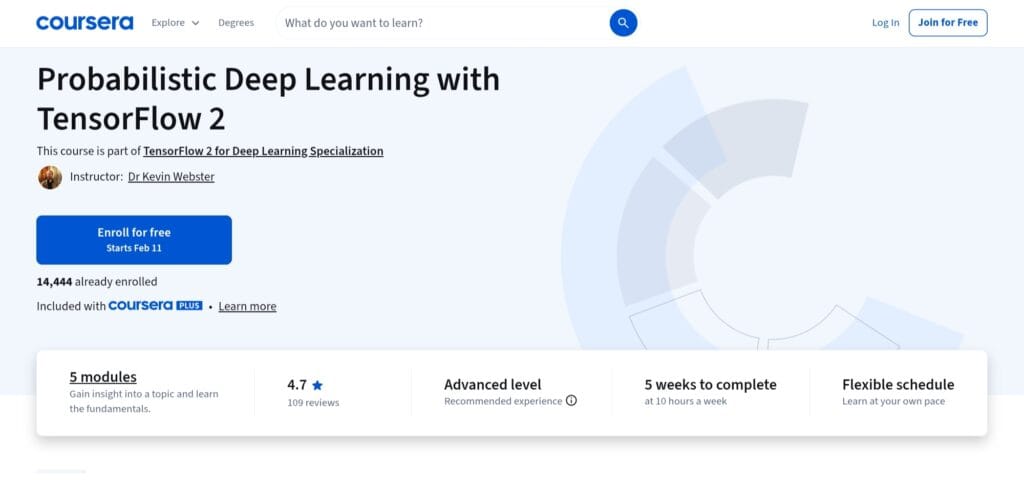
Probabilistic Deep Learning with TensorFlow 2 focuses on the growing importance of uncertainty and probabilistic modeling in deep learning.
Traditional neural networks frequently make point predictions without expressing confidence; this course bridges that gap by teaching students how to create models that quantify uncertainty, evaluate distributions, and produce new data.
Using the TensorFlow Probability library, you will investigate Bayesian neural networks, normalizing flows, variational autoencoders, and other probabilistic structures that improve the robustness, interpretability, and usefulness of deep learning for safety-critical applications such as medical diagnosis and autonomous systems.
Skill Level: Advanced – recommended for learners with solid deep learning experience, familiarity with TensorFlow basics, and a grounding in probability & statistics.
Key TensorFlow Concepts Covered
- Understanding of TensorFlow Probability and distribution objects.
- Probabilistic layers and Bayesian neural networks to capture uncertainty in predictions beyond deterministic outputs.
- Methods to model complex data distributions and generate new samples.
- Concepts of Variational Autoencoders that learn latent representations and synthesize data.
Who This Course Is Best For
- Advanced deep learning engineers
- AI practitioners and researchers
- Developers who are building AI models for safety-critical domains
Read Also: Best Python Courses Online
9. TensorFlow Crash Course for Beginners – YouTube Video
This hands-on crash course on YouTube covers the fundamentals of TensorFlow in an interesting, beginner-friendly way.
Rather than just theory, the video leads you through real model creation and fundamental TensorFlow ideas that prospective AI learners need to get started coding comfortably.
The course covers ~23 hours of training and focuses on applying TensorFlow step by step, from understanding tensors and math principles to developing regression and classification models.
Skill Level: Beginner (great for total newcomers to TensorFlow and deep learning).
Key TensorFlow Concepts Covered
- TensorFlow fundamentals and operations, including tf.constant, tf.Variable, and basic arithmetic with tensors.
- Fundamentals of model building covering simple regression and classification model workflows.
- Features of TensorFlow 2.x, such as eager execution, GPU acceleration, and integration with NumPy.
- Model evaluation metrics and improvement strategies.
Who This Course Is Best For
- Absolute beginners who are looking for a free introduction to TensorFlow.
- Students and self-learners who are looking for a TensorFlow course.
10. TensorFlow Full Course 2026 – YouTube Video
This free, livestream-style TensorFlow full course recording on YouTube is intended to expose learners to the fundamentals of deep learning with TensorFlow, with an emphasis on practical, hands-on demos.
The video progresses from basic ideas in neural networks and activation functions to core TensorFlow procedures and model creation. It’s designed more like an extended tutorial than a short introduction, making it ideal for learners looking for a full beginner experience without having to pay for a course.
Skill Level: Beginner (ideal for those new to TensorFlow and deep learning).
Key TensorFlow Concepts Covered
- Deep learning fundamentals such as neural networks, activation functions, and optimizer mechanics.
- TensorFlow foundations and Keras workflows to build, train, and evaluate models.
- Image classification and prediction tasks to show real examples of model implementation.
- Practical coding demonstrations with Python and TensorFlow APIs.
Who This Course Is Best For
Absolute beginners who are looking for a video-based learning program without paying a premium cost.
Career Opportunities After Learning TensorFlow
Mastering TensorFlow allows you to pursue some of the most in-demand and future-proof positions in the AI ecosystem.
Because TensorFlow is widely used for developing, training, and deploying production-grade machine learning models, people with hands-on TensorFlow knowledge are in high demand across industries, not just in big tech but also in conventional sectors experiencing digital transformation.
The following are some of the most common career paths after studying TensorFlow.
Machine Learning Engineer
Machine Learning Engineers are responsible for designing, training, and implementing large-scale machine learning models. TensorFlow is an essential tool for this function, particularly for developing deep learning pipelines and production-ready models.
AI Engineer
AI engineers create end-to-end intelligent systems for applications such as recommendation engines, voice assistants, and computer vision products. TensorFlow is often used for transitioning AI models from experimentation to real-world applications.
Data Scientist
While data scientists are actively involved in data analysis and statistics, TensorFlow allows them to go beyond traditional models and apply deep learning approaches to complicated challenges involving images, text, and time series data.
Deep Learning Engineer
Deep Learning Engineers specialize in neural networks and advanced AI designs, so TensorFlow is an essential skill. These professions frequently require cutting-edge work in vision, NLP, and generative AI.
FAQs – Best TensorFlow Courses Online
Is TensorFlow hard to learn?
TensorFlow itself is not hard, but it can feel overwhelming at first if you’re completely new to machine learning. The learning curve mainly comes from understanding concepts like neural networks, loss functions, and optimization—not from TensorFlow syntax alone.
Can beginners learn TensorFlow without an ML background?
Yes, beginners can learn TensorFlow without a formal machine learning background, provided they start with the right course.
Is TensorFlow still worth learning?
Yes, TensorFlow is absolutely worth learning. It remains one of the most widely used deep learning frameworks for production environments, large-scale systems, and enterprise applications.
Final Verdict – Which TensorFlow Course Should You Choose?
The ideal TensorFlow course for you is determined by your present skill level, learning objectives, and career path.
A beginner looking to understand the principles of deep learning requires a completely different learning path than a professional looking to construct production-ready AI systems or specialize in advanced approaches.
Whether you want to break into AI, improve your skills for a better job, or understand deep learning frameworks, the appropriate TensorFlow training can help you get there faster.
Share Now

More Articles
Best Deep Learning Courses Online [Beginner to Advanced] (Coursera)
Best Machine Learning Courses online
How to Do Feature Engineering in Machine Learning: Step-by-Step Tips for Better Results
Discover more from coursekart.online
Subscribe to get the latest posts sent to your email.