
Because Python is the foundation of today’s most sought-after technologies, automation, data science, artificial intelligence, and machine learning, it remains the dominant programming language.
It is one of the most useful languages to learn in 2026 and beyond because of its clear syntax, extensive library ecosystem, and widespread industry adoption.
Because of this, picking the best Python courses online involves more than just learning syntax; it also involves developing abilities that are immediately applicable to real-world situations.
This article is intended for students who are just starting their coding journey, working professionals who want to advance their skills, and career changers who want to work in tech positions with significant room for advancement.
This list is unique since it prioritizes skills. We consider curriculum content, practical projects, certificate worth, and employment relevance rather than just popularity when assessing courses.
Every course offered here is designed to assist you in transitioning from studying Python to confidently utilizing it in real-world, career-focused situations.
Without any further delay, let’s now check out the best Python courses that we selected.
List of the best Python courses online
Here is my list of top Python courses that I shortlisted from the internet. Read the detailed reviews and then choose the right course for you.
- Python for Everybody Specialization
- Python for Data Science, AI & Development
- Crash Course on Python
- Microsoft Python Development Professional Certificate
- Introduction to Python Programming
- Programming in Python: A Hands-on Introduction Specialization
- Introduction to Python Fundamentals
- AI Python for Beginners
- Python for Cybersecurity Specialization
- Python for Genomic Data Science
1. Python for Everybody Specialization – Coursera
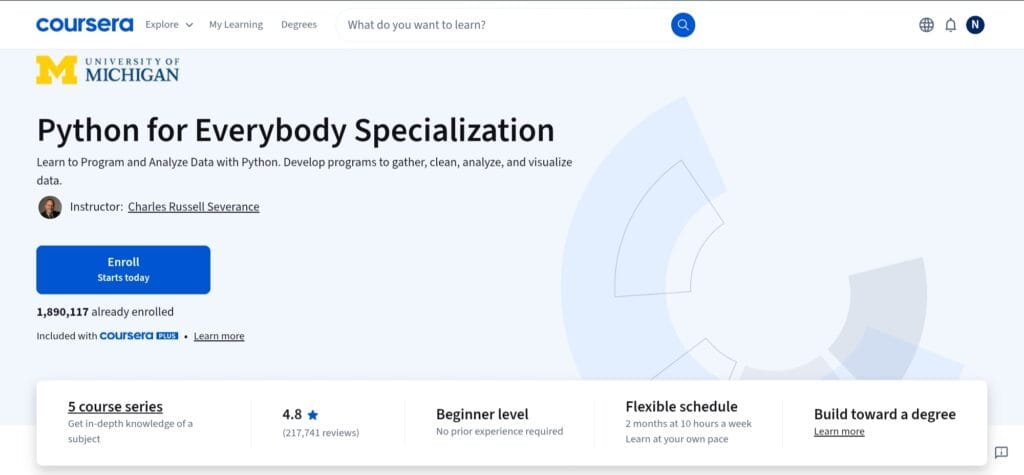
The University of Michigan’s Python for Everybody Specialization on Coursera is a thorough, beginner-focused course that moves students from basic Python syntax to real-world data retrieval and processing tasks.
It’s perfect for anyone who wishes to develop a solid foundation in Python and use it in practical data processing.
Who it’s for
This versatile Python course is suitable for a wide range of learners, such as beginners with no coding experience, career switchers, and professionals who want to get fluent in Python programming.
What problem it solves
The Python for Everybody Specialization course starts with the fundamentals of Python programming.
Then it gradually teaches data handling, web data extraction, databases, and visualization to make sure that students can work with real datasets confidently.
What You’ll Learn
- Foundational Python programming concepts (variables, loops, conditional statements, functions, etc.)
- Data structures (lists, dictionaries, tuples)
- Working with datasets using Python and SQL
- Web data access and scraping (HTML/XML, APIs)
- Data retrieval, processing, and visualization methods
Course Highlights
- It is a structured series of 5 progressive courses that are built upon one another.
- You will go through practice assignments to reinforce your learning.
- There is a final capstone project to retrieve and visualize data using the skills learned.
Duration & Learning Commitment
The Python for Everybody Specialization takes about two months to complete at a pace of 10 hours per week.
However, Coursera follows a flexible structure, so you can complete it faster or slower as per your pace.
Certificate & Credibility
After completing this course, you will get a certificate from Coursera and a credential from the University of Michigan.
You can share this certificate on your LinkedIn and resume to showcase to potential employers. The majority of employers globally recognize this certificate, but combining it with practical experience will open more opportunities for you.
Pros
- It is a beginner-friendly course, and no prerequisites are required.
- The course explains Python concepts and data tasks broadly.
- It has excellent ratings and good reviews from past learners.
Cons
- It may seem time-consuming for some learners.
2. Python for Data Science, AI & Development – Coursera
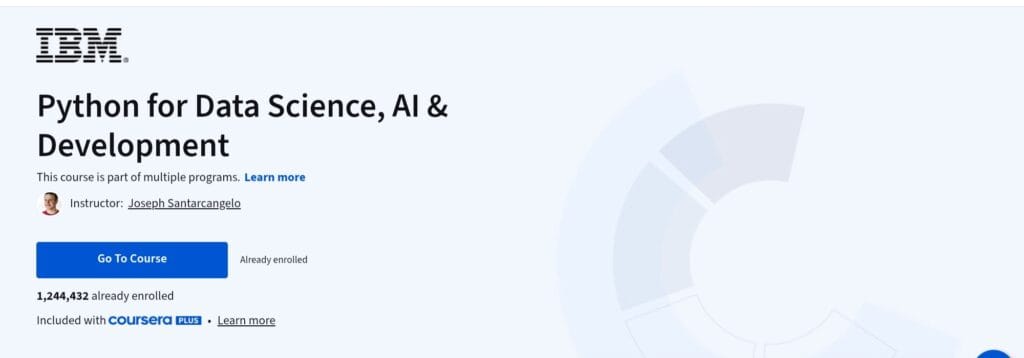
IBM offers a beginner-friendly, foundational Python course on Coursera called Python for Data Science, AI & Development.
This course connects fundamental Python programming with real-world uses in data processing, web data extraction, and simple automation.
This course assists students in developing practical Python abilities that are immediately applicable to projects involving data science and artificial intelligence.
Who it’s for
The Python for Data Science, AI & Development course is a great choice for beginners, aspiring data analysts, and professionals who want to strengthen their Python skills before taking an advanced course on data science or AI.
What problem it solves
This course teaches Python to people who have no programming experience so that they can program in Python confidently. It also trains you to work with essential data libraries used in AI and analytics workflows.
What You’ll Learn
- Basic Python syntax, variables, data types, and expressions.
- Fundamental control structures like conditions, loops, functions, and exception handling.
- Using NumPy and Pandas for data manipulation.
- Using APIs to work with web data and BeautifulSoup for web scraping.
- Core Python data structures such as lists, dictionaries, and tuples.
Course Highlights
Learners gain practical knowledge from hands-on labs using Jupyter Notebooks to reinforce coding concepts.
The course delivers practical projects with data extraction and processing to develop job-relevant skills.
Duration & Learning Commitment
Like all Coursera courses, this course has a flexible schedule so you can complete it at your own pace. Coursera estimates that this course will take approximately 3 weeks to complete if you study for 10 hours a week.
Certificate & Credibility
You will get a course completion certificate from Coursera, backed by IBM, which is a reputable credential to have.
You can include this certificate in your resume or upload it to your LinkedIn profile to showcase your skills in interviews.
Pros
- This course is a great choice for beginners with no coding experience.
- The course content excels at data-oriented Python skills like NumPy and Pandas.
- Practical projects and the flexible schedule make it easier to learn.
Cons
- Its main focus is on fundamental Python concepts rather than production-level topics.
Read Also: Is the Python for Data Science AI and Development Course On Coursera Worth It?
3. Crash Course on Python – Coursera
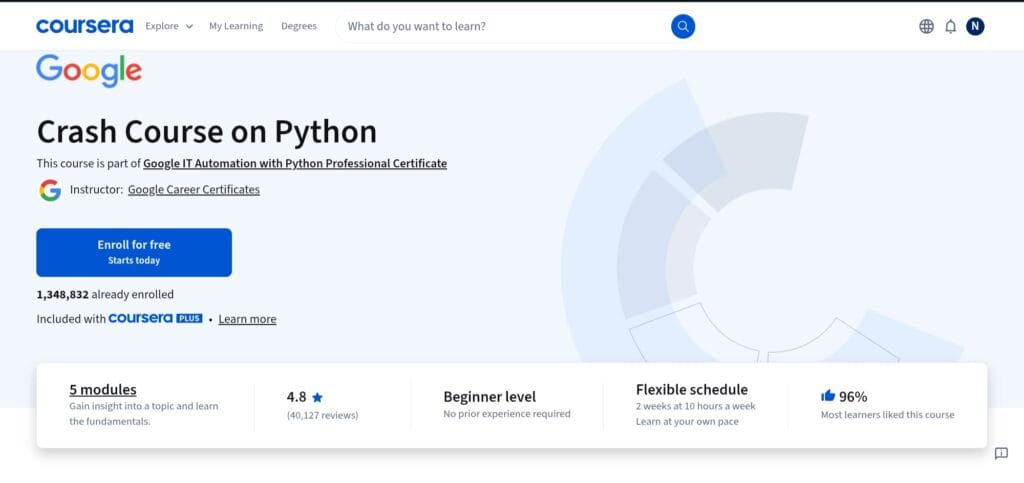
As part of the Google IT Automation with Python Professional Certificate on Coursera, Google Career Certificates offers the highly regarded beginner-level Python Crash Course.
It is a rapid start for students who wish to start coding with useful, automation-focused Python because it concentrates on key Python abilities and scripting principles.
Who it’s for
Beginners and students who want to learn Python fundamentals quickly to get eligible for intermediate Python courses or data-related training programs.
What problem it solves
The course aims to empower learners to code in Python to perform certain tasks and automate processes.
What You’ll Learn
- Fundamentals of Python, such as syntax, data types, and variables.
- Control flow structure and basic data structures.
- Core automation concepts in Python.
Course Highlights
The course emphasises practical learning with short & structured modules and real coding assignments.
Hands-on practice tasks to cement your skills.
Duration & Learning Commitment
The self-paced nature of this course gives flexibility to complete it at your own pace. If you give 10 hours per week, the course will take 2 weeks to complete.
Certificate & Credibility
You will get a certificate from Coursera with Google Credentials. You can add this certificate to your resume or LinkedIn profile for employer recognition.
Pros
- Beginners with no programming experience can enroll in this course.
- It focuses on scripting and automation concepts relevant to IT jobs.
- Industry recognition and credentials from Google.
Cons
- The course can feel too basic for learners who are looking for a comprehensive Python course.
4. Microsoft Python Development Professional Certificate – Coursera
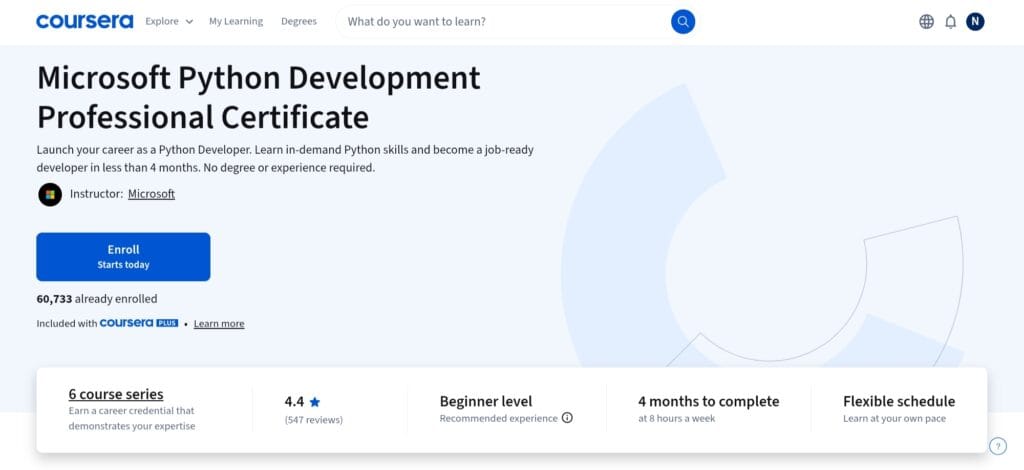
The Microsoft Python Development Professional Certificate on Coursera is a thorough, job-oriented program that takes students from fundamental Python coding to full-fledged Python developers capable of creating real-world apps.
This professional certificate from Microsoft combines fundamental knowledge with real-world projects in web development, automation, data processing, and sophisticated Python techniques.
Who it’s for
This professional certificate is ideal for aspiring Python developers, professionals who are looking for a comprehensive Python learning program, career switchers, and students who need a career-oriented Python learning pathway.
What problem it solves
In addition to equipping learners with Python programming skills, the professional certificate teaches how to apply it across web, data, automation, and cloud-based workflows. By doing so, it helps bridge the gap between theory and real-world jobs.
What You’ll Learn
- Python fundamentals like scripting, data structures, control flow, etc.
- Using Python libraries like Pandas, Matplotlib, and Plotly for data analysis and visualization.
- Core web development concepts with REST APIs, Flask, and database integration.
- Scripting and automation for actual tasks like data processing and API interaction.
- Sophisticated development methods such as testing, OOP, generative AI tooling, and cloud deployment.
Course Highlights
The Microsoft Python Development Professional Certificate has a thorough series of 6 courses that teach fundamental to advanced concepts.
Practical projects in the course will help you create a portfolio and showcase it to potential employers.
With real-world tasks, it connects the gap between theory and practical applications.
Duration & Learning Commitment
Like other courses on Coursera, this professional certificate has a flexible schedule so you can pursue it depending on your availability.
An estimated calculation on the course page suggests that it takes 4 months to complete at a pace of 8 hours per week.
Certificate & Credibility
After completing this course, you will get a certificate with credentials from Coursera and Microsoft. This certificate will be proof of your skills to present on your LinkedIn profile and resume.
Pros
- It is a comprehensive learning program that combines fundamental Python and real-world skills.
- Focuses on practical tools to give real experience to learners.
- The course is designed for job seekers who prefer practical experience over theory.
Cons
- Some learners may find it difficult to complete, as the time commitment is higher.
Read Also: The Data Science Toolkit: Most Used Data Science Tools Every Data Scientist Needs to Know
5. Introduction to Python Programming – Coursera
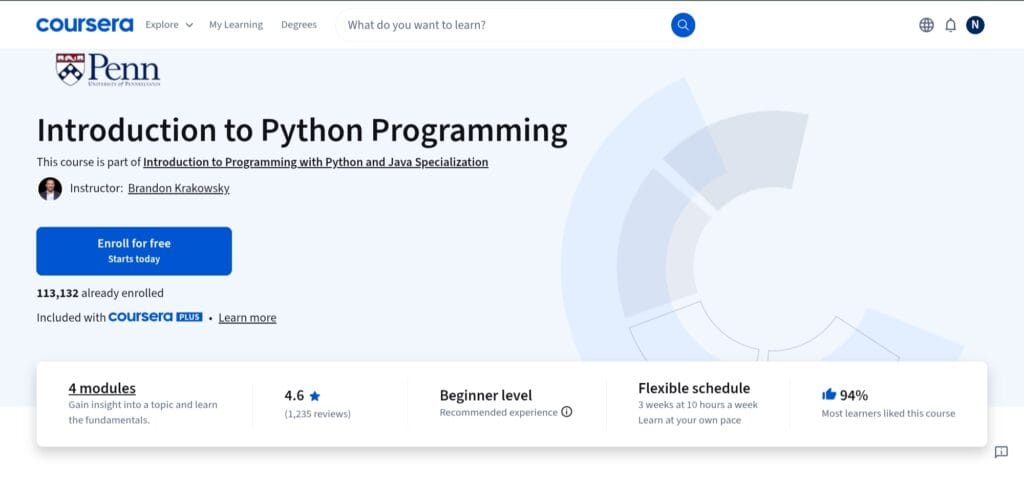
The University of Pennsylvania offers a beginner-friendly Python course called Introduction to Python Programming on Coursera that provides a solid foundation in programming principles and practical coding experience.
Before moving on to more difficult subjects, it is intended to assist students in gaining confidence in their ability to write Python code and comprehend fundamental ideas.
Who it’s for
Beginners, students, and professionals who are new to the coding environment need an introductory course to start with. This course will give an extensive explanation of Python programming concepts.
What problem it solves
The course makes Python programming accessible to individuals with no prior coding experience by breaking down Python concepts into small lessons and practical exercises.
What You’ll Learn
- Foundational Python concepts, such as variables, conditionals, loops, and functions.
- Core Python data structures, including lists, strings, tuples, sets, and dictionaries.
- Writing Python programs using IDEs and Jupyter Notebook.
- How to read from and write to files in Python.
- Best practices for program design and code documentation.
Course Highlights
The course has a structured approach with a series of 4 modules that explain Python concepts from basics to practical use cases.
It focuses on practical learning and teaches tools like PyCharm and Jupyter Notebook.
Duration & Learning Commitment
According to the official Coursera page, it takes approximately 3 weeks to complete at a pace of 10 hours per week. But the flexible schedule makes it easier to study at your own pace.
Certificate & Credibility
Upon completing this course, you will receive a certificate from Coursera backed by the University of Pennsylvania, which can be shared on LinkedIn and your resume.
Pros
- The course has a beginner-friendly structure that explains the concepts clearly.
- Provides practical coding tasks to give you a hands-on learning experience.
- The credential from a reputable university will add value to your portfolio.
Cons
- You may feel assignments challenging, but this will reinforce your skills.
6. Programming in Python: A Hands-on Introduction Specialization – Coursera
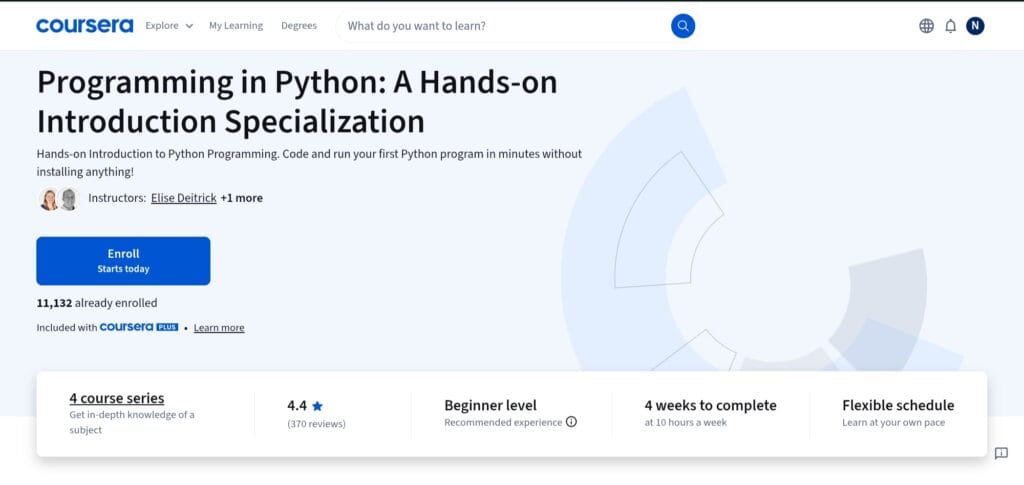
Programming in Python: A Hands-on Introduction Specialization is a project-driven, beginner-focused Python learning series on Coursera that uses real-world coding exercises and interactive projects to build practical programming abilities.
It provides students with a solid basis for future specialization or development work by covering everything from basic Python concepts to object-oriented design.
Who it’s for
Learners who are interested in basic Python programming concepts can consider this course.
Beginners, students, and individuals who are preparing for advanced learning programs will get a foundational understanding of Python programming logic from this course.
What problem it solves
By encouraging learners to write functional Python programs with confidence, the course addresses the gap between theoretical ideas and practical coding jobs.
What You’ll Learn
- Basic Python concepts like variables, data types, control flow, and loops.
- Python data structures, including lists, strings, and files.
- Object-oriented programming concepts, recursion, and functions.
- File management, practical scripting, program logic development, and data import/export.
Course Highlights
A series of 4 sequential courses that teach fundamentals and OOP design concepts.
Practical practice assignments, including interactive programs and automation scripts.
Duration & Learning Commitment
This specialization takes around 40 hours to complete. You can study at your own pace and finish it as Coursera offers a flexible schedule. You can complete this course in a month if you give 10 hours each week.
Certificate & Credibility
You will get a shareable certificate from Coursera after completing this course. Employers who value practical coding ability over traditional degrees will value this credential.
Pros
- It is a structured learning program to take you from fundamentals to intermediate concepts.
- Project-based learning approaches make it easier to understand.
- Complete beginners can join this course as it doesn’t have any prerequisites.
Cons
- It is not baked by any university.
7. Introduction to Python Fundamentals – Coursera
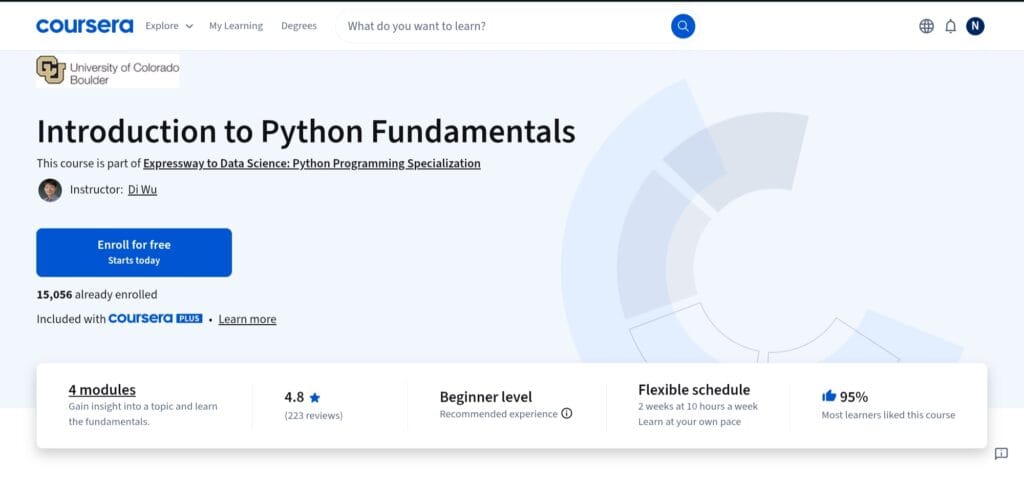
The University of Colorado Boulder’s Introduction to Python Fundamentals is a beginner-focused Coursera course that gradually covers key Python programming fundamentals.
It helps students develop a solid foundation in Python and gets them ready for more complex programming or data-focused careers with a strong emphasis on real coding.
Who it’s for
The Introduction to Python Fundamentals is ideal for individuals who are new to Python programming, professionals who want to revise their Python basics, and students who are preparing for intermediate data science or AI courses.
What problem it solves
This course teaches Python fundamentals in digestible modules, allowing learners to understand the concepts easily. As a result, learners can write simple Python programs and understand the logic behind certain programs.
What You’ll Learn
- Core Python concepts such as variables, data types, and operations.
- Control structures, input/output handling, and basic scripting.
- How to write simple and functional Python programs.
- Python programming principles that will be your foundation for intermediate courses.
Course Highlights
The course is intentionally designed with basic concepts and practical exercises to provide you with a great learning experience.
There are hands-on projects at the end of each module to test if you really understood the concept or not.
Duration & Learning Commitment
If you spend 10 hours per week on this course, you can complete it in 2 weeks. However, you can learn faster or slower depending on your availability since the course offers a flexible schedule.
Certificate & Credibility
You will receive a shareable Certificate issued by Coursera and the University of Colorado Boulder to showcase your skills.
Based on the skills you learn in this course and the practical projects you do, you can secure entry-level job positions or use these as a foundation for your higher studies.
Pros
- Complete beginners can start their coding journey with this course.
- Each practical project is designed to strengthen your concepts.
- The course has excellent reviews on Coursera.
Cons
- Assignments need a certain time commitment, which certain learners may not like.
8. AI Python for Beginners – Coursera
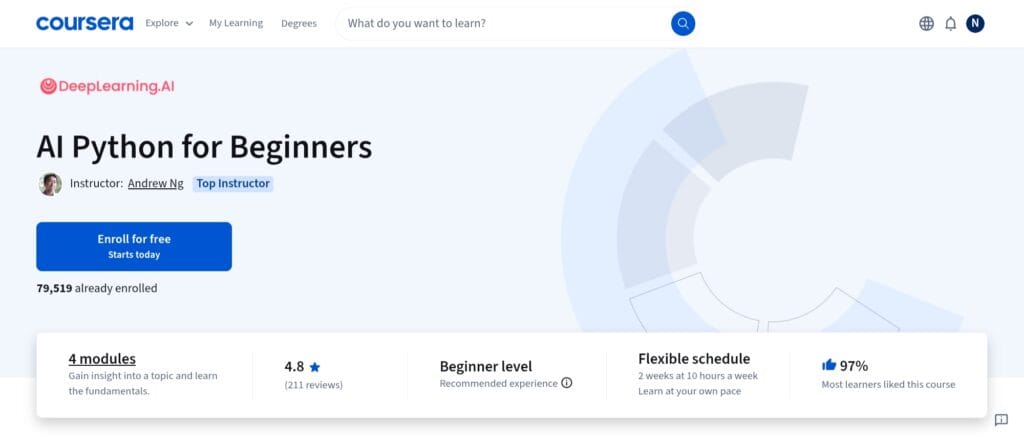
One of the most renowned instructors in AI education, Andrew Ng, teaches the beginner-focused Python course AI Python for Beginners on Coursera, which was developed by DeepLearningAI.
This course gives students a realistic way to begin coding and utilizing Python to create basic AI-related applications by combining fundamental Python concepts with basic AI concepts.
Who it’s for
Beginners, students, and professionals who want to learn Python to use it in AI-related tasks should take this course.
What problem it solves
The course focuses on teaching core Python programming skills. It demonstrates how Python can be used with AI tools to manipulate data, automate tasks, and develop simple intelligent applications.
What You’ll Learn
- Core Python programming concepts and how to use them in practical applications.
- Control structures, data structures, scripting basics, working with data in Python, and basic data manipulation.
- Prompt engineering fundamentals and simple AI agent concepts.
Course Highlights
The course has a series of 4 modules built one upon another that teach basic Python syntax and applications of Python coding with AI tools.
Through hands-on assignments and programming labs, the course allows you to practice what you have learned.
There are practical tasks like automation scripting and basic AI-assisted coding projects to give you real-world experience.
Duration & Learning Commitment
If you spend 10 hours each week, it will take approximately 2 weeks to complete the course. However, you can study at your own pace because of Coursera’s flexible schedule.
Certificate & Credibility
After completing this course, you will get a shareable certificate from Coursera, which can be added to your resume or LinkedIn profile.
It is taught by a reputable instructor in the data science and AI domain, Andrew Ng.
Pros
- This is a beginner-focused course, so learners with zero programming knowledge can join.
- It combines Python programming with practical AI-related tasks.
- In a structured format, the course covers Python fundamentals and simple AI concepts.
Cons
- It is an introductory course to Python and AI-centric concepts, not a deep dive.
9. Python for Cybersecurity Specialization – Coursera

The Python for Cybersecurity Specialization is an application-driven, intermediate-level Coursera learning path that teaches Python scripting in the context of actual cybersecurity activities.
This specialization is perfect for learners who wish to utilize Python in real-world security scenarios since it demonstrates how Python is used to automate both defensive and offensive operations throughout the cyberattack lifecycle, rather than only concentrating on syntax.
Who it’s for
Learners who work in the cybersecurity domain and possess basic Python knowledge can join this course to enhance their Python scripting capabilities. IT professionals and security analysts are also eligible for this course.
What problem it solves
This course functions as a bridge between Python programming and practical security workflows.
It teaches how to use Python to automate tasks, analyze threats, and develop tools for both attack simulation and defense in cybersecurity.
What You’ll Learn
- How to automate cybersecurity tasks using custom Python scripting.
- How to use Python for data access, network security, and exploitation techniques.
- Developing tools for system monitoring, threat detection, and anomaly detection.
- Working with encryption, command-and-control logic, and lateral movement processes.
- Applications of Python across the cybersecurity lifecycle.
Course Highlights
The specialization has 5 sequential courses that cover basic concepts as well as active defense and threat detection workflows.
Practical projects like persistence techniques, credential discovery, and network impact scripting give you a real-world view of cybersecurity scenarios.
Duration & Learning Commitment
As per Coursera, this specialization will take 4 weeks to complete if you give 10 hours every week. However, you can plan your own schedule and study at your own pace due to its flexible structure.
Certificate & Credibility
Coursera provides a shareable certificate to learners after completing this course. You can showcase this certificate to potential employers when seeking a new job or promotion.
It teaches practical scripting skills for cybersecurity tasks, so this credential will be valuable for your career enhancement.
Pros
- The course focuses on practical cybersecurity applications rather than abstract programming.
- It teaches a wide range of Python applications in the cybersecurity lifecycle.
- The practical and project-based structure adds value to your portfolio.
Cons
- Learners must have experience in Python and cybersecurity for this course.
10. Python for Genomic Data Science – Coursera
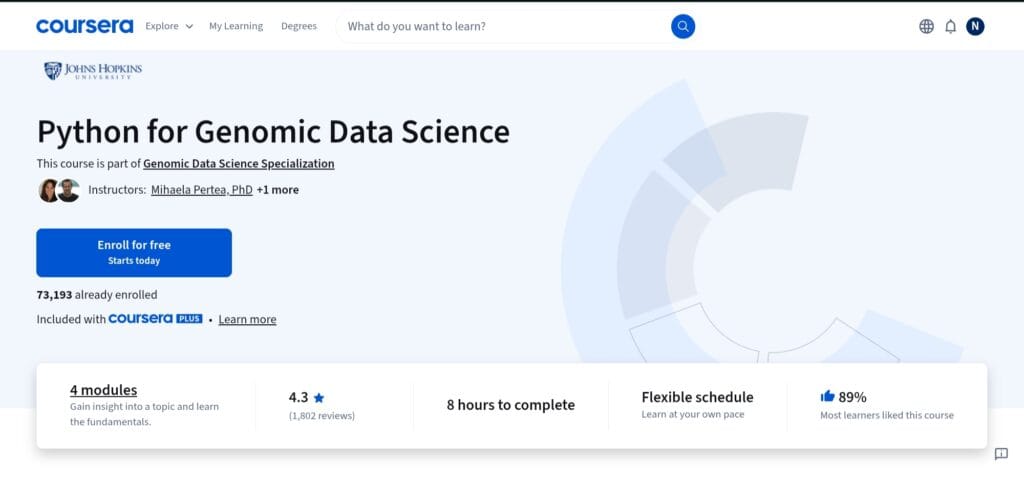
Johns Hopkins University offers a concentrated Python course on Coursera called Python for Genomic Data Science.
Its goal is to teach students the basics of programming while using Python for genomic and bioinformatics applications.
It combines domain-specific methods utilized in genomic data processing with fundamental coding abilities as part of the larger Genomic Data Science Specialization.
Who it’s for
Data science students, beginners who are interested in Genomics, professionals who want to apply Python within bioinformatics, and Python learners who want to learn about niche applications rather than general programming can study this course.
What problem it solves
Allows learners to gain practical Python skills and understand how data manipulation and scripting support genomic data analysis and bioinformatics tasks.
What You’ll Learn
- Core Python programming concepts like variables, control structures, modules, and functions.
- Data structures, loops, and file input/output scripting pipelines.
- How to work with Python in Jupyter Notebooks for interactive analysis.
- BioPython fundamentals for handling biological sequences and genomic data.
- Basic computational logic for bioinformatics tasks.
Course Highlights
It has a compact curriculum with a series of 4 modules covering Python concepts applied to genomic data applications.
There are hands-on assignments to strengthen your skills in the subject.
Duration & Learning Commitment
This short course has a duration of 8 hours. You can complete this course in one or two days, depending on your availability.
Certificate & Credibility
You will receive a Coursera certificate from Johns Hopkins University after completing this course. You can share this certificate on LinkedIn to showcase your skills.
Employers who are looking for candidates for relevant roles will value this credential.
Pros
- The course focuses on applying Python programming in real-world settings like genomics and bioinformatics.
- It is a part of a comprehensive specialization for deeper data science pathways.
- It is a balanced approach of core Python concepts and applied data tasks.
Cons
- Gives an introductory insight into genomic algorithms, not a deeper understanding.
Career Opportunities After Learning Python
Because Python is utilized in software development, data, automation, and AI-driven applications, it opens doors to a wide range of IT roles.
However, how well Python is integrated with real-world abilities and subject-matter expertise has a significant impact on professional results.
Key Job Roles
- Python Developer
Focuses on building scalable, clear Python code for tools, scripts, and apps. Backend logic, APIs, and integrations are common in entry-level positions.
- Data Analyst
Python is used for data processing, cleansing, and visualization. To extract insights from data, Python is usually used in conjunction with libraries like NumPy and Pandas.
- Data Scientist
Goes beyond analysis into modeling and prediction using Python, along with statistics and machine learning libraries.
- Automation Engineer
Builds scripts to automate repetitive IT, testing, or business processes using Python.
- Backend Developer
Uses Python frameworks to develop server-side logic, APIs, and database-driven applications.
Entry-Level Salary Expectations
In India, you can expect ₹4–8 LPA for freshers, depending on role, skills, and company.
Global opportunities range between $60,000–$90,000 per year for entry-level positions.
These salaries are typical. Your actual pay will be determined by your experience, project exposure, and specialization.
Skills Needed Beyond Python
Learning Python alone is not enough to get a job. You should learn SQL, Git, and frameworks like Pandas, Scikit-Learn, Flask, or Django to increase your chances of getting a job.
FAQs – Best Python Courses Online
Are online Python certificates worth it?
When offered by reputable companies like Coursera, Google, Microsoft, or prestigious colleges, online Python certifications are worthwhile. Certificates verify structured learning, demonstrate dedication, and bolster resumes, especially when paired with projects and real-world Python experience. But they do not by themselves guarantee employment.
Can I get a job after learning Python?
Learning Python alone won’t get you a job, but it can help. Depending on the position, employers may want additional abilities like SQL, Git, frameworks, or data tools. Python serves as a foundation, and using it in projects, internships, or real-world problem-solving prepares one for the workforce.
Is Python hard for non-programmers?
Because of its straightforward syntax and easy reading, Python is regarded as one of the simplest programming languages for non-programmers. Starting with beginner-friendly courses and emphasizing practice over theory-heavy material helps many non-technical beginners learn Python successfully.
Which Python course is best for data science?
For data science, Python courses that focus on data manipulation and analysis are the most effective. Courses like Python for Data Science, AI & Development, or Python tracks within data science specializations are ideal because they teach libraries like Pandas and NumPy, and introduce real-world data workflows.
Do Python courses include real projects?
Many of the best Python courses online include real-world projects, assignments, or labs. These projects help learners apply concepts such as data processing, automation, or web development. Project-based learning is crucial because employers value practical Python experience more than theoretical knowledge alone.
Final Verdict – Which Python Course Is Right for You?
The best Python course ultimately depends on your learning goal, not on which course is the most popular.
If you are a complete beginner, structured options like Python for Everybody Specialization or Crash Course on Python provide a smooth and confidence-building start.
For learners aiming at data science or AI, courses such as Python for Data Science, AI & Development, or AI Python for Beginners offer a more applied, future-focused path.
If your goal is job readiness, professional certificates like the Microsoft Python Development Professional Certificate stand out for their depth and portfolio value.
You should choose a course depending on what you want to do in Python, as different courses are meant for different purposes.
Share Now

More Articles
Best Machine Learning Courses online
Data Science Courses On Coursera To Help Land Your First Job
Free Generative AI Courses On Udemy
Discover more from coursekart.online
Subscribe to get the latest posts sent to your email.