
Language is the most natural way humans communicate, but teaching machines to understand it is one of the most difficult tasks in artificial intelligence.
Natural Language Processing (NLP) is the branch of artificial intelligence that allows computers to read, analyze, and synthesize human language using techniques from machine learning, linguistics, and statistical modeling.
Many of the digital products we use every day are now powered by NLP. Conversational systems like ChatGPT, translation services like Google Translate, and voice assistants like Amazon Alexa are all examples of NLP.
It also powers search suggestions, sentiment analysis, and automated customer support.
As the demand for AI-powered applications grows, NLP has become a valuable talent for developers, data scientists, and AI enthusiasts.
In this article, we examine the best natural language processing courses online to assist novices, programmers, and aspiring data scientists in developing real NLP competence.
What Is Natural Language Processing?
Natural Language Processing (NLP) is a subfield of artificial intelligence that allows computers to comprehend, interpret, and synthesize human language from text or audio.
Instead of treating language as a collection of words, NLP systems examine syntax, context, and meaning to extract relevant information from human interaction.
You come across NLP virtually every day.
NLP is at work behind the scenes when a customer care chatbot answers queries, a voice assistant like Amazon Alexa understands spoken commands, or programs like Google Translate convert languages.
It is also commonly used in sentiment analysis, which involves algorithms analyzing text from reviews or social media to identify whether opinions are good, negative, or neutral.
NLP’s power stems from its interdisciplinary foundation. It blends machine learning techniques, linguistic principles, and statistical modeling to enable robots to read human language in a structured and meaningful manner.
As AI systems progress, NLP continues to play a critical role in allowing computers to speak more easily with humans.
List of The Best Natural Language Processing Courses Online
| Sl NO. | Course Name | Best For | Duration | Level |
|---|---|---|---|---|
| 1 | Natural Language Processing Specialization | Perfect for data science students, machine learning practitioners, and Python developers | 3 Months | Intermediate |
| 2 | Natural Language Processing with Real-World Projects | Beginners in data science, developers interested in developing chatbots or conversational AI, and students | 4 Weeks | Beginner |
| 3 | ChatGPT Playground for Beginners: Intro to NLP AI | Beginners interested in AI, NLP, and generative language models | 2 Hours | Beginner |
| 4 | Modern Natural Language Processing | Intermediate learners, Python developers, and data science students | 4 Weeks | Intermediate |
| 5 | Natural Language Processing in Python | Python developers, aspiring data scientists, and machine learning enthusiasts | 12.5 hours | Beginner |
| 6 | Complete Machine Learning, NLP Bootcamp with MLOps & Deployment | Aspiring data scientists, machine learning engineers, and developers | 99 Hours | Intermediate |
| 7 | Intro to Natural Language Processing in Python for AI | Beginners in artificial intelligence, data science, and Python programming | 3.5 Hours | Beginner |
| 8 | Natural Language Processing: A 3-Step Process to Master NLP | Beginners, data enthusiasts, and professionals | 4 Hours | Beginner |
| 9 | Natural Language Processing with Deep Learning in Python | Intermediate Python developers, machine learning students, and data science students | 12 Hours | Intermediate |
| 10 | Investment Analysis with Natural Language Processing (NLP) | Finance experts, quantitative analysts, data science students, and Python developers | 12.5 Hours | Intermediate |
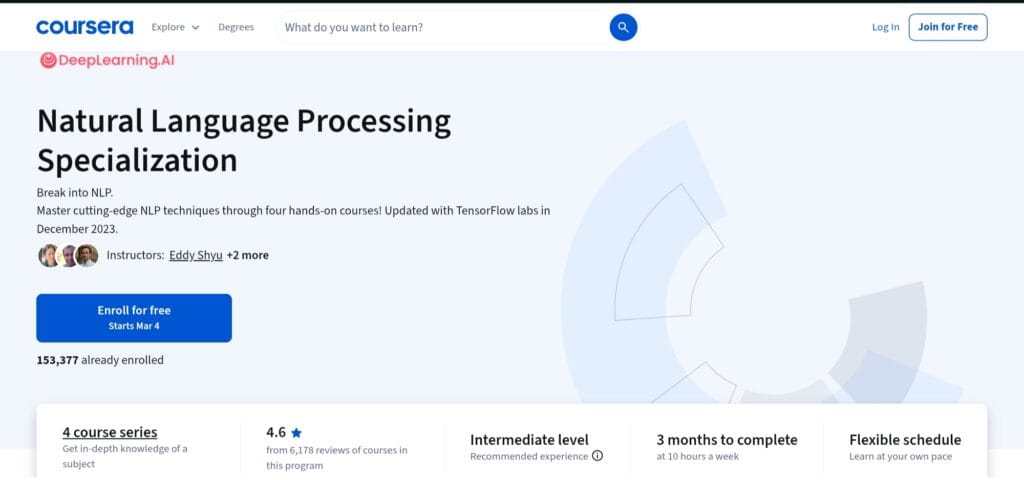
1. Natural Language Processing Specialization
Platform: Coursera
Instructor: Younes Bensouda Mourri, Łukasz Kaiser, Eddy Shyu (DeepLearning.AI)
Duration: ~3 months (around 10 hours per week)
Level: Intermediate
What You Will Learn
This thorough specialization teaches the fundamental approaches used to develop modern NLP systems.
You will learn how to use machine learning techniques such as logistic regression, Naive Bayes, and vector space models to perform sentiment analysis, word embeddings, machine translation, and document search.
The program also delves into complex issues like sequence models and attention mechanisms, which are at the heart of many modern language AI systems.
Practical labs will provide you with hands-on experience developing NLP applications and understanding how language models process text data.
Why This Course Is Worth Taking
This specialization was designed by DeepLearningAI experts and researchers from top AI firms, providing it with significant academic and industry credibility.
The program builds from basic NLP concepts to sophisticated deep learning techniques, making it one of the most structured NLP learning routes available online.
It prepares students to build practical NLP solutions for use in modern AI systems through hands-on assignments and real-world examples.
Best For
This course is perfect for data science students, machine learning practitioners, and Python developers looking to hone their NLP skills and create real-world language AI apps.
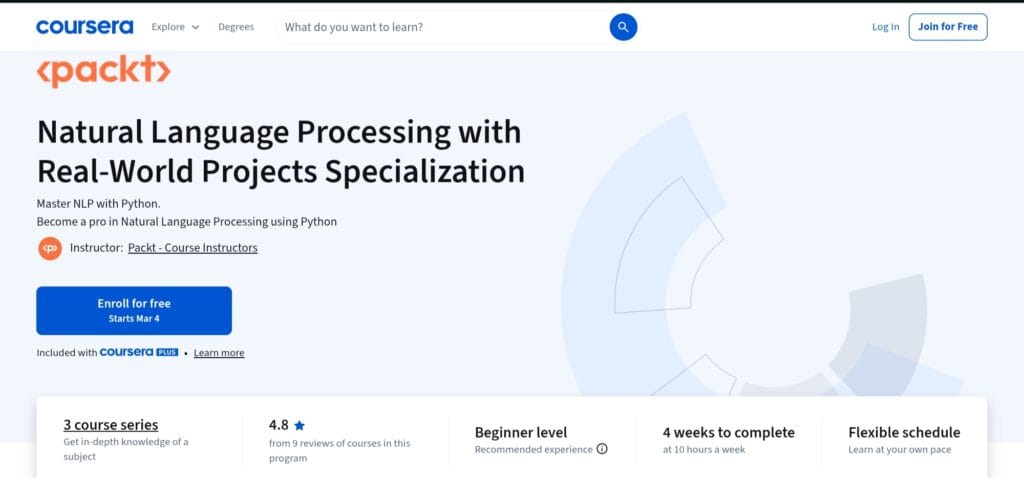
2. Natural Language Processing with Real-World Projects
Platform: Coursera
Instructor: Packt Instructors
Duration: ~3–4 weeks (self-paced specialization)
Level: Beginner to Intermediate
What You Will Learn
This specialization focuses on NLP training through hands-on projects and practical applications. You will investigate how machines analyze human language through approaches such as lexical processing, syntactic analysis, and semantic comprehension.
The program covers sentiment analysis, entity recognition, and text summarizing applications, as well as NLP model training. Building a chatbot using Rasa is one of the highlights, as you learn how to develop conversational systems that can handle real-world text and speech conversations.
Working on applied projects gives students hands-on experience creating NLP models that can comprehend and respond to language data.
Why This Course Is Worth Taking
Unlike theory-heavy NLP courses, this curriculum focuses on solving real-world problems. Each session focuses on applied learning, allowing you to create functional NLP solutions like chatbots and text analysis tools.
This project-based approach teaches students how NLP concepts translate into practical AI applications used in today’s products and services.
Best For
Beginners in data science, developers interested in developing chatbots or conversational AI, and students who prefer project-based NLP training for simple theoretical education should join this course.
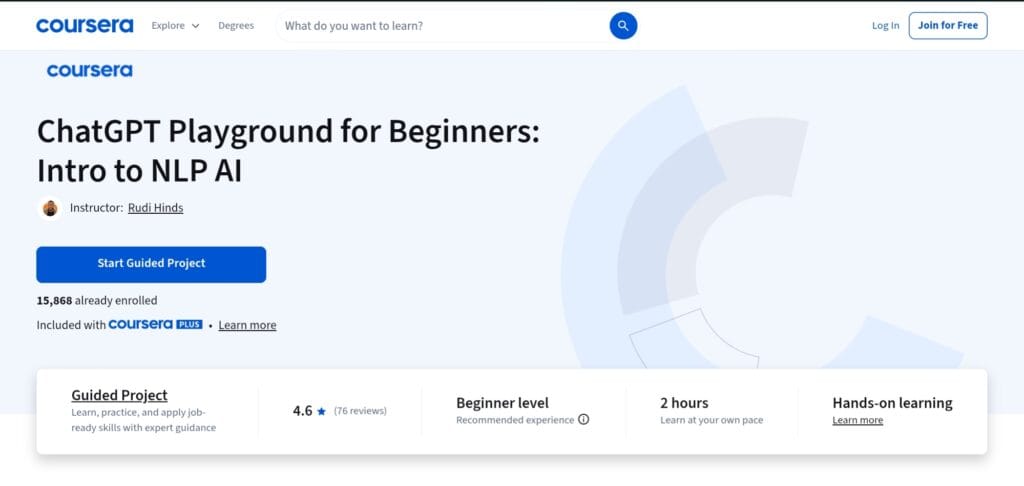
3. ChatGPT Playground for Beginners: Intro to NLP AI
Platform: Coursera
Instructor: Rudi Hinds
Duration: ~2 hours
Level: Beginner
What You Will Learn
This guided project teaches students about the principles of AI-powered language systems through hands-on experimentation with the ChatGPT Playground.
You’ll discover how language models generate responses and how parameters like temperature, max tokens, and top-p influence AI results.
The training also teaches how to arrange prompts and regulate AI behavior through system and user roles.
As part of the project, you will construct a small AI health assistant chatbot to experiment with leading conversational AI replies in real-world circumstances.
Why This Course Is Worth Taking
Unlike many academic NLP courses, this brief guided project emphasizes hands-on experience with generative AI technologies.
The step-by-step environment allows students to interactively tweak model parameters and monitor how AI responses change.
This hands-on method simplifies complicated NLP topics while also providing an overview of prompt engineering and conversational AI development.
Best For
Beginners interested in AI, NLP, and generative language models, as well as students or professionals seeking a quick, hands-on introduction to how modern chatbots operate without prior coding skills.
4. Modern Natural Language Processing
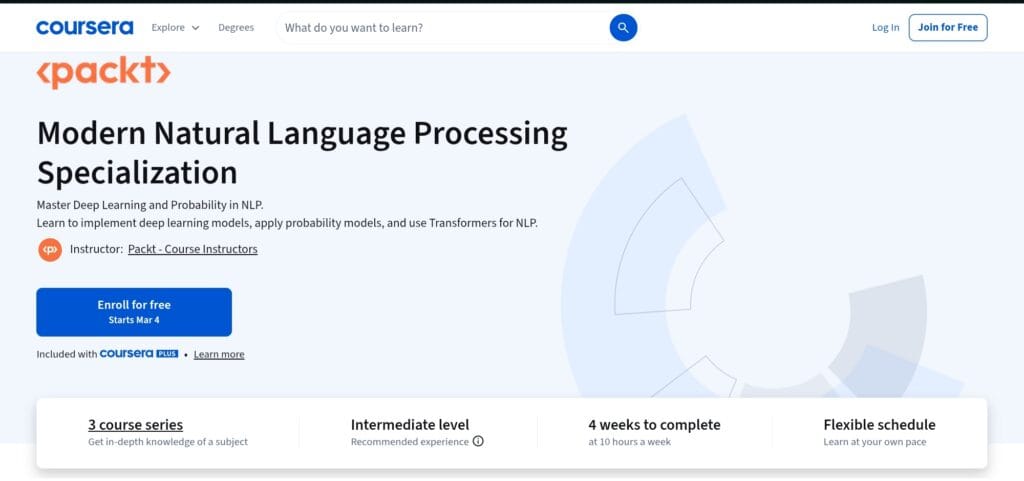
Platform: Coursera
Instructor: Packt Instructors
Duration: ~4–6 weeks (self-paced specialization)
Level: Intermediate
What You Will Learn
This specialization focuses on advanced strategies for developing intelligent language systems. You will begin by learning how neural networks power NLP models before moving on to real text categorization and language modeling implementations with TensorFlow.
The course also covers sophisticated deep learning architectures, such as convolutional neural networks (CNNs) and recurrent neural networks (RNNs), which are used to handle sequential text.
Along the process, you’ll see how probability-based techniques and deep learning work together to address real-world NLP problems like document categorization, sentiment analysis, and text prediction.
Why This Course Is Worth Taking
This specialization is useful since it focuses on recent deep learning approaches to NLP. Instead of focusing just on traditional methods, it teaches how today’s AI systems process language through neural networks and TensorFlow frameworks.
This makes the course especially valuable for students who want to grasp the technology that underpins advanced language models and AI-powered apps.
Best For
Intermediate learners, Python developers, and data science students who want to move beyond the fundamentals of NLP and understand how modern deep learning models are applied to real-world language processing tasks.
Also Read: Best TensorFlow Courses Online to Master Deep Learning and AI
5. Natural Language Processing in Python
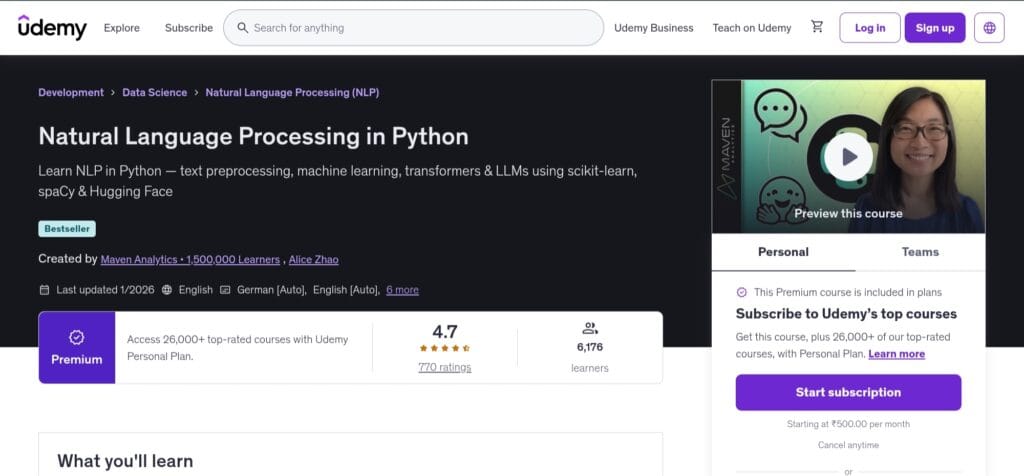
Platform: Udemy
Instructor: Maven Analytics (Alice Zhao)
Duration: ~12.5 hours
Level: Beginner to Intermediate
What You Will Learn
This hands-on course teaches students how to create NLP apps using Python and contemporary machine learning techniques.
You’ll study the principles of language processing, such as text cleaning, tokenization, lemmatization, and vectorization, before moving on to applied machine learning techniques like sentiment analysis, text classification, and topic modeling.
In addition, the course covers neural networks and the Transformer architecture, which explain how modern NLP models work. Learners gain hands-on experience with popular Python packages such as spaCy, scikit-learn, and Hugging Face, doing tasks such as named entity recognition, document similarity, and text generation.
Why This Course Is Worth Taking
Unlike many theory-heavy NLP programs, this course highlights practical Python implementation. The curriculum progresses from traditional NLP methodologies to modern large language model processes, allowing students to grasp how real-world NLP systems are developed.
It provides a structured way to master both core and advanced NLP concepts through over 160 lectures and guided coding activities.
Best For
Python developers, aspiring data scientists, and machine learning enthusiasts who want a hands-on, project-based introduction to developing NLP systems and dealing with contemporary language models.
6. Complete Machine Learning, NLP Bootcamp with MLOps & Deployment
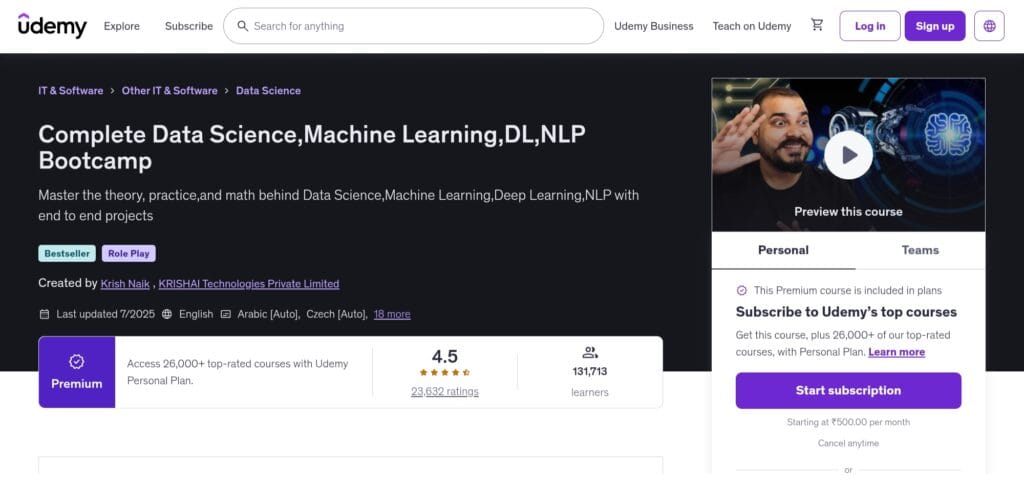
Platform: Udemy
Instructor: Krish Naik
Duration: ~99 hours
Level: Beginner to Advanced
What You Will Learn
This lengthy bootcamp takes you from fundamental machine learning ideas to advanced natural language processing and production deployment.
You’ll study Python programming, statistics, and machine learning algorithms before moving on to deep learning and NLP approaches, including text categorization, language modeling, and transformer structures.
The course also covers modern MLOps methods, such as how to version datasets, track experiments, and deploy models with Git, Docker, MLflow, and cloud services.
Learners receive hands-on experience creating, training, and deploying machine learning and NLP systems for real-world applications through a series of projects.
Why This Course Is Worth Taking
Many NLP courses concentrate solely on model development. This bootcamp goes a step further by teaching the entire machine learning lifecycle, including model deployment and monitoring in production.
It offers a comprehensive understanding of how modern AI systems are produced and deployed in industry by mixing ML, deep learning, NLP, and MLOps in a single program.
Best For
Aspiring data scientists, machine learning engineers, and developers seeking a complete understanding of machine learning and natural language processing (NLP), from theory and coding to real-world implementation.
7. Intro to Natural Language Processing in Python for AI
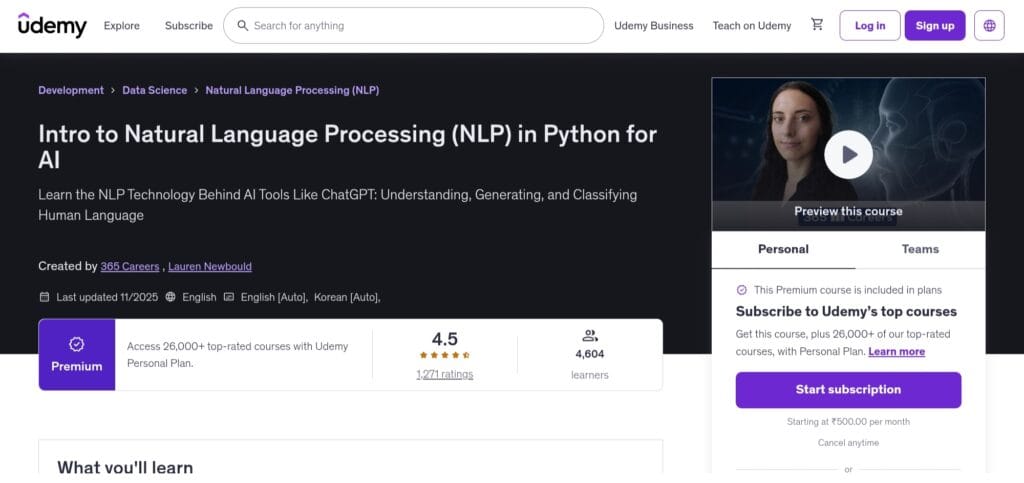
Platform: Udemy
Instructor: 365 Careers (Lauren Newbould)
Duration: ~3.5 hours
Level: Beginner
What You Will Learn
This beginner-friendly course uses Python to teach the practical principles of natural language processing.
You’ll begin by learning how to clean and preprocess text data, including tokenization and formatting for machine learning models. Following that, the course delves into important NLP techniques such as part-of-speech tagging, named entity recognition, sentiment analysis, topic modeling, and text classification.
You will also learn how to vectorize text and prepare datasets for machine learning techniques, providing you with the skills needed to create simple NLP apps and analyze big text datasets.
Why This Course Is Worth Taking
This course distinguishes itself because it emphasizes straightforward explanations and systematic learning rather than overwhelming beginners with dense theory.
Each idea is explained with actual coding examples to help learners understand how NLP models analyze real-world text input.
By the end, students will have a good understanding of how modern AI systems analyze language and how to start developing their own NLP projects.
Best For
Beginners in artificial intelligence, data science, and Python programming looking for a brief yet practical introduction to Natural Language Processing and machine learning techniques for text analysis.
8. Natural Language Processing: A 3-Step Process to Master NLP
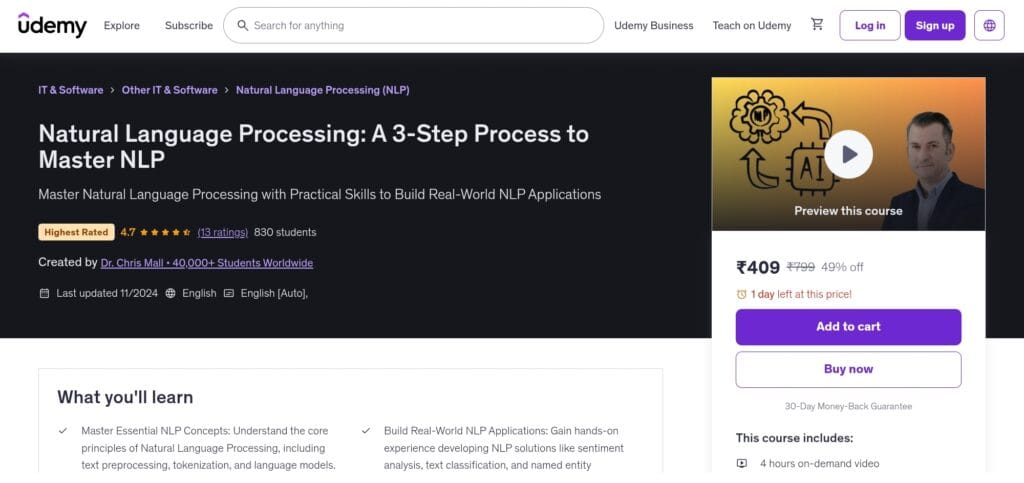
Platform: Udemy
Instructor: Dr. Chris Mall
Duration: ~4 hours
Level: Beginner to Intermediate
What You Will Learn
This course presents Natural Language Processing using a three-step approach that simplifies how machines evaluate human language.
You will begin by learning how linguistic data is gathered and prepared for analysis. The course then introduces fundamental NLP techniques such as text processing, sentiment analysis, and extracting insights from unstructured text data.
Learners will also look at how NLP may be utilized in real-world settings such as customer feedback analysis, chatbot building, and automated text analytics through practical explanations and demonstrations.
Why This Course Is Worth Taking
This course’s clear and simplified learning framework is one of its strongest points. Instead of overloading learners with sophisticated algorithms, it explains how NLP works in three steps.
This systematic method makes it easier for beginners to grasp the workflow of language analysis and how NLP techniques are used in real-world applications.
Best For
Beginners, data enthusiasts, and professionals who want a quick yet practical introduction to Natural Language Processing and how language data can be analyzed to generate useful insights can join this course.
9. Natural Language Processing with Deep Learning in Python
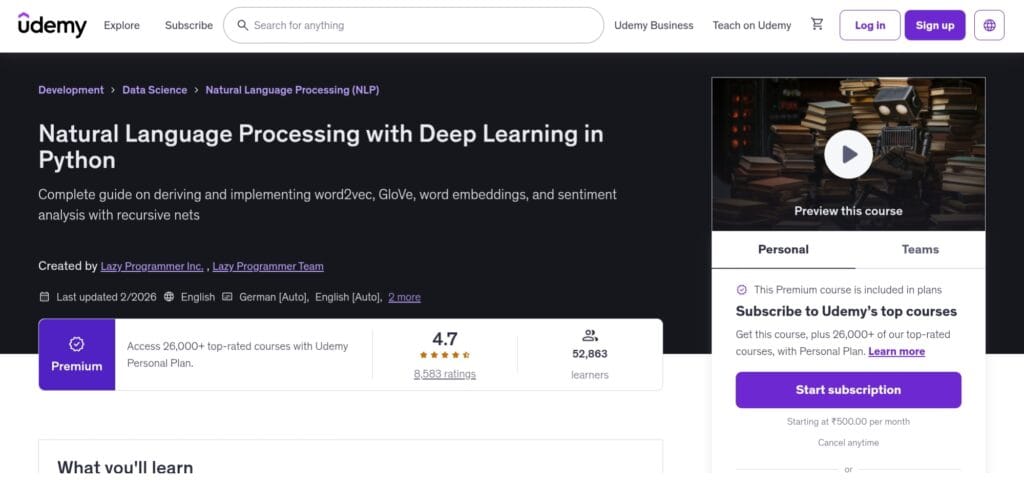
Platform: Udemy
Instructor: Lazy Programmer Inc.
Duration: ~12 hours
Level: Intermediate
What You Will Learn
This course teaches deep learning techniques for natural language processing using Python.
You will learn how to turn raw text into numerical representations using approaches such as TF-IDF, word embeddings, Word2Vec, and GloVe, all of which are required for training NLP models.
The course also delves into probability-based language models and neural network designs for tasks such as sentiment analysis, document categorization, and text generation.
By implementing algorithms step by step, students gain hands-on experience constructing NLP systems and comprehending how modern language AI models analyze text input.
Why This Course Is Worth Taking
This course is unique because it bridges the gap between traditional NLP approaches and new deep learning methodologies. It discusses the mathematics and intuition that drive algorithms such as Word2Vec and neural language models.
This better understanding allows students to develop greater problem-solving abilities when developing AI programs that process massive text datasets.
Best For
Intermediate Python developers, machine learning students, and data science students seeking to expand their knowledge of neural network-based NLP models and sophisticated text processing approaches.
10. Investment Analysis with Natural Language Processing (NLP)
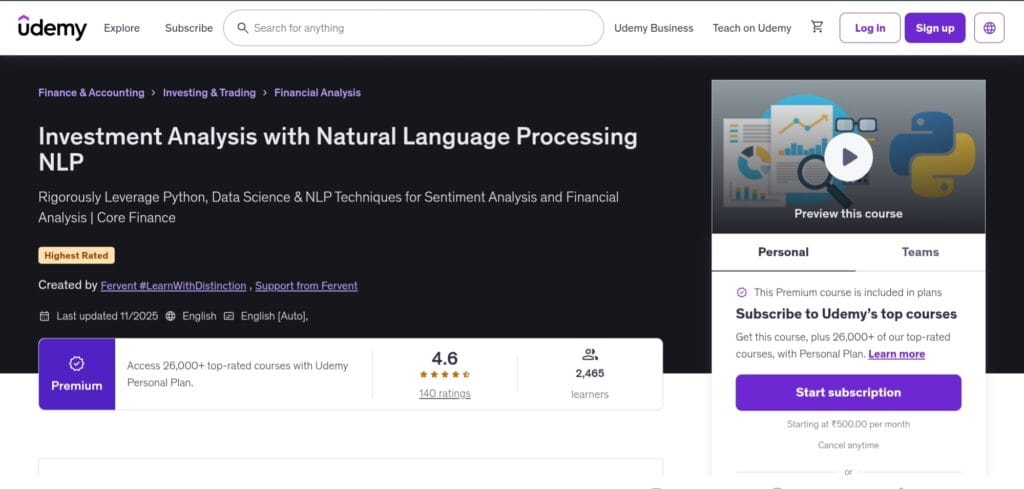
Platform: Udemy
Instructor: Fervent – Learn With Distinction
Duration: ~12.5 hours
Level: Intermediate
What You Will Learn
This course looks at how Natural Language Processing can be used to analyze financial data and make investing decisions.
You’ll learn how to utilize Python and data science approaches to evaluate massive amounts of financial content, including news stories, corporate reports, and market commentary.
Sentiment analysis is a primary topic in which NLP models detect positive or negative market sentiment that might influence stock prices.
The course also covers how to clean financial datasets, create text-analysis pipelines, and use natural language processing (NLP) approaches to extract insights from real-world financial data.
Why This Course Is Worth Taking
Most NLP courses cover general AI applications, but this program focuses on financial NLP, which is a burgeoning field in quantitative finance.
By mixing Python programming, sentiment analysis, and financial modelling, the course teaches students how hedge funds and analysts use textual data to assist investment strategies and market research.
Best For
Finance experts, quantitative analysts, data science students, and Python developers who want to use NLP approaches for financial analysis, market sentiment research, and investment decision support.
Career Opportunities After Learning NLP
Natural Language Processing lies at the crossroads of artificial intelligence, machine learning, and linguistics, making it a useful specialization in today’s AI-powered job market.
As firms rely more on language data, from customer feedback to search queries, NLP professionals are in great demand in technology, banking, healthcare, and e-commerce. After finishing a thorough NLP course, students can follow a variety of intriguing job opportunities.
Also Read: Will AI Take My Job or Create a New One? A Deep Dive into the Post-AI Job Market
NLP Engineer
NLP engineers specialize in developing systems capable of understanding and producing human language.
They frequently create models for tasks like sentiment analysis, text classification, machine translation, and document summarization. They usually use Python libraries and machine learning frameworks to train models that handle massive amounts of text data.
AI Engineer
AI engineers create and implement intelligent systems that can replicate human decision-making. When using language technology, they create applications like chatbots, virtual assistants, and automated support systems. Many modern conversational systems, including platforms like ChatGPT, rely significantly on complex NLP algorithms.
Machine Learning Engineer
Machine learning engineers are responsible for designing, training, and implementing machine learning models in production.
In NLP-related roles, they create scalable pipelines for processing text data and training algorithms for tasks such as topic modeling, recommendation systems, and predictive text generation.
Data Scientist
Data scientists study both organized and unstructured data to find insights that help businesses make decisions.
They may extract meaning from customer reviews, social media posts, support issues, and survey results, allowing firms to better analyze trends, sentiment, and user behavior.
Also Read: A Day in the Life of a Data Scientist: What to Expect?
FAQs – Best Natural Language Processing Courses Online
Can beginners learn NLP?
Yes, beginners can learn Natural Language Processing, especially through well-structured online courses designed for newcomers.
Do NLP courses require Python?
Most modern NLP courses use Python because it has powerful libraries for text analysis and machine learning. Tools such as NLTK, spaCy, and scikit-learn are widely used in NLP development.
How long does it take to learn NLP?
The time required to learn NLP depends on your background and study schedule. Beginners can understand the core concepts in a few weeks through structured courses.
Are NLP certifications worth it?
NLP certifications can be valuable because they demonstrate your knowledge of language processing techniques and machine learning concepts. While certificates alone do not guarantee a job, they help strengthen your resume and show commitment to learning AI skills.
Final Verdict – Which NLP Course Should You Choose?
Choosing the proper NLP course is ultimately determined by your existing skill level, learning objectives, and level of interest in artificial intelligence.
Natural Language Processing is a fast-expanding subject because modern applications, such as chatbots, language translation systems, and voice assistants, rely largely on language-understanding technology.
If you want the most thorough learning path, Coursera’s Natural Language Processing Specialization is a great option. It covers everything from fundamental NLP techniques to advanced models and practical applications like sentiment analysis and machine translation.
For students who prefer hands-on Python coding, Udemy courses on NLP projects and deep learning provide practical experience with tools such as NLTK, spaCy, and machine learning frameworks that are routinely used in real-world NLP systems.
Share Now

More Articles
Will AI take over data science jobs? A balanced perspective
Roadmap to Become A Data Scientist In 6 Months (Step-by-Step Guide)
Best Generative AI Courses On Coursera That Explain Real-World Applications
Discover more from coursekart.online
Subscribe to get the latest posts sent to your email.