
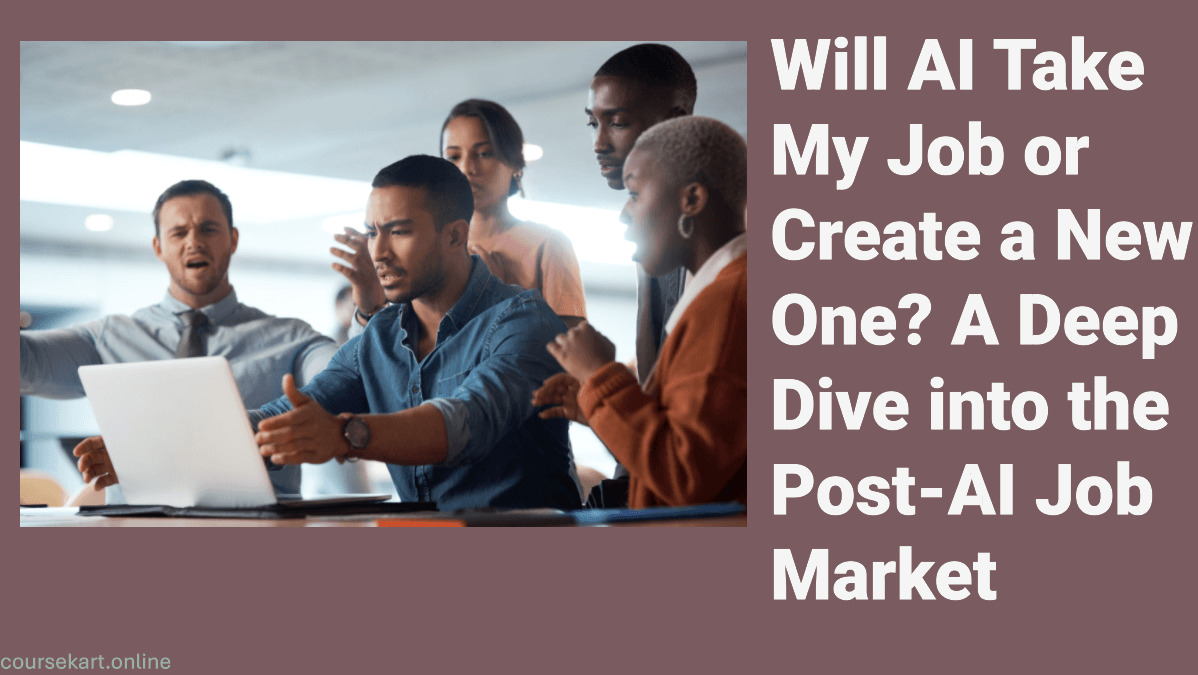
The concept of machines doing human tasks was limited to science fiction a few years ago. It’s our reality now. Artificial Intelligence (AI) is already there in the room, thanks to chatbots that answer consumer questions and algorithms that accurately diagnose medical issues. In an effort to increase productivity, reduce expenses, and surpass rivals, industries worldwide are rushing to implement AI.
However, every new discovery raises a series of questions, some fearful, some encouraging. Will AI Take My Job? Or will it open up completely unimaginable new opportunities?
This discussion isn’t limited to boardrooms or tech forums. Every working person is impacted by this question, including educators, drivers, designers, and analysts.
Why is this so important? Because every job has a family, a dream, and a means of subsistence behind it. The emergence of AI is a profoundly personal and cultural change, not merely an economic one.
It has an impact on our lives, careers, and future planning. With the correct knowledge, we can confront the uncertainty with clarity rather than dread, even though it can feel overpowering.
We’ll delve deeply into the implications of the AI revolution on the job market in this post. We’ll look at the jobs that are most at risk, the new positions that AI innovation is creating, and who has to be ready to adjust.
We’ll help you future-proof your profession in an era of intelligent robots by separating hype from truth, fear from fact, and providing insights along the way.
Let’s begin!
2. Understanding AI and Automation

Before discussing whether AI will replace you in your current position or create a new one, let’s first clarify what AI is and is not.
Fundamentally, robots created to imitate human intelligence are referred to as artificial intelligence (AI). This involves making decisions, identifying patterns, learning from data (machine learning), and occasionally even bettering themselves without explicit programming.
Consider automation as the body and artificial intelligence (AI) as the brain. Automation is the part that carries out instructions, frequently without constant supervision.
You’ve probably heard of machine learning, a branch of artificial intelligence in which algorithms “learn” from data to generate predictions or judgments. For instance, machine learning is used when Netflix recommends a show you might enjoy.
On the other hand, automation encompasses a wide range of repetitive, rule-following tasks, such as software bots processing invoices or robotic arms assembling cars.
Now, not all AI is created equal. There are two major categories:
- Narrow AI is what we mostly have today. It’s designed to perform specific tasks—like voice recognition in your phone or fraud detection in your bank account. It can be fast and accurate, but it doesn’t “understand” the world. It just does one job really well.
- General AI, on the other hand, would be like having a human-level mind in a machine—capable of reasoning, emotion, creativity, and problem-solving across any domain. We’re nowhere near that yet, and experts debate when—or if—we’ll ever get there.
What is more immediate, however, is the astonishing rate at which narrow AI is being implemented. You’ve already encountered it, whether it’s chatbots answering customer service questions at midnight, recommendation engines curating your shopping lists, or robotic process automation (RPA) automating tedious activities in banks, hospitals, and offices.
Why is this occurring so quickly? Moore’s Law, which states that computing power doubles approximately every two years, is somewhat to blame. Rapid AI application across sectors is the result of a confluence of factors, including exponential growth and corporate executives’ continual pursuit of speed, accuracy, and reduced costs.
The bottom line? Automation and artificial intelligence (AI) are not merely possibilities for the future; they are realities that are rapidly changing the nature of employment. And the first step to navigating the changes they bring is to grasp their nature.
3. Historical Context: Technology and Jobs

Humanity experienced waves of disruption from revolutionary technologies long before artificial intelligence. People kept asking the same unsettling question with every advancement: “Will this take my job?” Nevertheless, we continued to adapt. Jobs didn’t just disappear; they changed.
Let’s revisit the 18th and 19th-century Industrial Revolution. Handloom weavers and craftspeople in European communities watched with horror as machines started to take the place of manual labor.
A room full of trained artisans could not match the performance of a single mechanized loom. There were protests. In their desperation, the Luddites famously destroyed machines.
However, despite the loss of many traditional jobs, new occupations such as mechanics, engineers, and factory operators arose out of the chaos. The world simply began producing things in a different way; it didn’t stop producing things.
Then, in the middle of the 20th century, came the Computer Age. The jobs of mailroom clerks, switchboard operators, and typewriters were reduced or eliminated.
However, the same silicon chips that eliminated those employment also created other sectors, like digital design, software development, IT services, and cybersecurity. Opportunities for people who were eager to reskill remained even though the employment changed.
In the early 2000s, we entered the Internet and Mobile Era. Almost everything was affected, including media, transportation, retail, and communication. E-commerce supplanted physical enterprises.
While digital marketing flourished, newspapers dropped. Social media sites and ride-hailing applications changed whole industries. It appeared to be an employment apocalypse at first.
However, if you go further, you’ll discover millions of previously undiscovered jobs, like social media managers, software developers, data analysts, UX designers, and content producers.
What is the commonality among these revolutions? Indeed, many professions were altered and whole new ones were created, but many more were lost. The labor market changed, not disappeared. Early adopters frequently reaped the greatest benefits.
The important thing is this sequence of disruption followed by reinvention. History demonstrates that when technology eliminates a certain type of labor, it typically leads to a need for new talent and new abilities elsewhere. Transition can be painful, but it can also lead to advancement.
AI nevertheless adheres to this historical rhythm even if it may feel different—smarter, faster, and more complicated.
The important thing is not to fear the past, but to learn from it. Because, like in previous waves, those who welcome change will emerge victorious, not those who fight it.
4. How AI is Disrupting the Job Market Today

If we learned from the past that technology is changing how we work, the present is showing us how fast that shift may occur. AI is already changing industries in the real world, one work at a time, and is no longer just a theory being tested in labs.
Let’s begin with manufacturing and logistics, two industries that have historically depended on human labor for quality assurance, sorting, and coordination.
These days, Amazon warehouses are populated by AI-driven robots that move quickly while lifting, scanning, and delivering packages with remarkable accuracy. Real-time delivery route optimization is done by algorithms, which make judgments more quickly than a human dispatcher could. How many human pickers and packers are required? Shrinking.
The change is much more noticeable in retail and customer service. Consider your most recent encounter with a business. Was it a chatbot or a human? Businesses are using AI more and more to manage routine inquiries, grievances, and transactions.
Grocery shop cashiers have been replaced by self-checkout technology. Virtual agents are revolutionizing customer-facing positions because they never sleep, never take breaks, and get better with each encounter.
Another industry that is suffering is finance and accountancy. Once requiring weeks for teams of analysts to do, AI tools now monitor compliance, detect fraud, analyze financial trends, and even produce reports.
Only the more strategically important tasks remain in human hands, as low-level bookkeeping and clerical work are quickly being automated.
Then there is transportation, where the possibility of driverless cars is gradually becoming a reality. Highway tests of AI-powered delivery vans and trucks are already underway.
Big ride-hailing companies are spending billions on autonomous vehicles. If these tests become commonplace, what will happen to the millions of cab drivers, delivery drivers, and truckers?
Which occupations are most at risk from this AI revolution, then? The explanation is obvious: roles that involve a lot of data, rules, and repetition.
These include data entry, assembly line work, low-skilled secretarial occupations, and basic bookkeeping. AI is probably aiming for a task if it can be divided into manageable steps and doesn’t call for emotional intelligence, creative thinking, or sophisticated judgment.
Consider the review of legal documents. Specialized AI trained to identify discrepancies and indicate hazards can now complete tasks that formerly needed paralegals and junior associates to sift through mounds of paperwork in a matter of minutes.
AI models are already helping radiologists in the healthcare industry by reviewing MRIs and X-rays, sometimes spotting details that the human eye might overlook.
It’s a real disruption. It’s quick. Furthermore, it is happening now rather than in the far future. However, even as AI is taking over some jobs, it is also making us think more deeply about what humans are capable of that robots cannot. How can we concentrate on that?
Because the opportunities are there.
5. Where AI is Creating Jobs and New Opportunities

A quieter revolution is taking place, one in which AI is creating jobs, reshaping roles, and opening doors to completely new careers, even though the headlines frequently highlight the jobs AI is replacing.
If you look closely, you’ll see new roles that weren’t even there a few years ago. To make sure algorithms act properly and openly, businesses are now employing AI ethics advisors. Someone needs to ask: Is our system biased as we give machines more and more decision-making authority? Is it responsible? That someone is in demand right now.
Prompt engineers, experts in creating exact instructions for big language models like ChatGPT, are likewise in greater demand. Although it may seem specialized, it’s rapidly becoming a useful ability in fields like software development and marketing.
Another crucial component is data annotators. AI learns by example, and in order for a machine to understand examples, they must be labeled. For example, images, texts, medical records, and audio clips must all be organized by humans.
Of course, there is also a growth in more technical roles. AI researchers, product managers, and machine learning engineers are assisting companies in developing more intelligent products for a variety of sectors.
To safeguard sensitive data and make sure these systems function within moral and legal bounds, cybersecurity analysts and AI auditors are taking over in the meantime.
Entire ecosystems are developing around the transformation, going beyond direct AI positions. Platforms for education and upskilling, such as online institutions and coding boot camps, are in high demand.
Businesses are making significant investments in training because people are keen to acquire the skills necessary to prosper in this new world.
Additionally, human-centered design is becoming more and more important as machines replace mechanical design. Although AI solutions have great potential, they must be easy to use and intuitive. Human-computer interaction experts and UX designers can help ensure that AI works for people rather than against them.
AI has even given new life to the trend of remote work, which was accelerated by the pandemic. Jobs in tech support, product creation, and virtual operations management are being created by the increasing prevalence of virtual collaboration technologies driven by intelligent transcription, real-time translation, and intelligent scheduling.
Not to be overlooked is entrepreneurship. Startups are essential to redefining what is possible in every tech revolution.
AI-powered solutions are being developed by small teams worldwide for a variety of applications, including sustainability, education, mental health, and agriculture.
People with ideas may now create goods more quickly thanks to artificial intelligence (AI), which is lowering the entry barrier.
A few doors are indeed closing. However, a lot of others are opening up. The future belongs to those who see the opportunity that lies within change, not to those who are afraid of it.
6. Who Should Be Worried?
Not everyone is affected equally, as is the case with any significant change. In the era of artificial intelligence, some professions are flourishing or changing, while others face a more uncertain future. Who, then, ought to be most worried at the moment?
First, let’s look at employees in jobs that are low in complexity and highly automatable. These are jobs that don’t demand a lot of creativity, judgment, or emotional intelligence, and they involve repetitive duties and rigorous restrictions.
Consider telemarketers, warehouse sorters, data entry clerks, and entry-level bookkeepers. The likelihood that AI can complete a task more quickly, more affordably, and around the clock increases if it can be expressed as a set of instructions.
However, access to change is just as important as the type of job. Particularly at risk are people who don’t have the time, means, or help to pick up new skills.
Not everyone has the funds to enroll in a course or go to a bootcamp, flexible job schedules, or dependable internet connectivity. A second layer of risk is created by the digital divide: people who could reskill but aren’t given the opportunity.
Additionally, some industries and geographical areas can find themselves falling behind. When a competitor implements better technologies overnight, a sector’s workforce may find itself out of date if it opposes technological updates, whether because of outmoded infrastructure, regulations, or mindset.
How quickly you’re willing (and able) to adjust to new technology is more important than the technology itself.
So how do you know if your job is at risk? There are a few warning signs worth watching:
- Your work is becoming procedural, with little room for decision-making or innovation.
- You rarely use digital tools beyond email or spreadsheets.
- Your role is seen more as a cost center than a creative or strategic asset.
- You feel like you’re doing the same task day in and day out, without needing to grow or learn.
This has to do with awareness, not fear. You have power when you know where the dangers are. Upskilling, switching to a more robust industry, or just being interested in how technology is changing your profession are all examples of proactive decisions that enable you to make.
In actuality, tasks rather than people are being replaced. Additionally, your career will be more future-proof the more valuable your skills become.
7. Who Shouldn’t Worry (For Now)?
The workforce is undoubtedly changing due to AI, but not all jobs are in danger—in fact, many are growing in value in this new environment. You’re in a much safer place if your job requires abilities like empathy, inventiveness, or sophisticated judgment that are still difficult for robots to imitate.
First, let’s address the obvious: emotional intelligence and creativity. Although they may create material and remix patterns, machines lack empathy. They are able to create visuals and make music, but they lack the human understanding of humor, wonder, and grief.
Because of this, professions like teaching, writing, design, and therapy continue to be fundamentally human. No algorithm can replicate the emotional complexity and connection that these occupations demand.
Complex problem-solving jobs are also naturally protected from automation, particularly when the problems are open-ended or unclear.
Consider strategists, lawyers, scientists, or systems engineers who do more than just carry out duties; they also analyze evolving data and make critical decisions. These positions require flexibility, abstract thought, and frequently experience-based wisdom.
Then there are professions based on presence, trust, and concern. Would you want your family to hear bad news from a robot? Or take care of your kid? Or help you deal with grief?
Human presence, empathy, and the capacity to read emotional cues are essential for occupations like healthcare, social work, leadership, and counseling. Although machines may help, humans will still be responsible for the majority of the job.
In actuality, some of today’s most resilient workers are actively learning to collaborate with AI rather than opposing it.
Marketers who are data-savvy and use AI to test campaigns more quickly. AI tools are being used by doctors to improve diagnosis.
AI generators are fed cues by architects and product designers to generate fresh concepts. AI doesn’t threaten these people; on the contrary, it makes them more productive.
You’re on solid ground if your work enables you to tackle complex problems, lead others, think creatively, or give others a sense of being seen and heard. Additionally, you’re leading the change rather than just surviving it if you’re already incorporating AI as a utility rather than a threat.
So, while no job is 100% future-proof, many roles still offer a deeply human edge that machines just can’t replicate. At least not anytime soon.
8. The Importance of Reskilling and Lifelong Learning

One fact remains true in a world where algorithms can write code, diagnose diseases, and compose poetry: those who never stop learning will prosper.
Greetings from the reskilling revolution, a movement that is rapidly gaining traction around the world.
Organizations worldwide are investing in assisting individuals in reorienting, upgrading, and future-proofing their jobs, from the World Economic Forum (WEF) to platforms such as Coursera, edX, and Skillshare. Governments are also taking action to alter the workforce through public-private collaborations, legislative changes, and funding.
But this revolution isn’t just a policy trend—it’s a personal necessity.
To stay relevant, individuals need to cultivate future-proof skills—abilities that machines struggle to replace and that evolve with technology rather than against it. At the heart of this are three pillars:
- Digital literacy: Understanding the tools that drive today’s economy—from spreadsheets and cloud platforms to AI interfaces—is no longer optional. Whether you’re a teacher or a technician, being comfortable with tech is the new baseline.
- Critical thinking: As information overload becomes the norm, the ability to ask good questions, evaluate sources, and think independently is more essential than ever. AI can offer answers—but it’s humans who must ask the right questions.
- Adaptability and agility: Perhaps the most underrated superpower is the ability to change—fast. Those who see change not as a threat but as an invitation will lead the future.
The good news? You don’t have to retrain for years or return to school. The learning pathways of today are accessible, adaptable, and modular. Even people with little time or money can access the tools for change, whether it’s a digital marketing certification, a microcredential in AI for healthcare, or a coding bootcamp.
Tech workers are no longer the only ones who need to be “AI-aware.” AI is affecting every sector, including banking, education, agriculture, and logistics. You can get a significant advantage by understanding how AI affects your industry and how to leverage it as a tool.
Naturally, people cannot bear the burden by themselves. Businesses need to change their perspective from “hiring for the future” to “training for the future.”
Upskilling initiatives and internal learning academies are already being established by progressive employers. Governments can also play a part by supporting displaced workers, reforming education, and investing in digital infrastructure.
The message is unambiguous: It is no longer safe to stand motionless. However, it has never been easier to move forward.
Maintaining a career is only one aspect of lifelong learning; another is maintaining one’s sense of empowerment in a world that is ever-changing. And your willingness to keep learning is your greatest asset on that journey, not what you already know.
9. Expert Predictions: What Does the Future Hold?
In the era of artificial intelligence, making predictions about the future can be like trying to read tea leaves in a hurricane. Change is happening at a dizzying rate. Nevertheless, some of the top research institutes and economists in the world are providing well-founded, empirically supported insights that enable us to see the future clearly, but not with certainty.
McKinsey & Company estimates that by 2030, automation might replace up to 30% of current work hours in all industries.
However, they stress that this will result in a significant reorganization of the labor market rather than widespread unemployment. Yes, millions of jobs may be lost, but millions more will be created, especially in the fields of education, technology, healthcare, and green energy.
According to Gartner, almost every profession will involve AI by 2026, with many positions becoming “human-AI partnerships.”
Consider employment transformation rather than complete job loss, where people concentrate on their strengths while machines take care of the labor-intensive, repetitive, and analytical tasks.
The view provided by the World Economic Forum (WEF) is cautious but optimistic. According to the WEF’s Future of Jobs report, 97 million new jobs that are more appropriate for the new division of labor between humans and machines may be created over the next several years, even though 85 million jobs may be replaced by machines.
That could be a net benefit, but there is a crucial catch: only if employees are provided with the resources and assistance they need to make the switch.
Prominent economists draw attention to the danger of structural changes, which could leave some industries or communities behind.
For example, there may be pockets of economic pain and pockets of prosperity if AI adoption slows down in rural manufacturing areas while accelerating in urban tech hubs.
Policymakers are therefore being advised to prioritize school reform, targeted retraining initiatives, and inclusive growth.
In the next three to five years, office work, customer service, and logistics are probably going to undergo significant upheaval.
More businesses will use AI technologies to enhance human talents rather than completely replace their workforce. Consider how finance departments use algorithms to identify irregularities or marketing teams use AI to create content.
The concept of a hybrid workforce is probably going to become the standard in the long run (10–20 years). Workers will work with, consult, and even depend on AI tools as creative partners in addition to using them. Like the internet boom, new sectors will arise that call for capabilities we haven’t yet identified.
The most important lesson? Catastrophe is not inevitable, but change is. Future work can be better, not simply different, if we approach this moment with human empathy, a well-thought-out plan, and a resolute commitment to upskilling.
10. Actionable Takeaways for Different Audiences
Our lives, jobs, and economies are now being shaped by the AI revolution; it is not a far-off idea. However, a reactive approach is not necessary to move forward. Each of us—employees, employers, and students—can take proactive measures to confidently navigate the future if we are conscious and intentional.
For Employees: Audit, Adapt, Advance
Begin by posing a challenging but crucial query to yourself: Could a machine perform the majority of my daily tasks? It’s time to think about new ways to add value if your tasks are data-driven, repetitive, or highly structured. That involves adding new talents to your repertoire, not leaving your current position.
Determine which human strengths—communication, critical thinking, creativity, and teamwork—remain strong. Look into online classes, workshops, or certifications that help you become more digitally fluent and learn how to work with AI rather than against it.
For Employers: Choose Progress with Responsibility
Automation is alluring because it promises cost savings, speed, and efficiency. However, responsible innovation takes people into account in addition to profit. Instead of asking, “How can we replace workers?” forward-thinking businesses question, “How can we elevate them?”
Establish upskilling pathways in your company. Make investments in cross-functional training, mentorship initiatives, and learning platforms. Employees will frequently surprise you with innovative solutions if you are open and honest about your automation goals.
For Students and Career Changers: Future-Proof Your Path
This is a great time if you’re just starting out in your career or are prepared to change directions. You can write yourself into the narrative of the changing job landscape.
Pay attention to domains like data science, healthcare, education, design, environmental science, and emerging technology that combine human intelligence with machine assistance. Develop cross-disciplinary thinking. Integrate ethics with engineering, creativity, coding, or data and storytelling.
Additionally, in an AI-powered environment, soft skills like empathy, curiosity, and resilience can be your greatest strengths.
Conclusion: Will AI Take My Job?
A turning point occurs in every generation when the world changes, and we have to choose between holding onto the past and moving forward. That time is now for us. And AI is the engine behind it.
AI is disruptive, yes. Workflows are being altered, jobs are being automated, and long-held beliefs about what work actually entails are being questioned. On the other hand, if we’re prepared to adjust, AI is also creating opportunities for new professions, more intelligent tools, and more fulfilling work.
This is not a human vs machine conflict. Humans and machines are working together on this. Instead of replacing people, the future of work will redefine roles, with humans contributing the empathy, creativity, and big-picture thinking that no algorithm can match while computers tackle the monotonous and analytical tasks.
Therefore, whether AI will change your employment is not the main question. It’s your level of readiness to adapt to it.
We shall only be held back by fear. However, flexibility? Your superpower is that. Farmers became manufacturing workers, typists became programmers, and now customer service representatives are AI trainers or product designers, thanks to it. Every change in history has resulted in both growth and discomfort.
Change is therefore unavoidable. But we can lead this shift if we have the correct attitude, the right resources, and the right support.
Let’s go with bravery, curiosity, and confidence rather than dread.
There is no waiting for the future.
We assist in its development.
Frequently Asked Questions
Will AI take over all jobs eventually?
No, not every job. Even though AI will continue to automate a lot of monotonous, routine, and rule-based operations, there are whole industries that depend on human judgment, creativity, empathy, and adaptability—qualities that computers currently find difficult to match. Actually, rather than being displaced by AI, many careers in the future will be formed around it. The emphasis is now on redefining work rather than replacing it.
How soon will AI start affecting my job?
It already is in a lot of industries. The effects are already being felt in industries including marketing, finance, logistics, and customer service. However, your sector, region, and work function will determine how much and how quickly disruption occurs. Learning complementary skills now will help you remain ahead if your job involves a lot of manual processes or organized decision-making.
What are the safest jobs from AI automation?
For the time being, the safest jobs are those that call for human interaction, critical thinking, emotional intelligence, and complicated problem-solving. These consist of positions such as:
Medical personnel (therapists, nurses)
Teachers and educators
Counselors and social workers
Professionals in the creative industries (authors, designers, filmmakers)
Human-centered design and strategic leadership positions
Automating a task becomes more difficult the more human it is.
Can I learn AI skills without a tech background?
Absolutely. Many introductory courses, bootcamps, and platforms are designed for non-tech professionals. You can start by learning:
The basics of how AI works
Tools like ChatGPT, Google AI, or no-code automation platforms
Domain-specific AI applications in your industry
Ethical and societal implications of AI
Whether you’re in marketing, education, HR, or finance, AI literacy is becoming a must-have—and you don’t need to be a coder to get started.
Is AI a threat to entrepreneurship?
It’s more of an enabler than anything else. AI is reducing entry barriers by enabling solo entrepreneurs and small teams to use sophisticated tools. AI may help entrepreneurs scale more quickly, operate more efficiently, and compete globally by automating customer service, improving content, creating prototypes, and analyzing data.
The actual danger? disregarding it. The most successful businesspeople embrace AI as a strategic advantage and adjust early.
Share Now

Related Articles
How to Transition into a Data Science Career from a non-tech background: Tips for Professionals
The AI Impact on Jobs: New Careers, New Challenges
8 Soft Skills Every Data Scientist Needs to Succeed

As an engineer with a passion for learning and sharing knowledge, I created CourseKart.online to help students, professionals, and lifelong learners choose the best online courses. With so many options available, finding the right one can be overwhelming. My goal is to simplify that process by offering insights, reviews, and recommendations on the top online learning resources. I hope my posts inspire you to keep growing, learning, and exploring new opportunities.
Discover more from coursekart.online
Subscribe to get the latest posts sent to your email.