
Last updated on January 8th, 2026 at 11:02 am
Data science abilities have quickly evolved from specialist knowledge to vital professional currency in today’s digital environment. Nowadays, businesses in all sectors use data to inform decisions, streamline processes, and obtain a competitive edge.
For specialists who can glean valuable insights from the ever-expanding universe of information, this surge in demand has opened up previously unheard-of opportunities.
By removing conventional barriers to entry, online learning has democratized access to data science education. Aspiring data scientists can now study at their own speed from professionals in the field all across the world without being constrained by geographical location, strict schedules, or the exorbitant expenses of formal university programs.
These online resources provide organized routes into this intricate profession, giving novices easily assimilated educational experiences that foster competence and confidence.
Our meticulously selected list highlights the top ten places to begin your data science adventure, sifting through the deluge of online courses. Based on factors such as curriculum quality, instructor experience, possibilities for real-world application, community support, and return on investment, we have assessed these choices.
Whether you want to change occupations, advance in your current position, or just learn more about this intriguing field, these online data science courses provide clear paths to gaining employable skills that will be useful in our increasingly data-driven society.
What To Look For In A Beginner Data Science Course?
The foundational course you take at the start of your data science learning journey can determine whether you succeed or fail. When assessing data science courses aimed at beginners, the following factors are crucial:
Extensive Curriculum Addressing Foundations
Search for courses that provide a strong foundation by clearly elucidating fundamental ideas. Fundamental topics, including statistical analysis, data visualization, machine learning methods, and programming fundamentals (usually Python or R), should all be included in the curriculum.
Watch carefully for programs that claim to make you an expert in a matter of weeks without addressing these important foundational elements. The most effective courses link these basic concepts in a logical manner, assisting you in comprehending how they cooperate in practical settings.
Practical Applications and Interactive Projects
Your skills won’t be developed by theory alone. Project-based learning is a component of successful courses that pushes you to apply ideas to real-world situations. These real-world elements aid in strengthening your comprehension and creating a portfolio that shows prospective employers your ability.
Look for classes with supervised projects where you can construct models that address real-world issues, clean up untidy datasets, and produce visualizations that tell captivating tales. This practical experience is crucial for turning theoretical knowledge into useful abilities.
Support and Quality of the Instructor
The quality of instruction frequently determines the difference between confusion and clarity. Give top priority to classes instructed by seasoned professionals who can anticipate typical pitfalls and clearly explain difficult ideas.
The availability of assistance, whether in the form of strong Q&A systems, teaching assistants, or direct teacher feedback, is equally crucial. There will definitely be difficulties when learning data science, but having prompt assistance will help small setbacks turn into bigger ones.
Interaction with the Community
Due to the collaborative nature of data science, courses that encourage vibrant learning communities are extremely beneficial. During difficult modules, other students can exchange resources, give different explanations, and inspire one another.
Peer review opportunities, group projects, discussion boards, and even virtual meetings are examples of strong community components. These relationships frequently last beyond the actual course, forming networks of professionals who offer opportunities and assistance going forward.
Appropriate Time Allocation and Pacing
If the course format isn’t compatible with your life, even the best-designed course won’t help you. When weighing your alternatives, take into account your learning preferences and available time.
Intense bootcamp-style programs work well for certain students, while others require flexibility to manage their studies and other obligations. In order to keep you moving forward without being overburdened, the finest courses set clear expectations for weekly time commitments and appropriate deadlines.
Look for programs that give you enough structure to keep things moving forward while still allowing for some flexibility.
By giving these five considerations top priority when choosing a course, you’ll position yourself for a fruitful and fulfilling educational journey that fosters true proficiency rather than merely checking boxes.
Top 10 Online Data Science Courses For Beginners
1. Data Science Specialization by Johns Hopkins University (Coursera)
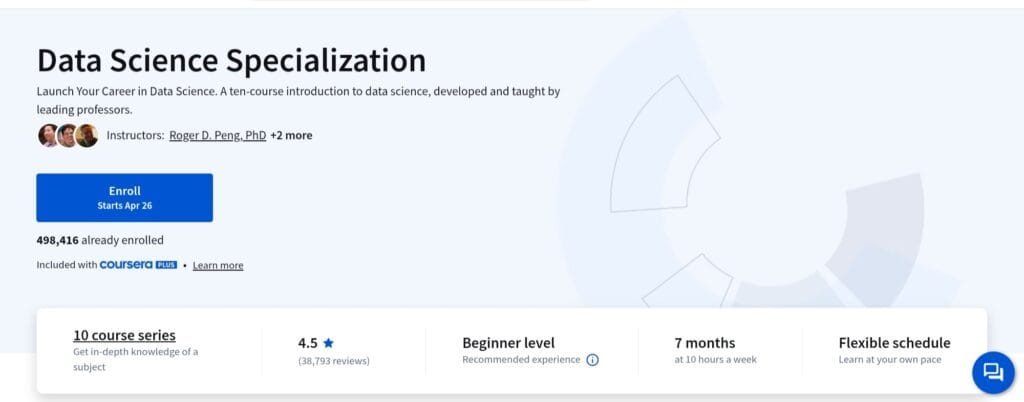
This comprehensive specialization includes ten courses that cover everything from the fundamentals to more advanced ideas. You will start with the basics of R programming, work your way through statistical inference and exploratory data analysis, and finish with a capstone project in which you will use all of your knowledge to address a real-world issue. Curriculum topics include:
- R programming language fundamentals
- Getting and cleaning data
- Exploratory data analysis and visualization
- Statistical inference principles
- Regression models
- Machine learning basics
- Developing data products
The entire specialty takes ten months and about eight to ten hours a week. It is flexible enough to accommodate different schedules, though, because each course may be completed separately and at your own leisure.
You can reschedule due dates if your schedule becomes hectic, thanks to Coursera’s flexible deadlines.
This specialization is unique because it takes a methodical approach to developing your talents from the ground up. The content has been thoughtfully arranged by the instructors to guarantee that ideas logically build upon one another.
A strong foundation in a language that is frequently used in academic research and statistical analysis is provided by the emphasis on R programming.
Every course consists of hands-on activities that reinforce theoretical ideas, culminating in a capstone project that allows you to demonstrate your newly acquired abilities to prospective employers.
The specialization begins with fundamental programming ideas and progressively increases in complexity, making few assumptions about your past expertise.
Professors Roger Peng, Jeff Leek, and Brian Caffo are well known for their ability to simplify difficult statistical ideas. With the help of the courses’ comprehensive practice activities and instant feedback, you may assess your comprehension before continuing.
The lively discussion boards, where fellow students and teaching assistants offer support when you run into difficulties, are especially beneficial.
2. IBM Data Science Professional Certificate (Coursera)
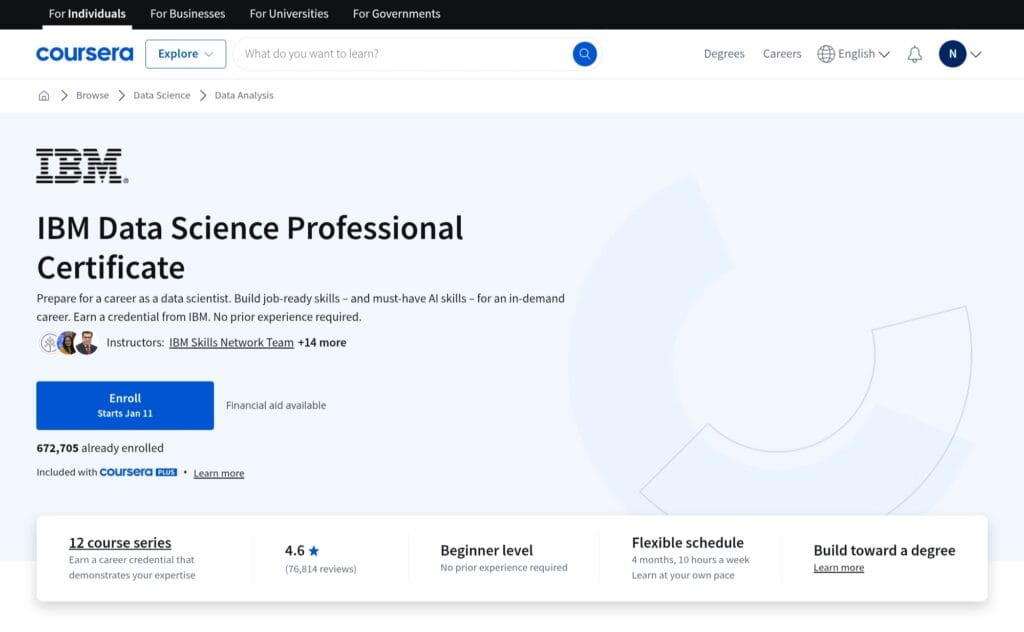
Industry leaders at IBM created the extensive curriculum for the IBM Data Science Professional Certificate. This twelve-course program starts with the principles and techniques of data science before delving into the development of useful abilities. Throughout the course, you will gain proficiency in:
- Python programming for data analysis
- Data visualization techniques with Matplotlib and Folium
- Database access and SQL fundamentals
- Data analysis with Pandas and NumPy
- Machine learning with Scikit-learn
- Deep learning and neural networks basics
- Applied data science capstone project
Because IBM is directly involved, the information is guaranteed to match the needs and practices of the industry today. The certification highlights methods and technologies that are currently in use in business settings, with an emphasis on the Python ecosystem, which is the industry standard for data science applications.
Students are exposed to professional-grade platforms that data scientists use all around the world through practical practice using IBM Cloud and Watson Studio. Because of this industrial linkage, you will acquire applicable abilities rather than abstract ideas with little real-world applicability.
This certificate program stands out for emphasizing learning by doing. Every course includes a number of practical laboratories where you will apply novel ideas to actual situations.
The curriculum ends with a large capstone project in which you will address a real-world issue from the beginning, including gathering data, analyzing it, and presenting your results.
Compared to course completion certificates alone, these projects produce tangible portfolio items that much more successfully showcase your abilities to prospective employers.
IBM created the course material especially to fill the skills shortage in the data science workforce. In addition to emphasizing the most in-demand technical abilities, the curriculum fosters the development of complementary soft skills, including data-driven decision-making and clear technical communication.
After finishing, you will receive an industry-recognized IBM Digital Badge. Additionally, the curriculum offers professional resources, such as advice on how to create a CV and interview techniques tailored to data science positions, which gives graduates a leg up when they enter the workforce.
Read the Full Course Details here: What will you learn in the IBM Data Science Professional Certificate course on Coursera?
3. Google Data Analytics Professional Certificate (Coursera)
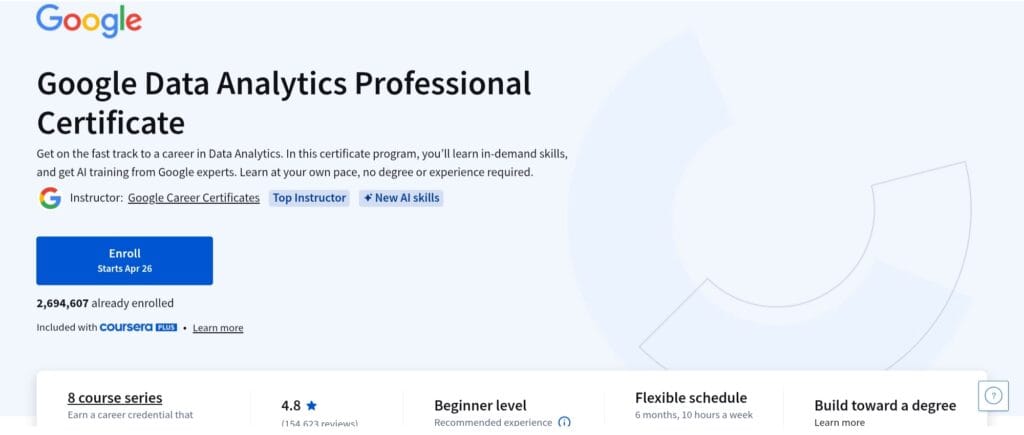
The certification program offered by Google builds analytics capabilities from the bottom up in a thorough manner. Eight courses that address the following topics are included in the curriculum to systematically enhance both technical and analytical thinking skills:
- Foundational data analytics concepts and processes
- Spreadsheet proficiency for data manipulation and analysis
- Data cleaning and transformation techniques
- SQL for database querying and data extraction
- R programming for statistical analysis
- Data visualization principles and tools
- Case study analysis and presentation skills
This program stands out for striking a balance between the development of technical skills and the analytical thinking and problem-solving techniques employed by Google and other professional data analysts.
What sets the certificate program apart is its unwavering emphasis on real-world, industry-relevant applications. Each module ties learning to real-world business problems and situations rather than only introducing abstract ideas.
Realistic datasets that reflect the complexity and messiness found in real analyst tasks are used by students. The course includes real-world case studies from Google’s own operations, which help students understand how one of the most data-rich companies in the world uses data to inform decisions.
This practical method guarantees that graduates may move from learning to implementation with assurance.
Google has thoughtfully designed this curriculum with a deliberate learning path that fosters competence and confidence. As your skills advance, more complex tools and techniques are progressively introduced, starting with easily understood principles that don’t require any prior knowledge.
Every course expands your analytical toolkit while building on previously covered information. With numerous opportunities to practice and reinforce new abilities before increasing complexity, this well-considered process enables total beginners to develop job-ready proficiency in reasonable increments.
This certificate offers thorough job market preparation in addition to technical training. For data analyst jobs, the program offers specialized career resources such as resume workshops, portfolio-building advice, and interview training.
Google has created tasks that effectively convert into portfolio items that showcase your ability to prospective employers.
You will be able to connect with more than 130 U.S. firms who accept the credential through Google’s employment consortium after completing it. You will be prepared for your data job both technically and professionally, thanks to the curriculum’s emphasis on workplace scenarios and professional communication skills, which are crucial for success in analyst roles.
4. Python for Data Science, AI & Development by IBM (Coursera)
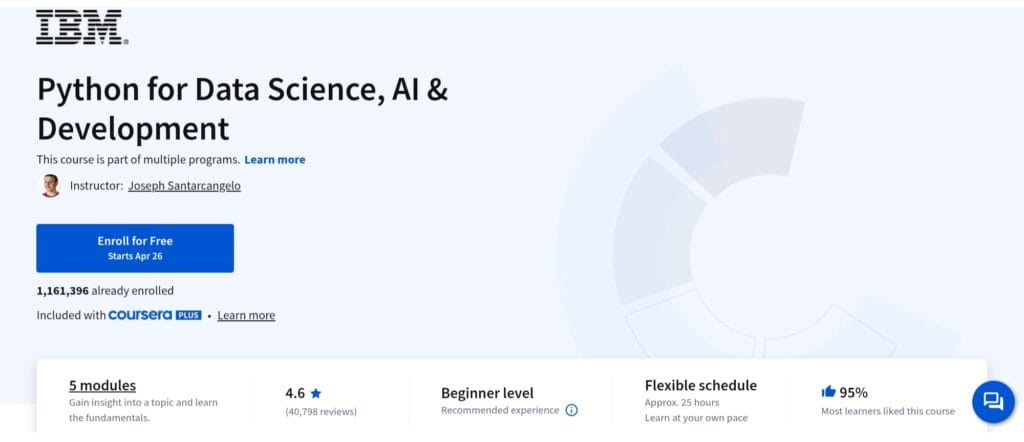
As the name suggests, this concentrated course offers a solid foundation in Python that is designed especially for data science applications. Every idea is taught via the prism of data analysis and scientific computing, in contrast to typical Python classes.
Before swiftly moving on to how these foundations allow for data manipulation and analysis, students start with the essentials of Python, which include syntax, data types, and control structures.
The course teaches you to think like a programmer and an analyst at the same time by emphasizing the creation of understandable, efficient code that adheres to data science best practices.
This focused approach guarantees that you get deep mastery of the elements most pertinent to analytical work while avoiding wasting time on Python notions that are rarely utilized in data science.
The course offers thorough training on the fundamental Python libraries that serve as the foundation for contemporary data science projects. You will gain practical experience with:
- NumPy for efficient numerical computing and array operations
- Pandas for data manipulation, cleaning, and transformation
- Matplotlib and Seaborn for creating insightful data visualizations
- SciPy for statistical analysis and scientific computing
- A basic introduction to machine learning with Scikit-learn
With its focus on applied learning and abundance of practical laboratories and coding activities, IBM’s course stands out. Practice with Jupyter notebooks, where you’ll deal with actual data sets rather than fabricated ones, instantly reinforces each concept.
By using IBM’s Cloud-based technologies, the course enables you to develop in browser-based settings without the need for complex local setup. The intricacy of these workouts increases gradually, leading to mini-projects that incorporate several libraries and methodologies.
This hands-on method guarantees that you establish confidence in your abilities to tackle actual analytical problems while also ensuring that you create muscle memory for frequent data science tasks.
For novices with little to no programming expertise, this course is a great balance. The pacing is purposefully made to be both beginner-friendly and engaging for anyone with some programming experience.
Python’s structure is made intuitive by early modules that lay forth fundamental ideas with concise justifications and illustrations. The level of difficulty progressively rises as the course moves into library-specific material, with more assistance offered for increasingly challenging subjects.
For beginners, the anticipated 5–6 week completion time (at 3-5 hours per week) is a great investment—enough to develop true competency without being too demanding. Additional practice could be helpful for complete beginners, but the course offers enough scaffolding that prior coding knowledge is actually not necessary.
5. Data Analysis with R Specialization by Duke University (Coursera)
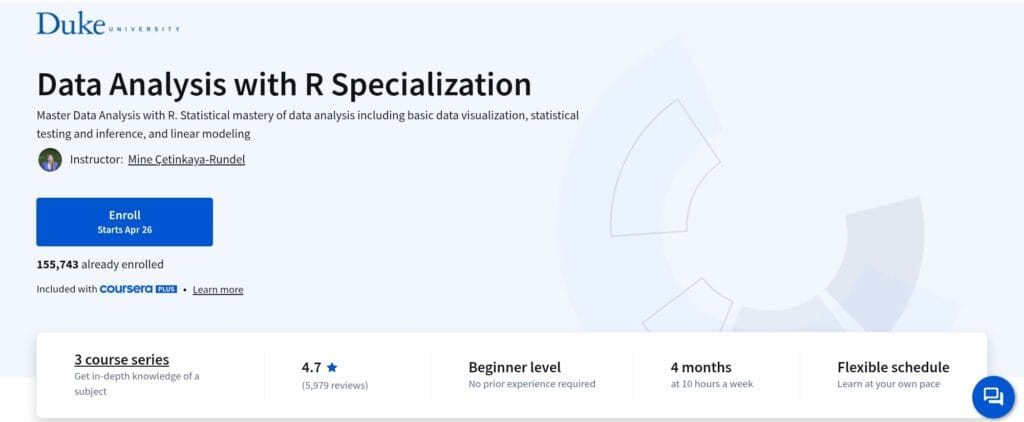
This specialization is excellent at creating a strong statistical foundation that fosters genuine analytical thinking and goes beyond the simple use of tools. Professors from Duke University’s esteemed statistics department created the program, guaranteeing that ideas are presented with academic rigor while also being understandable to novices.
Pupils acquire a thorough understanding of statistical inference, hypothesis testing, experimental design, and probability theory—fundamental ideas that are applicable regardless of the tools or languages they ultimately choose to employ.
The courses place a strong emphasis on statistical thinking as a discipline, teaching you how to properly interpret results and when to apply particular techniques in addition to how to conduct tests.
Graduates of this course stand out because of their strong statistical foundation, which helps them steer clear of typical analytical mistakes that self-taught practitioners encounter.
The specialization introduces R programming in a methodical manner and is intended especially for people who have never coded before. The courses deliberately introduce functions and packages as they become pertinent to particular analytical tasks, avoiding overburdening students with R’s extensive ecology.
The lesson highlights R’s strengths and statistical foundations, demonstrating how its architecture streamlines data analysis processes. Students gain knowledge through steadily increasing guided coding tasks that provide concise explanations of R’s occasionally peculiar syntax and data structures.
You will have mastered R’s fundamental features, the Tidyverse ecosystem, and R Markdown to create reproducible analyses by the end of the specialization—all necessary abilities for contemporary data analysis jobs.
Because visualization is so crucial to analysis and communication, it is given particular focus throughout this area. Students learn how to produce educational, publication-quality visuals that clearly convey ideas using the robust ggplot2 program.
Along with technical implementation, the education covers best practices for visualization, teaching you how to create plots that answer specific queries and steer clear of deceptive representations.
From simple charts to intricate, multi-layered representations that use several data sources, you will advance. A special focus is on utilizing R Shiny to create interactive dashboards and visualizations, which offer useful skills for producing data products that stakeholders may examine on their own.
The best thing about the specialization is that it consistently uses real, messy datasets from real-world commercial and research settings.
These include social scientific research, economic indicators, environmental measurements, and public health data—all of which expose users to a variety of data kinds and analytical problems.
Every course contains hands-on projects that allow you to apply newly learned techniques to real-world datasets, navigating the full analytical process from data import and cleaning to modeling and results communication.
By addressing a significant data analysis problem that is similar to professional employment, the capstone project integrates all of the knowledge gained throughout the specialization.
With the help of this applied method, graduates are guaranteed to acquire both academic knowledge and real-world experience that they can use on the job.
6. Data Science A-Z: Real-Life Data Science (Udemy)
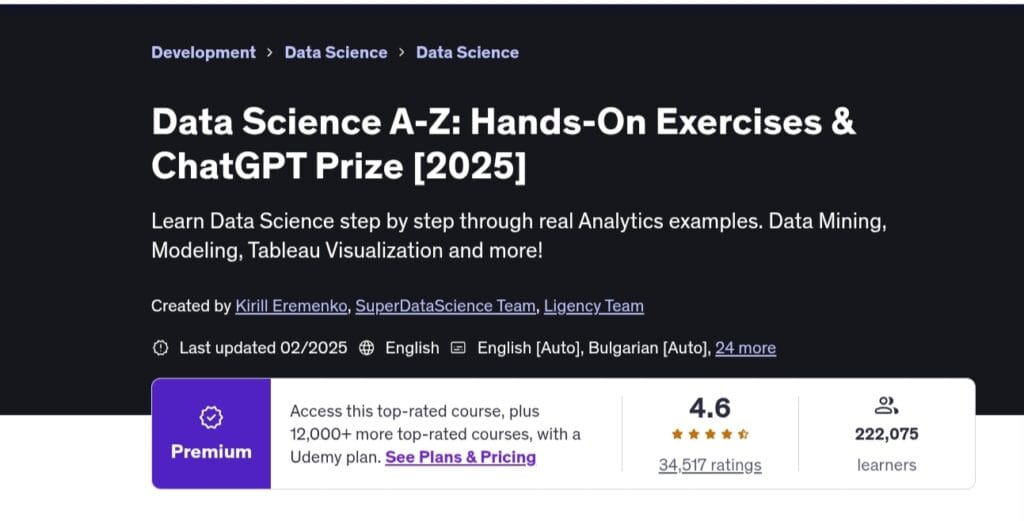
This Udemy bestseller provides one of the most comprehensive end-to-end overviews of the data science workflow for novices, living up to its “A-Z” label.
Instructor Kirill Eremenko walks students through the full data science lifecycle, from developing business questions to deploying completed models, rather than concentrating only on certain tools or methodologies.
Statistics, data mining, modeling, and visualization are all covered throughout the course in a coherent way that demonstrates how these topics relate to one another in real-world situations.
This strategy is especially useful because it helps students learn not just how different techniques work together to solve real-world problems but also how each methodology fits into the larger data science ecosystem.
Beginners gain an essential “big picture” understanding from this holistic viewpoint that is lacking in many more specialized courses.
The course does a great job of demythologizing the crucial but frequently disregarded data preparation step that takes up a large portion of a data scientist’s time. Pupils acquire useful skills for locating and managing outliers, missing values, and irregularities in unprocessed data.
The visualization modules teach careful data storytelling methods that assist in effectively explaining findings to stakeholders who are not technical, going beyond simple charting. Instead of just showing data, special emphasis is paid to developing visuals that address particular business concerns.
Students are better prepared for the realities of working with faulty datasets thanks to this emphasis on the entire workflow—from muddy data to clear insights—a challenge that is rarely covered in more theoretical courses.
This course stands out from more academically oriented ones since it consistently emphasizes value generation and business applications. Every technique is presented not only as a technical idea but also as a means of resolving certain business issues and influencing choices.
Examples from operations, marketing, finance, and customer analytics show how data science has a real business impact. By learning to explain technical results in terms of potential ROI and practical recommendations, students gain the critical ability to convert analysis into business value.
The course is especially helpful for people who want to use data science in corporate settings instead of research settings because of its commercial slant.
Beginners particularly benefit from Eremenko’s teaching style, which blends depth and accessibility. Before delving into technical implementation, complex concepts are conveyed through understandable analogies and visualizations.
The course uses a “show, then do” approach in which students observe the teacher solve a problem step-by-step before working through a comparable task on their own.
The inclusion of typical errors and troubleshooting scenarios that get pupils ready for the inevitable disappointments they’ll face in the real world is very remarkable.
Although the course makes use of a variety of tools, such as SQL, Tableau, and simple modeling software, the focus is always on concepts rather than platform-specific specifics, guaranteeing that the information is transferable to other technical contexts.
With 21 hours of video content presented in manageable chunks, the pacing successfully balances thorough coverage with preserving student interest.
7. Machine Learning A-Z: Hands-On Python & R (Udemy)
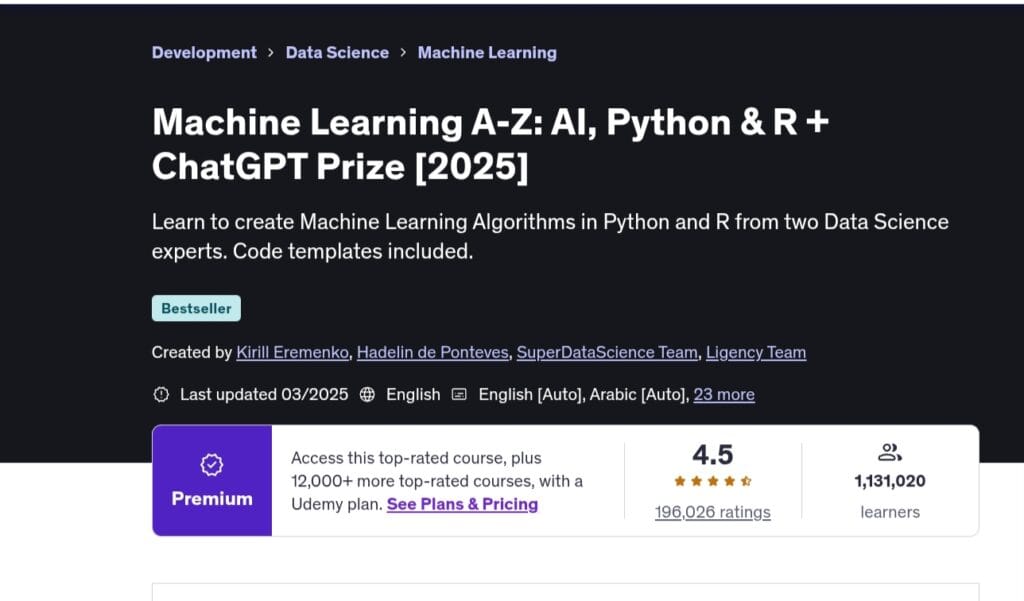
This course stands out for its exceptional ability to make machine learning accessible to true beginners. Before delving into mathematical formulas, instructors Kirill Eremenko and Hadelin de Ponteves introduce concepts through accessible explanations, thereby eliminating the intimidating aspect of machine learning.
In order to develop intuition about how and why the method works, each algorithm is first theoretically presented using parallels and representations from everyday life. Formulas are made less scary and more meaningful by introducing the underlying mathematics only after this conceptual basis has been established.
Even people without strong backgrounds in mathematics can understand machine learning because of this careful pedagogical development, which broadens the field’s appeal while maintaining the depth required for real-world applications.
In order to help novices grasp the field, the course provides thorough coverage of machine learning techniques categorized into distinct groups. Pupils advance through:
- Regression techniques (linear, polynomial, SVR, decision trees, random forests)
- Classification methods (logistic regression, K-NN, SVM, kernel SVM, naive Bayes)
- Clustering approaches (K-means, hierarchical clustering)
- Association rule learning
- Reinforcement learning basics
- Natural language processing fundamentals
- Deep learning introduction (artificial neural networks, convolutional neural networks)
The course examines the implementation of each algorithm as well as its advantages, disadvantages, and suitable applications, assisting students in developing their ability to make decisions about which tools to utilize for particular issues.
This course stands out in the crowded field of machine learning instruction thanks to its dual-language approach, which offers parallel implementations in both Python and R. With this method, students can acquire proficiency in both environments or learn in the language of their choice.
In the guided coding activities that accompany each algorithm, students construct models step-by-step while receiving thorough explanations for every line of code. Realistic datasets of a suitable level of difficulty are used throughout the course; they are difficult enough to illustrate practical applications without being too demanding for novices.
The troubleshooting sections that cover typical mistakes and performance problems are especially helpful because they get students ready for the debugging difficulties they’ll unavoidably encounter in real projects.
The vast collection of downloadable code templates and tools that students can use right away for their own projects is one of the course’s most useful elements. These templates are modular and well-documented, making it simple to modify them for use with other datasets and issue areas.
Additionally, the course offers feature selection tools, preprocessing pipelines that save countless hours when beginning new projects, and evaluation frameworks for evaluating model performance.
With the help of these tools, learning is transformed from a merely academic exercise into a practical capability development exercise that enables students to apply their abilities to real-world issues right away without having to start from scratch with implementation specifics.
These tools, along with the lively Q&A community in the course, offer continuous assistance that goes well beyond finishing the course.
8. Python for Data Science and Machine Learning Bootcamp (Udemy)
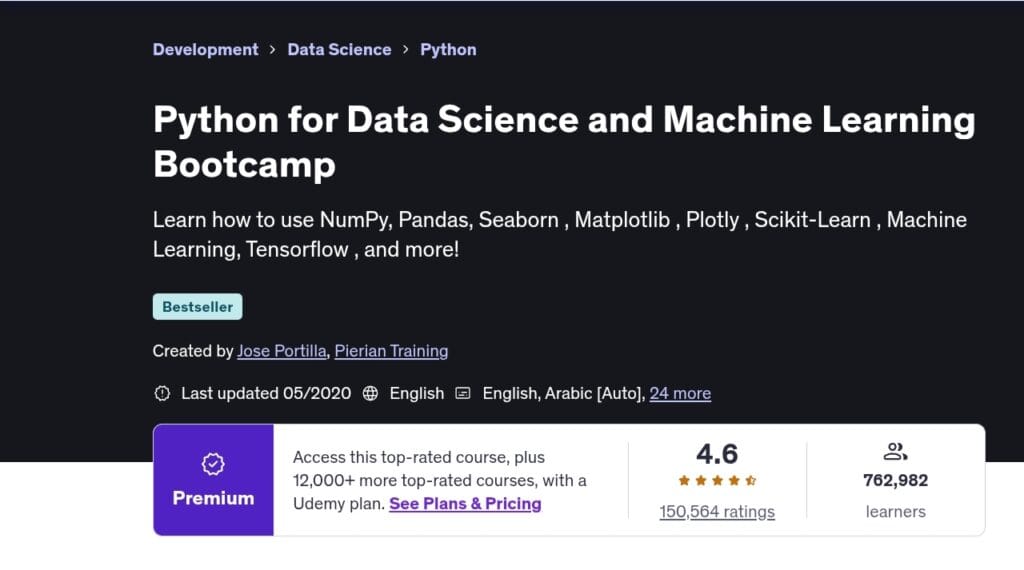
This bootcamp is excellent at turning Python beginners into competent data analysts by using instructional modules that are meticulously arranged. The basics of Python, including variables, data structures, functions, and control flow, are covered first by instructor Jose Portilla.
He then moves fluidly on to discuss how these building blocks facilitate data analysis and manipulation. The course focuses on Python capabilities like list comprehensions, lambda functions, and effective iteration patterns that are especially pertinent to data handling.
The context-driven teaching methodology of this bootcamp sets it apart; each Python idea is instantly linked to its use in data analysis, assisting students in comprehending not only syntax but also intent. While guaranteeing that novices acquire the particular programming patterns most useful for data science tasks, this targeted relevance keeps them interested.
The course covers Python’s data science ecosystem in great detail and gives students practical experience with the key libraries that underpin contemporary analytics workflows:
- NumPy for numerical computing and array operations
- Pandas for data manipulation, cleaning, and analysis
- Matplotlib, Seaborn, and Plotly for diverse visualization approaches
- Scikit-learn for machine learning implementation
- TensorFlow and Keras for deep learning applications
- SQL databases and SQLAlchemy for data extraction and storage
The course delves deeply into each library’s fundamental features rather than providing cursory overviews, teaching students how to use these resources efficiently for practical applications. The focus on how these libraries function as a cohesive ecosystem rather than as separate tools is very beneficial.
The project-based nature of the bootcamp sets it apart from more academic courses. Every major topic ends with an extensive project in which students use their newly acquired knowledge to tackle real-world data problems in a variety of fields, such as e-commerce, social media, healthcare, and finance.
From the first stages of data collection to cleaning, investigation, modeling, and visualization, these projects are made to resemble professional operations. Students have created six to eight substantial portfolio pieces by the end of the semester, which they can present to prospective employers.
The focus on recording analysis procedures and sharing results equips students to produce practical insights as well as models, which is a critical difference in professional data science employment.
Different learning styles and schedules are accommodated by the bootcamp’s well-thought-out design. The more than 25 hours of video footage are divided into modular segments that can be viewed sequentially or selectively depending on one’s interests and past knowledge.
Concept explanations, live code examples, independent tasks, and solution reviews are all included in each subject, offering a variety of learning modalities that promote comprehension. Downloadable notebooks, datasets, and more materials that facilitate self-directed research are all part of the extensive resources bundle.
Regardless of experience level, this adaptable structure makes effective use of learning time by allowing total beginners to move gradually through the full curriculum while allowing those with some background to concentrate on particular areas for skill growth.
9. The Data Science Course: Complete Data Science Bootcamp (Udemy)
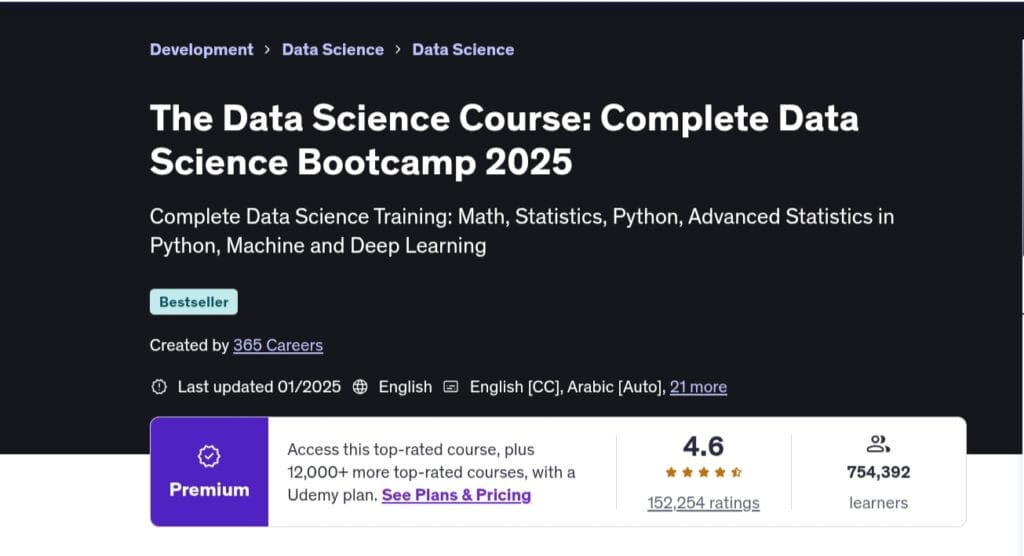
This extensive bootcamp sets itself apart by providing genuinely end-to-end coverage of the data science domain in a unified curriculum. The curriculum, created by the 365 Careers team, has a smooth learning flow that combines business applications, programming implementation, and statistical theory.
With each module building on prior knowledge, the course framework carefully moves from fundamental ideas through ever more complex procedures. When assembling several specialized courses, gaps, and redundancies are frequently discovered; this architectural coherence removes them.
The way the program integrates theoretical knowledge with real-world application throughout is especially beneficial since it guarantees that students get both depth of knowledge and practical skills.
For individuals looking for a thorough introduction to the diverse area of data science, this bootcamp offers a structured yet comprehensive starting point with over 30 hours of information arranged into logical learning routes.
This bootcamp’s outstanding handling of the statistical and mathematical foundations of data science is where it really excels. The course builds strong quantitative foundations through concise, visual explanations that make difficult ideas understandable without being oversimplified rather than viewing these as barriers to be hurried past. Students acquire a practical understanding of –
- Descriptive and inferential statistics
- Probability distributions and their applications
- Hypothesis testing methodology
- Linear algebra fundamentals
- Calculus concepts relevant to machine learning
Every mathematical idea is closely related to how it is used in data analysis and modeling, which aids students in comprehending not only formulae but also the logic underlying analytical techniques. Students who have this mathematical foundation are better equipped to go beyond cookbook implementations and gain a genuine comprehension of how algorithms operate and when to use particular strategies.
The course teaches programming in a pragmatic manner, emphasizing the development of useful coding abilities over computer science theory. Python is taught to students from the ground up, with a focus on its ability to manipulate, analyze, and visualize data.
The teaching approach moves smoothly to advanced ideas without needless repetition while accommodating total beginners with thorough explanations and lots of examples. Students learn the particular coding patterns and techniques most pertinent to analytical work when programming training is contextualized within data challenges.
The course’s integration of programming and mathematics, which demonstrates how to convert statistical ideas into functional code that addresses actual issues, is especially successful.
In addition to its technical substance, this bootcamp offers outstanding assistance to individuals wishing to pursue careers in data science. Insights regarding industry expectations, role definitions, and career paths within the area are woven throughout the curriculum. There are sections in the course specifically focused on:
- Portfolio development strategies
- Resume building specifically for data positions
- Interview preparation with practice questions
- Job search tactics for the data science market
- Freelancing and consulting opportunities
This career counsel reflects the changing requirements of data science employers and is based on actual industry practices rather than general recommendations. Beyond the technical curriculum alone, this helpful advice on how to properly position talents in job markets helps fresh graduates and career changers close the knowledge gap between education and employment.
10. SQL for Data Science + Data Analytics + Data Visualization (Udemy)
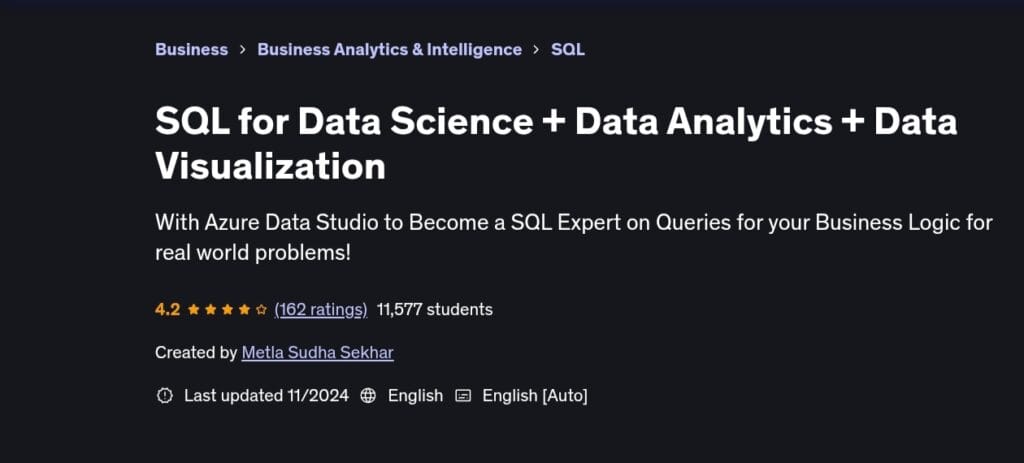
For prospective data scientists, data analysts, and business intelligence specialists, the Udemy course “SQL for Data Science + Data Analytics + Data Visualization” provides a thorough introduction to SQL. It is intended for novices and offers a well-organized path from basic SQL ideas to sophisticated data analysis methods, guaranteeing that students can successfully traverse the data environment.
Beginning with the fundamentals of SQL, the course covers key operations, including SELECT, WHERE, GROUP BY, and JOIN. Students gain practical experience in filtering and sorting data, performing aggregations, and efficiently querying databases. As the course goes on, it covers increasingly difficult subjects like window functions, subqueries, and common table expressions, giving students the tools they need to tackle challenging data analysis assignments.
This course’s concentration on practical applications is one of its best qualities. Through hands-on projects that mimic real-world business situations, students get a greater comprehension of SQL’s role in data-driven decision-making. These initiatives offer useful experience in addressing actual data difficulties in addition to reinforcing theoretical knowledge.
The course teaches students how to properly convey their findings by introducing them to data visualization techniques in addition to querying. Learners can develop their ability to create visually appealing dashboards and reports—a critical skill in the data analytics industry—by combining SQL with visualization tools.
Experienced teachers who mix interesting material with concise explanations make difficult subjects understandable. Their instruction guarantees that students grasp SQL syntax as well as its real-world uses in analytics and data science.
In conclusion, the SQL foundation covered in this Udemy course is strengthened by real-world projects and visualization strategies. It’s a great place to start for anyone wishing to work in analytics or data science since it provides the skills and information required to properly analyze and interpret data.
How To Choose The Right Online Data Science Course For You?
The choice of the ideal data science course is not a one-size-fits-all task. Which option is best for you will depend on your particular situation, goals, and limitations. Here’s how to choose something that fits your individual path:
Based On Your Background
Which course will be most beneficial to you depends largely on your current knowledge and abilities. You may be prepared to explore more complex algorithms and methods if you have a background in statistics or mathematics. While total beginners benefit from classes that systematically establish these essential abilities, programmers can frequently skip basic Python or R lectures.
Does the course make assumptions about your past knowledge that you don’t have? On the other hand, will you waste time going over things you already know well? The perfect education should challenge you just enough to get you to grow but not so much that you lose interest and stop learning.
Career Goals Alignment
Different skill sets are required for different data science roles. While machine learning engineers need an in-depth understanding of algorithms and software development skills, data analysts need excellent SQL and visualization skills. In addition to strong statistical underpinnings, data scientists frequently require a combination of the two.
Think about whether the skills this course teaches are applicable to your desired role before enrolling. Does it contain initiatives in your target field that would make an impression on prospective employers? The courses that go straight to your career destination are the ideal ones for your journey.
Learning Style Preferences
Each of us processes information in a unique way. While some people prefer thorough theoretical explanations before beginning practical applications, others do best with hands-on, project-based learning. Think about whether you learn more effectively by:
- Diagrams and visual demonstrations
- Interactive activities in coding
- Actual projects
- Lectures and readings that are organized
- Peer education and cooperative dialogue
Selecting a course that aligns with your preferred learning style will help you recall more information and make the experience more enjoyable.
Time Availability
Be reasonable when it comes to your timetable. You won’t benefit from a challenging bootcamp that requires more than 20 hours per week if you can only regularly dedicate 5 hours. Self-paced learning is flexible in certain courses, but rigorous deadlines are in others. Take into account:
- Do you prefer short, intensive learning or a longer, more gradual approach?
- Can you maintain a regular study schedule, or do you need the flexibility to pause during busy periods?
- Are deadlines motivating for you, or do they create unnecessary pressure?
Keep in mind that the “best” course is only the one that meets you where you are, transports you to your desired destination, and does it in a manner that accommodates the realities of your life. Your learning process will be more efficient and pleasurable if you take the time to find this match.
Final Thoughts – Online Data Science Courses
Beginners can choose from a variety of learning options in the data science field, including hands-on boot camps and organized academic courses. Remember that consistency is more important than perfection when selecting a platform, whether it’s DataCamp’s interactive approach, Coursera’s academic collaborations, or any other one of our suggestions.
Although it may seem overwhelming to start your data science path, everyone starts somewhere. Don’t give up if things appear difficult at first; the profession embraces a variety of backgrounds and viewpoints. Practice and perseverance will eventually turn difficult concepts into well-known instruments.
Consider creating a short portfolio project to highlight your newly acquired talents after finishing your first course. To interact with other students, take part in challenges, and get feedback on your work, join data science forums like GitHub or Kaggle. Investigate specialist courses in fields that interest you as your confidence increases, such as data visualization, natural language processing, or deep learning.
In data science, learning never really ends, but if you have the correct foundation, you’ll be ready for an interesting and fulfilling journey.
FAQ
Do I need programming experience to start learning data science?
No, a lot of introductory courses start from scratch when teaching programming. However, you can advance more quickly if you have some prior knowledge of fundamental ideas. If you’re starting from scratch, look for classes that say “no prerequisites” explicitly.
How long does it take to learn enough data science to get a job?
Though this depends on learning speed and time commitment, most novices require three to six months of regular study to develop employable skills. Alongside your education, concentrate on developing a portfolio to show companies that you have real-world skills.
Which programming language should I learn first for data science?
Because of its huge libraries and ease of reading, Python is typically suggested for novices. For those who are interested in statistical analysis, R is a great substitute. Eventually, many effective data scientists pick up both skills.
Are free courses sufficient or should I invest in paid options?
While paid courses frequently offer more extensive information, projects, mentorship, and certificates, free courses might be a good starting point. Before spending money on premium options, think about using free resources to gauge your interest.
How do I know if a data science course is up-to-date with industry standards?
Verify when the course was last updated, check the curriculum for references to contemporary technologies (such as Scikit-learn, PyTorch, or TensorFlow), and search for references to real-world applications. Generally speaking, courses taught by working professionals or with industry links are more up to date.
Share Now:

Related Articles
30+ Best Generative AI Tools for Beginners to Try in 2025
Generative AI 101: What Is It and How Does It Work?
dWhat is Data Science? A Beginner’s Guide to This Thriving Field

As an engineer with a passion for learning and sharing knowledge, I created CourseKart.online to help students, professionals, and lifelong learners choose the best online courses. With so many options available, finding the right one can be overwhelming. My goal is to simplify that process by offering insights, reviews, and recommendations on the top online learning resources. I hope my posts inspire you to keep growing, learning, and exploring new opportunities.
Discover more from coursekart.online
Subscribe to get the latest posts sent to your email.