
From an experimental idea to a fundamental architectural pattern in contemporary Generative AI systems, Retrieval-Augmented Generation (RAG) has advanced quickly.
RAG has emerged as the go-to method for developing AI that is precise, context-aware, and based on reliable data sources as businesses push large language models beyond basic text creation into practical, knowledge-driven applications.
Enterprise chatbots, internal knowledge assistants, and domain-specific search tools are all powered by RAG, which greatly reduces hallucinations while allowing LLMs to answer with relevancy.
Due to this change, there is an increasing need for experts who know not only how LLMs operate but also how to use vector databases, embeddings, and sophisticated retrieval techniques to connect them sensibly with outside knowledge.
For developers, data scientists, and AI engineers hoping to maintain their competitiveness in the Generative AI ecosystem, the best RAG courses online are now crucial upskilling pathways rather than specialized learning resources.
The top RAG courses available online are listed in this article, which has been thoroughly assessed for their technical breadth, practicality, and conformity to industry standards.
Beyond course recommendations, you will understand what makes a RAG course genuinely beneficial, what frameworks and tools you should anticipate mastering, and how these abilities transfer into LLM applications that are ready for production.
With the aid of this tutorial, you will be able to make well-informed learning decisions and confidently proceed toward developing dependable, enterprise-grade AI systems.
What Is Retrieval-Augmented Generation (RAG)?
Large language models and external information retrieval are combined in Retrieval-Augmented Generation (RAG), a Generative AI technique that generates responses that are both factually based and contextually rich.
RAG systems actively retrieve pertinent data from external sources, such as documents, databases, or knowledge bases, at the time a query is requested, as opposed to depending just on the information encoded in a model during training.
The model’s prompt is then filled with this recovered data, enabling the LLM to produce responses that represent up-to-date, domain-specific, and verified knowledge.
Conceptually, RAG operates in three stages –
- Retrieval – Relevant documents or text chunks are fetched using embeddings and vector databases.
- Augmentation – The retrieved context is added to the user query.
- Generation – The LLM produces a response grounded in the supplied context.
Why RAG Significantly Improves Factual Accuracy
Hallucination, the propensity to provide believable but false information, is one of the most enduring problems with standalone LLMs. By anchoring replies in retrieved evidence, RAG directly overcomes this constraint.
The model’s outputs become more dependable, auditable, and consistent with true data since it is directed by pertinent source information during inference.
Because of this grounding mechanism, RAG is currently regarded as a best practice for LLM applications intended for production.
Real-World Applications of RAG
RAG is already being deployed across multiple high-impact use cases, including the following.
- AI-powered chatbots that answer questions using company-specific documents
- Semantic search systems that deliver precise, context-aware results
- Internal knowledge bases for enterprises, enabling employees to query proprietary data securely
- Customer support assistants are trained on manuals, FAQs, and policy documents
Read Also: Best Generative AI Courses On Coursera That Explain Real-World Applications
Who Should Take a RAG Course?
Retrieval-Augmented Generation is not a niche skill reserved for a group of people. It is a practical, production-oriented capability that bridges multiple roles in the generative AI ecosystem.
The following professionals will benefit from a well-structured RAG course.
- AI / ML Engineers
RAG’s architecture-driven approach to enhancing model reliability will be helpful to engineers creating and implementing machine learning systems.
Retrieval pipelines, assessment techniques, and scalable deployment patterns are all covered in RAG courses, which aid in bridging the gap between theoretical LLM knowledge and practical system design.
- Backend & Full-Stack Developers
RAG is particularly useful for developers incorporating AI into applications when creating intelligent features like document-based chat, semantic search, and AI assistants.
Developers may integrate APIs, vector databases, and LLMs into reliable, end-to-end systems that can be updated and maintained over time with the help of RAG training.
- Data Scientists
RAG offers a logical progression of current expertise in data processing, embeddings, and experimentation for data scientists moving into Generative AI.
They can go from model training to knowledge-centric AI systems that function on actual, structured, and unstructured data by learning RAG.
- Generative AI Professionals
RAG is crucial for creating production-grade solutions for professionals who already work with LLMs, rapid engineering, or AI workflows.
RAG courses enhance knowledge of retrieval tactics, context optimization, and hallucination reduction—essential skills for advanced AI positions.
- Startup Founders Building AI Products
Without the expense and difficulty of fine-tuning huge models, founders developing AI-driven companies may use RAG to provide accurate, unique, and domain-specific experiences.
The architectural clarity required to make wise technological decisions and speed up product development is provided by an RAG course.
List of The Best RAG Courses Online
Here are my top choices for RAG courses available online. Have a quick overview of these courses and choose the right course for your study.
| Sl No. | Course Name | Level | Duration | Best For |
|---|---|---|---|---|
| 1 | IBM RAG and Agentic AI Professional Certificate – Coursera | Advanced | 8 Weeks | Advanced AI practitioners and engineers aiming to build enterprise-grade RAG and autonomous AI systems. |
| 2 | RAG for Generative AI Applications Specialization – Coursera | Intermediate | 4 Weeks | Developers and AI engineers seeking a practical, project-oriented path from foundational RAG concepts to building complete retrieval-augmented applications. |
| 3 | Retrieval Augmented Generation (RAG) – Coursera | Intermediate | 3 Weeks | Learners who want a practical, tool-agnostic foundation in RAG systems, emphasizing design choices, accuracy trade-offs, and production-oriented pipelines. |
| 4 | AI & LLM Engineering Mastery – GenAI, RAG Complete Guide Specialization – Coursera | Intermediate | 4 Weeks | Learners who want a comprehensive, project-driven path from foundational AI engineering through advanced RAG and custom LLM application construction. |
| 5 | Create Embeddings, Vector Search, and RAG with BigQuery – Coursera | Advanced | 2 Hours | Professionals seeking to leverage BigQuery’s managed ecosystem to build practical RAG pipelines integrated with vector search. |
| 6 | LLM Engineering with RAG: Optimizing AI Solutions | Intermediate | 3 Hours | Practitioners seeking a compact, engineering-oriented RAG introduction focused on optimizing real AI solutions with enterprise data and scalable pipelines. |
| 7 | Learn RAG From Scratch – Python AI Tutorial from a LangChain Engineer – YouTube | Intermediate | 2.5 Hours | Learners who prefer a hands-on, code-first walkthrough of RAG fundamentals directly from an engineer who builds with LangChain. |
| 8 | RAG Tutorial 2025: Complete Introduction to Retrieval Augmented Generation – YouTube | Beginner to Intermediate | Around 5 Hours | Learners who want a foundational, code-oriented RAG introduction that builds understanding from the ground up using practical Python examples. |
| 9 | Complete RAG Crash Course With LangChain in 2 Hours – YouTube | Intermediate | 2 Hours | Learners who want a concise, hands-on walkthrough of building RAG pipelines with LangChain in a time-efficient format. |
| 10 | Langchain RAG Course: From Basics to Production-Ready RAG Chatbot – YouTube | Intermediate | 2 Hours | Developers seeking a practical, code-driven path from RAG basics to building a production-ready chatbot with LangChain. |
1. IBM RAG and Agentic AI Professional Certificate – Coursera
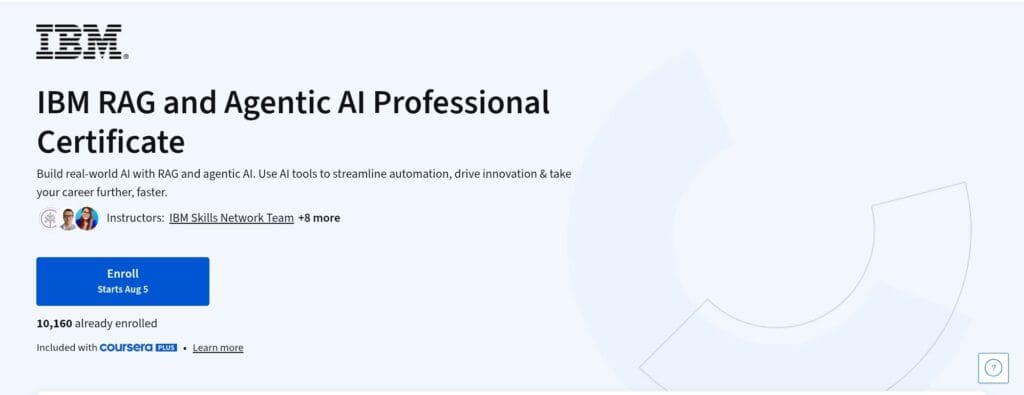
The IBM RAG and Agentic AI Professional Certificate is a comprehensive, multi-course program designed to span the full lifecycle of next-generation AI development.
Beyond foundational RAG concepts, it deep-dives into agentic workflows, tool calling orchestration, multimodal inputs, and AI agent design, equipping learners with both the architectural insights and hands-on skills needed to build context-aware, autonomous applications.
The curriculum blends retrieval-enhanced pipelines with advanced agent frameworks like LangGraph and CrewAI, providing a true end-to-end AI engineering experience.
Tools Covered: LangChain, LangGraph, Model Context Protocol, AI Orchestration, Vector Databases, OpenAI API, Prompt Engineering, CrewAI, AG2/AutoGen
Key Highlights
- The course covers broad concepts from RAG pipelines and vector stores to autonomous multi-agent orchestration.
- Guides learners build real applications using LangChain, Gradio interfaces, and novel AI orchestration tools.
- The key focus is on industry-standard skills like scalable, production-aligned AI systems with responsible AI principles.
- A professional certificate from IBM via Coursera will boost your visibility on professional profiles and resumes.
- Includes lessons on text, speech, and image modalities—an advantage over RAG-only programs.
Who This Course Is Best For
- Experienced AI engineers and ML professionals looking to architect scalable, production-grade RAG systems with advanced orchestration.
- Practitioners who want to go beyond retrieval and generation, mastering agentic and multimodal workflows.
- Developers and technical leaders aiming to build context-aware, autonomous AI applications in enterprise environments.
Pros
- Covers comprehensive concepts, including RAG and the next evolution of AI system design.
- Practical labs and projects help build real-world experience.
- Offers a balanced mix of retrieval, generative, and agentic AI topics.
Cons
- The advanced level may be challenging for beginners without prior Python and AI experience.
Read Full Review – IBM RAG and Agentic AI Professional Certificate – A Detailed Review
2. RAG for Generative AI Applications Specialization – Coursera
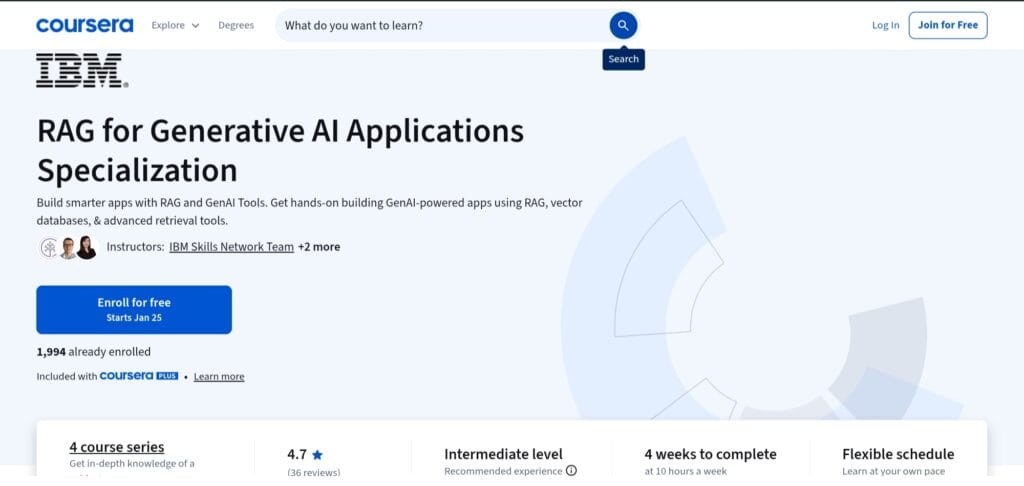
The RAG for Generative AI Applications Specialization is a structured learning program that equips learners with the skills required to design, build, evaluate, and deploy RAG-enabled Generative AI applications in real environments.
You will begin with GenAI fundamentals and prompt engineering before progressing into core RAG pipelines, advanced retrieval patterns, vector database mechanics, and end-to-end app construction.
Hands-on labs help you explore real tools like LangChain and LlamaIndex while leveraging FAISS and Chroma for semantic search and retrieval workloads.
This specialization will guide you through the following topics.
- Building RAG-powered apps and interactive interfaces with Flask and Gradio
- Designing efficient retrievers and integrating LLMs with external knowledge
- Mastering vector database operations and similarity search
- Implementing advanced retrieval patterns that improve accuracy and relevance
Tools Covered: LangChain, LlamaIndex, FAISS, Chroma DB, Gradio, Python, Prompt Engineering
Key Highlights
- With a series of 4 courses, the specialization walks from foundational concepts to advanced RAG workflows.
- Practical labs with industry tools like LangChain, LlamaIndex, FAISS, and Chroma DB.
- Emphasis on constructing complete RAG applications with user interfaces.
- Skills aligned with how RAG is used in search, recommendation systems, and context-aware agents.
Who This Course Is Best For
- Intermediate developers with Python experience are ready to transition into AI application engineering.
- AI engineers and data scientists are looking to embed RAG into production systems rather than just understand its theory.
- Professionals targeting roles where retrieval-driven LLM solutions are a core requirement in products and services.
Pros
- The structured and progressive learning path covers the full lifecycle of RAG application development.
- Focuses on practical and project-based learning.
- Discusses both retrieval and generation tools broadly used in the industry.
Cons
- People with no prior coding experience may feel the pacing is too fast.
3. Retrieval Augmented Generation (RAG) – Coursera
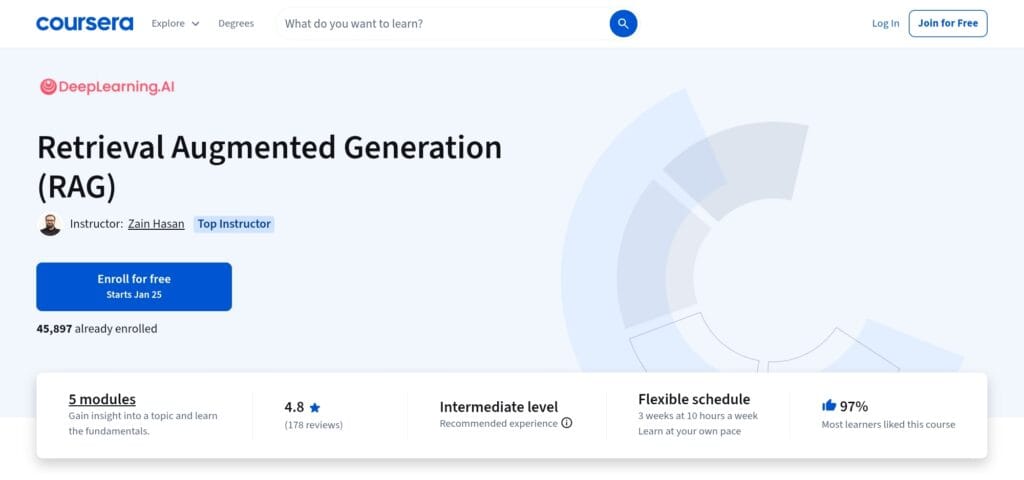
The Retrieval Augmented Generation course by DeepLearning.AI offers an organized pathway to the core RAG system components. It begins with foundational design principles and steadily advances toward building functional pipelines that integrate retrieval and generation.
Across five modules, it guides learners through designing retrievers, working with vector databases, crafting effective embeddings, and evaluating system trade-offs in speed, cost, and quality.
The program culminates in constructing real RAG systems capable of handling domain-specific tasks such as chatbots and knowledge-driven assistants, exposing learners to both conceptual frameworks and hands-on implementation strategies.
Tools Covered: LLMs, vector databases (e.g., Weaviate), semantic search, embeddings, prompt engineering, retrievers, hybrid retrieval approaches, and evaluation techniques
Key Highlights
- The specialization has a focused curriculum covering essential RAG system design and implementation from retrievers to evaluation.
- Learners who understand Python and generative AI workflows can take this course.
- Includes programming assignments that reinforce each RAG component with structured, real-world tasks.
- Teaches you how to weigh speed, accuracy, and cost when selecting retrieval strategies.
Who This Course Is Best For
- Intermediate AI developers who want a balanced grounding in both theory and practice for RAG.
- Professionals with basic Python and generative AI knowledge looking to understand component-level system decisions in RAG pipelines.
- Learners preparing to build RAG-powered tools like chat interfaces, semantic search engines, or knowledge assistants in real projects.
Pros
- Teaches all stages of a RAG system from retrieval engines to evaluation.
- Strong emphasis on hands-on labs and production-oriented practices.
- Ideal transition course for learners moving beyond basics but not yet ready for advanced engineering programs.
Cons
- Focuses on general RAG principles rather than deep dives into specific frameworks like LangChain or LlamaIndex.
Read Also: Best Machine Learning Courses online
4. AI & LLM Engineering Mastery – GenAI, RAG Complete Guide Specialization – Coursera
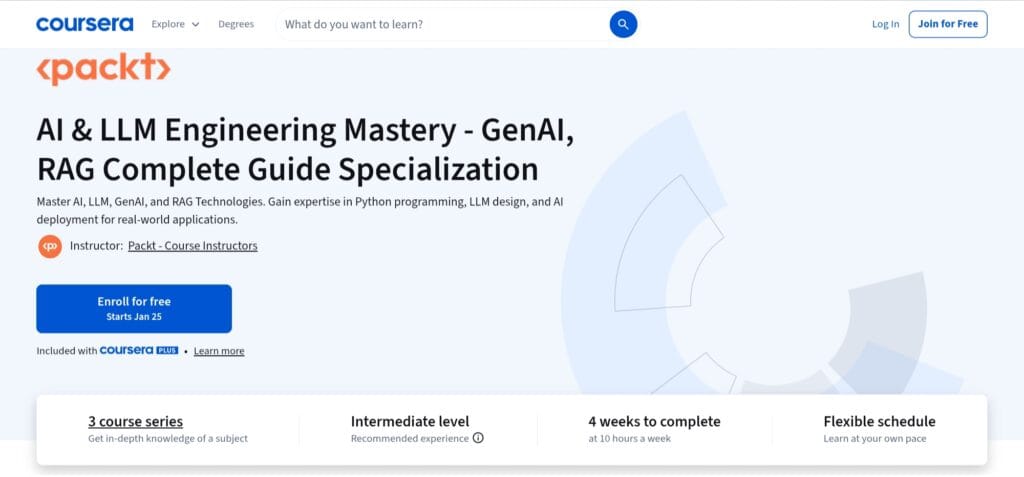
This specialization takes learners from core generative AI fundamentals to real-world RAG-augmented application engineering.
It starts with establishing a robust development environment and Python programming skills tailored for AI workflows, then progresses into designing and implementing LLM systems, including RAG architectures and context-aware pipelines.
The curriculum emphasises advanced prompt strategies, memory and context management, and hands-on construction of AI tools such as chatbots, summarizers, and information retrieval agents.
It also covers fine-tuning techniques with efficiency-focused methods like LoRA, enabling learners to optimize and deploy models effectively.
Upon completion, learners will be able to build, evaluate, and deploy production-ready AI systems that integrate retrieval-based knowledge with generative models.
Tools Covered: OpenAI API, LangChain, Hugging Face Transformers, vector databases, LoRA fine-tuning, RAG pipelines, chatbot frameworks, deployment tooling
Key Highlights
- It offers a comprehensive AI engineering path from environment setup and Python fluency to advanced application deployment.
- Gives exposure to multiple tools like LangChain, Hugging Face Transformers, and vector databases.
- Features dedicated modules on implementing RAG within context-rich applications.
- Covers efficient model adaptation and building AI features ready for real use.
- Upon completion, you will get a shareable certificate from Coursera.
Who This Course Is Best For
- Intermediate to advanced developers who want a structured pathway to master GenAI engineering with RAG tightly integrated into applications.
- AI engineers and machine learning practitioners seeking both conceptual mastery and hands-on proficiency with modern AI development stacks.
Pros
- Bridges foundational AI, large language models, and RAG engineering in one unified specialization.
- Despite focusing on production patterns, it exposes learners to diverse frameworks and workflows.
- Emphasis on building deployable systems rather than solely theoretical understanding.
Cons
- With its wide coverage, some RAG-specific topics may receive less depth compared to focused RAG-only courses.
5. Create Embeddings, Vector Search, and RAG with BigQuery – Coursera
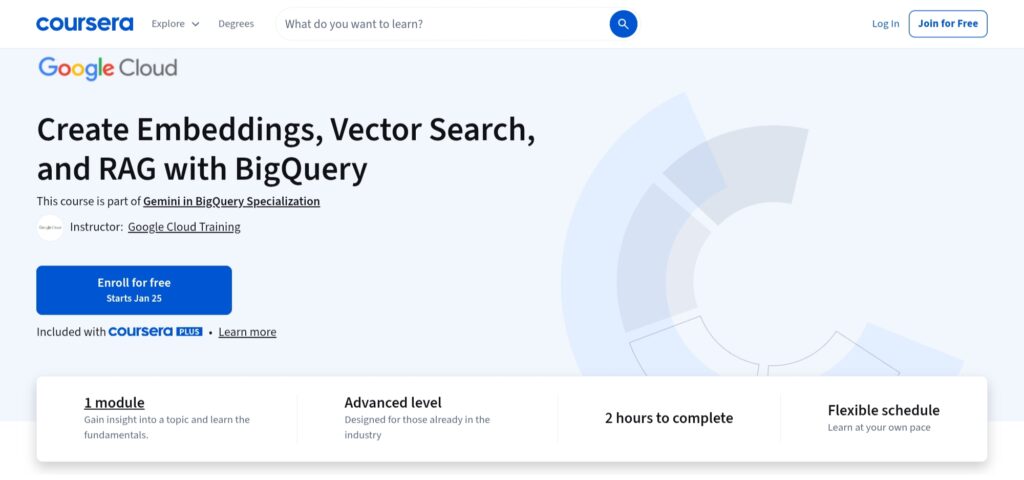
The Create Embeddings, Vector Search, and RAG with BugQuery course on Coursera helps build a RAG workflow using BigQuery’s vector capabilities.
You will explore how to generate embeddings with BigQuery models, perform vector search within the platform, and assemble these components into an RAG pipeline that mitigates hallucinations and enhances response relevance for real-world use cases.
This course is tightly scoped yet high-impact, making it ideal for engineers and data professionals embedding AI workflows into Google Cloud solutions.
Tools Covered: BigQuery, vector search, embeddings, Google Gemini models, RAG pipelines on Google Cloud Platform
Key Highlights
- Teaches embedding generation, vector search, and RAG pipeline assembly within BigQuery’s managed analytics environment, which is a strong differentiator from general tool-agnostic courses.
- Designed for efficient learning with focused modules that can be completed in a short timeframe.
- Exposure to modern generative models (Google Gemini) within BigQuery workflows.
Who This Course Is Best For
- Cloud engineers and data professionals focused on integrating LLM-driven RAG features into BigQuery-centric architectures.
- AI practitioners looking to leverage managed vector search and generative models within enterprise-scale datasets.
- Developers already familiar with Google Cloud who want a specialized RAG implementation path rather than a generic architecture overview.
Pros
- Covers embedding generation, vector search, and RAG implementation without unnecessary theoretical overhead.
- A credible credential backed by Google Cloud Training.
- Ideal for learners integrating generative AI into BigQuery and Google Cloud workflows.
Cons
- Less applicable if you plan to build RAG systems outside the Google Cloud ecosystem.
6. LLM Engineering with RAG: Optimizing AI Solutions
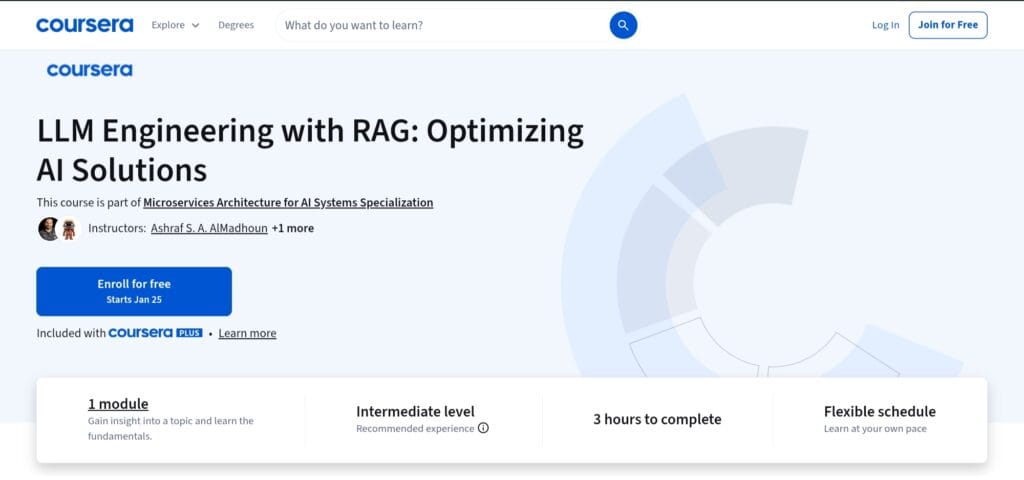
This RAG course on Coursera offers a practical introduction to engineering RAG-augmented LLM applications, focusing primarily on integrating enterprise data sources with large language models and optimizing retrieval workflows for production scenarios.
You will get exposure to RAG architectures, vector search with FAISS, prompt refinement for high-quality outputs, and deployment strategies.
The course blends conceptual foundations with hands-on activities that demonstrate how to connect LLMs to real data, refine retrieval quality, and deliver scalable AI solutions that address business-critical problems.
Practical examples guide you through connecting data pipelines, optimizing retrieval processes, and deploying RAG-powered applications that produce contextually relevant answers.
Tools Covered: LangChain, FAISS vector search, OpenAI API, prompt optimization, scalable AI deployment, enterprise-data integration, Hugging Face deployments
Key Highlights
- Offers hands-on experience with LangChain, FAISS, and OpenAI APIs for retrieval and generation workflows.
- Practical guidance on building and optimizing RAG pipelines suitable for real enterprise contexts.
- Focuses on deployment and scalable AI solutions that transition from experiments to production.
- Designed to be completed quickly, ideal for professionals with limited time but specific goals.
Who This Course Is Best For
- Intermediate developers and AI engineers who want a high-impact, time-efficient introduction to engineering RAG solutions.
- Learners interested in connecting enterprise data, refining retrieval quality, and deploying RAG applications.
Pros
- Short, engineering-oriented content with direct practical relevance.
- Exposure to LangChain, vector search (FAISS), prompting, and deployment strategies.
- Emphasis on architectures suitable for enterprise-level AI solutions.
Cons
- Limited depth compared with full-length RAG specializations or multi-course programs.
7. Learn RAG From Scratch – Python AI Tutorial from a LangChain Engineer – YouTube
This free, in-depth YouTube tutorial provides a practical, implementation-oriented introduction to RAG, taking viewers through all the core components of a retrieval-augmented system from a Python perspective.
Led by a LangChain engineer, the session starts with indexing and retrieval basics and steadily unfolds into advanced query transformation strategies such as RAG Fusion, decomposition, multi-query handling, and routing techniques.
Throughout the video, learners see real code examples and live explanations that demonstrate how to connect an LLM with custom data using retrieval workflows, build robust retrievers, and refine queries for better results.
Tools Covered: Python, LangChain, semantic indexing, retrievers, retrieval strategies, query refinement techniques, vector search concepts
Key Highlights
- The course is taught by a LangChain developer, offering an engineer-level perspective beyond surface-level explanations.
- Gives a step-by-step explanation of indexing, retrieval, and generation workflows with actionable examples.
- Includes nuanced methods like query decomposition, routing, and hybrid RAG strategies.
- Emphasis on hands-on Python coding rather than just a conceptual overview.
Who This Course Is Best For
- Developers and AI practitioners who learn best through live coding and want to grasp RAG fundamentals in a real environment.
- Learners familiar with Python and basic LLM concepts seeking free, detailed guidance before investing in paid courses.
- Engineers aiming to understand practical RAG patterns and techniques directly from someone building with LangChain.
Pros
- High-value tutorial without cost, covering substantive RAG workflows.
- Demonstrates implementation details that strengthen practical understanding.
- Goes beyond basic indexing and retrieval into nuanced RAG methods.
Cons
- It is not a formal course and lacks a structured curriculum and assessment found in paid programs.
8. RAG Tutorial 2025: Complete Introduction to Retrieval Augmented Generation – YouTube
This YouTube tutorial serves as a comprehensive introductory walkthrough to Retrieval-Augmented Generation (RAG), designed to take learners from basic concepts through to assembling functioning RAG workflows.
This session explains the architecture of retrieval-augmented systems, how to integrate an LLM with document retrieval, and how vector search and embeddings enable contextualized responses.
The full series gives you a complete understanding of RAG concepts, enabling you to build AI applications with LLMs and vector databases.
Tools Covered: Python, vector database fundamentals, retrieval workflows, LLM integration, embeddings, and semantic search concepts
Key Highlights
- Introduces RAG architecture and practical components in a clear, accessible format.
- Demonstrates real code workflows to build core RAG elements.
- Focused on building working RAG applications rather than purely theoretical concepts.
Who This Course Is Best For
- Beginners and early learners who want to ground their understanding of RAG fundamentals with real code examples.
- Developers familiar with Python but new to retrieval-augmented systems.
- Learners seeking free, practical content before investing in a paid structured course.
Pros
- Helps learners see RAG workflows implemented in real time.
- High-value content with no enrollment cost.
- Sets the stage for deeper topics in follow-up videos.
Cons
- The tutorial assumes familiarity with basic Python and development workflows.
9. Complete RAG Crash Course With LangChain in 2 Hours – YouTube
This is a 2-hour crash course on RAG that delivers a practical, implementation-focused introduction to Retrieval-Augmented Generation (RAG) using LangChain.
Rather than dwelling on theory, the course emphasizes how to connect an LLM with external knowledge sources so that responses are grounded in context and accuracy.
Participants explore key RAG components, including embeddings, vector search, and retrieval pipelines, and follow along with real code examples that demonstrate how to pull domain-specific information into LLM prompts.
The content is tailored for developers who want fast, actionable skills that can be applied directly to building AI tools.
Tools Covered: LangChain framework, Python, vector embeddings, semantic search, retrieval pipelines, external knowledge integration
Key Highlights
- Designed to cover fundamental RAG concepts and implementation in about two hours.
- Practical usage of LangChain to glue together retrieval and generation workflows.
- Real code examples help demystify pipeline construction and execution.
- The accompanying code repository is often provided to help learners follow along.
Who This Course Is Best For
- Developers and AI practitioners with some Python experience who want a compact yet practical introduction to RAG implementation.
- Learners preparing to build basic RAG-augmented tools without investing in longer formal courses.
- Self-taught engineers who prefer video tutorials with real-world coding demonstrations.
Pros
- Delivers core RAG implementation insights in a short format.
- Available on YouTube without any enrollment cost.
- Focuses on code and real applications rather than heavy theory.
Cons
- As a crash course, it may not cover advanced RAG patterns or performance optimization techniques.
10. Langchain RAG Course: From Basics to Production-Ready RAG Chatbot – YouTube
This YouTube tutorial walks learners through the end-to-end construction of a RAG-powered chatbot that can answer domain-specific queries based on uploaded documents.
Starting with the fundamentals of document ingestion and vector embeddings, the session progresses into building a retrieval pipeline and integrating an LLM via LangChain.
Learners also implement a RESTful backend using FastAPI and a user-friendly interface with Streamlit, transforming raw components into a deployed application. The course emphasizes both theory and practice, combining architectural explanations with working code.
Tools Covered: Python, LangChain, vector embeddings, FastAPI backend integration, Streamlit frontend, semantic search, document ingestion
Key Highlights
- Available on YouTube, making it easy to start without cost.
- Builds a full RAG chatbot pipeline with frontend and backend integration.
- Combines LangChain, FastAPI, Streamlit, and vector search for real-world application development.
- Live coding approach demonstrates real code examples and workflows.
Who This Course Is Best For
- Intermediate developers and AI engineers who want to connect theoretical RAG knowledge with a real, deployed project.
- Learners with experience in Python and web frameworks aiming to see how RAG components fit within an application stack.
- Self-taught engineers who prefer practical video tutorials with step-by-step implementations.
Pros
- Free content that lowers barriers to entry for learners.
- Teaches how a complete RAG application is built and deployed.
- Combines RAG logic with backend and frontend development.
Cons
- As a YouTube tutorial, it does not provide assessments or a certificate.
Career Opportunities After Learning RAG
Gaining proficiency in Retrieval-Augmented Generation leads to high-impact positions at the nexus of corporate systems, software architecture, and AI engineering.
RAG skills are becoming a powerful differentiator in the job market as companies transition from testing huge language models to implementing dependable, production-grade AI.
These are a few of the most pertinent employment paths where having RAG experience is immediately beneficial.
Generative AI Engineer
Generative AI engineers are in charge of creating and implementing LLM-powered systems that function dependably in practical settings.
These experts use their RAG talents to create apps that greatly increase accuracy and reliability by fusing generative models with outside information sources.
In addition to prompt engineering, employers are progressively expecting Generative AI Engineers to comprehend retrieval pipelines, vector databases, and evaluation procedures.
LLM Engineer
The architecture, scaling, and optimization of language-model systems are the main concerns of LLM engineers.
In this position, RAG is essential because it enables LLMs to access vast, dynamic knowledge libraries while maintaining their lightweight nature.
RAG-trained engineers are in a good position to work on internal AI tools, domain-specific copilots, and search-augmented assistants where data relevance and freshness are crucial.
AI Application Developer
RAG helps AI application developers create dynamic, data-aware experiences out of static AI features.
Developers who comprehend RAG may construct applications that adjust to new information without retraining models, whether they are creating chatbots, document Q&A systems, or semantic search interfaces.
Because of this, RAG skills are particularly useful in productivity-driven products, e-commerce, and SaaS.
Enterprise AI Consultant
Enterprise AI consultants offer guidance to businesses on how to safely and effectively incorporate AI into current systems.
Consultants can create solutions that use proprietary data while upholding control, compliance, and transparency thanks to their understanding of RAG.
RAG-based system architects are in great demand for strategy, implementation, and optimization projects as businesses emphasize the adoption of AI at scale.
FAQs on RAG Courses
Is RAG better than fine-tuning?
RAG is not a replacement for fine-tuning, but in most real-world production scenarios, it is the preferred approach. Fine-tuning embeds knowledge into a model’s weights, making updates costly and slow when information changes. RAG, by contrast, retrieves relevant data at inference time, allowing systems to stay current simply by updating the underlying knowledge source.
Do I need ML knowledge to learn RAG?
You do not need deep machine learning expertise to get started with RAG, but basic familiarity with Python and AI concepts is important. Most RAG courses are designed for developers, data scientists, or AI practitioners who understand APIs, data handling, and prompt-based interactions with LLMs.
How long does it take to learn RAG?
The time required to learn RAG depends on your background and learning goals. For developers with Python experience, basic RAG concepts can be understood in 1–2 weeks through tutorials or crash courses.
Is RAG used in real-world products?
Yes, RAG is widely used in real-world, enterprise-grade AI products. It powers internal knowledge assistants, customer support chatbots, semantic search engines, document analysis tools, and AI copilots across industries such as finance, healthcare, legal, and SaaS.
Conclusion
The most important factor when selecting the top RAG courses available online is the usefulness of what you create, not just the quantity of hours or brand name.
The best long-term returns come from courses that focus on practical projects, introduce you to industry-relevant tools like LangChain, vector databases, and deployment frameworks, and handle actual production issues like evaluation and scalability.
Effective learning must acknowledge that RAG is both an engineering discipline and a concept.
Lastly, don’t fall into the trap of attempting to learn everything at once. Start with a single, well-aligned lesson, develop a functional RAG application, and iteratively improve your comprehension.
Your architectural sense is strengthened by every project, no matter how modest, and it gets you ready for more complicated systems.
Consistent, applied learning is ultimately what distinguishes competent practitioners from true RAG professionals in an area that is developing as quickly as generative artificial intelligence.
Share Now

More Articles
Best SQL Courses Online [Practically Chosen]
Best Deep Learning Courses Online [Beginner to Advanced]
best AI courses online [AI Career Guide]

As an engineer with a passion for learning and sharing knowledge, I created CourseKart.online to help students, professionals, and lifelong learners choose the best online courses. With so many options available, finding the right one can be overwhelming. My goal is to simplify that process by offering insights, reviews, and recommendations on the top online learning resources. I hope my posts inspire you to keep growing, learning, and exploring new opportunities.
Discover more from coursekart.online
Subscribe to get the latest posts sent to your email.