
Artificial intelligence, or AI, refers to computer systems that are programmed to accomplish activities that would normally require human intelligence.
These duties involve learning from data, identifying trends, making decisions, and automating complex procedures.
Voice assistants and recommendation engines, as well as fraud detection and medical diagnostics, are no longer considered experimental. It is already ingrained in how modern businesses run.
As enterprises in technology, healthcare, finance, marketing, and manufacturing adopt AI-driven solutions, the demand for qualified AI workers grows.
Companies are searching for more than simply researchers; they need people who can create, apply, and manage AI systems in real-world settings.
This guide is intended for students trying to develop future-ready skills, working professionals looking to upgrade their skills, and career changers looking to enter high-growth tech professions.
All courses included here are evaluated based on curriculum depth, instructor credibility, hands-on projects, and the true value of their credentials.
List of the Best AI Courses Online (Coursera)
Here are the top AI courses I shortlisted for you. Select the right course from this list and take your career to the next level.
| SL No | Course Name | Best For |
|---|---|---|
| 1 | AI For Everyone | Best for beginners and non-technical professionals who want a clear, business-level understanding of AI. |
| 2 | AI Foundations for Everyone Specialization | Best for professionals who want structured AI fundamentals without coding, but with strategic depth. |
| 3 | Google AI Essentials Specialization | Best for learners seeking industry-backed AI fundamentals with practical, real-world context. |
| 4 | Microsoft AI & ML Engineering Professional Certificate | Best for aspiring AI and ML engineers aiming for job-ready, hands-on engineering skills. |
| 5 | IBM AI Developer Professional Certificate | Best for developers who want practical AI application skills using real tools and enterprise workflows. |
| 6 | Exploring Artificial Intelligence Use Cases and Applications | Best for business leaders and consultants focused on applying AI to real organizational problems. |
| 7 | IBM AI Engineering Professional Certificate | Best for technically inclined learners targeting advanced AI engineering and deployment roles. |
| 8 | AI Agent Developer Specialization | Best for developers interested in building autonomous, decision-driven AI agent systems. |
| 9 | IBM Generative AI Engineering Professional Certificate | Best for engineers looking to specialize in generative AI, LLMs, and modern AI systems. |
| 10 | AI Agents and Agentic AI in Python: Powered by Generative AI Specialization | Best for Python developers who want to build intelligent, agentic AI systems using generative models. |
1. AI For Everyone
AI For Everyone is a strategic, non-technical introduction to artificial intelligence designed by Andrew Ng, one of the foremost educators in AI.
Instead of teaching algorithms or code, this course focuses on AI’s conceptual and organizational implications, making it suitable for professionals and decision-makers who want to comprehend AI’s potential without becoming programmers.
The course is delivered through Coursera and includes bite-sized video courses and real-world corporate case examples, bridging the gap between technological innovation and strategic implementation.
What You Will Learn
- Foundational definitions of artificial intelligence and machine learning, explained without jargon
- Practical frameworks for identifying AI opportunities in business processes
- The lifecycle of an AI project and how to align it with organizational goals
- Common pitfalls in AI adoption, including data readiness and change management
- How to build a cross-functional team that can operationalize AI insights
Who This Course Is For
The AI for Everyone course is excellent for product managers, executives, business analysts, consultants, and professionals in non-technical roles who want to understand AI concepts.
Students and career switchers who want to pursue a career in AI will benefit from this course.
Pros
- Crystal-clear explanations without technical complexity
- Excellent for leadership and strategic planning contexts
- Short duration with flexible pacing
- Taught by a respected AI educator with a strong learning community
Cons
- Not suitable for learners seeking hands-on coding or model development
Read Also: What Is The AI for Everyone Course By DeepLearning AI On Coursera?
2. AI Foundations for Everyone Specialization
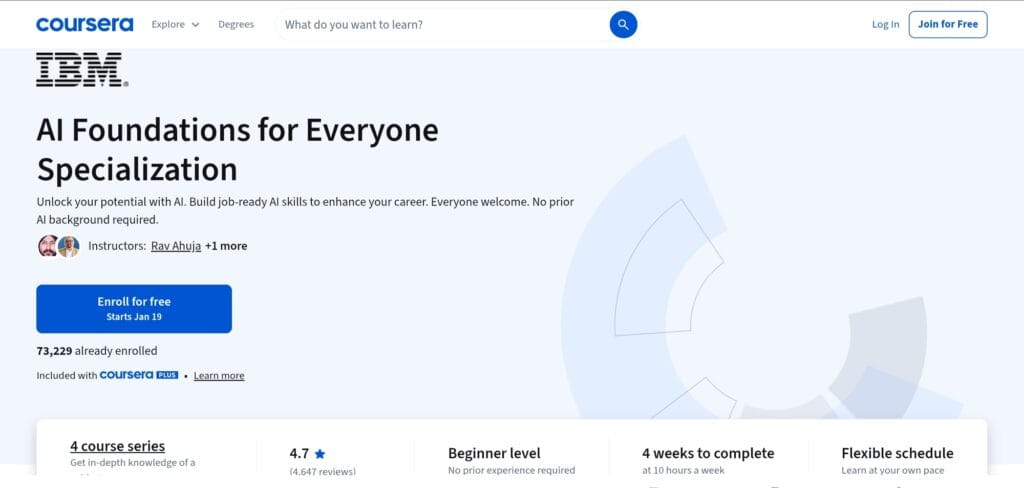
The AI Foundations for Everyone Specialization is a structured learning path that takes learners from basic AI awareness to actionable insight without leaning on heavy mathematics or programming.
This specialization, hosted on Coursera and created by industry professionals, comprises many courses that provide a comprehensive understanding of how AI works, how it is implemented in real-world contexts, and how businesses may safely leverage its possibilities.
Compared to single-course introductions, this specialization provides a progressive framework that steadily enhances your comprehension, making it appropriate for ambitious professionals and strategic thinkers.
What You Will Learn
- Core AI concepts like supervised vs. unsupervised learning and neural networks
- Real-world AI applications across functions such as marketing, finance, operations, and HR
- Ethical considerations and governance frameworks for deploying AI responsibly
- How to assess AI use cases, estimate impact, and prioritize AI initiatives
- A strategic lens on data readiness, AI project design, and performance evaluation
Who This Course Is For
This specialization is suitable for corporate leaders, non-technical workers, aspiring AI consultants, and students who want more than just a basic understanding.
If you want to lead teams, work comfortably with AI technologists, or analyze AI investments, this curriculum has both breadth and strategic depth.
Pros
- Comprehensive multi-course structure that builds clarity incrementally
- Strong emphasis on ethical and responsible AI practices
- Applicable frameworks for business and operational decision-making
- Well-paced for learners, balancing professional commitments
Cons
- Not focused on hands-on coding or technical implementation
3. Google AI Essentials Specialization
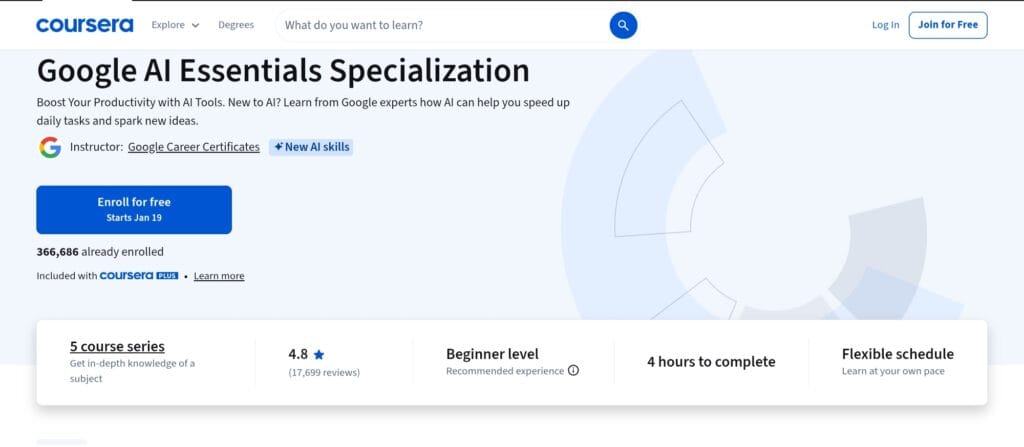
The Google AI Essentials Specialization is a practical yet conceptual program designed by Google to equip learners with a real-world-ready understanding of AI fundamentals.
Unlike purely theoretical introductions, this specialization combines fundamental principles with contextualized examples from Google’s AI ecosystem.
It is offered through Coursera and is designed to assist students in building confidence in understanding how AI workflows work, why particular design decisions are important, and how one thinks of AI as a solution tool rather than a buzzword.
What You Will Learn
- Core AI building blocks, including machine learning concepts, data pre-processing, and model evaluation
- How to interpret AI results and assess model effectiveness
- Practical uses of AI in search, vision, language, and recommendation systems
- Tools and frameworks that mirror professional AI practices
- Frameworks for deploying AI responsibly with attention to fairness and ethics
Who This Course Is For
This specialization is ideal for students who desire a well-rounded introduction that is neither completely academic nor overly technical.
It’s great for business executives, aspiring AI practitioners, new grads, and technical generalists looking to take their first steps into more advanced AI education.
Pros
- Backed by Google’s practical expertise and design philosophy
- Comprehensive coverage of AI basics with real-world context
- Good mix of conceptual explanations and applied scenarios
- Flexible pacing through Coursera with industry-recognized certification
Cons
- Not the best choice for learners seeking deep coding experience
4. Microsoft AI & ML Engineering Professional Certificate
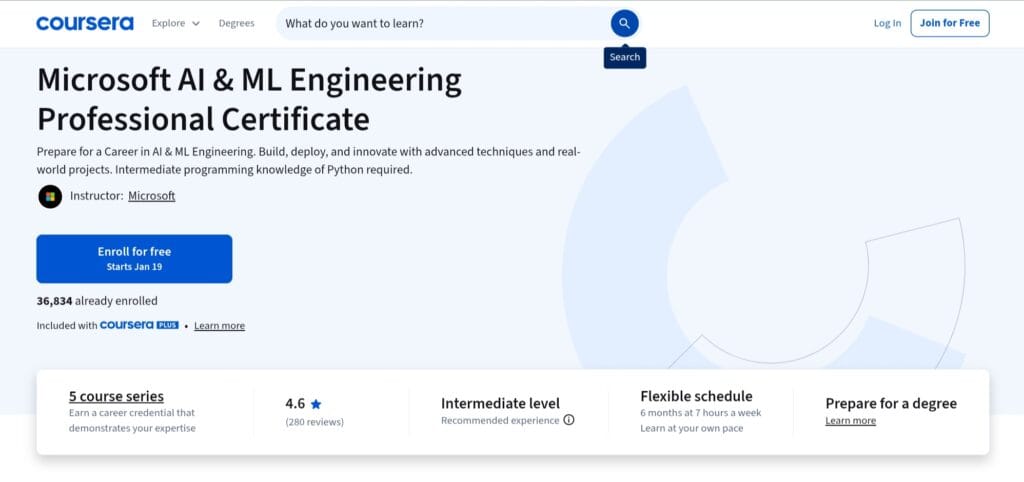
The Microsoft AI & ML Engineering Professional Certificate is a comprehensive, career-oriented program engineered to transform learners into capable practitioners in both artificial intelligence and machine learning.
The Microsoft-developed curriculum emphasizes practical model deployment, industry best practices, and practical engineering skills.
This certification goes beyond theory to focus on practical tools and procedures that meet employment requirements, particularly for positions requiring both machine learning expertise and AI fluency.
What You Will Learn
- Fundamentals of machine learning and supervised/unsupervised learning paradigms
- Practical model training, evaluation, and optimization techniques using industry-grade tools
- Core concepts of AI systems, including neural networks and their applications
- End-to-end workflow for deploying models into production environments
- Responsible AI principles, fairness considerations, and governance practices
Who This Course Is For
This professional certificate is suited for learners with at least a basic foundation in programming and statistics, such as software developers, data analysts, aspiring ML engineers, or technologists seeking to solidify their AI and ML credentials.
It also benefits career switchers targeting technical roles where both AI understanding and machine learning engineering skills are prerequisites.
Pros
- Rigorous, industry-aligned curriculum with a practical engineering focus
- Strong emphasis on real-world workflows, deployment, and responsible AI
- Certificate from Microsoft, a leading enterprise AI technology provider
- Structured for job readiness and portfolio-worthy project outcomes
Cons
- More time-intensive (6 Months) compared with overview-style courses
5. IBM AI Developer Professional Certificate
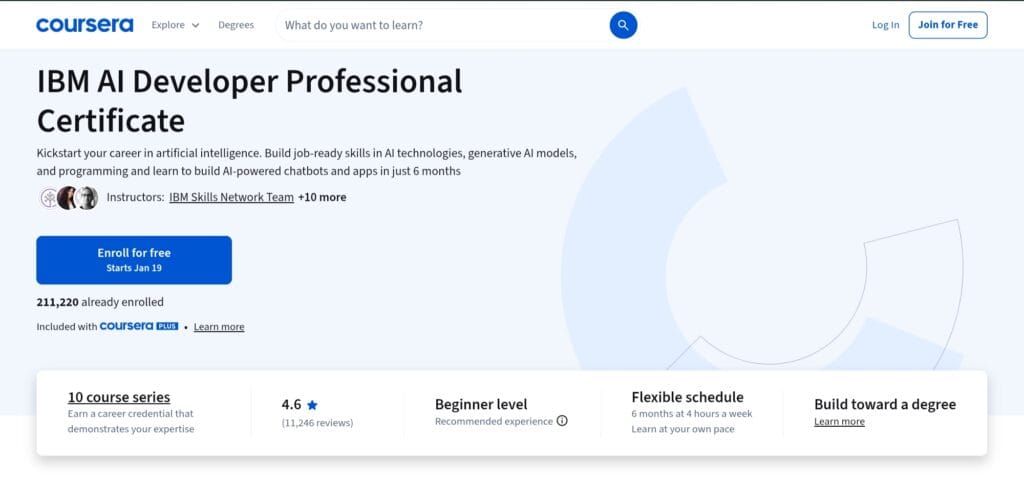
The IBM AI Developer Professional Certificate is a hands-on, career-focused program designed to equip learners with practical skills in building, training, and deploying AI solutions using tools from the IBM Watson ecosystem and open-source frameworks.
This credential integrates real-world datasets, cloud-based tools, and industry-relevant procedures, emphasizing practical intelligence in contrast to merely theoretical introductions.
The program is especially beneficial for students who wish to work on actual AI systems rather than only comprehend the principles, because it is designed to bridge the gap between academic understanding and industrial demand.
What You Will Learn
- Core AI and machine learning concepts such as classification, clustering, and regression
- Building and training machine learning models using Python libraries and IBM Watson tools
- Natural language processing (NLP) techniques for extracting insights from text
- Deploying AI models and integrating them into applications
- Best practices for model evaluation, optimization, and ethical AI considerations
Who This Course Is For
This professional certificate is suitable for aspiring AI developers, software professionals, data analysts, and technical job changers seeking hands-on exposure with real-world tools and procedures.
It is especially beneficial for students seeking a balanced blend of machine learning basics, NLP experience, and practical deployment skills applicable to enterprise situations.
Pros
- Strong practical emphasis with real-world tools and datasets
- Broad coverage of AI techniques, including NLP and model deployment
- Certificate from IBM, a reputable enterprise AI brand
- Structured to build a portfolio of applied projects
Cons
- May move quickly for learners without prior programming exposure
Read Also: Will AI Take My Job or Create a New One? A Deep Dive into the Post-AI Job Market
6. Exploring Artificial Intelligence Use Cases and Applications
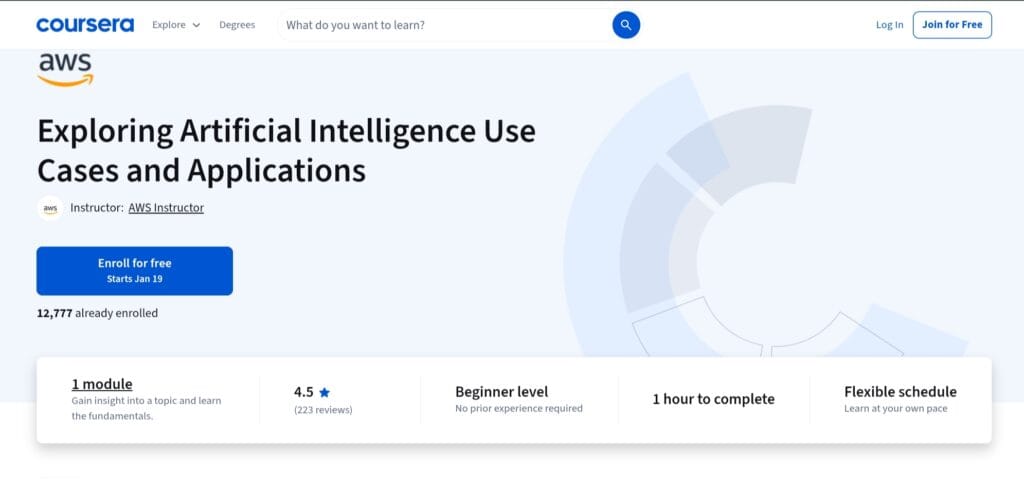
Exploring Artificial Intelligence Use Cases and Applications is a strategically designed course that goes beyond theory to illuminate how AI delivers value across industries.
Rather than focusing on programming or model construction, this course provides students with a practical grasp of real-world AI applications, assisting them in determining where and how AI may solve business challenges.
Learners acquire clarity on AI’s impact, limitations, and possibilities in operational contexts through carefully chosen case studies and industry examples, making this an ideal bridge between conceptual knowledge and strategic application.
What You Will Learn
- Diverse AI use cases across sectors such as healthcare, finance, retail, logistics, and manufacturing
- How organizations apply AI to optimize processes, improve insights, and enhance customer experiences
- Criteria for evaluating the feasibility and ROI of an AI initiative
- Practical frameworks to prioritize AI projects based on business value
- Ethical considerations and potential risks associated with AI implementation
Who This Course Is For
This course is especially beneficial to business executives, product managers, consultants, and strategic thinkers who need to convert AI opportunities into concrete projects.
It is also appropriate for learners who have a basic understanding of AI and want to know how AI affects organizational outcomes without requiring coding or data science experience.
Pros
- Strong focus on practical, real-world examples rather than abstract theory
- Helps bridge the gap between AI knowledge and business applications
- Applicable frameworks for prioritizing AI initiatives
- Compact and well-structured for busy professionals
Cons
- Not focused on technical skills or hands-on model development
7. IBM AI Engineering Professional Certificate
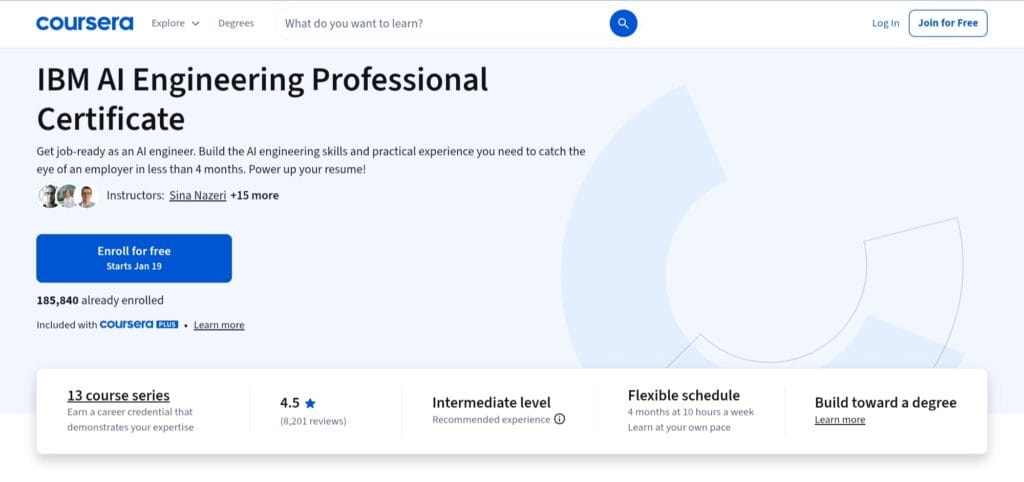
The IBM AI Engineering Professional Certificate is an intensive, project-driven program designed to develop industry-ready AI engineers.
Unlike introductory or business-oriented courses, this certificate emphasizes hands-on application, scalable AI model creation, and interaction with production environments.
Developed by IBM AI practitioners, the curriculum integrates foundational machine learning, deep learning, and MLOps workflows with hands-on experience with tools and frameworks commonly used in enterprise applications.
The end result is a learning experience that reflects real-world job requirements and trains students not only to understand AI, but also to design and deploy it efficiently.
What You Will Learn
- Core machine learning algorithms, including regression, classification, and clustering
- Deep learning fundamentals with neural networks and convolutional models
- Real-world data handling, feature engineering, and model optimization
- Deploying and operationalizing models using MLOps principles
- Best practices for performance monitoring, versioning, and continuous delivery
Who This Course Is For
This professional certificate is designed for students who have some programming and data experience, such as software developers, data engineers, or analysts, who wish to transition into AI engineering employment.
It also benefits career changers looking for technical roles that require both model development and deployment skills.
Pros
- Strong emphasis on applied, real-world AI workflows
- Covers both machine learning and deep learning comprehensively
- Teaches MLOps principles critical for production-grade systems
- Project portfolio that aligns with employer expectations
Cons
- Requires solid prior knowledge of Python, mathematics, generative AI basics, and data fundamentals
8. AI Agent Developer Specialization
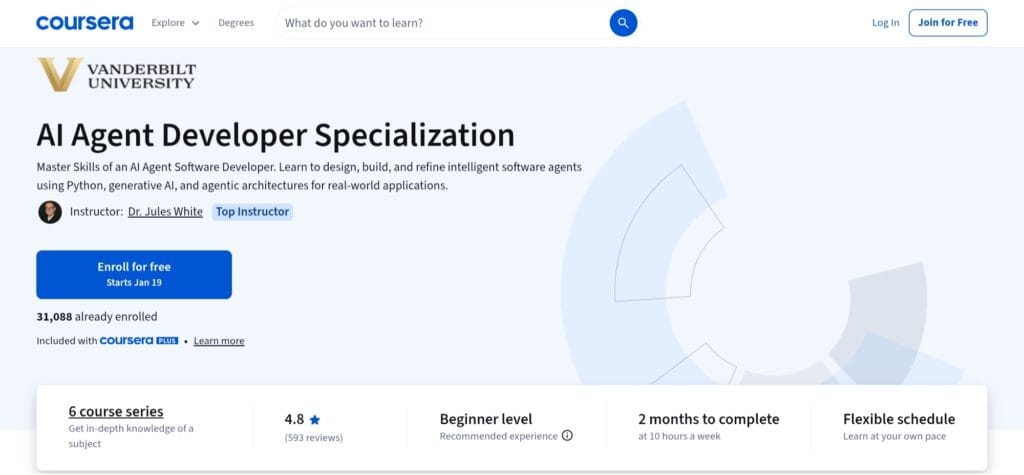
The AI Agent Developer Specialization is a cutting-edge program focused on the design, development, and deployment of autonomous AI agents, software entities capable of performing tasks, making decisions, and interacting with users or environments without constant human direction.
Unlike broad introductory courses, this specialization delves into the agent architectures, decision processes, and real-world workflows that serve as the foundation for everything from intelligent assistants to autonomous systems.
Learners will investigate both the theoretical basis and practical applications that are increasingly influencing modern AI applications.
What You Will Learn
- Foundational principles of AI agents, including perception, action selection, and learning loops
- Architectures for building autonomous systems, such as reactive, deliberative, and hybrid agents
- Practical methods for integrating agents with environmental inputs (e.g., APIs, sensors)
- Reinforcement-inspired strategies for decision-making under uncertainty
- How to evaluate, debug, and optimize agent behaviors in real scenarios
Who This Course Is For
This specialization is ideal for students with a technical mindset and coding skills (particularly in Python) who want to concentrate on interactive and autonomous AI systems.
It is great for aspiring AI developers, robotics enthusiasts, software engineers, and research-oriented learners seeking a specific but highly relevant skill set as AI systems grow more dynamic and context-aware across industries.
Pros
- Focused, deep dive into autonomous AI agent concepts
- Realistic workflows that reflect current industry trends
- Strong foundation for robotics, autonomous systems, and intelligent automation roles
- Project-oriented learning that builds practical implementation skills
Cons
- Requires some prior programming and algorithmic understanding
Read Also: Generative AI and You: What can you create with Generative AI?
9. IBM Generative AI Engineering Professional Certificate
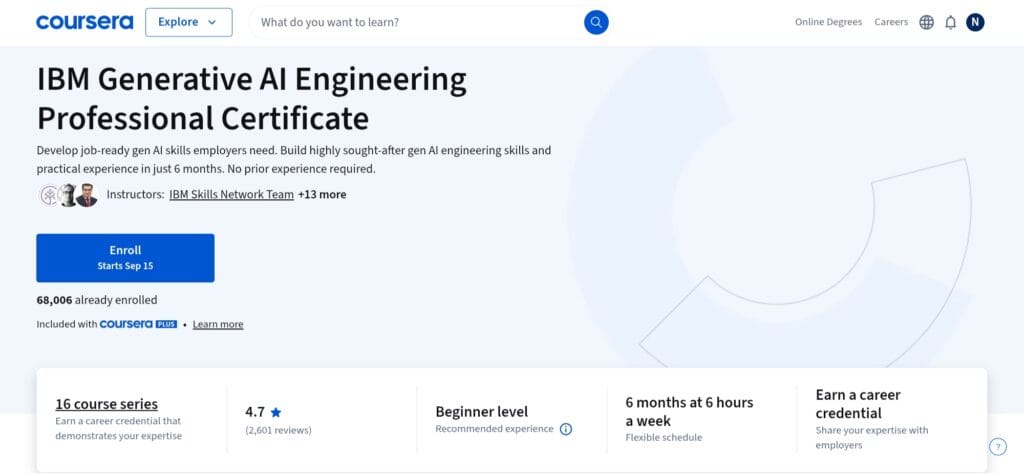
The IBM Generative AI Engineering Professional Certificate is a forward-looking program tailored to the rising demand for generative AI skills, particularly in contexts where machines create meaningful content such as text, images, code, and multimodal outputs.
Developed by IBM and hosted on Coursera, this certificate blends foundational knowledge with stringent engineering practice, focusing on building, evaluating, and deploying generative models using state-of-the-art techniques and tools.
It is designed not just to teach concepts but to empower learners to contribute to real generative AI systems in practical settings.
What You Will Learn
- Core principles of generative AI, including probabilistic modeling and latent representations
- Transformer architectures and attention mechanisms are foundational to large language models (LLMs)
- Methods for fine-tuning and customizing pre-trained models for specific tasks
- Techniques for evaluating generative model quality, safety, and fairness
- Deployment workflows for scalable generative AI applications, including APIs and model serving
Who This Course Is For
This professional certificate is suitable for aspiring AI engineers, machine learning professionals, software developers, and technically inclined learners who wish to specialize in generative AI, one of the most in-demand skill sets in today’s AI job market.
It presupposes a basic understanding of Python and beginning machine learning, making it ideal for students looking to go from broad AI foundations to cutting-edge generative systems.
Pros
- Intensive focus on generative AI, a rapidly growing and highly relevant domain
- Blend of theory and application with real hands-on projects
- Prepares learners for roles involving LLMs, multimodal systems, and advanced automation
- Certificate from a reputable enterprise AI provider
Cons
- It may be challenging for beginners without prior technical experience
Read the Full Review: IBM Generative AI Engineering Professional Certificate – A Detailed Review
10. AI Agents and Agentic AI in Python: Powered by Generative AI Specialization
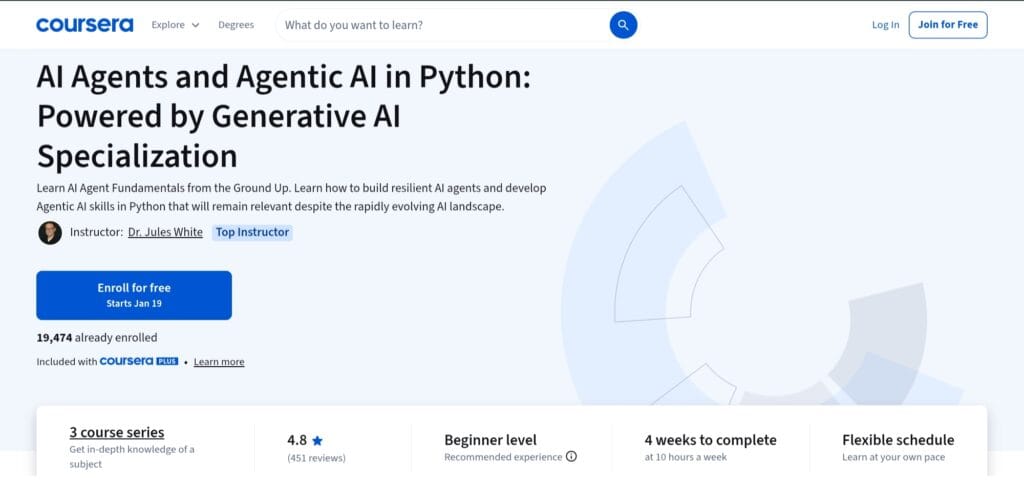
The AI Agents and Agentic AI in Python: Powered by Generative AI Specialization is a highly practical, technically oriented program that bridges agent-based architectures with modern generative AI workflows.
This specialization teaches students how to create, develop, and implement intelligent agents that use generative models to carry out challenging tasks. It is situated at the nexus of autonomous systems and large-language models.
It focuses on conceptual clarity and practical implementation abilities that mirror current industry demands in automation, AI orchestration, and adaptive behavior design, with a focus on Python and project-based modules.
What You Will Learn
- Python techniques for constructing and managing autonomous AI agents
- Integration of generative models (such as LLMs) into agent decision loops
- Strategies for environment interaction, task planning, and feedback loops
- Debugging, evaluating, and optimizing agentic AI systems in realistic scenarios
- Architectural patterns for agent frameworks suitable for automation and service tasks
Who This Course Is For
For students who wish to focus on intelligent agent design using generative AI and have a basic understanding of Python and machine learning, this specialization is perfect.
It is especially suitable for engineers, software developers, AI researchers, and robotics enthusiasts who want to create adaptive systems that can communicate with environments, users, or APIs on their own.
Pros
- Strong focus on practical Python workflows and agent implementation
- Relevant to cutting-edge trends in agentic AI and automation
- Hands-on projects that build demonstrable skills for portfolios
- Applicable to domains like autonomous tools, productivity agents, and task orchestration
Cons
- Less emphasis on broader AI fundamentals outside agentic and generative contexts
Read Also: Best Python Courses Online
FAQ – Best AI Courses Online
Are online AI courses worth it?
Online AI courses that provide structured instruction, practical projects, and accredited certifications are worthwhile. Many programs are relevant to actual job tasks because they are created by industry leaders like Google, IBM, and Microsoft. Selecting a course that fits your objectives rather than just popularity is crucial.
Do AI courses require coding?
Not every AI course calls for coding. Programming is frequently avoided in beginning and business-focused courses in favor of principles, applications, and strategy. However, Python and simple math are typically needed for technical AI and engineering programs. Students can progressively transition from non-technical to coding-based AI courses.
Can I get a job after learning AI?
Job chances can be greatly enhanced by learning AI, but outcomes depend on the application and the depth of competence. Courses with projects, useful tools, and deployment skills are more focused on the workplace. AI jobs frequently call for complementary abilities like problem-solving, data handling, and Python. It is advisable to think of AI courses as career accelerators rather than immediate employment guarantees.
Is AI harder than machine learning?
While machine learning is a subset of AI that focuses on algorithms and data-driven learning, AI is a larger field. AI is simpler to comprehend conceptually at a high level. Math, statistics, and coding make machine learning more difficult. Before focusing on machine learning, many students begin with the foundations of AI.
Can non-technical students learn AI?
Yes, concept-driven and application-focused courses can help non-technical students master AI. A lot of AI programs are made for professionals in management, business, and creativity. In order to enable non-technical learners to collaborate with AI-driven teams and technologies with confidence, these courses place a strong emphasis on comprehending AI capabilities, limits, and use cases.
Final Verdict
Choosing the right AI course depends far more on your background and career objective than on course popularity.
If you are a beginner or non-technical professional, concept-driven programs like AI For Everyone or Google AI Essentials provide clarity without overwhelming complexity.
For learners targeting technical roles, professional certificates from IBM or Microsoft offer hands-on depth, real projects, and job-aligned skills.
Those aiming to work with cutting-edge systems should look toward agent-based or generative AI specializations.
Share Now

More Articles
Best Machine Learning Courses online
Soft Skills for Software Engineers: Beyond Coding and Debugging
5 Real-World Machine Learning Use Cases That Boost Revenue

As an engineer with a passion for learning and sharing knowledge, I created CourseKart.online to help students, professionals, and lifelong learners choose the best online courses. With so many options available, finding the right one can be overwhelming. My goal is to simplify that process by offering insights, reviews, and recommendations on the top online learning resources. I hope my posts inspire you to keep growing, learning, and exploring new opportunities.
Discover more from coursekart.online
Subscribe to get the latest posts sent to your email.