
Last updated on May 7th, 2026 at 06:26 pm
These days, machine learning is not just a specialized ability for PhDs or researchers. It is a fundamental aspect of commonplace products now, such as fraud detection, self-driving features, generative AI tools, Netflix suggestions, and Google search results.
Professionals with machine learning expertise are in greater demand as businesses across all sectors depend increasingly on data-driven choices.
The best machine learning courses online that provide useful skills, real-world context, and career worth are therefore actively sought after by students today.
This guide is intended for developers who wish to go beyond basic Python into applied machine learning, professionals who want to upskill or change careers, and beginners who want a clear starting point.
This post will assist you in sorting through the hundreds of courses that promise unattainable results.
This list is unique because it is experience-based rather than promotional. The way the courses are taught, how well they prepare you for actual use cases, and whether or not they value your time and effort as a student are all taken into consideration when evaluating them.
By the end of this article, you will have a clear understanding of these machine learning courses and choose the right course as per your current learning level (beginner, intermediate, or advanced).
List of the Best Machine Learning Courses Online
Some of the most reputable online machine learning courses currently offered are reviewed in-depth and based on my research. I hope these reviews will assist you in finding the ideal machine learning course.
1. Machine Learning Specialization — Coursera (Andrew Ng & DeepLearning.AI)
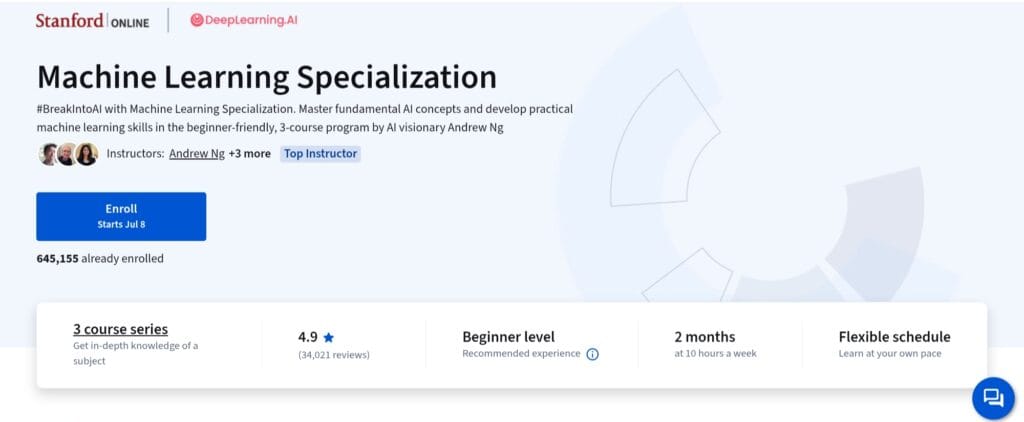
Developed by Andrew Ng in partnership with DeepLearning.AI and Stanford Online, the Machine Learning Specialization on Coursera is one of the most popular online machine learning courses.
It is designed for students who want a strong foundation in contemporary machine learning with real code and real applications, especially if they’re getting ready to change careers or are taking their first significant step into the field.
What you will learn
Instead of concentrating only on abstract theory, this specialization emphasizes practical skills you’ll utilize in actual machine learning work.
By the end, you will be proficient in the following skills. These are precisely the kinds of talents that actual projects and employers require.
- Use scikit-learn, NumPy, and Python to build, train, and assess models.
- Use techniques for supervised learning, such as regression and classification
- For multi-class challenges, use TensorFlow to construct and optimize neural networks.
- Utilize ensemble techniques and decision trees to boost performance.
- For clustering and anomaly identification, use unsupervised learning.
- Construct recommender systems and fundamental deep reinforcement learning models.
Key highlights of this course
- Beginner-friendly but comprehensive
Instead of only watching lectures, it’s designed to help you go from being a coding newbie to a skilled ML practitioner with practical experience.
- 3-course series (~2 months at ~10 hrs/week)
Structured education that is getting more sophisticated, yet is still doable with persistent work.
- Real tools used in industry
TensorFlow, scikit-learn, Python, and real datasets let you become fluent in real-world situations rather than merely concepts.
- Shareable certificate
To show recruiters how skilled you are, include the Coursera credential on your resume or LinkedIn page.
- Taught by Andrew Ng
One of the most reputable names in AI education, providing students with clear explanations of difficult subjects.
Pros
- Incredibly well-structured educational path.
- Combines theory with coding techniques.
- Provides practical skills that you can apply to projects and interviews.
Cons
- Some learners feel the pace requires discipline, as it requires a commitment of 2 months.
For students seeking a comprehensive, project-based machine learning course with a certificate that equips them for practical challenges and foundational positions in data science and artificial intelligence, Andrew Ng’s Machine Learning Specialization is the ideal choice.
Read Also: Machine Learning Specialization by Andrew Ng Full Review
2. Machine Learning with Python — Coursera (IBM)
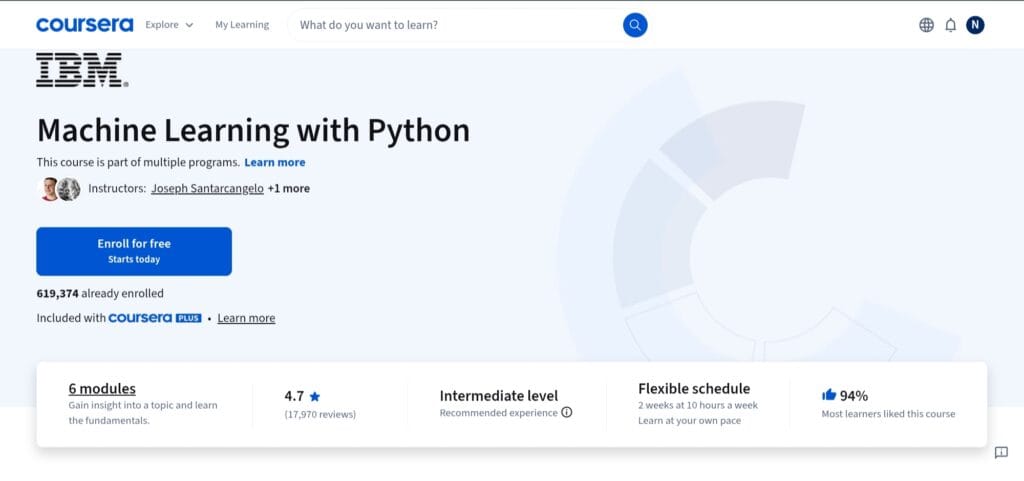
The IBM Machine Learning with Python course on Coursera is a great option if you are already familiar with Python and want to use that knowledge directly to solve actual machine learning issues.
It stands out as a useful, practical introduction designed for students who want systematic advice on creating and assessing models in Python but are beyond the bare fundamentals.
What you will learn
The fundamental practical skills that contemporary ML practitioners employ on a daily basis are the main emphasis of this course.
You will learn how to implement end-to-end machine learning processes that are important in projects or entry-level positions through these hands-on exercises.
- Using Python’s machine learning ecosystem and actual data to build and assess models
- Regression and classification method implementation using scikit-learn
- Using dimensionality reduction and clustering to find patterns without labels
- Using cross-validation, model validation, and optimization methods
- Developing full machine learning solutions, including evaluation and preprocessing
Key highlights
- Hands-on focus
Beyond instructional videos, concepts are reinforced with 15 applied exercises using actual datasets.
- Industry tools
Industry technologies like Python, scikit-learn, feature engineering, and best practices for model evaluation will all be covered.
- Practical projects
Includes a final project where you create and assess models, like a rainfall predictor, to provide you with a concrete addition to your portfolio.
- Shareable certificate
Earn an IBM-branded certification you can add to your LinkedIn or résumé.
- Flexible pacing
Designed to be finished in around 2 weeks at ~10 hours each week, although you can work at your own pace.
Pros
- Extremely useful and project-focused; ideal if you want to immediately implement machine learning with Python.
- You can gain confidence using tools like scikit-learn with its real dataset labs.
Cons
- Beginners first need to study Python to join this course.
It is ideal for students looking for a machine learning course with credentials that prioritize practical Python skills and experience over theoretical concepts.
Read Also: Machine Learning with Python Course Full Review
3. Mathematics for Machine Learning Specialization — Coursera (Imperial College London)
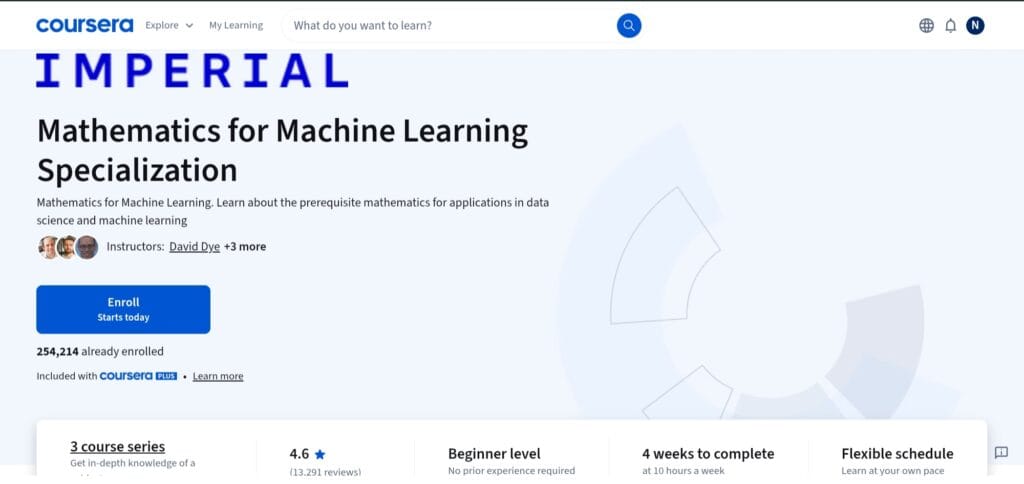
This specialization focuses on comprehending the math that underpins machine learning rather than creating models first.
This is one of the best foundational machine learning courses online if you’ve ever been perplexed by gradients, vectors, eigenvalues, or the reasons why certain algorithms act in a certain manner.
It is perfect for those who wish to gain a deeper understanding of machine learning techniques before delving into complex models or extensive coding.
What you will learn
This specialization gives you practical mathematical fluency that directly helps real machine learning tasks. These are the kinds of abilities that facilitate debugging, creativity, and reasoning about machine learning models outside of “black box” usage.
- Using linear algebra to analyze and modify data (projections, matrices, and vectors)
- Understanding multivariable mathematics and optimization in the context of algorithm training
- To manage high-dimensional datasets, use dimensionality reduction methods like PCA
- How to use Python notebooks to apply these mathematical techniques to actual machine learning situations
- Self-assurance in analyzing and modifying algorithms, as opposed to only using libraries
Key highlights
- 3-course structured path
Linear Algebra, Calculus, and PCA all build upon one another with ever greater sophistication while remaining accessible to beginners.
- Real Python practice
NumPy and Jupyter notebooks allow you to apply mathematical ideas to actual datasets rather than just theory on paper.
- Flexible pacing
Designed for around 10 hours per week (takes 4 weeks to complete) and self-paced study.
- Shareable certificate
Get a Coursera credential from Imperial College London to demonstrate your proficiency in mathematical concepts of machine learning.
- Highly rated by learners
Good reviews highlight the course’s ability to bridge the gap between applied machine learning and academic mathematics.
Pros
- Great for elucidating the rationale behind fundamental machine learning ideas; it develops intuition that facilitates subsequent courses and practical projects.
Cons
- The course does include light coding but doesn’t offer job-related training.
Enroll in this course if you’re looking for a math-focused machine learning course that will help you grasp advanced ML concepts with confidence.
Read Also: Mathematics for Machine Learning Specialization Full Review
4. IBM Machine Learning Professional Certificate — Coursera
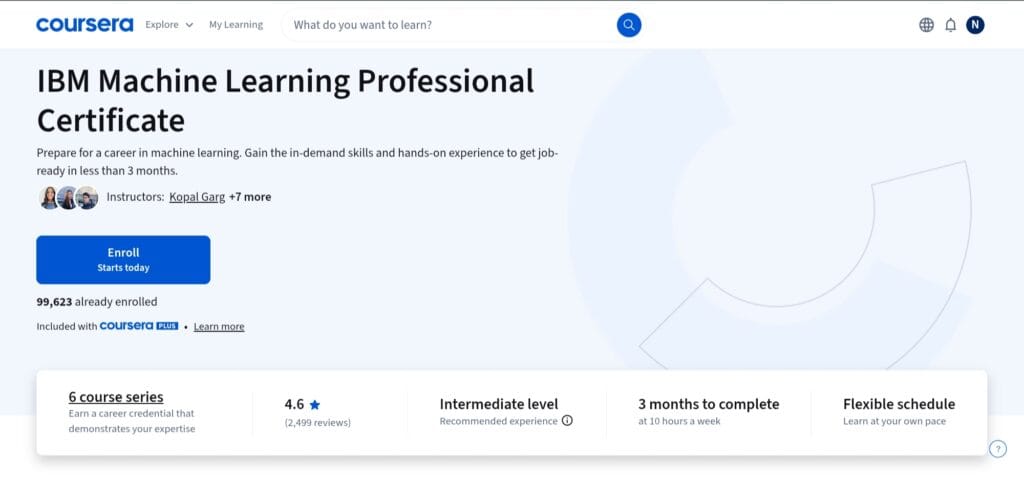
Instead of focusing only on theory, the IBM Machine Learning Professional Certificate on Coursera is a comprehensive credential intended to prepare you for practical machine learning work.
This program is worth your consideration if you’re searching for one of the best machine learning courses online that offers a reputable professional certificate and aids in the development of practical skills in a variety of algorithms and jobs.
It is ideal for students who desire an organized, project-based route to applied machine learning and have some experience with Python and basic statistics.
What you will learn
You will gain practical skills throughout this 6-course professional certificate that are similar to responsibilities frequently found in data science and machine learning positions.
Throughout, you will interact with actual datasets and business-relevant issues; these are not isolated chapters of theory.
- Conduct exploratory data analysis and get actual datasets ready for modeling.
- Create, assess, and contrast supervised learning models for classification and regression
- Utilize dimensionality reduction and unsupervised learning strategies.
- Use the fundamentals of reinforcement learning and neural networks.
- Build recommendation systems with matrix factorization and clustering.
- Finish a capstone project that demonstrates a complete end-to-end solution that satisfies industry standards.
Key highlights
- Professional certificate with industry recognition
After finishing, you receive a shareable IBM-branded certificate that you may use on your resume or LinkedIn page.
- Six integrated courses (~3 months at ~10 hrs/week)
Intended to be taken sequentially so that each builds upon the last, providing you with a seamless learning progression.
- Hands-on projects
A capstone project and many hands-on laboratories help you demonstrate, not simply explain, what you know.
- Widely accessible
You can fit study time around your schedule because it is taught in English with several language subtitle options and adjustable pacing.
- Tools and libraries
Real analytical workflows, visualization tools, scikit-learn, and Python provide you with abilities that are immediately applicable to real-world applications.
Pros
- Includes projects that help you create a portfolio that you can present to potential employers and covers a wide spectrum of machine learning techniques with practical application.
- A reliable certificate that attests to your abilities is also included.
Cons
- Absolute beginners may have difficulty in this course as it requires basic Python understanding.
Ideal for students looking for a career-focused machine learning course with a certificate that combines real-world projects with a fundamental understanding, especially if you intend to present your work to recruiters as part of a machine learning portfolio.
Read Also: IBM Machine Learning Professional Certificate Full Review
5. Machine Learning Specialization — Coursera (University of Washington)
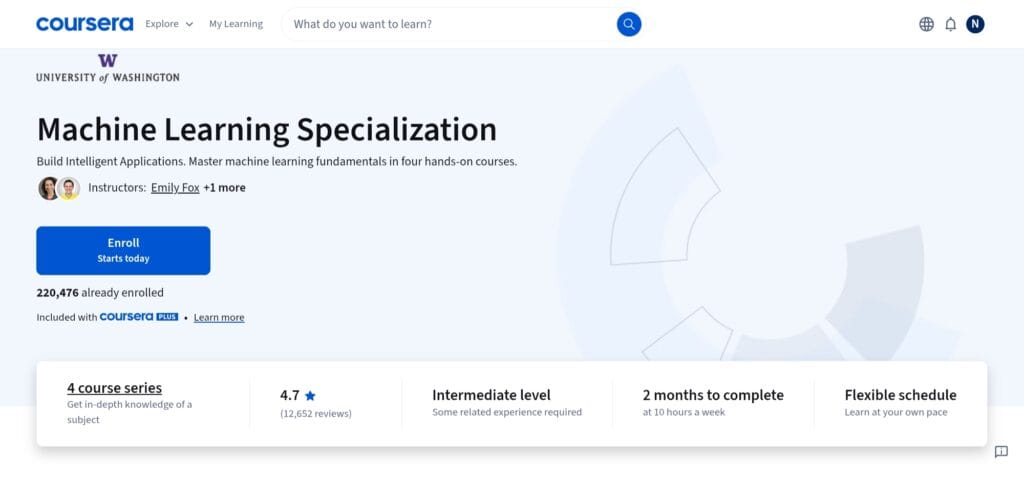
The University of Washington’s Machine Learning Specialization on Coursera is a well-organized, project-focused curriculum for students who wish to advance beyond beginning tutorials and have some prior experience with math and programming.
When you want to discover how learning systems address various corporate, scientific, and technological problems and develop practical skills using real datasets, this course ranks among the best machine learning courses online.
What you will learn
This specialization helps you use machine learning techniques end-to-end in a variety of real-world contexts, as opposed to merely teaching discrete concepts. Employers and project work truly depend on these practical skills.
- Recognize the steps involved in machine learning workflows, from model review to data intake.
- Create classification and prediction models with Python and standard ML tools.
- Utilize similarity metrics, information retrieval, and clustering for unstructured data.
- Adjust models for efficiency and contextualize the findings.
- To improve pattern extraction, apply dimensionality reduction and feature engineering.
- Comfortably incorporate machine learning into more extensive analytical pipelines.
Key highlights
- Comprehensive applied focus
Throughout a four-course series, you will apply algorithms to practical applications like retrieval, clustering, and prediction.
- Learner-friendly pacing
It takes two months to finish and is intended for roughly ten hours each week. You may study at your own pace thanks to the modular sessions.
- Diverse use cases
This course reflects the range of problems a machine learning practitioner encounters, including regression, clustering, and even elements of computer vision and text mining.
- Shareable certificate
Obtain a certificate upon completion to showcase your accomplishment on your resume or LinkedIn page.
- Offered by a reputable institution
The curriculum was created by researchers at University of Washington and is supported by real-world case studies and academic analysis.
Pros
- Outstanding theory-practice balance, with a distinct emphasis on using machine learning in practical applications as opposed to merely abstract explanations.
- Understanding is strengthened by the project-based assignments.
Cons
- It is geared toward intermediate learners; those who are new to programming or math may discover that they need a little more background before beginning.
Perfect for students looking for a hands-on, certificate-granting machine learning course that teaches them how to apply ML techniques in a variety of applications and gets them ready for mid-level positions in analytics and data-driven organizations.
Read Also: Machine Learning Specialization by University of Washington
6. Fundamentals of Machine Learning and Artificial Intelligence — Coursera (AWS)
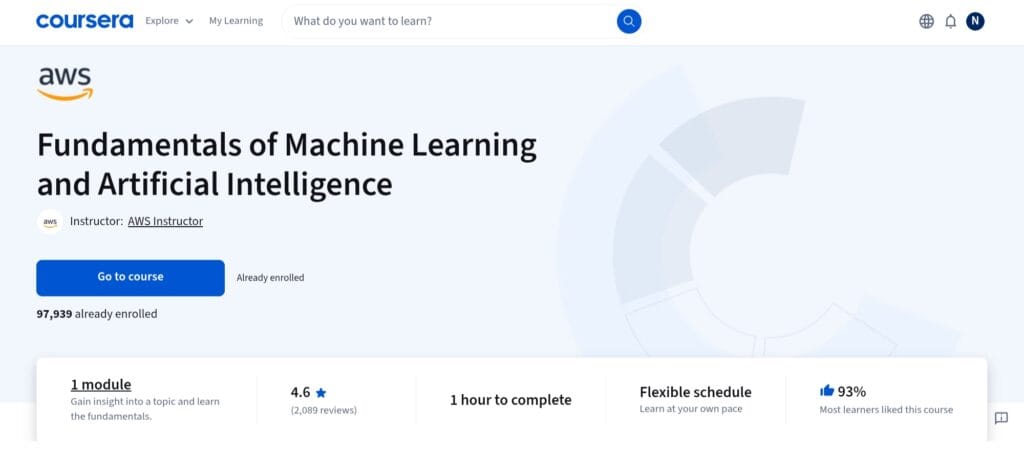
The Coursera course Fundamentals of Machine Learning and Artificial Intelligence by Amazon Web Services (AWS) is a wonderful place to start if you’re new to machine learning and want a brief, gentle introduction that demystifies fundamental concepts without going into too much depth.
For students who wish to learn about machine learning and artificial intelligence (AI) and how they integrate into actual technological stacks before moving on to more advanced courses, this is one of the best beginner-friendly machine learning courses available online.
What you will learn
This course focuses on providing you with a useful conceptual foundation that explains ML and AI topics rather than heavy code or complicated arithmetic.
This kind of information is helpful if you want to speak intelligently about AI/ML in meetings, interviews, or projects, or if you intend to take advanced courses in the future.
- What AI and machine learning really do in practical applications.
- The relationships between deep learning, AI, and ML.
- The definition of current generative AI and its applications.
- How ML services are integrated by AWS into practical business solutions.
- The application of AI/ML from a broad perspective, as opposed to specific engineering expertise.
Key highlights
- Very short and focused
About 1 hour of learning with a flexible schedule, ideal for busy learners.
- High learner rating
About 4.6 out of 5, with very positive comments on usefulness and clarity.
- Big-picture perspective
Explains how ML and AI, especially generative AI and AWS services, integrate into today’s technological environments.
- One assignment
A quick reflection quiz helps reinforce your understanding without heavy pressure.
- Shareable certificate
Obtain a certificate that you can use on your resume or LinkedIn page.
Pros
- Quick, easy to understand, and ideal for complete novices who wish to begin learning AI and machine learning without knowing any code.
- It is simple to finish quickly because of its brief duration.
Cons
- Because the course is so brief and high-level, it doesn’t teach practical skills or hands-on coding that employers look for in job roles.
Best for students looking for a beginner-friendly overview of machine learning and artificial intelligence that will provide the groundwork for more advanced, hands-on courses.
Read Also: Fundamentals of Machine Learning and Artificial Intelligence Full Review
7. MLOps | Machine Learning Operations Specialization — Coursera (Duke University)
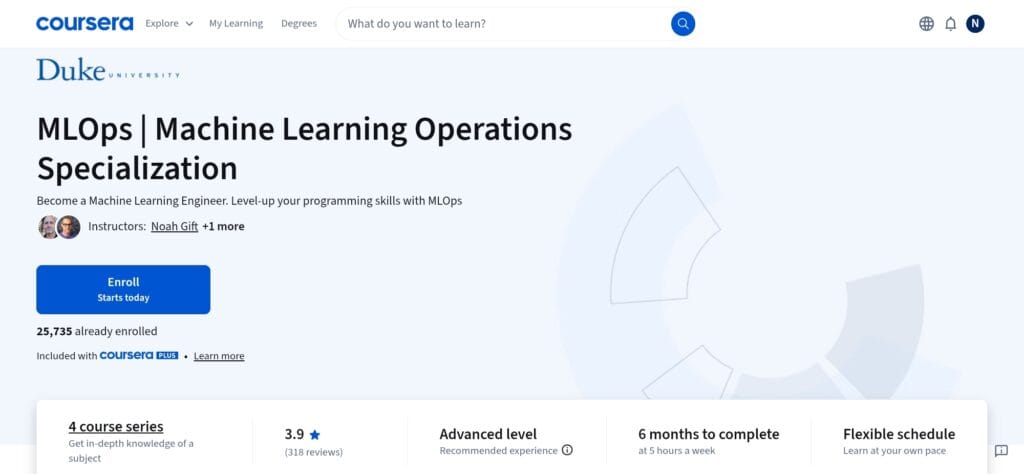
If you want to learn how to deploy, manage, and operationalize machine learning models in real-world settings, the Duke University MLOps | Machine Learning Operations Specialization on Coursera is one of the more practical programs in the machine learning ecosystem.
While this is not a standard machine learning course, it is extremely useful if you want to work as an ML Engineer, MLOps Engineer, or Cloud AI Specialist where ML models must run consistently in production.
What you will learn
This specialization gives you interdisciplinary abilities that connect cloud and DevOps technologies with machine learning, a crucial distinction in production settings.
Machine learning engineers who operate in production settings need to have these abilities.
- Create and implement end-to-end machine learning pipelines that transfer models from testing to production.
- To scale and host models, use cloud platforms like AWS SageMaker and Azure ML.
- To automate processes, use tools like Hugging Face, Docker, MLflow, and CI/CD systems.
- Use best practices for model tracking, data management, and lifecycle monitoring.
- Recognize model versioning, deployment tactics, and API delivery for practical applications.
Key highlights
- Advanced, career-oriented structure
A four-course program with an emphasis on practical skills rather than just theory, intended to take about six months at about five hours per week.
- Hands-on with real tools
Workflow automation, model deployment tooling, and the practical application of cloud services are all covered in courses that closely relate to industrial operations.
- Shareable certificate
Obtain a Coursera specialized certificate from Duke University to include on your resume or LinkedIn page.
- Real workflows
You gain expertise in pipeline orchestration, cloud deployment, continuous deployment, and environment automation, all of which are tasks associated with production machine learning teams.
Pros
- Traditional courses frequently lack the practical insights into machine learning processes that this specialization offers.
- In contemporary ML engineering roles, the focus on automation, cloud deployments, and pipeline planning is immediately applicable.
Cons
- It assumes existing Python, DevOps, and ML foundations (not ideal for total beginners).
Excellent for students who already grasp the fundamentals of machine learning and wish to specialize in operationalizing models, particularly if your project or career calls for the deployment and upkeep of ML systems in production.
Read Also: Machine Learning Operations Specialization Full Review
8. Applied Machine Learning in Python — Coursera (University of Michigan)
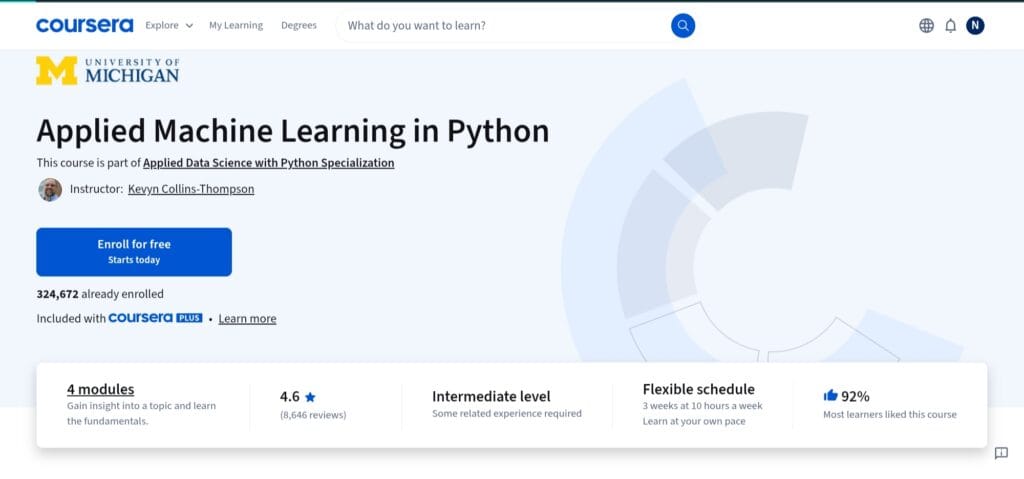
The University of Michigan’s Applied Machine Learning in Python course on Coursera is a useful, intermediate-level machine learning course that is perfect for students who wish to advance into real ML workflows and have a basic understanding of Python.
It is part of the Applied Data Science with Python series and stands out as one of the best machine learning courses online for acquiring abilities that bridge basic tutorials and real-world projects.
What you will learn
This course aids in the development of the applicable skills most frequently required for ML activities in the real world.
By the end, you will be able to create functional Python scripts that apply these methods to datasets and generate insights that can be put to use.
- Determine when and how to use supervised learning techniques (regression and classification).
- Create unsupervised learning techniques like feature extraction and grouping.
- Create features and assess models with scikit-learn and Python.
- Recognize overfitting, validation techniques, and model generalizability.
- Analyze sophisticated techniques like random forests and ensemble methods, as well as model performance indicators.
Key highlights
- Applied focus
Instead of only using lecture slides, the focus is on applying machine learning techniques to address actual problems.
- Scikit-learn toolkit
You’ll have direct access to one of the most popular machine learning libraries in the business.
- Portfolio-ready tasks
Projects include using clustering and creating prediction models, which are excellent for giving employers real-world examples.
- Intermediate pacing
Roughly 3 weeks at ~10 hours per week, allowing you to learn without overload.
- Shareable certificate
Earn a Coursera certificate that you can add to your LinkedIn profile or resume.
Pros
- Focused on practical methods of machine learning with code and lucid explanations; excellent transition from introductory courses to more complex ML responsibilities.
Cons
- Not a con, but you need prior knowledge of Python for this course.
Read Also: Applied Machine Learning in Python
9. Machine Learning Foundations for Product Managers — Coursera (Duke University)
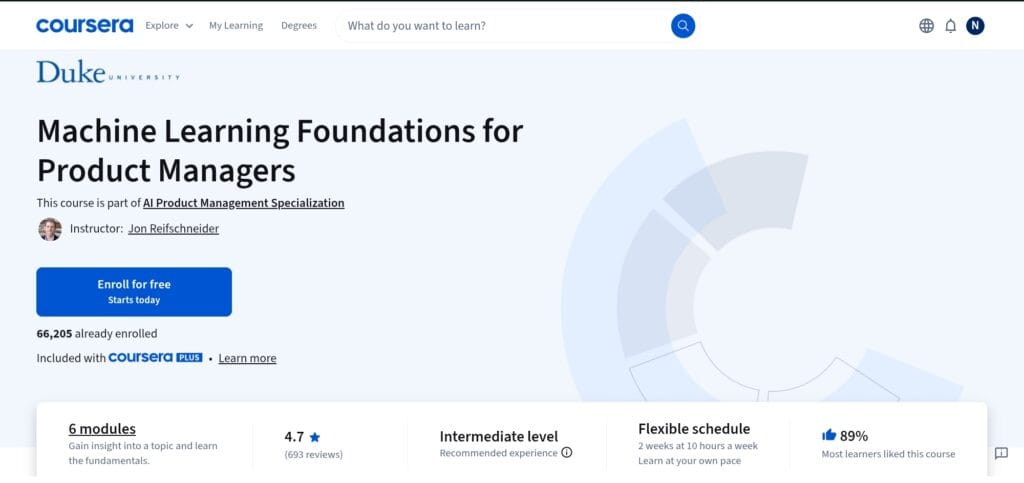
The Coursera course Machine Learning Foundations for Product Managers is designed for students who wish to comprehend machine learning from a product and strategy standpoint instead of as engineers creating models on a daily basis.
If your job requires you to collaborate with data science teams, define ML product needs, or create AI-driven solutions, this is one of the best machine learning courses online.
Product managers, project managers, and technical decision-makers who require a basic understanding of machine learning without heavy coding will find it ideal.
What you will learn
This course emphasizes conceptual fluency and practical application of machine learning concepts that are important in product contexts rather than extensive programming.
These are the abilities that enable you to make well-informed ML-related product decisions and interact with developers in an efficient manner.
- The function of machine learning and its constraints in contemporary goods
- How to approach modeling from data to trained models
- How to assess and analyze models with actual decision metrics
- Useful intuition for both supervised and unsupervised methods (trees, grouping)
- How to formulate and evaluate applications of deep learning in language and vision problems
- Applying the modeling process to an actual dataset for a project-based capstone
Key highlights
- Balanced conceptual depth
ML is easy for non-engineers to understand because it doesn’t require a lot of coding expertise.
- 6 engaging modules (~2 weeks)
Designed to be digestible yet thorough in 10 hours per week of study.
- Hands-on project
You can put what you’ve learned to use and observe how modeling choices impact results in a low-barrier real scenario.
- Broad applicability
Covers important concepts like model assessment, trees, regression, clustering, and the fundamentals of deep learning, allowing you to effectively contribute to product strategy conversations.
- Shareable certificate
Earn a Coursera certificate that you can showcase on LinkedIn or your professional portfolio.
Pros
- Excellent for non-technical individuals who need to learn about machine learning, its applications, and how to work with technical teams.
- Reviewers observe that the pace is reasonable and the explanations are understandable.
Cons
- A few learners felt some advanced topics (like deep learning) moved faster than expected.
Read Also: Machine Learning Foundations for Product Managers Full Review
10. Machine Learning with Apache Spark — Coursera (IBM Skills Network)
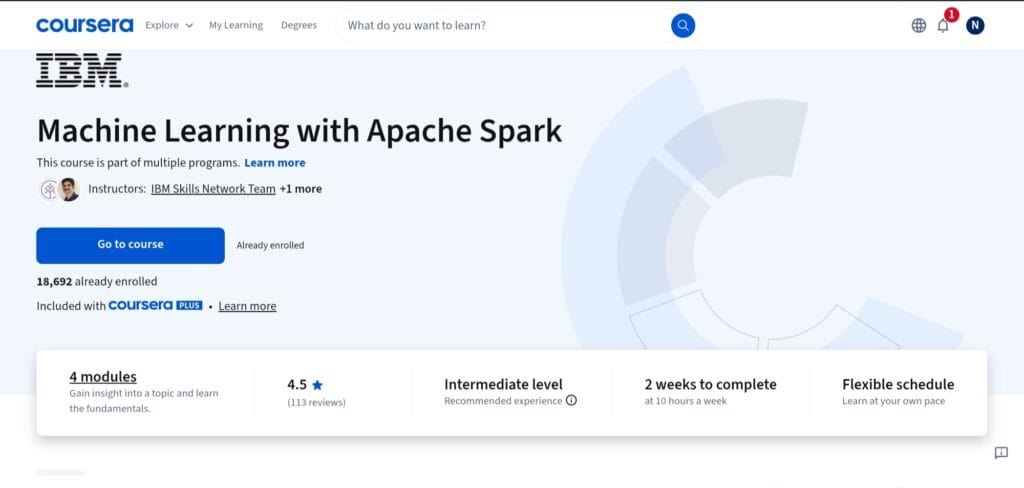
The Machine Learning with Apache Spark course on Coursera explains how models and data pipelines function when data volumes are big for students who wish to tackle machine learning at scale rather than only on tiny, in-memory datasets.
If you want to integrate machine learning (ML) with big data technologies and real-world engineering workflows, this is one of the best machine learning courses online.
This is especially true for positions where Spark and distributed processing are essential competencies (such as data engineering or ML engineering).
What you will learn
In contrast to entry-level ML courses, this course focuses on applied, big data-ready machine learning techniques.
These are useful skills that are important if you want to work with business systems or big datasets that go beyond the “local notebook” scale.
- How data engineering pipelines incorporate machine learning and why Spark is important in such a setting
- Analyzing models and contrasting methods like grouping, classification, and regression at scale
- Building machine learning workflows using SparkML that include model persistence, feature extraction, and transformation
- Managing huge datasets with distributed data processing techniques with Spark SQL
- Establishing a reliable connection to Spark clusters and coordinating machine learning operations in dispersed environments
Key highlights
- Intermediate focus
Designed to be completed in ~2 weeks at ~10 hours/week — digestible but packed with real workflows.
- Hands-on labs & final project
A project where you apply Spark ML to a situation akin to actual data engineering activities is preceded by a number of assignments.
- Practical tool exposure
Anticipate learning about SparkSQL, SparkML pipelines, PySpark, data transformation, and model lifecycle management techniques.
- Shareable certificate
You can earn a Coursera completion certificate to add to your LinkedIn or résumé.
Pros
- Combining data engineering and machine learning workflows with distributed processing technologies is a unique way to get started with machine learning and a useful differentiation for analytics positions in larger companies.
Cons
- Some learners note that Spark’s distributed context adds complexity that may feel abstract without deeper systems experience.
Read Also: Machine Learning with Apache Spark Courses Full Review
Which Machine Learning Course Should You Choose?
Selecting the best machine learning course can be more difficult than actually learning machine learning because there are so many excellent possibilities.
The secret is to fit the course to your time commitment, job objective, and present skill level. Here is concise, persona-based advice to help you make a decision with confidence and speed.
If you are a complete beginner
Choose: Machine Learning Specialization – Andrew Ng (Coursera)
This is one of the greatest ML courses for beginners if you’re just beginning out and want a methodical, self-assurance-boosting path.
It emphasizes developing intuition before complexity, provides straightforward explanations of topics, and integrates Python-based workflows progressively.
You won’t feel hurried, and by the time it’s all over, you’ll know how machine learning really functions.
If you want a job-oriented path
Choose: IBM Machine Learning Professional Certificate (Coursera)
This program is intended to help you achieve employability rather than just theory. It places a strong emphasis on practical projects, actual datasets, and an end-to-end capstone that you may present during interviews.
If you’re looking for a job in data science or machine learning and want something that recruiters will recognize, this is a good option.
If you already know Python
Choose: Applied Machine Learning in Python – University of Michigan (Coursera)
You don’t have to start from scratch if you know how to use Python and handle simple data. This course focuses on utilizing scikit-learn to apply machine learning techniques, eschewing the fluff.
For students who wish to transition from tutorials to actual machine learning problem-solving, it is perfect.
If you want a recognized certificate
Choose: Machine Learning Specialization (Andrew Ng) or IBM Machine Learning Professional Certificate
When it comes to career flipping, internal job transfers, or LinkedIn, these two stand out as machine learning courses with certificates that businesses genuinely respect.
Strong foundational knowledge is indicated by Andrew Ng’s specialization, whereas IBM’s certificate indicates practical, employable abilities.
If you are a working professional
Choose: MLOps | Machine Learning Operations – Duke University (Coursera)
This is the best option if you already work in technology, data, or engineering and want to learn how machine learning models are implemented, tracked, and maintained in actual systems.
Instead of beginning with theory, it emphasizes cloud platforms, production procedures, and operational thinking.
FAQs – Best Machine Learning Courses Online
What is the best machine learning course for beginners?
The ideal choice for novices is a course that progressively introduces coding while providing clear explanations of subjects.
Andrew Ng’s Machine Learning Specialization on Coursera is frequently suggested as beginner friendly because it emphasizes developing intuition, employs real-world examples, and does not require prior machine learning experience.
It provides an organized route that enables newcomers to advance with assurance.
Are online machine learning certificates worth it?
When they are offered by reputable organizations or platforms and are backed by practical projects, online machine learning certifications are worthwhile. Certificates are valued by employers as evidence of organized education, but they are most significant when paired with genuine projects and practical skills.
Is machine learning hard for non-programmers?
For non-programmers, machine learning may initially seem difficult, but it is not unachievable. Many courses designed for beginners begin with basic Python and go over concepts step-by-step. Non-programmers can learn machine learning with consistent practice and perseverance, particularly if they prioritize comprehending logic over learning code.
Do I need strong math skills to learn machine learning?
To begin using machine learning, advanced math knowledge is not necessary. For the majority of beginning and intermediate courses, a basic grasp of algebra, probability, and statistics is sufficient. Math shouldn’t deter you from beginning, but it will eventually help you comprehend models better if you master some linear algebra and calculus.
Can I learn machine learning without a computer science background?
Without a degree in computer science, many students are able to study machine learning. Graduates in business, engineering, and science are among the many backgrounds that might benefit from online courses. Your willingness to practice, create projects, and comprehend how machine learning addresses actual issues is more important than your degree.
Is machine learning still a good career choice in 2026?
In 2026, machine learning is still a popular job choice. Businesses are still investing in automation, AI technologies, and data-driven systems. Professionals with real-world experience are still in great demand in sectors, including technology, finance, healthcare, and e-commerce, despite growing competition.
Conclusion
Selecting the finest online machine learning course is more about matching the course to your existing abilities, objectives, and time commitment than it is about following the most well-known name.
Since machine learning is a vast area, no single course can cover it all at once. The most intelligent learners begin with a solid foundation, get real-world experience, and then progressively specialize.
If you are a beginner, focus on clarity and structure before speed. If your goal is career growth or a job switch, prioritize courses that offer hands-on projects and a recognized certificate.
And if you are already working in tech, learning how machine learning is applied, deployed, and maintained in real systems will give you a long-term edge.
Start with the course that fits you best today, commit to it fully, and let your progress guide the next step.
More Articles
Roadmap to Become A Data Scientist In 6 Months (Step-by-Step Guide)
AutoML vs Manual ML: Which One Delivers Better Results (and When)?
Top 10 Advanced Data Science Courses On Coursera For Experienced Professionals
Best Deep Learning Courses Online [Beginner to Advanced]
Natural Language Processing Explained: How NLP Powers ChatGPT and Modern AI

As an engineer with a passion for learning and sharing knowledge, I created CourseKart.online to help students, professionals, and lifelong learners choose the best online courses. With so many options available, finding the right one can be overwhelming. My goal is to simplify that process by offering insights, reviews, and recommendations on the top online learning resources. I hope my posts inspire you to keep growing, learning, and exploring new opportunities.
Discover more from coursekart.online
Subscribe to get the latest posts sent to your email.