
Last updated on February 10th, 2026 at 10:36 am
Today’s tech-driven world relies heavily on machine learning, which is no longer a specialized expertise. Many of the apps and tools we use on a daily basis are powered by machine learning (ML), from Netflix’s recommendation systems to banks’ fraud detection systems.
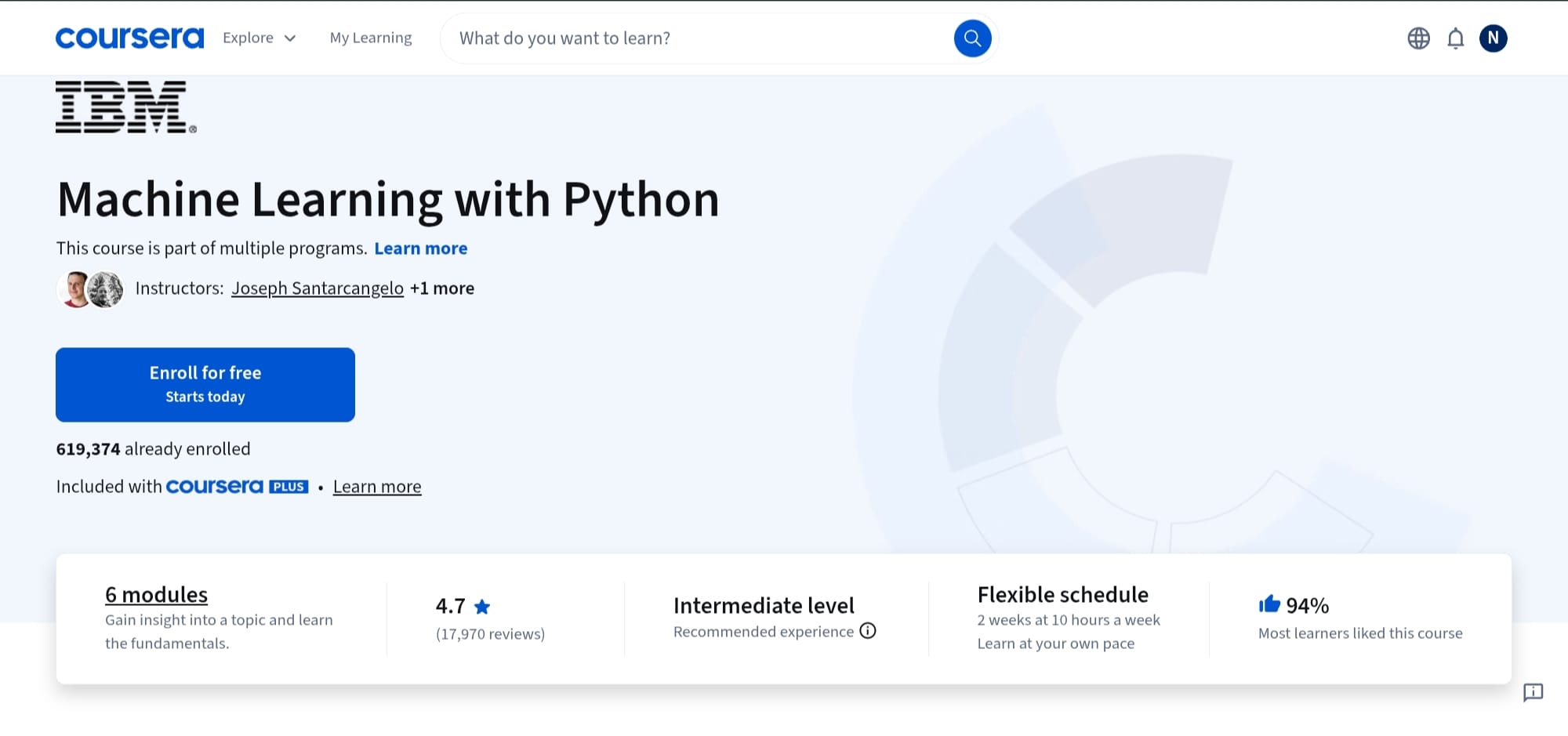
The IBM Machine Learning with Python course on Coursera is one of the most useful places to start if you’ve wanted to work in this field but weren’t sure where to begin.
This course is unique because of its straightforward, practical teaching methodology. It focuses on teaching you how machine-learning algorithms operate and how to use Python, rather than overloading you with complicated calculations.
The course provides you with a solid foundation based on practical applications, whether you’re learning to advance your job, go into data science, or create your own machine learning initiatives.
You also receive flexible learning because it’s available on Coursera, including brief videos, interactive labs, graded assignments, and a culminating project where you create an end-to-end machine learning model.
Your LinkedIn profile or CV may benefit from the IBM certificate you obtain upon completion, which lends legitimacy.
What skills will you learn in the Machine learning with Python course?
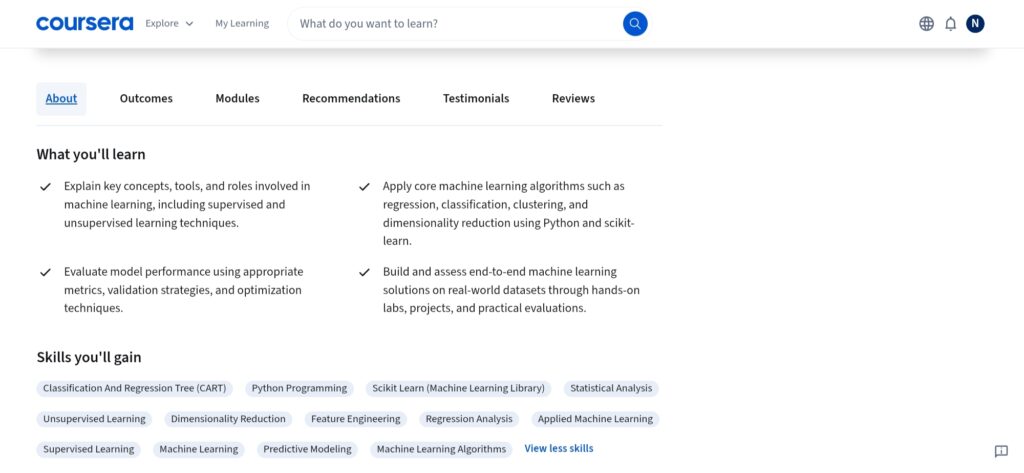
The goal of the Coursera course Machine Learning with Python is to equip you with useful, employable abilities that will enable you to comprehend how machine learning functions in the real world.
You will graduate from the course with a strong set of technical and fundamental abilities that you can use right away on actual projects. You will go through the following skills throughout this course.
Building Machine Learning Models from Scratch
You will discover how to use Python and the well-known scikit-learn toolkit to develop machine learning models.
This includes loading datasets, selecting the appropriate algorithm, training the model, and evaluating its precision. For anyone beginning a career in data science or AI, these are critical competencies.
Working with Real-World Datasets
The course teaches you how to use NumPy and Pandas to prepare, clean, and analyze datasets. You will learn how to manage missing values, convert data, and engineer fundamental features—skills that are essential to the success of your model.
Understanding Key Machine Learning Techniques
Regression, classification, and clustering are just a few of the frequently used machine learning techniques you will learn.
Algorithms such as Logistic Regression, Linear Regression, K-Nearest Neighbors, Support Vector Machines, Decision Trees, and K-Means Clustering will be demonstrated to you.
These abilities enable you to identify which approach is most effective for various kinds of issues.
Evaluating Model Performance
You will discover how to use metrics such as accuracy, precision, recall, confusion matrix, and mean squared error to assess the quality of your model. This aids in your decision-making while fine-tuning or enhancing your model.
Visualising Data and Model Results
You’ll learn the fundamentals of data visualization with Matplotlib so you can compare models, plot trends, and recognize patterns in your dataset. When showing your work in interviews or reports, this is useful.
Read Also: How to Visualize Data Like a Pro? Smart Strategies for Clear and Impactful Insights
End-to-End Machine Learning Workflow
You will comprehend every step of an ML project’s lifecycle, including data collection, preprocessing, model training, result evaluation, and deployment or presentation. This enables you to work on tiny machine learning tasks on your own.
Problem-Solving and Practical Thinking
Above all, this course develops your capacity to think like a practitioner of machine learning. You’ll discover how to tackle issues, pick appropriate resources, try out different algorithms, and keep trying until you get the best answer.
What concepts are taught in this course?
The Coursera course Machine Learning with Python covers all the key ideas you need to comprehend the principles of machine learning and how it functions in practical applications.
Starting with the fundamentals and working your way up to more complex concepts, the course is designed to progressively increase your understanding. Below is a summary of the main ideas you will discover.
Introduction to Machine Learning
The first part of the course explains what machine learning is, why it’s important, and how it’s utilized in practical situations.
You will discover the definition of machine learning, its various forms (supervised and unsupervised), how machine learning models learn from data, and its practical applications.
Supervised Learning Algorithms
Supervised learning, in which models are trained with labelled data, takes up a significant amount of the course.
You will investigate logistic regression for classification tasks, K-nearest neighbors for pattern matching, Support Vector Machines for high-accuracy classification, Decision Trees for rule-based prediction, and linear regression for continuous value prediction.
You learn not only how these algorithms work, but also when and why to use each one.
Unsupervised Learning Techniques
Additionally, the course exposes you to unsupervised learning, which is employed when there are no labels on your data.
You will learn how to group comparable data points using K-Means clustering, the fundamentals of hierarchical clustering, how algorithms organize data according to patterns, and practical applications such as anomaly detection and customer segmentation.
These ideas enable you to comprehend how machines identify patterns on their own without human assistance.
Data Preprocessing and Feature Engineering
Preparing data for your model to train efficiently is a major component of machine learning. Cleaning datasets, handling missing values, scaling and normalizing data, dividing data into training and testing sets, and developing fundamental features are all covered in this course. These abilities are essential for any ML project.
Evaluation and Model Performance Metrics
It’s critical to know if your model is operating effectively. Evaluation methods, including train-test split, confusion matrix, accuracy, precision, recall, F1-score, mean squared error, cross-validation fundamentals, and ways to prevent overfitting and underfitting, will all be covered.
Data Visualisation Concepts
The course teaches you how to use matplotlib to plot graphs, visualize trends and patterns, and compare various machine learning models to better understand your data and outcomes. When presenting your findings in reports or interviews, visualization is essential.
End-to-End Machine Learning Pipeline
The course culminates in teaching you how to construct a full machine learning workflow, which includes gathering and analyzing data, preprocessing and feature selection, selecting and training your model, assessing and fine-tuning your model, interpreting results, and presenting insights.
This comprehensive understanding gets you ready for actual machine learning tasks.
Final Project for Real-World Learning
You apply all you’ve learnt in a practical project at the end of the course. Using real-world data, you train and assess your own machine-learning model, providing you with hands-on experience that you can highlight in your portfolio.
Read Also: Best Machine Learning Courses online
Who should join this course?
Anyone who wishes to have a solid foundation in machine learning without becoming overwhelmed by complicated arithmetic or sophisticated theory should take the Coursera course Machine Learning with Python.
This course provides a straightforward and useful place to start, whether you’re interested in how intelligent systems operate, how predictions are produced, or how businesses use data to make decisions.
Students who wish to start their careers in data science, artificial intelligence, machine learning, or analytics will benefit greatly from this course.
The course simplifies concepts so that even non-technical students may grasp them, regardless of their subject of study—computer science, engineering, statistics, or anything else.
This course will assist you in taking the next step if you are familiar with basic Python and would like to develop that ability into something more potent.
Professionals in the workforce who intend to change occupations or improve their abilities will also find it ideal. Machine learning can give you a competitive advantage if you work in IT, software development, business analytics, finance, marketing, or operations.
You can learn even if you have a hectic work schedule because the lessons are self-paced. Your LinkedIn profile or resume may benefit from the IBM certificate you receive at the conclusion.
Entrepreneurs and tech enthusiasts who wish to learn how AI-driven products operate will find this course to be equally beneficial. Gaining an understanding of the fundamentals of machine learning can help you create more intelligent projects, automate processes, or use data to create novel solutions.
Put simply, this course is designed for anyone who wants to learn machine learning in a hands-on, practical, and beginner-friendly manner.
Simply be willing to study, practice, and investigate how data might be transformed into meaningful insights; you don’t need to be a math genius.
Will you get a job after completing this course?
Completing the Coursera course Machine Learning with Python is a great way to begin a career in data science or machine learning, but it’s crucial to know what the course can and cannot achieve.
Although this course won’t guarantee a job on its own, it will equip you with the necessary skills and self-assurance to start applying for freelance, internship, and entry-level positions.
This course’s most significant benefit is its practical approach to teaching machine learning. You create actual models, work with datasets, and finish a project that you can present in your portfolio—you don’t just listen to lectures.
Practical skills are highly valued by employers, and this course provides just that. You will have a strong foundation in Python, data processing, and machine learning techniques if you finish all of the assignments and practice frequently. These abilities are frequently needed for entry-level jobs.
However, it typically takes more than one course to get started in a machine-learning job.
The majority of successful students combine this course with extra practice, GitHub portfolios, modest personal projects, and perhaps additional study in fields like data visualization, deep learning, or statistics.
You can confidently apply for the following positions if you take this course seriously and keep developing your abilities.
- Machine Learning Intern
- Data Analyst
- Junior Data Scientist
- AI/ML Assistant
- Python Developer (with ML exposure)
Additionally, the IBM certificate you obtain enhances the legitimacy of your resume, particularly for recent graduates and career changers. It demonstrates that you have finished a structured training program and studied topics that are pertinent to the industry.
How long does this course take to complete?
The Machine Learning with Python course on Coursera is designed to be flexible, so you can complete it at your own pace. On average, most learners finish the course in 2 weeks by spending 10 hours per week.
How much does this course cost?

You can join this course individually or through the Coursera Plus subscription. The individual cost of the course is $49 per month.
However, if you take this course via a Coursera Plus subscription, it will cost you $59 per month. The advantage of this subscription is that it allows you to access 10,000+ courses on Coursera.
Is it worth taking the Machine Learning with Python course on Coursera?
In my opinion, it is worthwhile to enroll in this course, particularly if you’re a student, a professional in your early career, or someone changing careers and wants to learn how to use Python for real machine learning in an organized manner.
It helps you establish a foundation, gives you something legitimate to include on your CV, and offers good value for the effort.
Setting reasonable expectations is crucial, though. Think of it as the beginning, not the end, of your ML journey.
After finishing it, take some time to put what you’ve learned into practice by creating your own projects, contributing to open-source projects, showcasing your work on GitHub and LinkedIn, and learning new skills.
Share Now

More Articles
Data Science Courses On Coursera To Help Land Your First Job
Advanced Data Science Courses On Coursera For Experienced Professionals
AutoML vs Manual ML: Which One Delivers Better Results (and When)?

As an engineer with a passion for learning and sharing knowledge, I created CourseKart.online to help students, professionals, and lifelong learners choose the best online courses. With so many options available, finding the right one can be overwhelming. My goal is to simplify that process by offering insights, reviews, and recommendations on the top online learning resources. I hope my posts inspire you to keep growing, learning, and exploring new opportunities.
Discover more from coursekart.online
Subscribe to get the latest posts sent to your email.