
Building a machine learning model used to require days or even weeks of manual data cleaning, algorithm testing, and parameter adjustment. Every choice was made using intuition and experience in the field of manual machine learning.
In the present day, AutoML (Automated Machine Learning) has emerged as a significant player. AutoML tools are capable of handling data preparation, feature selection, model development, and even optimization with a few clicks.
It is quick, effective, and promises to open up machine learning to other people besides data scientists.
Despite the fact that AutoML makes things simpler, it doesn’t always equate to better. Modern AI development is currently centered on the AutoML vs Manual ML debate.
One side is automation, which democratizes data science and expedites workflows. Traditional, hands-on modeling, on the other hand, offers control and accuracy.
Therefore, the crucial question still stands: Should you rely on AutoML’s automation or maintain the artistry of Manual ML as automation continues to transform the way we create intelligent systems?
In this article, I will discuss AutoML vs Manual ML, the key difference between these technologies, and when to use which one for better results.
What is Manual Machine Learning?
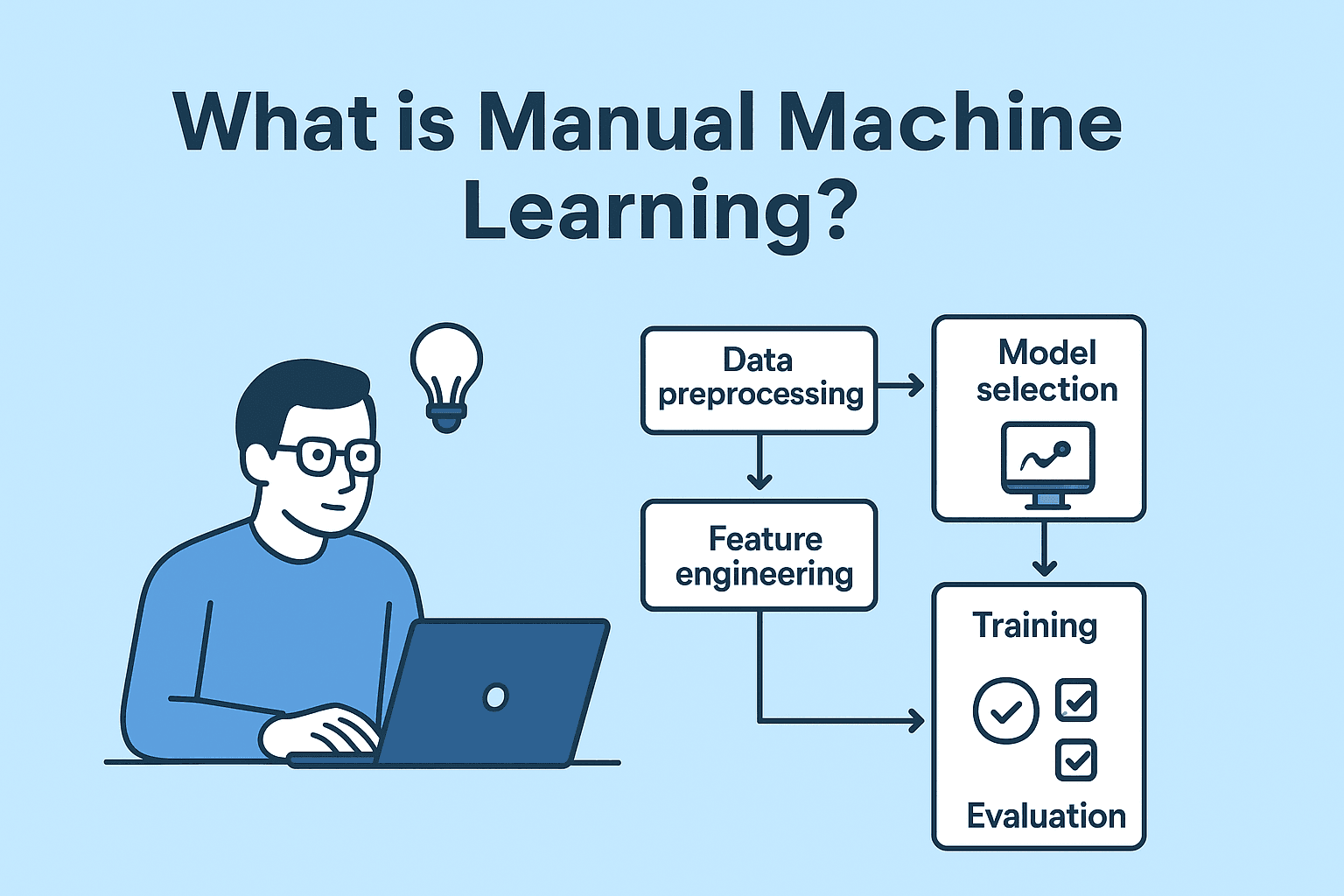
Manual Machine Learning was the cornerstone of all AI projects prior to automation taking center stage, and it still is in many respects.
With this method, data scientists take complete command of the model-building process, basing each choice on their knowledge of the data, algorithms, and the issue at hand.
Typically, the process starts with data preprocessing, which involves cleaning, normalizing, and transforming raw data to guarantee correctness.
Next is feature engineering, which is the imaginative process of choosing or producing the ideal input variables to aid in the model’s learning.
Experts carefully select the algorithm that best suits the situation, whether it be neural networks, random forests, or linear regression, after the data is ready.
The model then undergoes training and evaluation, during which its performance is assessed using metrics such as F1 score, accuracy, and precision.
Lastly, hyperparameter tuning refines the model for more accurate predictions and helps optimize results.
Manual machine learning is a very hands-on and iterative approach because each step calls for technical expertise, trial and error, and intuition.
This method provides data scientists with total transparency and control over the behavior of models and the reasons behind their predictions.
It is particularly helpful in situations that require explainability and accuracy, such as scientific research, financial modeling, or healthcare diagnostics, where knowing the reasoning behind a model’s decisions is just as crucial as knowing what it predicts.
Manual machine learning, or ML, is the artistic side of machine learning. It is slower, to be sure, but it is more insightful, flexible, and trustworthy.
Read Also: The Importance of Data Cleaning and How to Do It Effectively?
What is AutoML (Automated Machine Learning)?
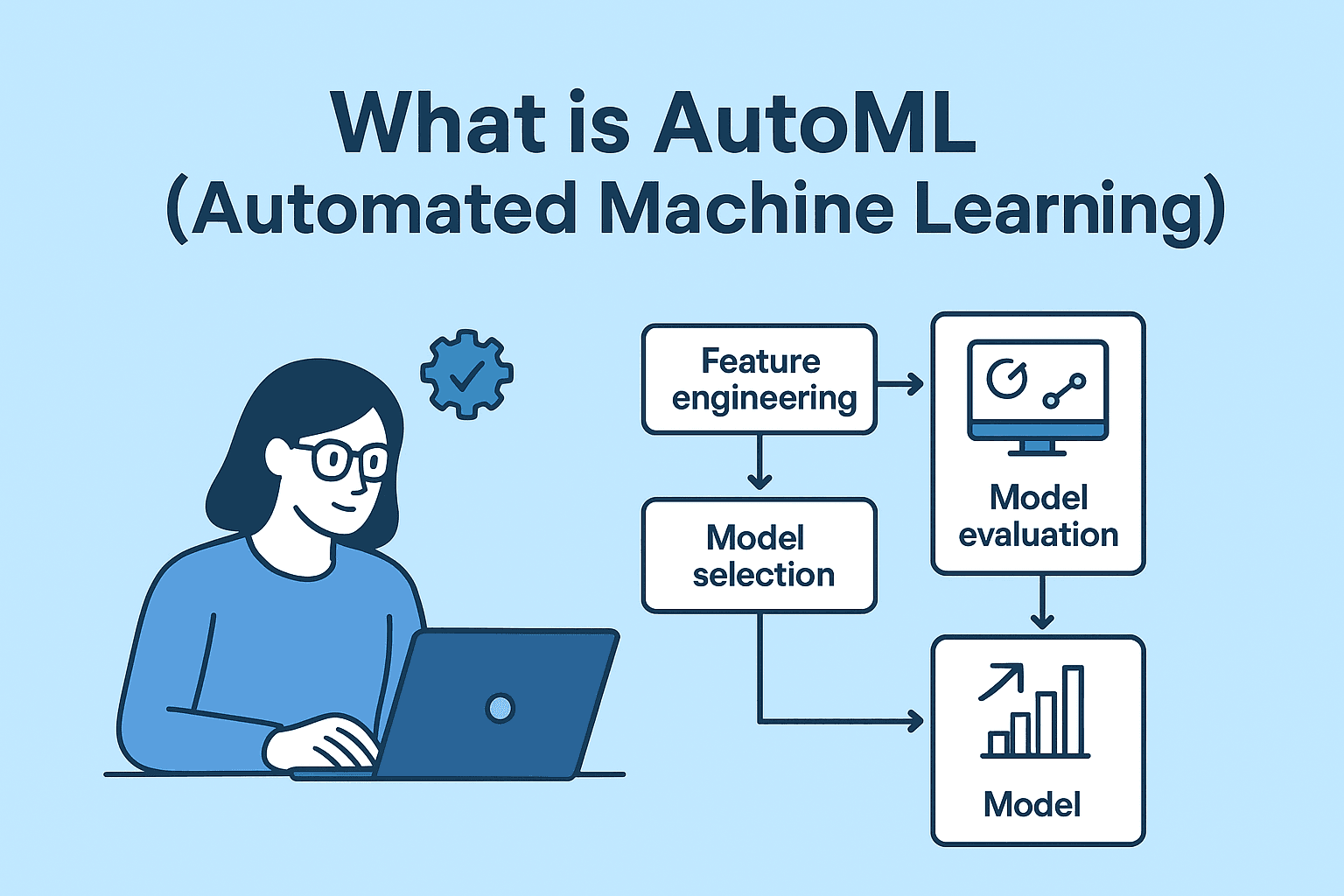
AutoML (Automated Machine Learning) is a novel approach that simplifies and accelerates the process of developing machine learning models.
Through the use of effective algorithms and integrated workflows, AutoML automates these difficult processes rather than requiring human intervention at every stage, from data cleansing to hyperparameter adjustment.
It might take hours or even days of skilled labor to complete activities like feature selection, model selection, hyperparameter tuning, and model evaluation in a typical machine learning pipeline.
The process of testing various algorithms, fine-tuning parameters, and choosing the best-performing model for you is automated by autoML tools. What was the outcome?
Quicker development, fewer mistakes made by people, and more time spent on problem-solving as opposed to technical tweaking.
H2O.ai, Auto-sklearn, DataRobot, and Google AutoML are a few of the most well-known AutoML platforms available today.
By using simple interfaces or little code, these tools enable users—even those with little prior knowledge of coding or data science—to train and implement high-quality models.
Making machine learning more approachable, effective, and scalable is the primary objective of AutoML, which is straightforward but effective.
Without requiring in-depth knowledge of data science, AutoML allows for quicker experimentation and decision-making, whether a startup is experimenting with consumer insights or a business analyst is forecasting sales patterns.
AutoML essentially embodies the development of machine learning, transforming a formerly highly complex procedure into a more accessible and effective workflow for all.
Key Differences: AutoML vs Manual ML
Although creating successful machine learning models is the goal of both AutoML and Manual ML, their approaches to achieving this goal are very different. The complexity of your project, your skill level, and time constraints all influence the best option.
Here is a closer look at the main distinctions between the two methods.
| Aspect | AutoML | Manual ML |
|---|---|---|
| Skill Level Required | Beginner-friendly | Requires deep ML knowledge |
| Time Efficiency | Faster | Time-consuming |
| Control | Limited | Full control |
| Interpretability | Often lower | High |
| Customization | Restricted | Highly flexible |
| Use Cases | Prototyping, quick models | Research, production-grade models |
Let’s discuss these points in detail.
Skill Level Required
AutoML technologies are perfect for novices or teams without a professional data scientist since they make machine learning easier.
Manual machine learning, on the other hand, is more appropriate for seasoned practitioners because it requires a solid understanding of algorithms, statistics, and code.
Time Efficiency
AutoML can produce models in a fraction of the time because automation takes care of the majority of the labor-intensive tasks.
Even though it is slower, manual machine learning enables intentional testing and optimization, which is crucial when precision and dependability are of the utmost importance.
Control
The amount of control you have over the process is limited by AutoML. Under the hood, you might not be aware of the features or algorithms in use.
With manual machine learning, you have total control and can make data-driven decisions at every turn, from deployment to preprocessing.
Interpretability
Because AutoML automates a large portion of the process, it may be more difficult to explain how the model comes to its conclusions.
With manual machine learning, on the other hand, you can see exactly how every feature and parameter influences the result.
Customization
Certain datasets or specialized issues might not always be compatible with the preset workflows that AutoML adheres to.
Every stage, from feature engineering to model optimization, can be adjusted and customized for extremely particular purposes using manual machine learning.
Use Cases
AutoML works best in situations where time-to-insight is crucial, such as rapid tests, prototypes, or standardized business challenges.
When control, interpretability, and precision are essential, manual machine learning excels in research, complicated modeling, and production settings.
Advantages and Limitations of AutoML
Like any new technology, AutoML has advantages and disadvantages. Although there are some limitations, it is completely changing the way machine learning projects are constructed. We should examine both perspectives.
Advantages of AutoML
1. Saves time and resources
The time required to convert raw data into a functional model is significantly decreased with autoML. Data scientists don’t need to spend hours optimizing algorithms; AutoML can do it for them.
Teams are able to test concepts more quickly and devote more time to strategy, analysis, and interpretation as a result of this efficiency.
2. Accessible for non-experts
AutoML’s accessibility is arguably its greatest benefit. It enables researchers, analysts, and business users who lack sophisticated data science abilities to create and implement models.
By democratizing machine learning, businesses are able to make data-driven decisions without depending entirely on skilled programmers and close the skills gap.
3. Automates repetitive ML tasks
Although necessary, tasks like feature selection, model comparison, and hyperparameter tuning are frequently tedious. By automating these tedious processes, autoML ensures consistency and lowers human error.
This automation is particularly useful for large-scale projects where it would take a lot of time to execute numerous experiments by hand.
4. Ideal for rapid prototyping
AutoML is the tool of choice when you need a fast proof of concept or want to see if machine learning can overcome a specific business issue.
Teams can quickly spin up models, validate outcomes, and iterate with them, which makes it ideal for startup or early-stage experimentation settings.
Limitations of AutoML
1. Limited model interpretability
AutoML’s tendency to feel like a “black box” is one of its main problems. Although it produces results, it’s not always evident how or why a model produced a particular forecast.
In sectors where explainability is crucial, like healthcare or banking, this lack of transparency may be a deal-breaker.
2. Less control over feature engineering
AutoML manages feature engineering automatically, which restricts customization but is convenient.
Because AutoML can’t perfectly reproduce domain expertise, expert data scientists frequently use it to create useful features. Because of this, it may overlook subtle trends in the data that could increase accuracy.
3. May not fit highly complex or domain-specific tasks
AutoML performs best on datasets that are well-defined and structured. Manual intervention is still required for more complex use cases, though, including deep learning, computer vision, or extremely specialized research.
Complex pipelines or specialized issues requiring expert supervision may be difficult for AutoML’s one-size-fits-all methodology to handle.
Advantages and Limitations of Manual ML
For data scientists who value accuracy, adaptability, and total control over their models, manual machine learning is still the preferred method even though autoML offers automation and speed.
But there are drawbacks to this practical approach as well. Let’s examine both viewpoints.
Advantages of Manual ML
1. High control and flexibility
With manual machine learning, data scientists have complete control over all aspects of the machine learning process, including feature design, algorithm selection, and hyperparameter tuning.
Because of this power, they can precisely customize models to fit their data and goals. Whether you want to optimize for interpretability, performance, or fairness, manual machine learning allows you to precisely tailor the process to meet your objectives.
2. Easier to interpret and debug
Manually creating models allows you to see how every choice affects the outcome. Error tracing, performance diagnosis, and ensuring the model operates as intended are all made simpler by this openness.
When explainability is crucial in regulated businesses or research initiatives, manual machine learning (ML) offers the clarity that automated techniques frequently don’t.
3. Better suited for advanced and domain-specific problems
Simply put, certain issues are too complicated or distinct to be automated. Manual machine learning enables specialists to use in-depth subject knowledge in situations such as scientific simulations, financial predictions, and medical diagnostics.
They are better than AutoML in choosing subtle algorithms, modifying models, and engineering specific features.
Limitations of Manual ML
1. Time-consuming
The process of manually creating models, from feature selection and data preprocessing to tuning and validation, can take a long time.
This procedure might cause delays in project schedules and lower overall efficiency when dealing with huge datasets or numerous experiments.
2. Requires skilled experts
Manual machine learning is mostly dependent on human skill. It requires an understanding of programming, statistics, and machine learning theory.
For startups or smaller teams, this strategy is resource-intensive because qualified data scientists are costly to hire and difficult to locate.
3. Not scalable for large, frequent experiments
When projects need to train or update hundreds of models on a regular basis, manual machine learning is unable to keep up.
Its scalability is limited by its need for human involvement. However, AutoML can automate these repeated processes with little supervision.
Keep in mind that
AutoML is ideal for rapid and scalable solutions because of its superior speed, accessibility, and automation. However, manual machine learning remains superior where accuracy, interpretability, and deep customisation are most important.
For situations requiring control, interpretability, and customisation, manual machine learning is the art of accuracy. However, in large-scale or fast-paced settings, its hands-on approach may become a hindrance, opening the door for regular chores to be automated.
When to Use AutoML vs Manual ML
When choosing between AutoML and Manual ML, it’s important to consider your project’s objectives, schedule, and level of experience rather than which is generally superior. You can save time, money, and frustration by knowing when to use each of their technologies.
Use AutoML if
1. You need quick insights or proofs of concept
AutoML is your best friend if speed is your top concern. Without having to spend weeks manually fine-tuning the model, it’s ideal for quickly producing prototypes, confirming concepts, or examining data patterns.
AutoML is frequently used by businesses to assess feasibility and obtain early insights before committing to full-scale development.
2. You have limited ML expertise
AutoML helps close the skill gap by enabling non-experts to understand machine learning.
With the aid of autoML technologies, your team can produce precise models without the need for complex arithmetic or code if it consists of analysts or business experts who comprehend the issue but lack the technical knowledge of machine learning.
3. You’re dealing with standardized datasets and business cases
AutoML performs exceptionally well for structured, well-defined datasets, such as marketing segmentation, customer churn prediction, and sales forecasting.
Because these issues follow known patterns, automated systems can function well without requiring a lot of customization.
Use Manual ML if
1. You require explainability or precision
It becomes crucial to comprehend the reasoning behind a model’s predictions when decisions have an effect on people’s lives or finances.
With manual machine learning, you can analyze results, modify features, and guarantee transparency—all of which are critical for sectors like public policy, finance, and healthcare.
2. You’re working on research, deep learning, or custom model architectures
Manual ML is essential for experimental research or cutting-edge projects. It allows you to push the limits of what AutoML tools can currently do, experiment with novel algorithms, and create unique neural networks.
3. You want to fine-tune each stage of the pipeline
Manual machine learning (ML) allows you the creative and analytical freedom to modify preprocessing processes, choose features, and test models individually if you prefer hands-on control.
It’s perfect for situations when you want to optimize speed or customize solutions for extremely precise data.
AutoML Vs Manual ML – Real-World Use Cases
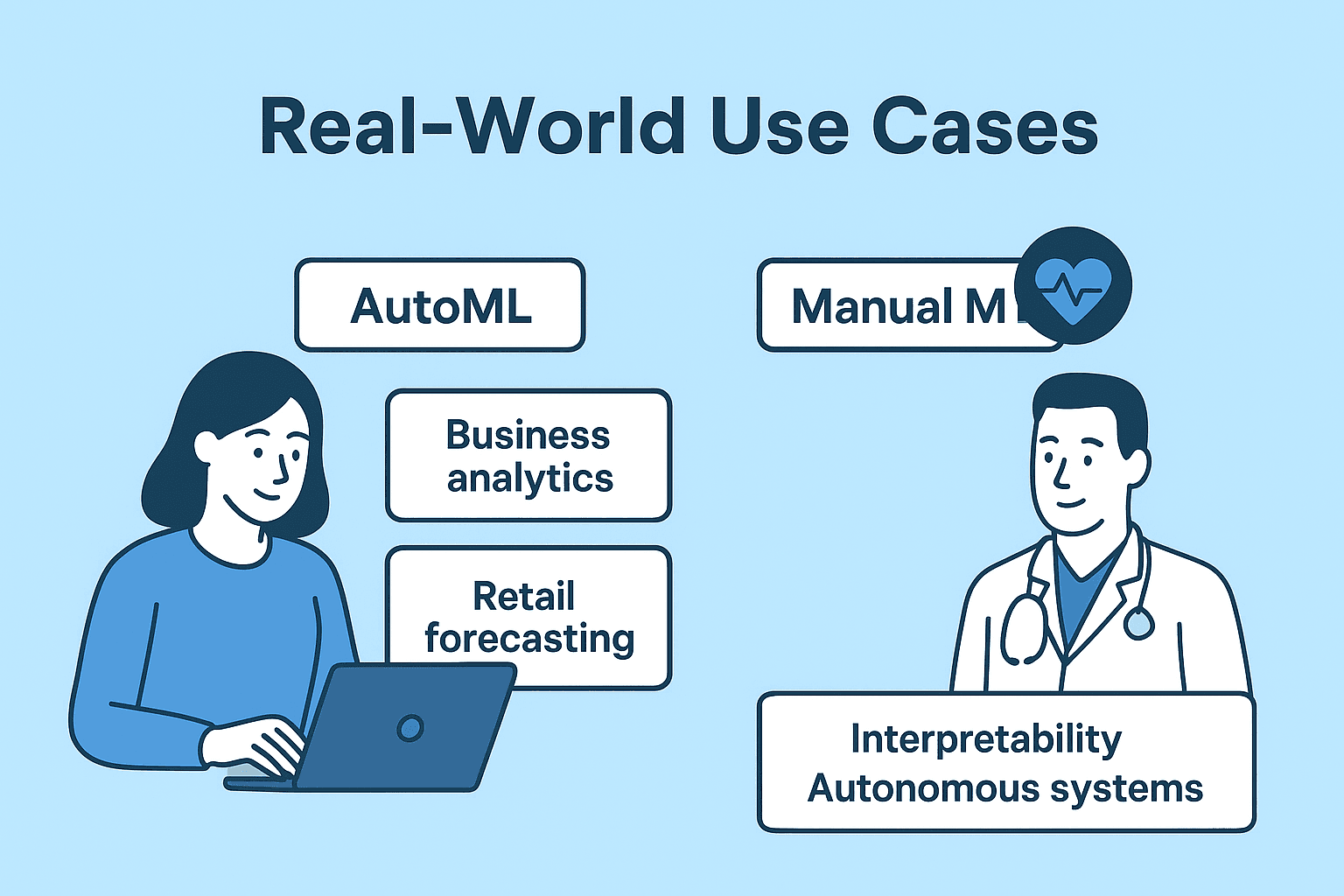
Both AutoML and Manual ML have made a name for themselves in the real world, with each technique being particularly effective in certain situations.
When applied to real-world use cases, their strengths—from fast-paced enterprises to precision-driven industries—become evident.
AutoML in Business Analytics
In sectors such as marketing, finance, and retail, efficiency and speed are more important than intricate personalization. AutoML excels at this point.
Businesses utilize AutoML for customer churn prediction, sentiment analysis, and sales forecasting, enabling teams to quickly construct predictive models without a dedicated data science department.
For instance, a retail business can use AutoML to predict demand for various products, keep inventory levels optimal, and determine which consumers are most likely to discontinue buying.
AutoML is also used by banks and fintech companies to detect transaction irregularities or automate credit risk rating with little manual effort. What’s the main advantage? Scalable solutions, reduced expenses, and quicker insights.
Manual ML in Healthcare and Autonomous Systems
On the other hand, manual machine learning rules domains that need responsibility, explainability, and accuracy.
For example, researchers and physicians in the healthcare industry need to know why a model predicts a specific diagnosis.
From the selection of characteristics to the interpretation of results, a manually constructed model offers total transparency, guaranteeing that any choice can be supported and examined.
Reliability and safety are also non-negotiable in autonomous systems like robotics and self-driving cars.
Intricate models that are constantly observed, adjusted, and verified are necessary for these applications; AutoML is not currently capable of handling them to this extent.
In this case, manual machine learning guarantees control, interpretability, and reliability.
Hybrid Approaches: The Best of Both Worlds
A lot of contemporary data teams are now using a hybrid strategy that combines the advantages of both approaches. For baseline modeling, autoML is used to rapidly discover the most promising parameters and algorithms.
After that, the results are manually refined, interpreted, and optimized by human professionals.
Automation and expertise work together to provide a potent workflow: AutoML speeds up experimentation, while Manual ML guarantees accuracy and legitimacy.
This hybrid approach is becoming a more and more popular option across industries since it helps businesses balance speed, performance, and trust.
Final Verdict
The goal of the AutoML vs Manual ML argument is to determine which method best suits your needs, not to declare one winner over the other.
Because of its exceptional speed, accessibility, and scalability, autoML is ideal for companies that require rapid insights, prototypes, or large-scale automation.
In contrast, manual machine learning is still the best option for deep customization, interpretability, and accuracy—qualities that are crucial for research and mission-critical applications.
Each strategy has a specific function in the contemporary data ecology. By empowering non-experts to create robust models, autoML democratizes machine learning and frees up data scientists to work on more strategic projects.
By guaranteeing quality, inventiveness, and accountability, manual machine learning maintains the depth and art of human-driven modeling.
AutoML can provide you with a significant advantage, whether you’re just getting started or are working with organized business data. In the event that your project requires experimentation, transparency, or fine-grained control, manual modeling remains the superior option.
The best strategy ultimately lies in knowing when to apply each technique, not in AutoML or Manual ML. A machine learning strategy that combines the speed of automation with the knowledge of human expertise will be effective, intelligent, and prepared for the future.
Frequently Asked Questions (FAQs)
What is the main difference between AutoML and Manual ML?
Automation and control are where the biggest differences lie. While manual machine learning (ML) requires human labor but offers complete control, flexibility, and improved interpretability, autoML automates the majority of the machine learning process, making it quicker and easier to use.
Is AutoML better than Manual ML for beginners?
Yes. Because it requires little coding or data science knowledge, autoML is easy for beginners to learn. Manual ML is more appropriate for experts who wish to modify models or conduct in-depth research, whereas it is best suited for short trials or business analytics jobs.
Can AutoML replace data scientists?
AutoML will not take the position of a data scientist. Rather, by automating monotonous processes like feature selection and tuning, it enhances them. In order to define issues, analyze findings, and guarantee the accuracy and fairness of models, data scientists are still crucial.
When should I choose Manual ML over AutoML?
In fields like healthcare, financial forecasting, or artificial intelligence research, when explainability, accuracy, or complicated modeling are required, go for manual machine learning. Manual methods provide a more in-depth understanding of model behavior and detailed control.
Can I combine AutoML and Manual ML in one project?
Certainly, in many situations, a hybrid strategy is most effective; you can utilize AutoML for base models or rapid prototypes and then manually improve the best models. By striking this balance, you may increase speed and accuracy without compromising quality.
Share Now

More Articles
What Is The Machine Learning Specialization By DeepLearning AI On Coursera?
Advanced Data Science Courses On Coursera For Experienced Professionals
Data Mining in Python – A Detailed Review

As an engineer with a passion for learning and sharing knowledge, I created CourseKart.online to help students, professionals, and lifelong learners choose the best online courses. With so many options available, finding the right one can be overwhelming. My goal is to simplify that process by offering insights, reviews, and recommendations on the top online learning resources. I hope my posts inspire you to keep growing, learning, and exploring new opportunities.
Discover more from coursekart.online
Subscribe to get the latest posts sent to your email.