
Last updated on February 9th, 2026 at 09:05 am
If you’re a business executive who keeps hearing about generative AI but isn’t sure how to put it to use, this training is just what you need.
Generative AI for Executives and Business Leaders is not about buzzwords or futuristic hype; instead, it demonstrates, step by step, how AI can alter your organization now.
In just a few hours, you’ll learn how to identify high-impact opportunities, align them with corporate objectives, and avoid costly mistakes that many businesses are now making. Consider it your fast-track guide to leading with AI confidence.
In this in-depth course review, we’ll look at the Generative AI for Executives and Business Leaders Specialization.
What skills will you learn in this course?
Based on my experience, this specialization’s greatest value lies in the highly useful skills it develops for leaders who wish to employ AI effectively.
It focuses on providing you with the attitude and resources to successfully lead AI initiatives in your company, not on teaching you how to write code or train models. Here is what you truly take away.
Identifying AI opportunities in business
You will discover how to look at your own company and identify areas where generative AI can truly help, whether it’s through chatbots that improve customer service, HR work simplification, or customized marketing campaigns.
It all comes down to focusing on use cases that truly make a difference and seeing past the hype.
Strategic decision-making with AI
The course teaches you to view artificial intelligence (AI) as a component of a broader business plan rather than as a showy toy.
You’ll learn how to evaluate potential ROI, match AI initiatives with your business’s objectives, and choose whether projects are worthwhile. By doing this, you can save money on ineffective, trendy tools.
Risk management and governance
Another essential skill is to manage the risks associated with AI, like bias, data protection, compliance concerns, and transparency.
In order to prevent future ethical or legal issues for your company, you will have a clear foundation for implementing responsible AI practices.
Building and presenting use cases
After completing the specialization, you will be able to develop and deliver an AI use case that is specific to your company.
Define the issue, describe the AI solution, weigh the risks, and demonstrate viability. It’s a skill that gives you credibility when talking about AI with your team, board, or even outside partners.
Effective communication about AI
Perhaps the most underappreciated skill is the ability to communicate AI in a way that both technical teams and stakeholders who are not technical can comprehend.
This helps you become a more successful leader in AI-driven projects and bridges a significant gap in many firms.
What concepts are taught in the Generative AI for Executives and Business Leaders Specialization?
The way the course is organized, you will learn about generative AI from the ground up, but always from a business perspective.
It concentrates on the ideas that executives and leaders find most important rather than overloading you with technical facts. The key ideas you will study in this course are outlined here.
Foundations of Generative AI
You begin by outlining the fundamentals of generative AI, including its definition, how it varies from conventional AI, and the reasons behind its significant influence on many industries.
You can communicate these concepts to your team without becoming bogged down in technical terms thanks to the course’s straightforward explanations of historical context.
Business Use Cases Across Functions
The area of expertise delves deeply into the practical business applications of generative AI. Marketing, customer service, human resources, finance, IT operations, and other areas will all be covered in your studies.
Helping you understand how the same technology may address wildly disparate issues depending on the situation is the goal.
Strategy and Integration
One of the key themes covered is how to integrate AI projects into the overall corporate strategy. You’ll learn how to calculate return on investment (ROI), comprehend operational implications, and determine whether an AI use case is worthwhile. This section truly prepares you to think like a decision-maker, not just a tech fan.
Responsible AI: Governance, Trust, and Ethics
The course highlights that AI cannot be implemented mindlessly. It discusses important governance ideas such as fairness, transparency, bias mitigation, data privacy, and compliance.
These are critical for any leader because a poorly managed AI effort can harm reputation and result in costly legal difficulties.
Risk Assessment and Mitigation
Along with governance, you will learn formal methods for assessing the risks of AI adoption, ranging from technical constraints to organizational issues. This notion teaches you how to foresee problems before they happen and how to implement controls to manage them.
Prompt Engineering and Hands-On Exploration
Even while the course isn’t technical, it does demonstrate how to interact directly with generative AI technologies.
You’ll learn about prompt engineering – how the wording of your instructions influences the outputs of AI systems. This hands-on experience helps technology feel more real and less abstract.
Building a Use Case Framework
The final section of the course teaches you how to develop and present your own generative AI use case.
You’ll learn how to describe a business problem, map AI as a solution, assess risks, ensure feasibility, and effectively express the benefit. This concept combines what you’ve learnt into a practical solution.
Read Also: Best Generative AI Courses On Coursera That Explain Real-World Applications
Who should join this course?
The intended audience for this course is extremely specific: those in leadership and decision-making positions who wish to leverage AI’s potential without becoming bogged down in its technical details.
This course is ideal for anyone who is responsible for fostering innovation, whether they are a CEO, manager, company founder, or even a mid-level leader.
It’s particularly helpful if your work involves making strategic decisions about new technologies and you don’t necessarily have a background in coding or data science.
Professionals who are interested in artificial intelligence but are feeling overloaded with information will also find it to be a wonderful fit.
The course reduces the clutter to actionable, business-oriented ideas that you can utilize immediately.
For instance, you will discover how generative AI fits into your role and how to spot the most promising use cases if you oversee marketing, human resources, finance, or customer service.
However, if you work as a software engineer, data scientist, or someone who wants to directly develop AI systems, this expertise may seem too advanced.
It won’t teach you how to implement AI pipelines or write code for models.
Rather, it’s about empowering leaders to manage risks, incorporate AI ethically, and match initiatives with business objectives.
To put it briefly, this course will be very helpful to anyone in a leadership position who wishes to spearhead AI adoption rather than develop AI solutions.
Will you get a job after completing the Generative AI for Executives and Business Leaders Specialization?
The course itself makes it apparent through its focus that finishing this course by itself is unlikely to result in you getting a new job.
Neither an advanced degree nor a technical certification that demonstrates your ability to create AI systems is actively sought after by employers.
Rather, it is a curriculum focused on leadership that enhances your capacity to strategically direct the adoption of AI within your company.
Nevertheless, the course might still be a significant career advantage. You will stand out as someone who knows not only what generative AI is but also how to use it profitably and responsibly if you now hold a managerial or leadership position.
This may lead to opportunities for cross-functional duties, promotions, or roles where AI strategy is starting to take precedence.
Executives and managers who can speak convincingly about AI and support their claims with a methodical approach are highly sought after in today’s market.
This specialization won’t be sufficient on its own if you want to venture into a technical role or change careers to AI.
More practical or technical courses in data science, machine learning, or AI engineering would have to be taken in addition to it.
But if you want to advance in leadership, consulting, product management, or corporate strategy, fields where strategic knowledge of AI is more important than coding, this course will undoubtedly boost your profile’s legitimacy and usefulness.
How long does this course take to complete?
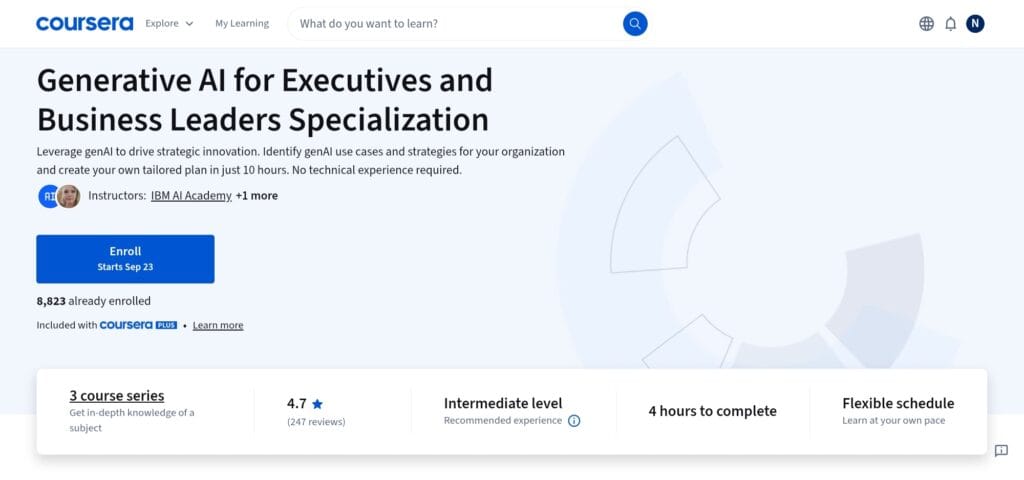
The specialization is designed to be very time-efficient. In total, it takes around 4 hours to complete all three courses. Each course is about 1 hour long, and since the content is broken into short video lectures, readings, and small assignments, it never feels overwhelming.
How much does this course cost?
Coursera offers a subscription model for the courses, and its cost is $49 per month. The actual cost may vary in your region due to ongoing offers on the platform.
However, you can also access courses on Coursera through a Coursera Plus subscription. This subscription plan costs $59 per month and gives you access to 10,000+ courses on Coursera.

Is it worth taking the Generative AI for Executives and Business Leaders Specialization?
The Generative AI for Executives and Business Leaders Specialization is a highly practical and focused training tailored exclusively to business executives.
It is not about coding or developing AI systems; rather, it teaches you how to strategically apply generative AI to produce actual commercial value.
From boosting customer service and marketing campaigns to optimizing HR and finance operations, this course will teach you how to identify the most significant opportunities and link AI projects with organizational goals.
It also highlights responsible AI adoption by discussing governance, ethics, and risk management, all of which are crucial for leaders in any sector.
This specialization’s strength and flexibility are two of its most notable features. It is designed for busy professionals who want practical insights without committing to a lengthy, technical program, lasting approximately 4 hours in total.
The lessons are succinct, easy to understand, and filled with practical concepts that will assist you in evaluating AI use cases, communicating their value to stakeholders, and making educated strategic decisions.
Completing the course also earns you an IBM certificate, which is a legitimate credential that proves your awareness of the importance of AI in business.
However, this course is not intended for those who want to learn how to construct AI systems directly.
The tools examined are mostly IBM’s Watsonx platform, and the emphasis is on strategy rather than technical implementation.
However, this training is very helpful if you want to influence organizational direction, lead AI adoption, or ethically integrate AI into your firm.
It offers the information and assurance needed for managers, consultants, or executives to make wise AI decisions and produce significant outcomes.
FAQ
Is this course suitable for someone without a technical background?
Yes, without a doubt. Executives, managers, and company leaders who might not have any prior coding or data science knowledge are the target audience for this course. Its main objectives are to find corporate use cases, comprehend the strategic value of generative AI, and ethically apply AI. You will learn how to make well-informed decisions on the use of AI in your company, without having to write code or train models.
What kind of AI skills will I gain?
Although you won’t get technical AI skills like model development or programming, you will acquire strategic abilities. These include spotting high-impact AI prospects, figuring out ROI, controlling risks, making sure AI is adopted ethically and responsibly, and creating compelling business use cases. Additionally, you will learn how to clearly and persuasively explain an AI strategy to stakeholders.
Share Now

More Articles
Best Prompt Engineering Courses Online [Prompting Mastery]
Best ChatGPT Courses Online (Learn Prompting, AI Workflows & Real-World Use Cases)
best AI courses online [AI Career Guide]

As an engineer with a passion for learning and sharing knowledge, I created CourseKart.online to help students, professionals, and lifelong learners choose the best online courses. With so many options available, finding the right one can be overwhelming. My goal is to simplify that process by offering insights, reviews, and recommendations on the top online learning resources. I hope my posts inspire you to keep growing, learning, and exploring new opportunities.
Discover more from coursekart.online
Subscribe to get the latest posts sent to your email.