

Last updated on February 9th, 2026 at 09:02 am
Imagine reducing the amount of time you spend coding by half, identifying bugs before they affect production, or creating test cases with a single question.
That is the potential of generative AI, which is reshaping the way developers work globally.
IBM’s Generative AI for Software Developers Specialization on Coursera gets you right to the practical side of learning.
You’ll delve into practical applications like prompt engineering, intelligent automation, and AI-powered code development rather than getting bogged down in theory.
If you’re an IT professional interested in the future of coding or a software developer trying to improve your competitive edge, this program gives you the hands-on skills you need to succeed in the AI-driven software development boom.
What skills will you learn in this course?
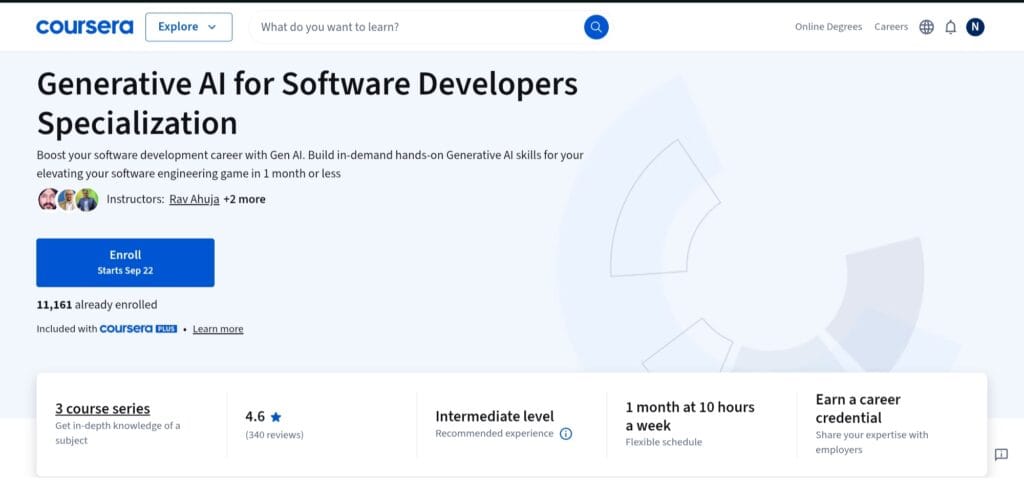
The goal of the Generative AI for Software Developers Specialization is to provide you with the practical hands-on skills and technical knowledge needed to succeed in the era of AI-assisted software development.
After completing this program, you will have the following skills.
- Understanding Generative AI Fundamentals
You will begin by studying the fundamentals of generative AI, including its definition, operation, and distinctions from conventional AI.
This gives you a broad overview of its uses by allowing you to explore text, image, audio, and code generation.
- Prompt Engineering
Prompt engineering, the ability to create efficient prompts to obtain precise and practical outcomes from AI models, is one of the most sought-after skills nowadays.
You’ll get experience creating prompts for design, debugging, coding, and other practical tasks.
- Applying Generative AI in Software Development
You’ll discover how to leverage AI technologies to optimize the entire software development lifecycle, from producing scripts and code snippets to developing test cases and automation activities.
- Working with Popular AI Tools
You will get practical experience with popular technologies like GitHub Copilot, IBM Watsonx, ChatGPT, and other generative AI platforms. This course helps you become proficient with these tools, which are quickly becoming standard in the developer’s toolbox.
- Debugging and Refactoring with AI
You’ll learn how AI can evaluate existing code, find errors, provide suggestions for enhancements, and even restructure code to increase performance—all while saving you a significant amount of time.
- Software Design and Architecture with AI
Beyond just coding, you’ll see how generative AI can support higher-level tasks like system design, architecture planning, and optimizing workflows.
- Testing and Automation
To free up your time to tackle more complex problems, the program teaches you how to automate repetitive chores, such as writing boilerplate code or creating unit tests.
- Ethical and Responsible AI Practices
Since AI comes with risks, you’ll also learn about bias, security, data privacy, and responsible use of generative AI. This ensures that you’re not just skilled but also ethically prepared to apply AI in real projects.
- Hands-On Project Development
Finally, you’ll put everything into practice by building applied projects—such as designing an AI-powered learning tool for developers—so you can showcase your abilities in a portfolio or on LinkedIn.
What concepts will you learn in the Generative AI for Software Developers Specialization?
The specialization is structured to take you step by step from foundational knowledge to hands-on applications of generative AI in software development. Here’s a detailed breakdown of the main concepts covered.
1. Foundations of Generative AI
You start by learning the fundamentals, such as what generative AI is and how it varies from conventional machine learning.
The course covers the differences between discriminative and generative models, the operation of large language models (LLMs) such as GPT, and the variety of uses they allow, including the creation of text and code as well as graphics, audio, and even video.
This foundation guarantees that you can follow along with more complex concepts later on, even if you’re new to AI.
2. AI Models and Tools in Practice
You will learn about the ecosystem of tools that developers are now employing in this course. ChatGPT, GitHub Copilot, IBM Watsonx, and other AI platforms will be covered, as well as how these models take in data and provide results.
Using these tools will allow you to observe directly how AI can be used at various phases of software development.
3. Prompt Engineering
One of the most important skills taught in this specialization is prompt engineering.
You’ll discover how to create, polish, and organize prompts to ensure AI models provide precise, pertinent, and excellent answers.
This covers ideas like context building for lengthy activities, iterative prompt refinement, zero-shot, one-shot, and few-shot prompting, and employing prompts for specialized outputs (such as creating test cases, debugging, or writing documentation).
4. Generative AI in Software Development
Here, the focus shifts to practical applications in coding. You’ll learn how AI can:
- Generate boilerplate code and scripts in multiple languages
- Suggest solutions for coding challenges
- Debug existing programs and identify errors
- Refactor messy or outdated code into optimized versions
- Assist in designing and architecting systems for scalability and efficiency
This section shows you how to make AI an active co-pilot in your day-to-day development tasks.
5. Testing and Automation with AI
The use of AI for quality assurance is another key idea. The course discusses the creation of automated scripts, integration tests, and unit tests using generative AI.
Additionally, you’ll discover how automation frees you up to concentrate on innovative problem-solving by reducing monotonous tasks.
6. Hands-On Projects and Applied Learning
The focus of the specialization is on action rather than just reading.
In guided projects, you will use generative AI principles, such as creating software documentation using AI or creating a customized learning environment for developers.
In addition to strengthening the theory, these projects help you develop a portfolio that you can present.
7. Ethics, Security, and Responsible AI
The program concludes by highlighting the significance of using AI responsibly.
You will gain knowledge about important topics such as preserving sensitive data, intellectual property concerns, bias in AI outputs, and making moral decisions when incorporating AI into software.
This guarantees that your expertise is in line with industry standards and best practices, in addition to being technical.
Who Should Join This Course?
Although the Generative AI for Software Developers Specialization is intended for a broad audience, students who wish to use AI in their software development endeavors will find it very beneficial. Who will gain the most from this course is discussed here.
1. Software Developers and Engineers
This course will help you incorporate generative AI into your everyday work if you are currently employed as a front-end, back-end, or full-stack developer.
With AI-powered assistance, you’ll learn how to write code more quickly, automate testing, debug more intelligently, and even create more effective structures.
2. Students and Aspiring Developers
This specialization can help university students, coding bootcamp graduates, or self-taught programmers prepare for the future of their careers.
Learning these abilities early can provide you with a significant advantage in internships, job interviews, and freelance opportunities because generative AI is quickly becoming a part of current development.
3. IT Professionals and Tech Enthusiasts
The course offers insights into how AI may develop scripts, automate procedures, and improve productivity for system administrators, DevOps engineers, and IT specialists.
These abilities can help you adjust to a workplace driven by artificial intelligence, even if you don’t code on a daily basis.
4. Career Switchers
The course will be a useful starting point for professionals from similar professions, such as data analysis, QA testing, or project management, who wish to transition into AI-enhanced software development.
A fundamental familiarity with programming is beneficial, although in-depth knowledge of machine learning is not required.
5. Entrepreneurs and Innovators
Generative AI can help you prototype more quickly, lower development costs, and test out new concepts if you’re creating your own apps, SaaS products, or companies.
You will learn how to use AI in your projects without a big development staff, thanks to this course.
Read Also: Best Generative AI Courses On Coursera That Explain Real-World Applications
Will You Get a Job After Completing This Course?
The Generative AI for Software Developers Specialization on Coursera is not a direct job guarantee program, but it does give you in-demand skills that can make you stand out in the tech job market.
Developers who can combine traditional coding skills with AI-powered development tools like ChatGPT, GitHub Copilot, and IBM Watsonx are highly sought after by employers today. This specialization will teach you the following skills.
- Write code more efficiently with AI assistance
- Automate repetitive development tasks
- Apply prompt engineering for real-world problem solving
- Integrate generative AI into software design, testing, and debugging
- Approach AI ethically and responsibly in projects
In software engineering, DevOps, QA testing, and even startup settings where productivity and creativity are essential, these abilities are highly valued.
That being stated, your entire profile will determine whether you get hired after finishing this course.
This specialization is most effective for novices and students when paired with solid programming foundations and portfolio projects.
By gaining these skills, working professionals can get an advantage in freelancing work, AI-focused positions, and promotions.
Crucially, IBM will also provide you with a Coursera Certificate that you can add to your résumé or post on LinkedIn.
The certification serves as evidence of your applied knowledge, which hiring managers and recruiters increasingly consider when evaluating applicants for AI-related positions, even though it won’t ensure employment on its own.
How long does the Generative AI for Software Developers Specialization take to complete?
Because the Generative AI for Software Developers Specialization is self-paced and flexible, you can learn at your own pace. According to Coursera, if students put in 8–10 hours a week, they should be able to complete the program in around one month.
The courses could be spread out across two to three months if you’re a professional or full-time student with limited hours.
The full specialization could be finished in a few weeks if you’re dedicated and put in extra time each week.
How Much Does this Course Cost?
The specialization is priced under the subscription model of Coursera, meaning you need to pay a monthly fee until you complete this course. Typically, the price starts around $49 per month, but the exact price depends on the country.
Additionally, you can join this course with the Coursera Plus Subscription plan. The Coursera Plus Subscription gives access to 10,000+ courses, certificate programs, and specializations on Coursera for a monthly ($59) or annual ($399) fee.

Also, it comes with a 7-day free trial. So you can experience this before making the final decision.
Is it worth taking the Generative AI for Software Developers Specialization on Coursera?
Yes, the Generative AI for Software Developers Specialization is definitely worth considering for anyone looking to stay ahead in the fast-evolving tech industry.
The course emphasizes real-world applications above theory, making it extremely practical.
You’ll discover how to use AI to create code, automate testing, debug programs, and streamline processes—skills that are highly sought after as more businesses integrate AI into their software development procedures.
This specialization’s primary benefit is that it is provided by IBM, a well-known leader in AI and technology worldwide. By doing this, the curriculum is guaranteed to be reliable, current, and in line with industry standards.
Direct instruction from professionals who are actively using AI technologies gives you insights that are not available through free resources or standard internet lessons.
The course is divided into three well-structured modules that cover everything from basic ideas to sophisticated applications, with lots of practical assignments in between.
You can use these projects to demonstrate your abilities to prospective employers by including them in your portfolio or LinkedIn profile.
They also let you put what you’ve learned into practice by creating AI-powered tools or writing code using AI.
Additionally, upon completion of the specialization, you will receive a Coursera certificate from IBM, which is a reliable indicator of your applicable expertise.
Certifications show hiring managers and recruiters that you have dedicated yourself to disciplined study and acquired pertinent, industry-endorsed abilities, even though they do not by themselves ensure employment.
Additionally, the course is affordable and flexible. Learning at your own speed, pausing and restarting classes as needed, and even applying for financial aid if necessary are all possible with Coursera’s subscription model.
The specialization provides a low-risk, high-value approach to upskilling in AI for software development, in contrast to costly bootcamps or offline programs.
In summary, this Coursera specialization is a wise investment if your objectives are to increase productivity, prepare your profession for the future, and acquire knowledge of generative AI applications for software development.
Both novices and seasoned professionals seeking to maintain their competitiveness in the AI-driven IT sector will find it excellent as it blends real-world knowledge, project experience, and industry recognition.
FAQ
Do I need prior coding experience to take this course?
Although the course is suitable for beginners to intermediate students, it is strongly advised to have some prior programming experience. You will find it easier to follow the practical tasks if you are familiar with languages like Python, Java, or JavaScript. Before beginning AI-driven software development, you might need to devote more time to the basics if you’re a total beginner.
Is this course suitable for career switchers or non-developers?
Yes. This expertise is beneficial for professionals who wish to transition into AI-enhanced software development from related professions like data analysis, QA testing, or project management. The course is accessible to motivated learners wishing to change occupations since it stresses real-world applications and has a smooth learning curve, even though some fundamental programming expertise is helpful.
Share Now

More Articles
Entry-Level Data Science Jobs: What Recruiters Really Want
Roadmap to Become A Data Scientist In 6 Months (Step-by-Step Guide)
Will AI Take My Job or Create a New One? A Deep Dive into the Post-AI Job Market

As an engineer with a passion for learning and sharing knowledge, I created CourseKart.online to help students, professionals, and lifelong learners choose the best online courses. With so many options available, finding the right one can be overwhelming. My goal is to simplify that process by offering insights, reviews, and recommendations on the top online learning resources. I hope my posts inspire you to keep growing, learning, and exploring new opportunities.
Discover more from coursekart.online
Subscribe to get the latest posts sent to your email.